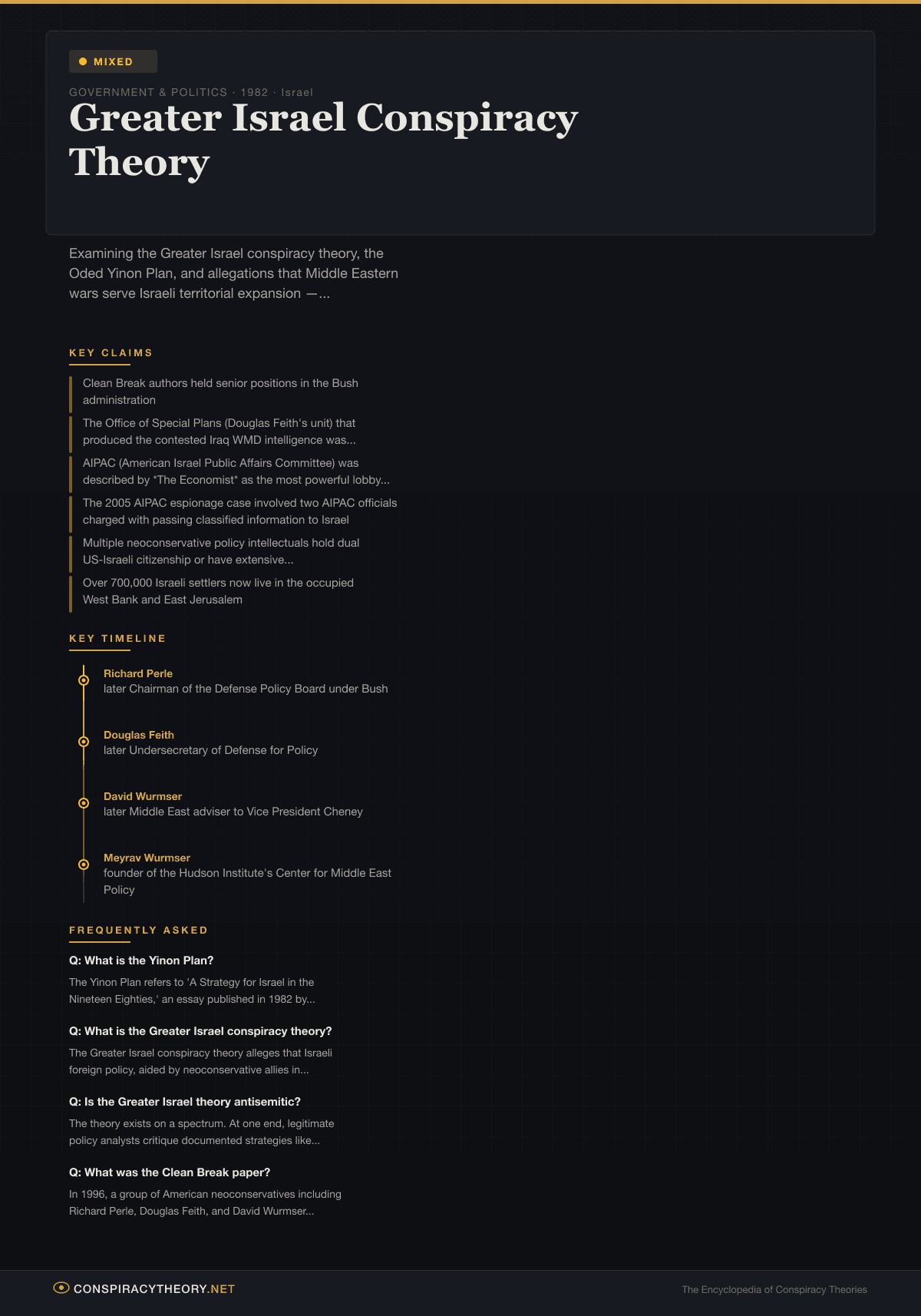
Greater Israel Conspiracy Theory
Overview
The Greater Israel conspiracy theory alleges that a long-term strategic plan exists to expand Israeli territory or dominance across the Middle East, potentially from the Nile River to the Euphrates — the boundaries some interpret from biblical descriptions of the Promised Land. In its most developed form, the theory holds that US-led wars in Iraq, Libya, Syria, and potentially Iran are not primarily about terrorism, weapons of mass destruction, or democracy promotion, but rather serve Israeli strategic interests by destroying or fragmenting Israel’s regional adversaries.
The theory draws on real documents — particularly the 1982 Yinon Plan, the 1996 “Clean Break” strategy paper, and the Project for the New American Century’s (PNAC) policy recommendations — and real personnel overlaps between Israeli policy circles and American neoconservative movement. This evidentiary basis distinguishes it from purely speculative conspiracies, though the theory’s conclusions often extend far beyond what the documents actually prove.
The topic is among the most sensitive in conspiracy discourse because it intersects with legitimate policy analysis, genuine geopolitical competition, and deeply harmful antisemitic traditions. Evaluating it requires carefully distinguishing between documented strategic thinking, reasonable inference, and conspiratorial projection.
Origins & History
Biblical and Zionist Roots
The concept of “Greater Israel” (Eretz Yisrael HaShlema) has roots in both biblical text and early Zionist ideology. Genesis 15:18 describes God’s promise to Abraham of land “from the river of Egypt to the great river, the Euphrates.” Revisionist Zionism, the right-wing branch of the Zionist movement founded by Ze’ev Jabotinsky, historically advocated for a Jewish state encompassing both banks of the Jordan River.
However, mainstream Israeli politics has largely abandoned maximalist territorial claims. Israel’s withdrawal from Sinai (1982), its disengagement from Gaza (2005), and its acceptance of the two-state framework (at least nominally) suggest that “Greater Israel” in its literal territorial sense is not actively pursued by the Israeli state. Critics counter that settlement expansion in the West Bank, the annexation of the Golan Heights, and the post-2023 rhetoric about “voluntary emigration” from Gaza indicate a more incremental approach.
The Yinon Plan (1982)
The foundational document for the modern conspiracy theory is “A Strategy for Israel in the Nineteen Eighties,” published in February 1982 by Oded Yinon in Kivunim (Directions), a journal of the World Zionist Organization. The essay argued:
- Iraq should be divided into a Shia state, a Sunni state, and a Kurdish state
- Syria should be broken up along ethnic and religious lines (Druze, Alawite, Sunni, Christian)
- Lebanon was already fragmenting and this process should continue
- Egypt could be destabilized through its Christian-Muslim divide
- Saudi Arabia and the Gulf states were inherently fragile
- Jordan could serve as a Palestinian state, resolving the Palestinian question
Yinon argued that the dissolution of Arab states into smaller, weaker entities would serve Israel’s security by eliminating the threat of unified Arab opposition. The essay was translated into English by Israel Shahak, a Holocaust survivor and anti-Zionist Israeli professor, who described it as an accurate representation of Israeli strategic thinking.
The debate: Defenders argue Yinon was a mid-level official expressing personal opinions in an obscure journal, and that the essay never became official policy. Critics counter that subsequent events — the fragmentation of Iraq, Syria, Libya, Yemen, and Sudan — closely mirror Yinon’s prescriptions, and that the essay reflected a strategic consensus rather than one man’s idle speculation.
The Clean Break Paper (1996)
A more direct connection between Israeli strategic planning and American policy emerged in 1996, when a study group including several future Bush administration officials produced “A Clean Break: A New Strategy for Securing the Realm” for incoming Israeli Prime Minister Benjamin Netanyahu. Key authors included:
- Richard Perle — later Chairman of the Defense Policy Board under Bush
- Douglas Feith — later Undersecretary of Defense for Policy
- David Wurmser — later Middle East adviser to Vice President Cheney
- Meyrav Wurmser — founder of the Hudson Institute’s Center for Middle East Policy
The paper recommended:
- “Removing Saddam Hussein from power in Iraq — an important Israeli strategic objective in its own right”
- Rolling back Syria through proxy warfare in Lebanon
- Weakening Iran through the elimination of its Iraqi and Syrian allies
- Abandoning the Oslo peace process
- Reasserting Israel’s right to the West Bank (“Judea and Samaria”)
The remarkable aspect of Clean Break is that its authors subsequently occupied positions in the US government where they could implement these very recommendations — which they substantially did.
PNAC and the Neoconservative Network
The Project for the New American Century (PNAC), founded in 1997, further developed the regime change agenda. Its members overlapped significantly with the Clean Break authors. PNAC’s September 2000 report, “Rebuilding America’s Defenses,” famously noted that the transformation of American defense posture would be slow “absent some catastrophic and catalyzing event — like a new Pearl Harbor.”
After 9/11, the PNAC agenda was substantially implemented:
- Iraq was invaded (2003) and subsequently fragmented along sectarian lines
- Syria was destabilized through civil war with documented Western and Gulf state support for rebel groups
- Libya was destroyed (2011) and remains a failed state
- Iran became the next target of “maximum pressure” campaigns
- The dominoes theory described in Clean Break and the Yinon Plan appeared to be playing out in sequence
Key Claims
The Sequential Destruction Theory
The most prominent version of the theory holds that the US has been systematically destroying Israel’s adversaries in sequence:
- Iraq (2003) — Destroyed as a unified state; fragmented along Shia/Sunni/Kurdish lines exactly as the Yinon Plan prescribed
- Libya (2011) — Destroyed as a unified state; descended into militia warfare
- Syria (2011-present) — Destabilized through civil war; fragmented among regime, rebels, Kurds, and ISIS
- Yemen (2015-present) — Destabilized through Saudi-led war with US support
- Iran (ongoing) — Maximum pressure sanctions, assassination of General Soleimani, potential military action
Proponents note that all of these nations were identified in General Wesley Clark’s famous 2007 revelation that a Pentagon memo after 9/11 listed seven countries to be taken down in five years: Iraq, Syria, Lebanon, Libya, Somalia, Sudan, and Iran.
The Dual Loyalty Argument
A more controversial strand of the theory focuses on the personnel connections between Israeli strategic planning and US policy-making:
- Clean Break authors held senior positions in the Bush administration
- The Office of Special Plans (Douglas Feith’s unit) that produced the contested Iraq WMD intelligence was staffed by neoconservatives with strong Israel ties
- AIPAC (American Israel Public Affairs Committee) was described by The Economist as the most powerful lobby in Washington
- The 2005 AIPAC espionage case involved two AIPAC officials charged with passing classified information to Israel
- Multiple neoconservative policy intellectuals hold dual US-Israeli citizenship or have extensive Israeli connections
Critics rightly note that this line of argument can slide into antisemitism by implying that Jewish Americans are inherently disloyal — a classic antisemitic trope. The legitimate version focuses on specific individuals and documented policy positions rather than ethnicity.
The Settlement-Industrial Complex
Beyond the international dimension, the theory encompasses Israel’s domestic settlement enterprise:
- Over 700,000 Israeli settlers now live in the occupied West Bank and East Jerusalem
- Settlement construction has accelerated under successive governments despite international condemnation
- The settler movement has significant political power, with settler-affiliated parties regularly joining coalition governments
- Critics argue that the settlement enterprise constitutes a slow-motion annexation that creates “facts on the ground” making a Palestinian state impossible
- The 2024-2025 far-right Israeli government included ministers who openly advocate annexation and population transfer
Evidence
Documentary Evidence
The theory has an unusually strong documentary foundation:
- The Yinon Plan — Published and available in English translation
- Clean Break — Published and freely available online
- PNAC reports — Published and documented
- Wesley Clark’s testimony — Filmed and widely available
- Clinton emails — Officially released through FOIA
- Congressional testimony — Multiple officials have testified about Israel’s influence on Middle East policy
- AIPAC’s own materials — The lobby’s stated positions and boasted legislative achievements are public record
Pattern Evidence
The sequential destruction of Israel’s regional adversaries closely follows the documents’ prescriptions:
- Iraq is fragmented along the exact ethnic/religious lines Yinon described
- Syria has been broken into regime, rebel, Kurdish, and formerly ISIS-held zones
- Libya was destroyed despite posing no threat to the United States
- Iran is the final target on the list, consistent with both Clean Break and PNAC
Personnel Overlap
The overlap between Israeli strategic planning and US policy implementation is documented:
- Perle, Feith, Wurmser — Clean Break authors who became Bush administration officials
- Paul Wolfowitz — Deputy Secretary of Defense, PNAC signatory
- Elliott Abrams — Iran-Contra figure, later Middle East adviser
- John Bolton — PNAC signatory, later National Security Adviser
Debunking / Counterarguments
The Agency Problem
Critics argue that the theory denies agency to the people of the Middle East. The Arab Spring was a genuine popular uprising, not an Israeli plot. Iraq’s sectarian tensions are real and not manufactured by Israel. Syria’s civil war had domestic roots in Assad’s brutal response to legitimate protests.
Correlation vs. Causation
The fact that events align with a 1982 essay doesn’t prove the essay caused them. The Yinon Plan may have been a prescient analysis of inherent regional fragilities rather than a blueprint that was deliberately executed. Arab states with artificial colonial borders, suppressed ethnic tensions, and authoritarian governance were always vulnerable to fragmentation.
US Interest Independence
American interests in the Middle East — oil security, counterterrorism, arms sales, containing rival powers — exist independently of Israel. The US would likely have intervened in Iraq and Libya even without Israeli strategic preferences. The neoconservative agenda may have paralleled Israeli interests without being directed by Israel.
The Antisemitism Problem
Some versions of the theory recycle classic antisemitic narratives about Jewish manipulation and dual loyalty. The most extreme versions claim that Israel directly controls US foreign policy, which overlaps with the antisemitic trope of Jewish puppet-masters. This has led mainstream analysts to avoid the topic even when legitimate policy questions exist.
Israel’s Actual Situation
If the Greater Israel plan were being executed, Israel’s strategic situation should be improving. In reality:
- Israel faces unprecedented threats from Iran, Hezbollah, and Hamas
- Regional instability has increased threats rather than reduced them
- The failed states created by regime change have produced groups (ISIS, various militias) hostile to Israel
- Public opinion worldwide has shifted against Israel, particularly after 2023-2025
Cultural Impact
Mainstream Policy Discourse
The theory has influenced mainstream policy debate more than most conspiracy theories:
- The “Israel Lobby” thesis, articulated by political scientists John Mearsheimer and Stephen Walt in their 2007 book, brought academic credibility to aspects of the theory
- Wesley Clark’s public statements lent military establishment credibility
- The Iraq War’s failure opened space for questioning its motivations
- The 2023-2025 Gaza conflict reignited debate about US-Israel policy alignment
Social Media Amplification
The theory has experienced massive amplification on social media platforms, particularly during periods of Middle Eastern conflict. Reddit’s r/conspiracy regularly features Greater Israel-related content among its most upvoted posts. The theory has crossed from fringe conspiracy forums into mainstream political discourse on platforms like Twitter/X and TikTok.
Geopolitical Realignment
The theory has contributed to broader shifts in how the Global South views Western-led interventions, feeding into the narrative that the “rules-based international order” is selectively applied to benefit Western and Israeli interests while being ignored when those same interests commit violations.
In Popular Culture
- John Mearsheimer and Stephen Walt, The Israel Lobby and U.S. Foreign Policy (2007)
- Wesley Clark’s interview on Democracy Now! (2007) about the Pentagon’s seven-country hit list
- Adam Curtis’s documentary HyperNormalisation (2016) touches on related themes
- Numerous political documentaries on the Iraq War examine neoconservative motivations
- The topic is a staple of political podcasts across the spectrum
Timeline
| Date | Event |
|---|---|
| 1948 | State of Israel established |
| 1967 | Six-Day War; Israel occupies West Bank, Gaza, Golan Heights, Sinai |
| 1982 | Oded Yinon publishes “A Strategy for Israel in the Nineteen Eighties” |
| 1996 | Clean Break paper written for Netanyahu |
| 1997 | PNAC founded |
| 2000 | PNAC publishes “Rebuilding America’s Defenses” |
| 2001 | 9/11 attacks; Pentagon memo reportedly lists seven countries for regime change |
| 2003 | US invades Iraq; Clean Break authors hold senior Bush administration positions |
| 2005 | AIPAC espionage case |
| 2007 | Wesley Clark reveals Pentagon’s seven-country plan; Mearsheimer-Walt book published |
| 2011 | Libya destroyed; Syria civil war begins |
| 2015 | Yemen war begins |
| 2020 | Abraham Accords normalize Israel-Gulf relations |
| 2023-2025 | Gaza conflict; regional escalation involving Hezbollah, Iran |
| 2025 | US-Iran tensions escalate; “Greater Israel” discourse surges online |
Sources & Further Reading
- Yinon, Oded. “A Strategy for Israel in the Nineteen Eighties.” Kivunim, February 1982.
- Perle, Richard, et al. “A Clean Break: A New Strategy for Securing the Realm.” Institute for Advanced Strategic and Political Studies, 1996.
- Project for the New American Century. “Rebuilding America’s Defenses.” September 2000.
- Mearsheimer, John J., and Stephen M. Walt. The Israel Lobby and U.S. Foreign Policy. Farrar, Straus and Giroux, 2007.
- Clark, Wesley. Interview on Democracy Now!, March 2, 2007.
- Petras, James. The Power of Israel in the United States. Clarity Press, 2006.
- Shahak, Israel. Translation and commentary on the Yinon Plan, 1982.
Related Theories
- 9/11 Inside Job — Theories connecting 9/11 to neoconservative/Israeli agendas
- Iraq WMD Conspiracy — The fabrication of intelligence to justify regime change
- Gaddafi Assassination Conspiracy — Libya’s destruction as part of the pattern
- Israel Lobby Conspiracy — The role of AIPAC and lobbying in US policy
- Military-Industrial Complex — The economic drivers of perpetual warfare
Frequently Asked Questions
What is the Yinon Plan?
What is the Greater Israel conspiracy theory?
Is the Greater Israel theory antisemitic?
What was the Clean Break paper?
Infographic
Share this visual summary. Right-click to save.