Heaven's Gate
Overview
On the afternoon of March 26, 1997, San Diego County sheriff’s deputies entered a rented mansion at 18241 Colina Norte in Rancho Santa Fe, California, and found 39 bodies. They were arranged on cots and mattresses throughout the house, lying on their backs, faces and torsos covered with purple cloth shrouds. Every one of them wore identical black shirts, black pants, and brand-new black-and-white Nike Decade sneakers. Each had a five-dollar bill and three quarters in their pocket. Each had a small overnight bag packed neatly beside them.
They were members of Heaven’s Gate, a UFO religious group led by Marshall Herff Applewhite — known to his followers as “Do” — who believed that their bodies were mere “containers” and that by shedding them, they would be transported aboard a spacecraft trailing Comet Hale-Bopp to an evolutionary “Next Level” of existence beyond human. It was the largest mass suicide in United States history.
The basic facts are not in dispute. What remains contested, nearly three decades later, is the question of how 39 educated, articulate, technically skilled adults — several of them professional web designers and software developers — arrived at a point where they methodically ingested phenobarbital mixed with applesauce and vodka, placed plastic bags over their heads, and died in coordinated shifts over a three-day period. The conspiracy theories surrounding Heaven’s Gate ask whether the explanation is really as simple as a charismatic madman and his willing followers, or whether something more deliberate was at work: intelligence community connections, MKUltra-style behavioral programming, foreknowledge that went unacted upon, and a manufactured UFO narrative timed to the Hale-Bopp hysteria.
This article is classified as mixed — the mass suicide itself is documented fact, but the surrounding conspiracy theories range from plausible questions about intelligence connections to speculative claims about mind control programming.
Origins — The Two
The story begins not in a mansion in the 1990s but in a psychiatric hospital in Houston in 1972.
Marshall Applewhite was a music professor at the University of St. Thomas, a man with a rich baritone voice and an intensity that students either found magnetic or unsettling. He had been fired from his previous position at the University of Alabama after an affair with a male student. By the early 1970s, his marriage had collapsed, his career was in freefall, and he checked himself into a psychiatric facility seeking to be “cured” of his homosexuality — a common and now-discredited therapeutic goal of the era.
There he met Bonnie Lu Nettles, a nurse with deep interests in theosophy, astrology, and channeling. The connection was immediate and, by their own account, cosmically ordained. They came to believe they were the “Two Witnesses” prophesied in the Book of Revelation — two figures who would be killed, lie dead for three and a half days, and then ascend to heaven in a cloud while their enemies watched. They referred to themselves by a series of paired names: Bo and Peep, Guinea and Pig, and finally Ti (Nettles) and Do (Applewhite).
Between 1973 and 1975, they traveled the country recruiting followers with a simple and audacious message: Earth was a garden, humans were plants, and the garden was about to be spaded under. The only way out was to abandon everything — family, possessions, identity — and prepare for physical pickup by a spacecraft. They called this process graduating to the “Next Level.”
Their first major public meeting, in Waldport, Oregon in September 1975, drew about 200 people. Roughly 20 followed them into the wilderness. The group disappeared from public view for years at a stretch, living a nomadic existence in campgrounds and cheap rentals across the American West. They surrendered their given names, adopted monastic-style gender neutrality, wore identical clothing, and submitted to Applewhite’s increasingly rigid behavioral controls — including, for some male members, voluntary surgical castration.
The Theology
Heaven’s Gate’s belief system was a syncretic tangle of Christianity, science fiction, and New Age ufology, but it had an internal logic that its adherents found rigorous.
The core doctrine held that the universe operated on levels. Humans occupied a low rung — biological “vehicles” or “containers” animated by souls that were themselves at varying stages of development. Above humans existed the “Next Level,” a physical realm populated by genderless, perfected beings who traveled in spacecraft and occasionally visited Earth to plant “seeds” of higher consciousness in select human containers. Jesus, in this framework, was a Next Level being who had occupied a human container two thousand years ago. Applewhite was the same soul, returned in a new container to collect his crew.
Earth itself was a school, or more accurately a greenhouse, managed by Next Level beings. Periodically it was “recycled” — wiped clean of its inhabitants so the process could start over. Applewhite taught that this recycling was imminent, and that the only escape was to leave one’s container behind and be physically taken aboard a Next Level craft.
What made the theology distinctive — and, to outsiders, deeply alarming — was its literalism. This was not metaphor. Applewhite was not speaking poetically about spiritual transcendence. He meant that actual, physical spacecraft would arrive, that actual, physical beings piloted them, and that the only way to board was to shed the body.
The members called themselves “the crew.” They referred to leaving Earth as “exiting their vehicles.” They modeled their organizational structure on Star Trek. The matching outfits were “away team” uniforms.
The Hale-Bopp Trigger
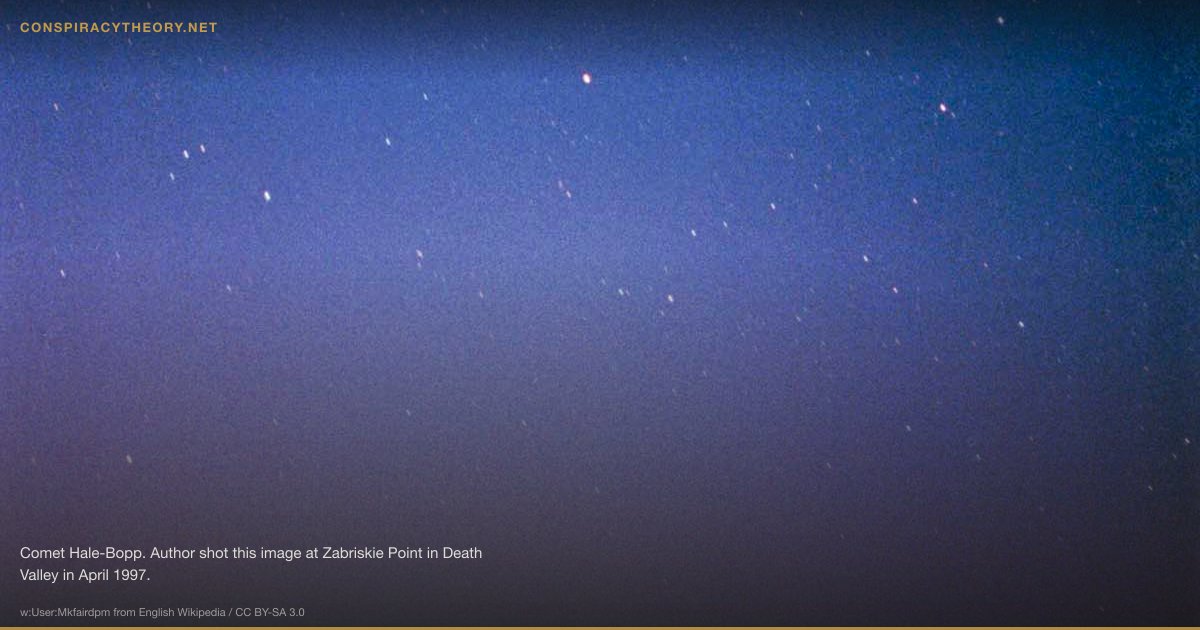
In July 1995, astronomers Alan Hale and Thomas Bopp independently discovered a comet that would become one of the brightest and most widely observed of the twentieth century. By late 1996, Hale-Bopp was visible to the naked eye and approaching its closest pass to Earth, scheduled for April 1, 1997.
On November 14, 1996, amateur astronomer Chuck Shramek took a CCD image of Hale-Bopp and noticed what he described as a “Saturn-like object” near the comet. He reported his finding on Art Bell’s Coast to Coast AM radio program, the flagship of late-night paranormal broadcasting. The claim went viral within the UFO community. Remote viewer Courtney Brown appeared on the show claiming that his team at the Farsight Institute had confirmed the object’s existence through psychic viewing, and that it was an artificial craft of enormous size.
Professional astronomers quickly determined that Shramek’s “companion object” was a background star — SAO 141894, an 8.5-magnitude star in the constellation Sagittarius that happened to fall near Hale-Bopp’s position in the sky that night. The University of Hawaii’s Institute for Astronomy published images showing no anomalous objects. But the correction couldn’t keep pace with the rumor. The “Hale-Bopp companion” became, in certain circles, an article of faith: a massive spacecraft using the comet as cover for its approach to Earth.
For Applewhite, this was the sign. He had been waiting decades for a trigger, and here it was — a celestial event visible to millions, with a spacecraft rumor attached to it. The companion object story arrived at precisely the moment the group needed a concrete mechanism for their theology. Conspiracy theorists have noted this timing and asked whether the Hale-Bopp companion narrative was organically generated or deliberately seeded to activate groups like Heaven’s Gate.
The Mass Suicide
The group began preparing in earnest in early 1997. They recorded farewell videotapes — hours of footage in which each member calmly and even cheerfully explained why they were choosing to “exit.” They packed identical bags. They ate identical final meals at a Marie Callender’s restaurant. They settled their affairs with a precision that investigators later described as chilling in its orderliness.
The suicides took place over approximately three days, in three shifts. This is one of the details that has most disturbed investigators and fueled conspiracy theories. The first group ingested lethal doses of phenobarbital mixed into applesauce or pudding, washed down with vodka, and then placed plastic bags over their heads to ensure asphyxiation. After they died, surviving members removed the bags, arranged the bodies on their backs, covered them with the purple shrouds, and then repeated the process. The final shift had no one left to cover them.
The youngest was 26. The oldest was 72. Twenty-one were women, eighteen were men. Among them was Thomas Nichols, the brother of actress Nichelle Nichols, who played Lieutenant Uhura on Star Trek — a connection that felt almost too on-the-nose given the group’s science fiction cosmology.
Rio DiAngelo, a member who had left the group weeks earlier at Applewhite’s instruction, received a FedEx package containing two videotapes and a letter on March 26. He drove to the mansion and discovered the bodies, then contacted the authorities.
Conspiracy Theories
The Operational Professionalism Problem
The most common starting point for Heaven’s Gate conspiracy theories is the sheer methodical precision of the event itself. This was not a Jonestown-style panic, where armed guards forced resisters to drink cyanide at gunpoint while children screamed. There was no coercion evident. No one struggled. No one changed their mind partway through. Thirty-nine people died in coordinated waves, each shift calmly tending to the dead before taking their own turn.
Skeptics of the official narrative argue that this level of behavioral uniformity goes beyond what charismatic leadership alone can produce. The comparison most frequently drawn is to MKUltra and its successor programs — the CIA’s documented experiments in behavioral modification through drugs, hypnosis, sensory deprivation, and psychological conditioning. Applewhite’s background in music and performance, combined with the group’s decades-long isolation, strict behavioral controls, dietary restrictions, sleep regulation, and the voluntary castrations, mirrors techniques associated with coercive psychological programming.
No direct evidence linking Applewhite to any intelligence program has been publicly established. But the question persists: did Applewhite independently develop a mind control methodology that happened to replicate intelligence-community techniques, or was there a connection?
The Tech Industry Connections
Heaven’s Gate was not a group of uneducated drifters. In the 1990s, the group operated a professional web design company called Higher Source, which built websites for clients including the San Diego Polo Club, a Christian music firm, and several local businesses. Their work was well-regarded and competitively priced. The group’s own website — heavensgate.com — was sophisticated by 1996 standards.
Conspiracy theorists have seized on the tech industry connection as suggestive of something deeper. In the mid-1990s, the internet was still substantially a project of the defense and intelligence establishment. San Diego, where the group was based, was (and is) one of the largest centers of defense contracting in the United States, home to major military installations and companies with deep intelligence community ties. The theory, which remains unsubstantiated, suggests that Higher Source may have functioned as a front or that the group’s technical skills attracted intelligence interest.
Foreknowledge and Inaction
In the months before the suicides, Heaven’s Gate was not exactly hiding. The group had posted extensive materials on their website declaring their intentions. They had taken out advertisements. They had mailed information packets to media outlets. Applewhite had recorded and distributed videotapes explicitly stating that the group planned to “exit their containers.”
The question raised by conspiracy theorists is straightforward: law enforcement and intelligence agencies were aware of the group. The FBI had monitored them intermittently since the 1970s, when Applewhite and Nettles were briefly arrested for auto theft and credit card fraud in Harlingen, Texas (charges related to a rental car, later dropped). Given the overt declarations of intent, why was no intervention attempted?
The conventional answer is that pre-Jonestown, there was no legal framework for intervening in the self-destructive plans of consenting adults who hadn’t committed a crime. Freedom of religion and bodily autonomy protections made preemptive action legally problematic. Critics of this explanation point out that law enforcement had intervened in other cult situations with far less provocation, and that the post-Waco political climate (the 1993 siege had occurred just four years earlier) may have made agencies reluctant to engage — or, more darkly, willing to let events play out.
The Hale-Bopp Companion as Psy-Op
The Hale-Bopp companion object story is the most concrete nexus between Heaven’s Gate and the broader UFO conspiracy ecosystem. The narrative emerged through a specific chain: an amateur astronomer’s misidentified image, amplified by Art Bell’s radio show, validated by a self-described remote viewer with intelligence community connections (Courtney Brown had previously worked for the U.S. Army), and rapidly disseminated through early internet forums.
Some researchers have proposed that the companion story was a deliberate psychological operation, or at minimum an experiment in memetic warfare — testing how quickly a fabricated narrative could propagate through alternative media channels and produce real-world behavioral changes. The fact that it demonstrably contributed to the deaths of 39 people gives this question a weight it might not otherwise carry.
There is no documented evidence that any government agency created or deliberately amplified the Hale-Bopp companion story. But the speed of its spread, the intelligence-adjacent background of some of its promoters, and its devastating real-world impact remain features of the case that conspiracy researchers consider unresolved.
The Website That Won’t Die
Perhaps the eeriest feature of the Heaven’s Gate story is its epilogue. The group’s website, heavensgate.com, remains online and functional nearly three decades after every member pictured on it died. It is maintained by two individuals — Mark and Sarah King — who were former members instructed by Applewhite to remain behind specifically to handle the group’s affairs and keep the digital record intact.
The Kings have given only a handful of interviews over the years. They still respond to emails sent to the site. They still believe. They describe their role as a duty rather than a choice.
For conspiracy theorists, the endurance of the website raises questions. Who funds the hosting? Why has the domain never been seized, challenged, or taken down? In an internet landscape where content moderation has become aggressively interventionist, why does a website promoting a belief system that directly led to 39 deaths remain untouched? The mundane explanation — that it violates no laws and the Kings pay the hosting bills — is probably sufficient. But the site’s persistence gives it the quality of a monument, or a signal left on for someone who might still be listening.
Bonnie Nettles and the Missing Years
Bonnie Nettles died of cancer in 1985, twelve years before the mass suicide. Her death created a theological crisis for the group: Ti and Do were supposed to be the Two Witnesses who would be killed together and resurrected. Her death from liver cancer in a Dallas hospital did not fit the prophecy. Applewhite adjusted the theology, declaring that Nettles had graduated to the Next Level ahead of the group and was now piloting the spacecraft that would collect them.
But the period between Nettles’ death in 1985 and the group’s reemergence in the mid-1990s is poorly documented. What happened during that lost decade? How did Applewhite maintain control of the group without the stabilizing presence of his co-leader? And how did the group transform from a loosely organized New Age wandering community into the disciplined, uniformed, technically proficient operation that executed a synchronized three-day mass suicide?
Something changed during those years. Whether the change was organic — a charismatic leader tightening his grip in the absence of his moderating co-founder — or facilitated from outside, is a question the existing record does not conclusively answer.
Cultural Impact
Heaven’s Gate became an instant touchstone for American culture’s anxieties about cults, technology, and the millennium. The images — the Nike Decades, the purple shrouds, Applewhite’s unblinking wide-eyed stare in the farewell video — embedded themselves in the national consciousness with a force that few news events achieve.
Nike quietly discontinued the Decade model. The sneakers have since become one of the most morbid collector’s items in fashion history, with unworn pairs selling for thousands of dollars.
The case arrived at a pivotal moment in the relationship between the internet and mainstream society. In 1997, most Americans were just beginning to understand what a website was. The revelation that a suicide cult had operated a successful web design business and used their own site to recruit and communicate forced a reckoning with the internet as a vector for dangerous ideas — a conversation that has only intensified in the decades since.
The farewell videos, in which smiling, lucid-seeming adults calmly discussed their imminent deaths, challenged assumptions about cult members as brainwashed automatons. These were not glassy-eyed zombies. They were articulate, even witty. Several laughed. This made the whole thing harder to process, not easier.
In popular culture, Heaven’s Gate has been referenced and fictionalized extensively: in the HBO documentary series Heaven’s Gate: The Cult of Cults (2020), in Ryan Murphy’s American Horror Story: Cult (2017), in songs, novels, and video games. The group’s aesthetic — the uniformity, the corporate-cult crossover, the retro-futurism — has been absorbed into the visual language of art and fashion in ways that would probably have bewildered its members.
Timeline
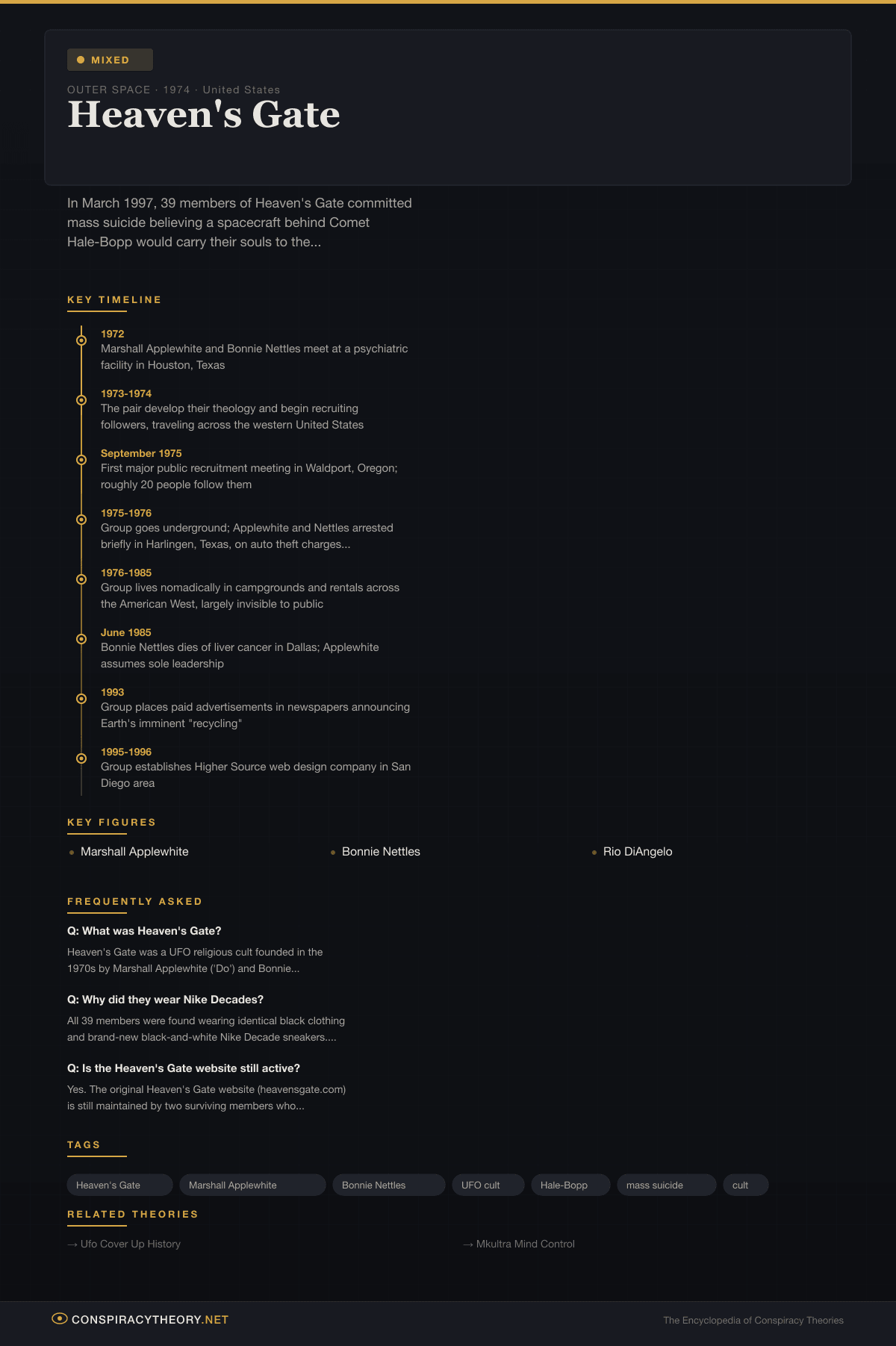
- 1972 — Marshall Applewhite and Bonnie Nettles meet at a psychiatric facility in Houston, Texas
- 1973-1974 — The pair develop their theology and begin recruiting followers, traveling across the western United States
- September 1975 — First major public recruitment meeting in Waldport, Oregon; roughly 20 people follow them
- 1975-1976 — Group goes underground; Applewhite and Nettles arrested briefly in Harlingen, Texas, on auto theft charges (later dropped)
- 1976-1985 — Group lives nomadically in campgrounds and rentals across the American West, largely invisible to public
- June 1985 — Bonnie Nettles dies of liver cancer in Dallas; Applewhite assumes sole leadership
- 1993 — Group places paid advertisements in newspapers announcing Earth’s imminent “recycling”
- 1995-1996 — Group establishes Higher Source web design company in San Diego area
- July 1995 — Comet Hale-Bopp discovered
- November 14, 1996 — Chuck Shramek reports “companion object” near Hale-Bopp on Art Bell’s Coast to Coast AM; astronomers quickly debunk the claim
- Late 1996 — Group rents mansion at 18241 Colina Norte, Rancho Santa Fe, California
- Early 1997 — Members record farewell videotapes; Applewhite records his final message
- March 22-24, 1997 — Group dines at Marie Callender’s; final preparations
- March 23-25, 1997 — Mass suicide carried out in three shifts over approximately three days
- March 26, 1997 — Rio DiAngelo receives FedEx package, drives to mansion, discovers bodies, contacts authorities
- March 27, 1997 — San Diego County Medical Examiner confirms 39 dead; cause of death: phenobarbital and alcohol with asphyxiation
- March 28, 1997 — Applewhite’s farewell video broadcast worldwide; Nike begins quietly discontinuing the Decade model
- 1997-present — Heaven’s Gate website maintained by surviving members Mark and Sarah King
- 2020 — HBO Max releases Heaven’s Gate: The Cult of Cults, a four-part documentary series
Sources & Further Reading
- Zeller, Benjamin E. Heaven’s Gate: America’s UFO Religion. NYU Press, 2014.
- Perkins, Rodney, and Forrest Jackson. Cosmic Suicide: The Tragedy and Transcendence of Heaven’s Gate. Pentaradial Press, 1997.
- Balch, Robert W. “Waiting for the Ships: Disillusionment and the Revitalization of Faith in Bo and Peep’s UFO Cult.” In The Gods Have Landed: New Religions from Other Worlds, edited by James R. Lewis. SUNY Press, 1995.
- Wessinger, Catherine. How the Millennium Comes Violently: From Jonestown to Heaven’s Gate. Seven Bridges Press, 2000.
- HBO Max. Heaven’s Gate: The Cult of Cults. Documentary series, 2020.
- Raine, Susan. “Reconceptualising the Human Body: Heaven’s Gate and the Quest for Divine Transformation.” Religion 35, no. 2 (2005): 98-117.
- Lanning, Kenneth V. Investigator’s Guide to Allegations of “Ritual” Child Abuse. FBI Behavioral Science Unit, 1992.
- DiAngelo, Rio (Frank Richard Lyford). Public statements and interviews, 1997-2020.
Related Theories
- MKUltra — The CIA’s documented mind control program; parallels drawn to Heaven’s Gate’s behavioral conditioning techniques
- UFO Cover-Up History — The broader history of alleged government suppression of UFO evidence, directly relevant to Heaven’s Gate’s cosmology
- Dead Internet Theory — The theory that much of the internet is artificial; Heaven’s Gate’s eternally maintained website is sometimes cited as an uncanny data point
- COINTELPRO — The FBI’s documented domestic surveillance and disruption programs; questions about what agencies knew about Heaven’s Gate before the suicides
- Project Monarch — The alleged extension of MKUltra into cult-based behavioral programming; frequently invoked in Heaven’s Gate conspiracy discussions
Frequently Asked Questions
What was Heaven's Gate?
Why did they wear Nike Decades?
Is the Heaven's Gate website still active?

Infographic
Share this visual summary. Right-click to save.