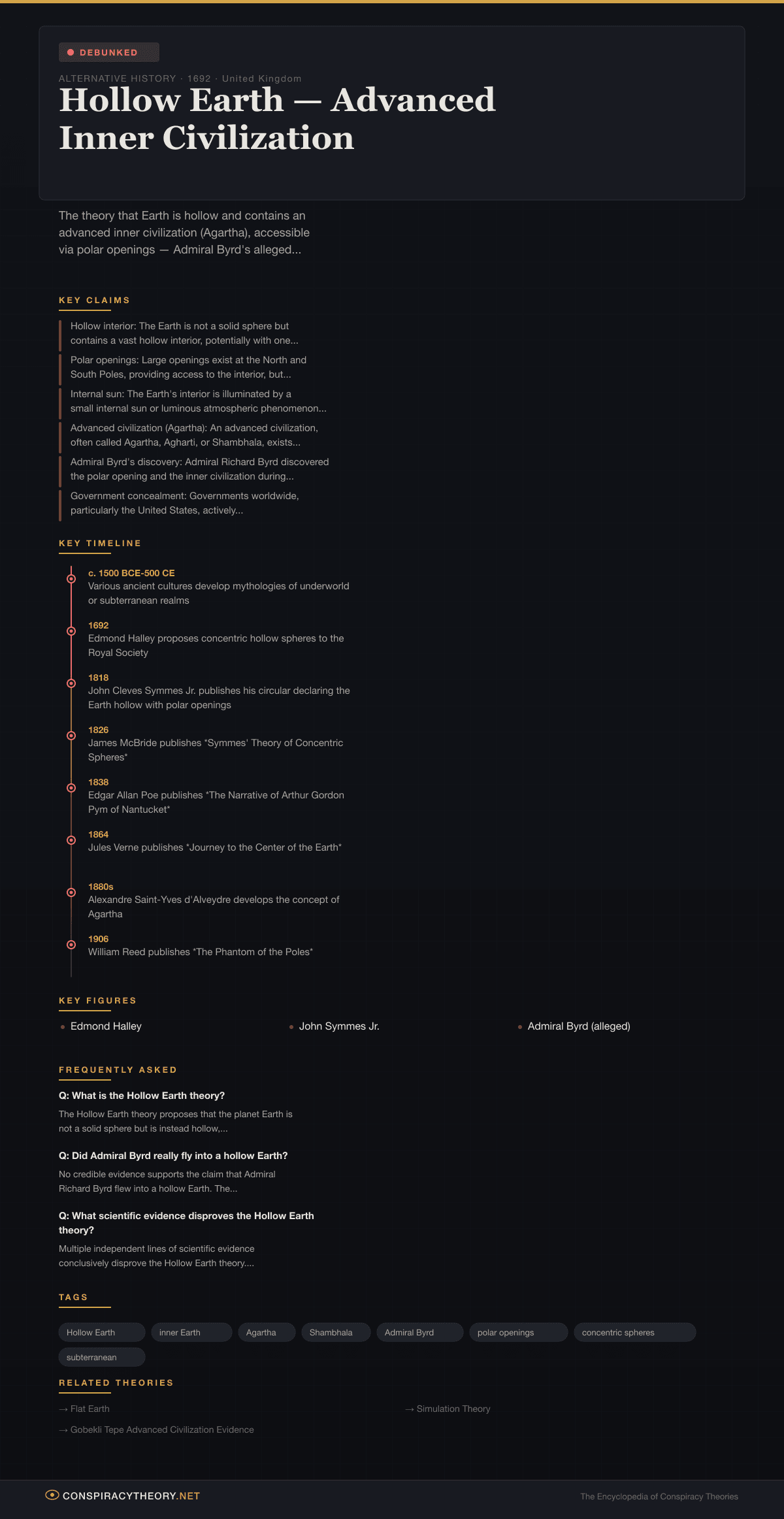
Hollow Earth — Advanced Inner Civilization

Overview
The Hollow Earth theory — the proposition that our planet is not a solid sphere but is hollow, potentially containing habitable inner surfaces, an internal light source, and advanced civilizations — represents one of the most enduring and imaginative alternative cosmological theories in Western thought. From its origins in serious 17th-century scientific inquiry through its transformation into 19th-century pseudo-science and its current status as a fringe belief intertwined with New Age spirituality and internet conspiracy culture, the Hollow Earth hypothesis has maintained a persistent hold on the popular imagination.
The theory exists in numerous variations, ranging from the relatively sober proposal that the Earth contains large cavities or subterranean spaces to the elaborate claim that the planet’s interior houses an advanced civilization called Agartha (or Agharti), illuminated by an internal sun, and accessible through openings at the North and South Poles. Some versions incorporate elements of Theosophy, Tibetan mysticism, Nazi occultism, and UFO lore, creating a syncretic cosmology that connects the inner Earth to virtually every other area of alternative belief.
Modern geoscience has conclusively established the internal structure of the Earth through seismological analysis, gravitational measurements, and magnetic field studies. The planet consists of a solid iron-nickel inner core, a liquid outer core, a viscous mantle, and a thin crust — a structure entirely incompatible with any version of the Hollow Earth hypothesis. Despite this scientific consensus, the theory retains a dedicated following, particularly in online communities where it intersects with other alternative belief systems.
Origins & History
The concept of a hollow or underworld Earth has ancient roots in mythology. Greek mythology described Hades as an underworld beneath the Earth’s surface, accessible through caves and rivers. Norse mythology spoke of Svartalfheim, the subterranean realm of the dark elves. Buddhist and Hindu traditions describe Agartha (or Shambhala), a spiritual kingdom said to exist within the Earth. While these mythological traditions are not identical to the modern Hollow Earth theory, they provided a cultural foundation for later speculations.
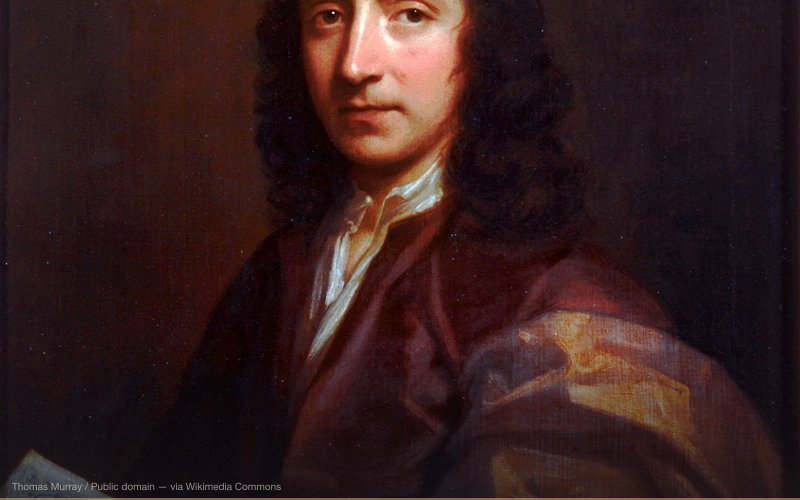
The scientific version of the Hollow Earth hypothesis was first seriously proposed by the English astronomer Edmond Halley — of Halley’s Comet fame — in 1692. Halley presented a paper to the Royal Society proposing that the Earth consisted of multiple concentric shells, each potentially habitable, separated by atmospheres and illuminated by luminous gases. Halley developed this model to explain observed irregularities in the Earth’s magnetic field, which he attributed to the rotation of inner shells at different rates than the outer surface. While Halley’s hypothesis was wrong, it was a legitimate scientific proposal by one of the era’s greatest minds, addressing a genuine scientific puzzle with the tools available at the time.
The theory gained its most passionate American advocate in John Cleves Symmes Jr., a retired U.S. Army officer who in 1818 published a circular declaring that the Earth was hollow, consisting of five concentric spheres with openings at both poles approximately 4,000 miles in diameter. Symmes launched a vigorous campaign to organize an expedition to the North Pole to find the opening, petitioning Congress and lecturing extensively throughout the United States. While Symmes never secured funding for his expedition, his advocacy brought the Hollow Earth concept to wide public attention and earned him both devoted followers and intense ridicule. Symmes’s theories influenced his follower James McBride, who published Symmes’ Theory of Concentric Spheres in 1826, and Jeremiah Reynolds, who successfully lobbied for what eventually became the U.S. Exploring Expedition of 1838-1842.
In the late 19th and early 20th centuries, the Hollow Earth theory was elaborated and transformed by several influential figures. Cyrus Teed, an American physician and alchemist, proposed an inverted version called the “Cellular Cosmogony,” in which the Earth’s surface is on the inside of a hollow sphere, and the universe — including the sun, moon, and stars — exists within the interior. William Reed’s The Phantom of the Poles (1906) and Marshall Gardner’s A Journey to the Earth’s Interior (1913) proposed that both poles contained openings to the interior, which was illuminated by an internal sun.
The theory took on an occult dimension in the early 20th century through its connection to Theosophical and esoteric traditions. The concept of Agartha — a hidden kingdom within the Earth populated by an advanced spiritual civilization — was popularized by the French occultist Alexandre Saint-Yves d’Alveydre in the 1880s and further developed by Ferdinand Ossendowski in Beasts, Men and Gods (1922). Nicholas Roerich, the Russian artist and mystic, claimed to have received knowledge of Shambhala during his Central Asian expedition in the 1920s.
The most dramatic modern addition to the Hollow Earth canon is the purported “secret diary” of Admiral Richard Byrd, published in 1964 — decades after Byrd’s actual polar expeditions. This document claims that during a February 1947 flight over the North Pole, Byrd entered the Earth’s interior through a polar opening and was greeted by an advanced civilization that warned him about the dangers of nuclear weapons. Byrd’s family and the U.S. Navy have never authenticated this diary, and Byrd’s actual records make no mention of any such experience. Nevertheless, the Byrd diary has become the central text of modern Hollow Earth belief.
Key Claims
- Hollow interior: The Earth is not a solid sphere but contains a vast hollow interior, potentially with one or more concentric shells, capable of supporting life
- Polar openings: Large openings exist at the North and South Poles, providing access to the interior, but are concealed by governments or hidden by atmospheric and magnetic effects
- Internal sun: The Earth’s interior is illuminated by a small internal sun or luminous atmospheric phenomenon that provides light and heat to the inner world
- Advanced civilization (Agartha): An advanced civilization, often called Agartha, Agharti, or Shambhala, exists within the Earth, possessing technology and spiritual wisdom far beyond surface humanity
- Admiral Byrd’s discovery: Admiral Richard Byrd discovered the polar opening and the inner civilization during his 1947 expedition but was ordered by the U.S. government to keep his discovery secret
- Government concealment: Governments worldwide, particularly the United States, actively suppress knowledge of the hollow Earth, restricting access to polar regions and controlling satellite imagery to prevent discovery
- UFO origin: Some Hollow Earth proponents claim that UFOs originate from the inner civilization rather than from extraterrestrial sources, explaining their apparent ability to appear and disappear
- Nazi connection: The Nazi regime, through its interest in occultism and Thule Society mythology, either discovered the inner Earth entrance or attempted to establish a base there, with some versions claiming that Nazi remnants survived in the interior after World War II
Evidence
Evidence cited by proponents:
Proponents point to Admiral Byrd’s alleged diary as primary evidence, claiming it provides a firsthand account of the inner Earth. They also cite Byrd’s public comments about “a land beyond the Pole” from radio broadcasts during his 1947 and 1955-1956 expeditions, interpreting figurative descriptions of unexplored Antarctic territory as literal references to the Earth’s interior.
Early satellite photographs showing dark areas at the poles are cited as evidence of polar openings. Proponents argue that modern satellite imagery has been deliberately edited to remove evidence of the openings, noting that many polar images are composites rather than single photographs.
The migration patterns of certain Arctic birds, which fly north in winter rather than south, are cited as evidence that warmer conditions exist beyond the pole. Similarly, reports of fresh-water icebergs (as opposed to sea-water ice) in the Arctic Ocean are interpreted as evidence of a fresh-water source within the interior.
Some proponents cite anomalies in the Earth’s magnetic field — including the movement of the magnetic poles and temporary weakening of the field — as evidence of interior structures not accounted for by standard geological models.
The universality of underworld and subterranean realm mythologies across diverse cultures is presented as evidence of genuine ancient knowledge of the hollow interior, preserved in symbolic form across civilizations.
Scientific evidence against the theory:
The evidence against the Hollow Earth theory is comprehensive and comes from multiple independent branches of science.
Seismology provides the most direct evidence of the Earth’s solid interior. When earthquakes occur, they generate seismic waves that travel through the planet’s interior. These waves are recorded by thousands of seismographs worldwide, and their behavior — including velocity changes, reflections at density boundaries, and shadow zones — has been used to map the Earth’s internal structure in detail since the early 20th century. Seismic data reveals distinct layers (crust, mantle, outer core, inner core) with specific density and composition characteristics that are entirely inconsistent with a hollow interior.
The Earth’s mass (5.972 x 10^24 kg) and average density (5.51 g/cm^3) are precisely known from gravitational measurements. The average density is significantly higher than surface rocks (approximately 2.7 g/cm^3 for continental crust), demonstrating that the interior must be composed of much denser material — consistent with an iron-nickel core and inconsistent with a large void.
Satellite observations, including continuous polar monitoring by weather and research satellites, show no polar openings. The Arctic and Antarctic have been extensively explored, mapped, and photographed from the surface, air, and space by thousands of expeditions involving multiple nations, with no evidence of openings.
The physics of planetary formation through gravitational accretion — well-understood through observation of other planets and computer modeling — precludes the formation of hollow planets. Gravity pulls matter toward the center, producing a solid body, not a hollow shell.
Debunking / Verification
The Hollow Earth theory is conclusively debunked by multiple independent lines of scientific evidence. No version of the theory is compatible with seismological data, gravitational measurements, or the known physics of planetary formation.
The Admiral Byrd diary has never been authenticated by any credible source. Byrd’s actual expedition records, maintained by the National Archives and the Byrd Polar Research Center at Ohio State University, contain no references to polar openings or inner civilizations. The “land beyond the Pole” phrases cited by proponents refer to unexplored Antarctic territory, not to the Earth’s interior.
The supposed polar opening images from early satellite photographs have been definitively explained as compositing artifacts. Early weather satellites took images in swaths, and the dark areas at the poles were simply areas not covered by the satellite’s camera track. Modern continuous satellite coverage shows no openings.
The bird migration patterns cited by proponents are explained by known ecological factors — some Arctic birds migrate to areas of open water within the Arctic where food remains available, not to a polar opening.
While the theory has historical interest as a case study in the evolution of scientific understanding — Halley’s concentric spheres were a serious if incorrect hypothesis — its persistence in the face of overwhelming contradictory evidence places it firmly in the category of pseudo-science.
Cultural Impact
Despite its debunked status, the Hollow Earth theory has had a rich and lasting cultural influence, particularly in literature, film, and popular entertainment.
Jules Verne’s Journey to the Center of the Earth (1864) is the most famous literary treatment, depicting an expedition through volcanic tubes into a subterranean world of prehistoric creatures and vast oceans. While Verne presented the story as fiction and did not endorse the Hollow Earth theory, the novel powerfully embedded the concept in popular imagination. Edgar Allan Poe’s The Narrative of Arthur Gordon Pym of Nantucket (1838) also draws on Hollow Earth imagery, with its mysterious polar conclusion.
Edgar Rice Burroughs created the fictional inner Earth world of “Pellucidar” in a series of novels beginning in 1914, establishing many of the tropes — internal sun, prehistoric creatures, primitive civilizations — that continue to characterize Hollow Earth fiction. The concept has appeared in numerous films, from the 1959 adaptation of Verne’s novel to the 2008 Brendan Fraser version, and in video games, comic books, and television series.
The Hollow Earth theory has intersected significantly with other alternative belief systems. In New Age spirituality, Agartha and Shambhala are often presented as real spiritual realms accessible through meditation or initiation. In the UFO community, the theory that flying saucers originate from within the Earth rather than from outer space has a dedicated following. In Nazi occultism and its modern derivatives, the Thule Society’s alleged interest in the inner Earth has become a staple of alternative World War II history.
The theory has also influenced science fiction and fantasy literature more broadly, contributing to the enduring popularity of “lost world” narratives and subterranean exploration stories. The concept of vast, hidden civilizations existing beneath the surface has been explored by authors from H.P. Lovecraft to China Mieville.
In the internet age, the Hollow Earth theory has experienced a revival in online communities, where it circulates alongside flat Earth theory, simulation theory, and other alternative cosmologies. YouTube channels, podcasts, and forums devoted to the theory attract millions of views and thousands of active participants.
Timeline
- c. 1500 BCE-500 CE — Various ancient cultures develop mythologies of underworld or subterranean realms
- 1692 — Edmond Halley proposes concentric hollow spheres to the Royal Society
- 1818 — John Cleves Symmes Jr. publishes his circular declaring the Earth hollow with polar openings
- 1826 — James McBride publishes Symmes’ Theory of Concentric Spheres
- 1838 — Edgar Allan Poe publishes The Narrative of Arthur Gordon Pym of Nantucket
- 1864 — Jules Verne publishes Journey to the Center of the Earth
- 1880s — Alexandre Saint-Yves d’Alveydre develops the concept of Agartha
- 1906 — William Reed publishes The Phantom of the Poles
- 1913 — Marshall Gardner publishes A Journey to the Earth’s Interior
- 1914 — Edgar Rice Burroughs publishes At the Earth’s Core, the first Pellucidar novel
- 1922 — Ferdinand Ossendowski publishes Beasts, Men and Gods, popularizing the Agartha legend
- 1926 — Admiral Byrd flies over the North Pole (no hollow Earth claims in his actual records)
- 1947 — Byrd’s Operation Highjump Antarctic expedition (later retroactively incorporated into the theory)
- 1964 — The purported “secret diary of Admiral Byrd” is published
- 1906-1970s — Seismological evidence progressively maps the solid interior structure of the Earth
- 2000s-present — Hollow Earth theory experiences revival in online communities, YouTube, and podcasts
Sources & Further Reading
- Standish, David. Hollow Earth: The Long and Curious History of Imagining Strange Lands, Fantastical Creatures, Advanced Civilizations, and Marvelous Machines Below the Earth’s Surface. Boston: Da Capo Press, 2006.
- Kafton-Minkel, Walter. Subterranean Worlds: 100,000 Years of Dragons, Dwarfs, the Dead, Lost Races and UFOs from Inside the Earth. Port Townsend: Loompanics, 1989.
- Halley, Edmond. “An Account of the Cause of the Change of the Variation of the Magnetical Needle with an Hypothesis of the Structure of the Internal Parts of the Earth.” Philosophical Transactions of the Royal Society 17 (1692): 563-578.
- Verne, Jules. Journey to the Center of the Earth. Paris: Pierre-Jules Hetzel, 1864.
- Gardner, Marshall B. A Journey to the Earth’s Interior. Aurora, IL: Self-published, 1913.
- Ossendowski, Ferdinand. Beasts, Men and Gods. New York: E.P. Dutton, 1922.
- Lowrie, William. Fundamentals of Geophysics. Cambridge: Cambridge University Press, 2007.
Frequently Asked Questions
What is the Hollow Earth theory?
Did Admiral Byrd really fly into a hollow Earth?
What scientific evidence disproves the Hollow Earth theory?
Infographic
Share this visual summary. Right-click to save.