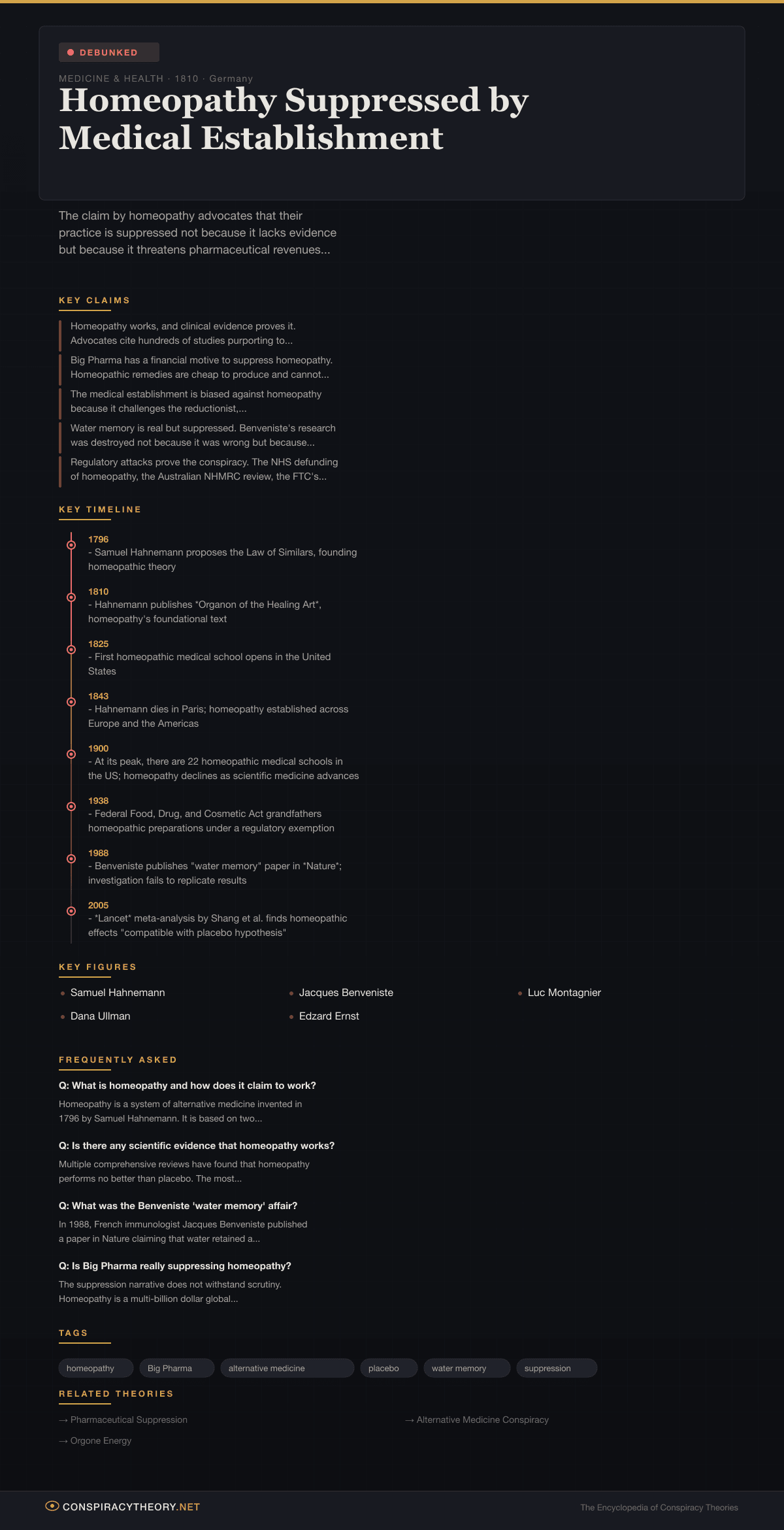
Homeopathy Suppressed by Medical Establishment

Overview
In the back of your local pharmacy, past the aspirin and the cough syrup and the blood pressure medications, there is almost certainly a shelf of products labeled with names like Oscillococcinum, Arnica Montana 30C, and Nux Vomica. They come in elegant packaging. They cost real money — sometimes more per ounce than the pharmaceutical products on the adjacent shelves. And they contain, in the most literal chemical sense, nothing.
Not “almost nothing.” Not “trace amounts.” Nothing. A standard 30C homeopathic preparation has been diluted to a factor of 10^60 — a one followed by sixty zeros. To put this in perspective, the total number of atoms in the observable universe is estimated at around 10^80. A 30C dilution is the equivalent of dissolving one molecule of a substance in a sphere of water with a diameter approximately equal to the distance between the Earth and the Sun. At dilutions above roughly 12C (10^24), Avogadro’s number guarantees that not a single molecule of the original substance remains in the solution. You are drinking water. Possibly very expensive water.
Homeopathy’s practitioners and advocates know this. They do not deny the chemistry. Instead, they claim that the dilution process — which involves vigorous shaking, or “succussion,” at each stage — imprints the “energy” or “memory” of the original substance onto the water molecules, and that this imprint is what produces the therapeutic effect. They further claim that this effect has been demonstrated in clinical trials, that a conspiracy involving pharmaceutical companies, mainstream medicine, and regulatory agencies suppresses the evidence, and that homeopathy’s marginalization is not a consequence of its failure to demonstrate efficacy but rather proof of its threat to the pharmaceutical industry’s profit model.
This is the pharmaceutical suppression narrative applied to a practice whose foundational principles violate the known laws of chemistry and physics. It is debunked — not because powerful interests say so, but because decades of rigorous testing have consistently failed to find any effect distinguishable from placebo.
Origins & History
Samuel Hahnemann and the Birth of Homeopathy
Homeopathy was invented — there is no more accurate word — by Samuel Hahnemann (1755-1843), a German physician who became disillusioned with the medical practices of his era. His frustration was not unreasonable. Late 18th-century medicine was a catalog of horrors: bloodletting, mercury purgatives, arsenic preparations, and surgical procedures conducted without anesthesia or antisepsis. Patients frequently died of the treatment rather than the disease.
In 1796, Hahnemann began experimenting with cinchona bark (the source of quinine, used to treat malaria). He ingested it himself and experienced symptoms — fever, shivering, joint pain — that he considered similar to malaria symptoms. From this single self-experiment, he derived what he called the “Law of Similars”: like cures like. A substance that produces symptoms in a healthy person will cure those same symptoms in a sick person.
This was already scientifically questionable, but Hahnemann went further. He noticed that patients sometimes experienced severe reactions to his remedies (which, at this stage, actually contained active substances). To reduce these reactions, he began diluting his preparations. He then made a claim that would define homeopathy forever: dilution did not weaken the remedies but made them stronger. The more you diluted, the more potent the medicine became. He called this “potentization” and attributed it to the vigorous shaking performed at each dilution stage.
In the context of 1800s medicine, homeopathy was genuinely revolutionary — though not for the reasons Hahnemann intended. Homeopathic remedies, being chemically inert, could not harm patients. In an era when mainstream treatments routinely killed, doing nothing was often the superior medical strategy. Homeopathic patients frequently did better than patients receiving conventional treatment, not because the remedies worked, but because they avoided the injuries inflicted by conventional therapies. This genuine historical advantage gave homeopathy a credibility it has traded on for two centuries.
The Modern Evidence Base
As scientific medicine advanced in the 20th century — developing germ theory, antibiotics, vaccines, evidence-based pharmacology — homeopathy’s claims came under increasing scrutiny. The results have been consistent and devastating:
The 2005 Lancet meta-analysis by Shang et al. analyzed 110 homeopathy trials and 110 matched conventional medicine trials. It found that the effects seen in homeopathy trials were consistent with placebo, while the effects in conventional medicine trials were not. The study’s conclusion: “the clinical effects of homoeopathy are placebo effects.”
The 2010 UK House of Commons Science and Technology Committee reviewed the evidence for homeopathy and concluded: “In our view, the systematic reviews and meta-analyses conclusively demonstrate that homeopathic products perform no better than placebos.” The committee recommended that the National Health Service stop funding homeopathic treatments, which it subsequently did (after a 2017 consultation).
The 2015 Australian National Health and Medical Research Council (NHMRC) reviewed 225 studies and found “no good quality evidence to support the claim that homeopathy is effective in treating health conditions.”
The 2017 European Academies Science Advisory Council (EASAC) statement declared that “there are no known diseases for which there is robust, reproducible evidence that homeopathy is effective beyond the placebo effect.”
In each case, homeopathy advocates accused the reviewers of bias, cherry-picking, or pharmaceutical industry influence. The Australian NHMRC was subjected to sustained criticism from homeopathy organizations, and the review process was independently audited in 2019 — the audit upheld the original conclusions.
The Benveniste Affair
The most dramatic episode in homeopathy’s scientific history was the “water memory” affair of 1988. Jacques Benveniste, a respected French immunologist at the French national research agency INSERM, published a paper in Nature claiming that water retained a biological imprint of substances dissolved in it even after extreme dilution. If true, this would have provided a physical mechanism for how homeopathy could work.
Nature took the unusual step of publishing the paper with an editorial disclaimer expressing reservations, and editor John Maddox organized an investigation team that included Maddox himself, fraud investigator Walter Stewart, and stage magician James Randi (whose expertise was in detecting experimental self-deception and fraud). The team visited Benveniste’s laboratory and supervised replications of the experiment. Under controlled conditions — particularly when the experimenters did not know which samples were diluted and which were controls — the effect vanished entirely.
Benveniste never accepted the investigation’s findings, accusing Nature of conducting a “Salem witch trial.” He continued pursuing water memory research for the rest of his career, eventually claiming that the biological imprint could be transmitted digitally over the internet. He was awarded two Ig Nobel Prizes (the satirical award for improbable research) and became a cautionary tale about the dangers of conviction outrunning evidence. He died in 2004.
In 2009, Nobel laureate Luc Montagnier published research claiming to find electromagnetic signals emitted by highly diluted DNA solutions, which homeopathy advocates seized upon as vindication. However, Montagnier’s results have not been replicated by independent laboratories, and his later career — which included claims about electromagnetic treatment of autism — has been widely criticized by the scientific community.
Key Claims
The homeopathy suppression theory makes several interlocking claims:
-
Homeopathy works, and clinical evidence proves it. Advocates cite hundreds of studies purporting to show homeopathic efficacy. They argue that negative systematic reviews are biased, that the methodology of conventional trials is inappropriate for homeopathy (because treatments are individualized), and that positive results are dismissed by establishment science.
-
Big Pharma has a financial motive to suppress homeopathy. Homeopathic remedies are cheap to produce and cannot be patented (the preparations are based on 200-year-old formulas). If widely adopted, they would undercut pharmaceutical revenues. Therefore, the pharmaceutical industry funds attacks on homeopathy, influences regulatory bodies, and pressures medical journals to reject positive studies.
-
The medical establishment is biased against homeopathy because it challenges the reductionist, materialist paradigm of Western medicine. Homeopathy operates on principles (vital force, energy medicine, information transfer) that fall outside the conventional scientific framework, and establishment science is constitutionally incapable of evaluating it fairly.
-
Water memory is real but suppressed. Benveniste’s research was destroyed not because it was wrong but because it threatened the paradigm. Future physics will validate what homeopathy has known for two centuries.
-
Regulatory attacks prove the conspiracy. The NHS defunding of homeopathy, the Australian NHMRC review, the FTC’s 2016 requirement that homeopathic products carry disclaimers about lacking scientific evidence — all are presented as coordinated attacks orchestrated by pharmaceutical interests.
Evidence
Why the Suppression Narrative Fails
The “Big Pharma suppresses homeopathy” narrative has a fundamental problem: homeopathy is not being suppressed. It is a global multibillion-dollar industry that operates freely in most countries:
Homeopathy is a $17+ billion annual global market. Boiron, the French company that makes Oscillococcinum (the best-selling homeopathic product in the United States), reported annual revenues exceeding $600 million. Heel, another major homeopathic manufacturer, operates in over 50 countries.
Homeopathic products are sold in mainstream pharmacies worldwide — CVS, Walgreens, Boots, and their equivalents in dozens of countries. They sit on shelves alongside pharmaceutical products, often without clear labeling distinguishing them.
France reimbursed homeopathy through national health insurance until 2021. Germany, India, Brazil, and other countries include homeopathy in their health systems. India has an entire ministry (AYUSH) that promotes homeopathy alongside other traditional medicine systems.
Homeopathic training institutions exist worldwide. Homeopaths practice legally in most countries. Professional organizations, conferences, and journals operate without interference.
If the pharmaceutical industry is conducting a suppression campaign against homeopathy, it is the least effective suppression campaign in the history of capitalism. The more parsimonious explanation is that homeopathy’s marginalization in evidence-based medicine reflects the evidence, not a conspiracy.
The Placebo Problem
The most intellectually honest version of the homeopathy debate is not about suppression but about placebo. Homeopathic consultations are typically long (often 60-90 minutes), empathetic, and highly personalized. The practitioner asks detailed questions about the patient’s physical symptoms, emotional state, personality, and life circumstances. This level of attention and care, which is increasingly rare in mainstream medicine, has real therapeutic value — not because the remedy works, but because the consultation itself is a powerful intervention.
Edzard Ernst, a former professor of complementary medicine at the University of Exeter who began his career as a homeopathy practitioner before becoming its most prominent academic critic, has argued that homeopathy’s apparent clinical effects are entirely explained by the combination of placebo response, natural disease resolution, regression to the mean, and the therapeutic benefits of the consultation process. His position is supported by the totality of the evidence: when the consultation is controlled for (i.e., when both groups receive the same consultation but one gets a homeopathic remedy and the other gets an identical-looking placebo), no difference in outcomes is found.
Medical consensus disclaimer: The scientific consensus, as expressed by the WHO, the American Medical Association, the NHS, the Australian NHMRC, and virtually every national medical organization in the world, is that homeopathic products have no demonstrated therapeutic effect beyond placebo. Patients considering homeopathy for serious medical conditions should consult a licensed medical professional.
Cultural Impact
Homeopathy remains enormously popular worldwide despite — or perhaps because of — its rejection by mainstream science. Its persistence says something important about the failures of modern healthcare systems rather than about the validity of homeopathic theory.
In many countries, patients turn to homeopathy not because they believe in water memory but because homeopathic practitioners offer something conventional medicine increasingly does not: time, attention, and the sense that they are being treated as a whole person rather than a collection of symptoms. The average homeopathic consultation lasts 60-90 minutes; the average primary care appointment in the United States lasts 17 minutes. In a healthcare system optimized for efficiency over empathy, homeopathy fills a genuine human need, even if it fills it with sugar pills.
The cultural politics of homeopathy vary dramatically by country. In India, where homeopathy was introduced during the British colonial period, it is mainstream and government-supported. In France, homeopathy’s defunding in 2021 provoked significant public backlash. In the UK, the NHS stopped funding homeopathy after the 2010 parliamentary review, but private practice continues. In the United States, homeopathic products occupy a peculiar regulatory gray zone — they are regulated by the FDA but under a framework that predates modern drug approval standards.
The 2016 FTC ruling requiring homeopathic products to carry disclaimers stating that they have no scientific evidence of efficacy — or alternatively to disclose that their claims are based only on theories from the 1700s — was a significant regulatory development. In practice, enforcement has been limited, and homeopathic products continue to be marketed with implicit health claims.
The homeopathy debate also intersects with broader questions about medical paternalism, patient autonomy, and the limits of evidence-based medicine. Even critics who accept that homeopathic remedies are chemically inert grapple with the question: if a patient feels better after a homeopathic consultation, and if the remedy is harmless, what exactly is the problem? The answer, of course, is that the problem arises when patients use homeopathy instead of evidence-based treatment for serious conditions — a pattern that has contributed to preventable deaths, particularly in pediatric cases.
Timeline
- 1796 — Samuel Hahnemann proposes the Law of Similars, founding homeopathic theory
- 1810 — Hahnemann publishes Organon of the Healing Art, homeopathy’s foundational text
- 1825 — First homeopathic medical school opens in the United States
- 1843 — Hahnemann dies in Paris; homeopathy established across Europe and the Americas
- 1900 — At its peak, there are 22 homeopathic medical schools in the US; homeopathy declines as scientific medicine advances
- 1938 — Federal Food, Drug, and Cosmetic Act grandfathers homeopathic preparations under a regulatory exemption
- 1988 — Benveniste publishes “water memory” paper in Nature; investigation fails to replicate results
- 2005 — Lancet meta-analysis by Shang et al. finds homeopathic effects “compatible with placebo hypothesis”
- 2010 — UK House of Commons Science and Technology Committee finds “no evidence” homeopathy works beyond placebo
- 2015 — Australian NHMRC concludes “no good quality evidence” for homeopathy efficacy
- 2016 — FTC requires homeopathic products to carry efficacy disclaimers
- 2017 — NHS England stops funding homeopathic treatments; EASAC issues statement on homeopathy inefficacy
- 2019 — Australian NHMRC review independently audited; original conclusions upheld
- 2021 — France delists homeopathy from national health insurance reimbursement
Sources & Further Reading
- Shang, Aijing, et al. “Are the clinical effects of homoeopathy placebo effects? Comparative study of placebo-controlled trials of homoeopathy and allopathy.” The Lancet 366 (2005): 726-732.
- UK House of Commons Science and Technology Committee. Evidence Check 2: Homeopathy. Fourth Report, Session 2009-10.
- National Health and Medical Research Council (Australia). Evidence on the Effectiveness of Homeopathy for Treating Health Conditions. 2015.
- Ernst, Edzard. Homeopathy: The Undiluted Facts. Springer, 2016.
- Singh, Simon, and Edzard Ernst. Trick or Treatment: The Undeniable Facts about Alternative Medicine. W.W. Norton, 2008.
- Maddox, John, James Randi, and Walter W. Stewart. “‘High-dilution’ experiments a delusion.” Nature 334 (1988): 287-290.
- Hahnemann, Samuel. Organon of the Healing Art. 1810 (6th edition, 1842).
- European Academies Science Advisory Council. “Homeopathic products and practices.” EASAC Statement, September 2017.
Related Theories
- Pharmaceutical Suppression — The broader claim that Big Pharma suppresses effective treatments
- Orgone Energy — Another suppressed “energy medicine” claim
- Anti-Vaccination Movement — Overlapping distrust of mainstream medicine
- Statin Cholesterol Myth — Challenges to mainstream pharmaceutical treatments
Frequently Asked Questions
What is homeopathy and how does it claim to work?
Is there any scientific evidence that homeopathy works?
What was the Benveniste 'water memory' affair?
Is Big Pharma really suppressing homeopathy?
Infographic
Share this visual summary. Right-click to save.