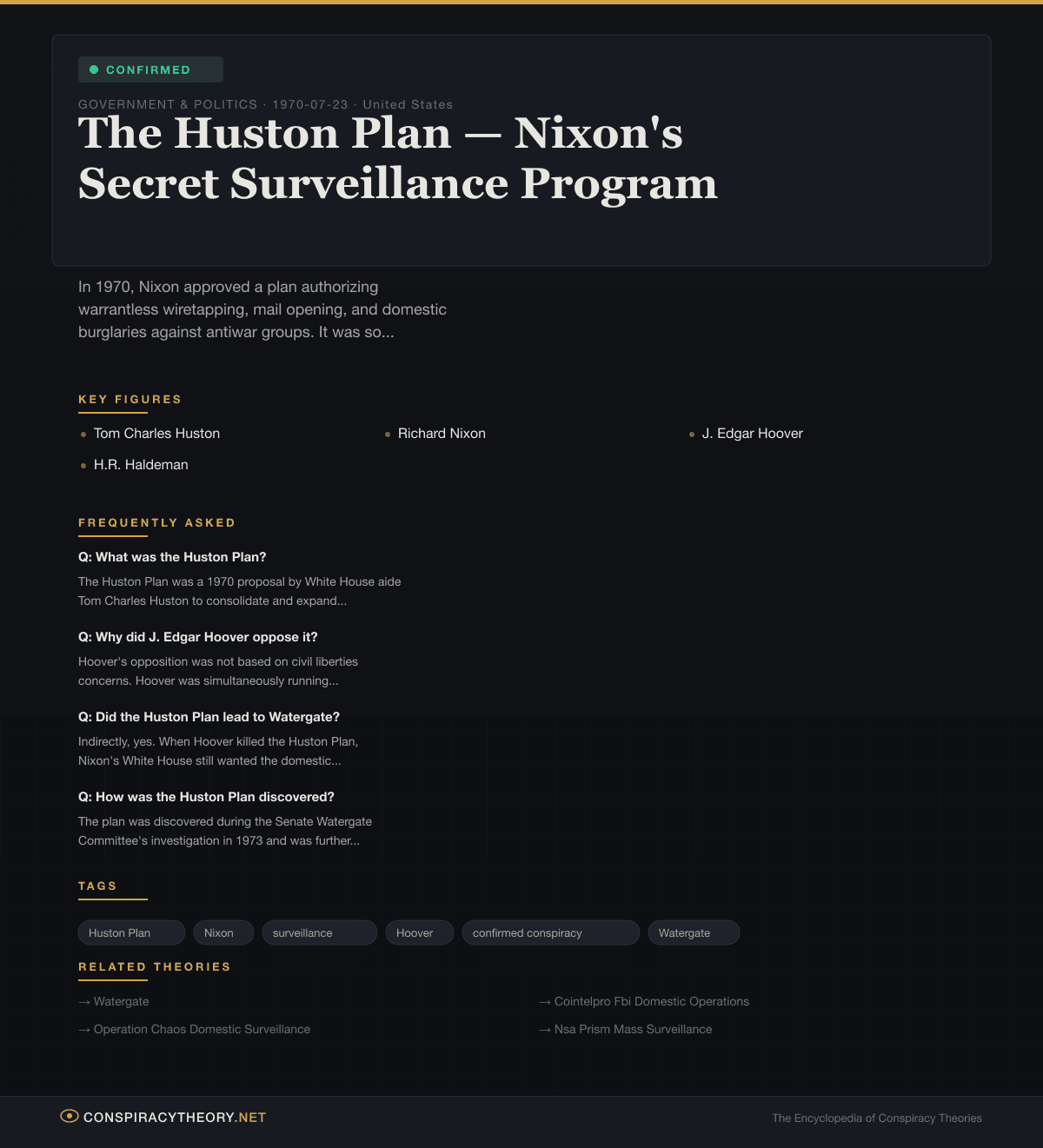
The Huston Plan — Nixon's Secret Surveillance Program
Overview
In the summer of 1970, a 29-year-old White House aide named Tom Charles Huston sat down and wrote one of the most remarkable documents in the history of American government surveillance. It was a plan — later known simply as the Huston Plan — that proposed authorizing the federal government to wiretap American citizens without warrants, open their mail, break into their homes and offices, and recruit informants on college campuses.
Huston was refreshingly honest about what he was proposing. In the plan’s cover memo, he noted that several of the recommended techniques were “clearly illegal.” He recommended them anyway.
President Richard Nixon approved the plan on July 23, 1970. It was the most expansive domestic surveillance program ever formally authorized by a president — a blueprint for a police state, reduced to a tidy bureaucratic document with recommendations organized by bullet point.
Five days later, it was dead. J. Edgar Hoover — the FBI director who had spent decades running COINTELPRO, wiretapping Martin Luther King Jr., and compiling secret files on politicians — refused to implement it. Hoover didn’t object because the plan was illegal. He objected because it threatened his bureaucratic territory.
The irony is almost too perfect: the most dangerous domestic surveillance program in American history was stopped not by courts, not by Congress, not by the Constitution, but by a turf war between two men who had already spent decades violating civil liberties. And when the plan died, Nixon’s White House created the Plumbers unit instead — the same group that would break into the Watergate complex and bring down the presidency.
The Context
Nixon’s War at Home
By 1970, Nixon was consumed by what he perceived as a domestic insurgency. The antiwar movement was massive — the November 1969 Moratorium had brought half a million protesters to Washington. The Weather Underground and other radical groups were carrying out bombings. College campuses were in constant turmoil. In May 1970, the National Guard killed four students at Kent State, and the country seemed to be tearing itself apart.
Nixon viewed the domestic opposition as a threat comparable to a foreign enemy. He was convinced — despite the findings of Operation CHAOS, which had repeatedly failed to find evidence — that foreign governments were directing the antiwar movement. He wanted the intelligence agencies to crush the opposition, and he was frustrated that the existing programs weren’t aggressive enough.
The Interagency Problem
Nixon’s frustration was compounded by an interagency turf war. The FBI, CIA, NSA, and military intelligence all conducted domestic surveillance, but they didn’t share information effectively. Hoover had restricted FBI cooperation with other agencies after he became concerned about potential exposure of the Bureau’s own illegal operations. The result was a system in which multiple agencies were spying on Americans but weren’t coordinating with each other.
Nixon wanted a unified domestic intelligence operation, directed from the White House, that would combine the capabilities of all agencies. He assigned the task to Tom Charles Huston.
The Plan
Tom Charles Huston
Huston was a young conservative activist — a former chairman of the Young Americans for Freedom — who had joined the Nixon White House as a staff assistant focused on internal security matters. He was intelligent, ambitious, and possessed of the particular certainty that comes with being 29 years old and having the ear of the president.
In June 1970, Huston chaired the Interagency Committee on Intelligence (ICI), which brought together the heads of the FBI, CIA, NSA, and Defense Intelligence Agency to develop a comprehensive plan for domestic intelligence. Huston’s report, formally titled “Domestic Intelligence Gathering Plan: Analysis and Strategy,” was completed in July 1970.
The Recommendations
The Huston Plan recommended:
Electronic surveillance: Expanded warrantless wiretapping of “individuals and groups in the United States who pose a major threat to the internal security.” The plan acknowledged that this would require overriding existing legal restrictions.
Mail coverage: Resumption of CIA mail opening programs (which had been partially curtailed) and expansion of FBI mail interception.
Surreptitious entry: Authorization for “break-ins” — the government breaking into homes and offices of suspected subversives to photograph documents and install listening devices. Huston’s memo noted this was “clearly illegal” but argued it was “highly productive” and recommended it anyway.
Development of campus sources: Relaxation of restrictions on recruiting informants among college students under 21 years old.
Intelligence coordination: Creation of an Interagency Group on Domestic Intelligence and Internal Security, chaired by a White House representative, to coordinate all domestic intelligence activities.
Huston attached an “options” paper that explicitly noted the illegality of several recommendations. For burglary, he wrote: “Use of this technique is clearly illegal: it amounts to burglary. It is also highly risky and could result in great embarrassment if exposed. However, it is also the most fruitful tool and can produce the type of intelligence which cannot be obtained in any other fashion.”
The casual acknowledgment of criminal activity, submitted to the President of the United States in a formal memorandum, remains one of the most extraordinary documents in the history of executive power.
Hoover’s Objection
The Bureaucratic Kill
Nixon approved the plan on July 23, 1970. Hoover was informed. Hoover said no.
Hoover’s objection was expressed in a series of footnotes he had attached to the plan during the ICI deliberations — footnotes that essentially dissented from every significant recommendation. His objections were not principled. Hoover was running COINTELPRO, which involved many of the same techniques the Huston Plan proposed. His concern was not that the activities were illegal but that:
-
The plan would reduce FBI autonomy: The proposed interagency coordination structure would place domestic intelligence under White House direction rather than FBI control. Hoover had spent decades building the FBI’s independent power and was not about to surrender it to a 29-year-old White House aide.
-
The FBI would take the blame: If the illegal activities were exposed, the FBI — not the White House — would be the public face of the scandal. Hoover, who was acutely sensitive to the Bureau’s public image, refused to accept that risk.
-
Hoover’s turf: The plan would have required the FBI to share intelligence with the CIA and NSA, agencies Hoover distrusted and competed with.
Nixon, who feared Hoover’s power and the secret files Hoover allegedly maintained on politicians (including, presumably, Nixon), backed down. The plan was formally withdrawn on July 28, 1970 — five days after it was approved.
The Consequences
The Plumbers
The Huston Plan died bureaucratically, but the desire behind it did not. Nixon still wanted a domestic intelligence operation under White House control. Without the formal interagency apparatus the Huston Plan would have created, the White House improvised — creating the Special Investigations Unit, known as the “Plumbers,” to conduct the same kinds of operations (particularly break-ins and wiretapping) that the Huston Plan had proposed.
The Plumbers’ first operation was the September 1971 break-in at the office of Daniel Ellsberg’s psychiatrist — an attempt to find material to discredit the man who had leaked the Pentagon Papers. Their most famous operation was the June 1972 break-in at the Democratic National Committee headquarters at the Watergate complex.
The Huston Plan, in other words, was the egg that hatched Watergate. Nixon wanted illegal domestic surveillance capabilities. When the formal plan was blocked, he created informal ones. Those informal operations produced the scandal that destroyed his presidency.
The Church Committee
The Huston Plan became a central exhibit in the Church Committee’s investigation of intelligence abuses. The plan was significant not just for what it proposed but for what it revealed about the executive branch’s willingness to authorize explicitly illegal activities against American citizens.
Senator Church described the intelligence agencies’ accumulated power as potentially constituting a capacity for “total tyranny” and warned that the same capabilities used against domestic dissidents could be turned on any American. The Huston Plan was his Exhibit A.
Timeline
| Date | Event |
|---|---|
| June 1970 | Nixon convenes Interagency Committee on Intelligence |
| July 1970 | Huston completes domestic intelligence plan |
| July 23, 1970 | Nixon approves the Huston Plan |
| July 27-28, 1970 | Hoover objects; plan formally withdrawn |
| Sept 1971 | Plumbers break into Ellsberg’s psychiatrist’s office |
| June 1972 | Watergate break-in |
| 1973 | Huston Plan discovered by Senate Watergate Committee |
| Aug 1974 | Nixon resigns |
| 1975-76 | Church Committee investigates Huston Plan and related programs |
Sources & Further Reading
- Church Committee. Intelligence Activities and the Rights of Americans. Book II, Final Report, 1976.
- Senate Select Committee on Presidential Campaign Activities (Watergate Committee). Hearings, 1973.
- Dean, John. Blind Ambition. Simon & Schuster, 1976.
- Theoharis, Athan. Spying on Americans: Political Surveillance from Hoover to the Huston Plan. Temple University Press, 1978.
- Huston Plan document, declassified, available through National Archives.
Related Theories
- Watergate — The scandal the Huston Plan’s failure helped create
- COINTELPRO — Hoover’s own illegal domestic operations
- Operation CHAOS — CIA’s parallel domestic surveillance
- NSA Mass Surveillance — Modern descendant of the surveillance impulse

Frequently Asked Questions
What was the Huston Plan?
Why did J. Edgar Hoover oppose it?
Did the Huston Plan lead to Watergate?
How was the Huston Plan discovered?

Infographic
Share this visual summary. Right-click to save.