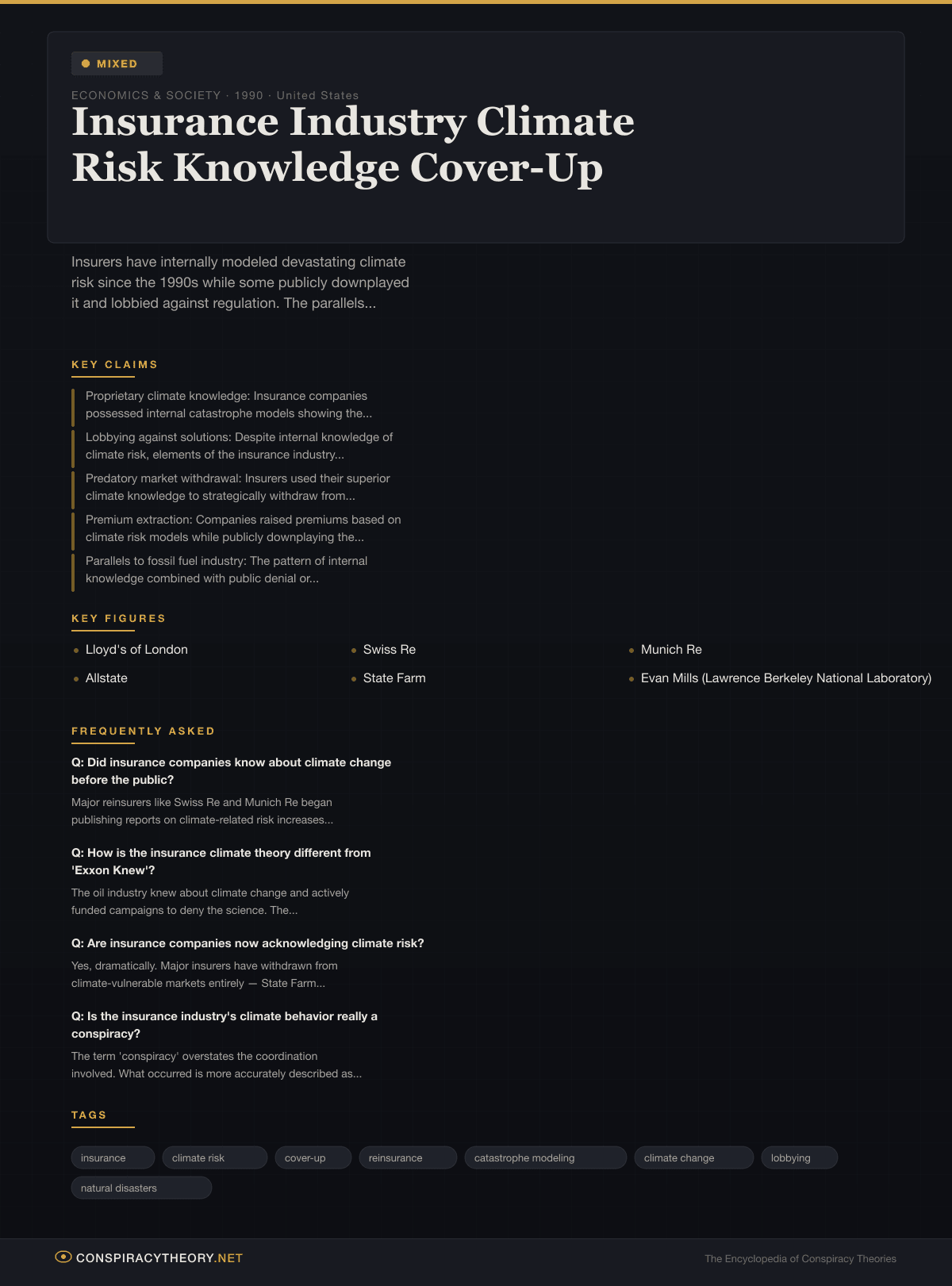
Insurance Industry Climate Risk Knowledge Cover-Up

Overview
Here is something unusual about the insurance industry: it is simultaneously one of the most data-driven, actuarially rigorous sectors of the global economy and one of the least transparent about what its data actually shows. Insurance companies don’t guess. They model. They hire armies of mathematicians, statisticians, and atmospheric scientists to calculate the probability of every conceivable catastrophe. And they’ve been doing this with climate change for longer than most people realize.
Since at least the early 1990s, major insurers and reinsurers have maintained sophisticated internal models projecting the impact of climate change on natural catastrophe losses. These models showed — decades ago — that rising temperatures, sea level rise, and increasing severe weather would produce dramatically escalating property losses. Swiss Re was publishing reports on climate risk in 1994. Munich Re was tracking the trend in catastrophe losses through the 1990s. Lloyd’s of London was scenario-planning for a world of climate-amplified disasters.
The conspiracy theory version of this story is straightforward: insurance companies knew the climate was changing, knew it would cause devastating losses, and deliberately concealed this knowledge while lobbying against climate regulation — all while quietly raising premiums and withdrawing from the most vulnerable markets. It’s the Exxon Knew playbook, applied to a different industry.
The reality is messier, more interesting, and harder to reduce to a simple villain narrative. Because the insurance industry’s relationship with climate change is genuinely paradoxical: some of the same companies that modeled climate risk internally also funded trade groups that opposed climate regulation. The industry simultaneously knew more than almost anyone about what was coming and failed to translate that knowledge into public action.
Origins & History
The Catastrophe Modeling Revolution
The modern era of insurance climate awareness begins with Hurricane Andrew in 1992. Andrew, which devastated southern Florida with $27 billion in insured losses (about $55 billion in 2025 dollars), bankrupted eleven insurance companies and fundamentally altered how the industry assessed catastrophe risk.
Before Andrew, catastrophe risk was assessed largely through historical experience — how much had storms cost in the past, therefore how much would they likely cost in the future. Andrew revealed that this backward-looking approach was catastrophically inadequate. The industry turned to computer-based catastrophe modeling, contracting with firms like AIR Worldwide, Risk Management Solutions (RMS), and EQECAT (now CoreLogic) to build sophisticated simulations of hurricane, earthquake, and flood risk.
These models incorporated atmospheric science, climate data, and — increasingly through the 1990s and 2000s — projections of how climate change would alter the frequency and severity of natural catastrophes. By the early 2000s, the most advanced catastrophe models were showing clear signals: climate change was going to make the insurance business dramatically more expensive.
The European Reinsurers Sound the Alarm
The most significant early voices on insurance and climate came from European reinsurers — the companies that insure insurance companies.
Munich Re began publishing annual reviews of natural catastrophe losses in 1988, tracking an unmistakable upward trend. By the mid-1990s, Munich Re’s scientists were explicitly attributing part of the trend to climate change. Their annual NatCatSERVICE reports became reference documents for climate researchers.
Swiss Re published its first major report on climate change and insurance in 1994 — Global Warming: Element of Risk — which outlined scenarios for how a warmer climate would affect the reinsurance business. Swiss Re’s subsequent work became progressively more urgent. By the 2010s, Swiss Re was publishing frank assessments warning that climate change could make entire regions uninsurable.
Lloyd’s of London commissioned and published climate risk analyses starting in the early 2000s. A landmark 2006 report by Lloyd’s, “Adapt or Bust,” warned that the insurance industry needed to fundamentally rethink its approach to climate risk or face existential challenges.
These were not buried internal documents. They were published reports, available to anyone who wanted to read them. The European reinsurance industry was, in many ways, ahead of most other industries in publicly acknowledging climate risk.
The American Disconnect
The story in the United States was different. While European reinsurers were publishing climate warnings, many American primary insurers and insurance trade groups were taking a quieter, more ambivalent stance.
The insurance trade lobby — organizations like the American Insurance Association (AIA) and the National Association of Mutual Insurance Companies (NAMIC) — opposed climate regulation on multiple occasions. The industry lobbied against cap-and-trade legislation, against EPA emissions regulations, and against state-level climate initiatives. Some industry-funded groups cast doubt on the severity of climate projections.
Allstate and State Farm, the two largest homeowners insurers in the US, present the starkest case studies. Both companies were sophisticated enough to model climate risk internally. Both raised premiums in climate-vulnerable areas. And both ultimately withdrew from some of the most vulnerable markets entirely — State Farm stopped writing new homeowners policies in California in 2023, citing wildfire risk; Allstate had largely pulled back from California and Florida years earlier.
The accusation is that these companies used their internal climate knowledge to protect themselves — raising prices, restricting coverage, withdrawing from risky markets — without transparently communicating to policyholders or the public why they were doing so, and without supporting the policy changes that might have addressed the underlying risk.
Evan Mills and Academic Documentation
Evan Mills, a staff scientist at Lawrence Berkeley National Laboratory, has done the most comprehensive academic work documenting the insurance industry’s relationship with climate change. His research, published in journals including Science and Climatic Change, tracks how insurance losses have escalated with climate-related events and how the industry’s internal knowledge has evolved.
Mills has documented a pattern that he characterizes as a “dual strategy”: some companies and industry segments acknowledged climate risk and adapted their business models, while others downplayed the climate connection in public communications even as they incorporated climate projections into their internal pricing and risk management.
Key Claims
-
Proprietary climate knowledge: Insurance companies possessed internal catastrophe models showing the impact of climate change on losses decades before this information was widely understood by the public or policyholders.
-
Lobbying against solutions: Despite internal knowledge of climate risk, elements of the insurance industry lobbied against climate regulations that would have addressed the underlying cause of their increasing losses.
-
Predatory market withdrawal: Insurers used their superior climate knowledge to strategically withdraw from high-risk markets, leaving homeowners and communities without coverage and without advance warning.
-
Premium extraction: Companies raised premiums based on climate risk models while publicly downplaying the climate connection — extracting higher payments without being transparent about the reason.
-
Parallels to fossil fuel industry: The pattern of internal knowledge combined with public denial or minimization mirrors the tobacco and fossil fuel industries’ documented strategies of suppressing inconvenient science.
Evidence
Supporting the Theory
The timeline is damning. Major reinsurers were publishing climate risk analyses in the early 1990s. The fact that the industry possessed sophisticated climate risk models while some trade groups simultaneously lobbied against climate regulation is documented and undeniable.
Market withdrawals confirm internal knowledge. When insurers withdraw from markets, they are revealing — through their actions — risk assessments that they haven’t shared in plain language with policyholders or the public. State Farm’s California withdrawal in 2023 was based on risk models that the company had not publicly disclosed in detail.
Trade group lobbying is documented. Insurance industry trade groups did lobby against climate legislation, including the Waxman-Markey cap-and-trade bill in 2009 and various EPA emissions regulations. This occurred while member companies were internally modeling climate-driven losses.
The Ceres Coalition documented the gap. Ceres, a sustainability-focused nonprofit, published multiple reports (beginning with “Availability and Affordability of Insurance Under Climate Change,” 2005) documenting the disconnect between what insurers knew about climate risk and what they communicated to regulators and the public.
Against the Theory (or at Least Complicating It)
European reinsurers were publicly vocal. The claim of a cover-up sits uneasily with the fact that Munich Re, Swiss Re, and Lloyd’s were publishing detailed climate risk analyses that anyone could read. The industry was not monolithic in its approach.
Raising premiums IS communication. When an insurer raises prices, it is, in a market sense, communicating about risk. The complaint that companies raised premiums without explaining climate change is somewhat like complaining that a stock price dropped without an explanatory footnote — prices are themselves information signals.
Climate regulation poses genuine business problems for insurers. The insurance industry’s lobbying against specific climate regulations doesn’t necessarily indicate climate denial. Regulatory proposals can impose costs and constraints on insurers that they oppose for business reasons even while accepting the underlying science.
The conspiracy framing overstates coordination. The insurance industry is not a monolith. It includes companies that were climate leaders (Swiss Re), companies that were climate laggards (various US primary insurers), and a vast middle that adapted slowly and unevenly. Characterizing this as a coordinated cover-up imports a level of intentional coordination that doesn’t match the messy, competitive reality.
Actuarial science is inherently proprietary. Insurance companies treat their risk models as trade secrets because those models are the core of their competitive advantage. Demanding that insurers publish their internal catastrophe models is asking them to give away their most valuable proprietary information — a request that no industry would readily accept, regardless of the issue.
Debunking / Verification
This theory is classified as mixed for good reason:
What’s confirmed: Major insurers had sophisticated internal climate risk models decades before the public fully grasped the implications of climate change. Some industry trade groups lobbied against climate regulation while member companies were modeling climate-driven losses. Insurers used their superior risk knowledge to protect themselves through premium increases and market withdrawals.
What’s not confirmed: A coordinated, industry-wide conspiracy to suppress climate science. The insurance industry’s behavior is more accurately described as a collection of self-interested decisions by competing companies, some of which were publicly transparent about climate risk and others of which were not.
The real scandal may be less about conspiracy and more about structural incentive misalignment: an industry whose business model depends on accurate risk assessment had little institutional incentive to advocate for the societal changes that would reduce the very risks it was profiting from pricing.
Cultural Impact
The insurance-climate connection has gained increasing public attention as climate-driven disasters have escalated and insurance market disruptions have hit homeowners directly. The withdrawal of major insurers from California and Florida — leaving millions of homeowners unable to obtain private coverage — has transformed what was once an abstract policy discussion into a kitchen-table financial crisis.
The emerging narrative of “insurers as climate canaries” — companies whose market behavior reveals climate truths that political discourse has been slow to accept — has become a significant frame in climate journalism. When State Farm stops writing policies in California, it carries an implicit message about climate risk that is harder to dismiss than any scientific paper.
The comparison to “Exxon Knew” has driven interest from climate litigation attorneys, who are exploring whether insurance industry internal documents could support legal claims similar to those brought against fossil fuel companies.
In Popular Culture
- Extensive coverage in The New York Times, ProPublica, Bloomberg, and financial media about insurance market withdrawals and climate risk
- ProPublica’s 2020 investigation into climate-driven insurance availability examined the industry’s internal knowledge
- Several documentaries on climate change have included segments on the insurance industry’s risk modeling
- The topic has become a regular subject on policy podcasts and financial analysis programs
Key Figures
- Munich Re: German reinsurer that has been publishing natural catastrophe loss data and climate risk analyses since 1988.
- Swiss Re: Swiss reinsurer that published one of the first major reports on climate and insurance in 1994.
- Lloyd’s of London: Historic insurance market that has published multiple climate risk reports.
- State Farm / Allstate: Major US homeowners insurers whose market withdrawals from California and Florida highlighted the gap between internal knowledge and public communication.
- Evan Mills: Lawrence Berkeley National Laboratory scientist who has academically documented the insurance industry’s climate risk knowledge and communication gaps.
- Ceres: Sustainability nonprofit that has published extensive research on insurance and climate risk.
Timeline
| Date | Event |
|---|---|
| 1988 | Munich Re begins publishing annual natural catastrophe reviews |
| 1992 | Hurricane Andrew causes $27 billion in insured losses; catalyzes catastrophe modeling revolution |
| 1994 | Swiss Re publishes Global Warming: Element of Risk |
| Late 1990s | Advanced catastrophe models begin incorporating climate change projections |
| 2005 | Hurricane Katrina; $65+ billion in insured losses; Ceres publishes insurance-climate report |
| 2006 | Lloyd’s publishes “Adapt or Bust” climate risk report |
| 2009 | Insurance trade groups lobby against Waxman-Markey cap-and-trade legislation |
| 2012 | Hurricane Sandy; $30+ billion in insured losses |
| 2017-2018 | Record US insured catastrophe losses from hurricanes and wildfires |
| 2020 | ProPublica investigation into climate-driven insurance availability |
| 2023 | State Farm stops writing new homeowners policies in California; Farmers Insurance follows |
| 2024-2025 | Multiple insurers restrict or exit climate-vulnerable markets nationwide |
| 2025 | LA wildfires produce estimated $30-40 billion in insured losses; market crisis deepens |
Sources & Further Reading
- Mills, Evan. “Insurance in a Climate of Change,” Science 309.5737 (2005): 1040-1044
- Swiss Re. Global Warming: Element of Risk (1994)
- Munich Re. NatCatSERVICE annual reports (1988-present)
- Lloyd’s of London. “Adapt or Bust: Insurers’ Response to Climate Change” (2006)
- Ceres. “Availability and Affordability of Insurance Under Climate Change” (2005, updated editions)
- Flavelle, Christopher. “Climate Change Is Destabilizing Insurance Industry,” The New York Times (various articles, 2020-2025)
- ProPublica. “Climate Change Will Force a New American Migration” (2020)
- Dlugolecki, Andrew. “Climate Change and the Insurance Sector,” Geneva Papers on Risk and Insurance 33.1 (2008)
Related Theories
- Exxon Knew / Fossil Fuel Climate Denial — The documented pattern of fossil fuel companies possessing internal climate science while publicly funding climate denial
- Corporate Climate Denial — The broader pattern of industries suppressing or minimizing climate science to protect business interests

Frequently Asked Questions
Did insurance companies know about climate change before the public?
How is the insurance climate theory different from 'Exxon Knew'?
Are insurance companies now acknowledging climate risk?
Is the insurance industry's climate behavior really a conspiracy?
Infographic
Share this visual summary. Right-click to save.