International Jewish Conspiracy

Overview
Few conspiracy theories have caused as much real-world devastation as the claim that Jewish people are secretly coordinating to control the world’s governments, banks, and media. Rooted in medieval European prejudice and supercharged by the forged Protocols of the Elders of Zion in the early twentieth century, this theory has served as the ideological foundation for pogroms, discriminatory legislation, and the Holocaust itself. It remains, by any honest accounting, the deadliest conspiracy theory in human history.
The theory has no basis in fact. The Protocols were exposed as a crude forgery more than a century ago. No evidence of a coordinated Jewish plan for world domination has ever been produced. Yet the narrative persists — mutating across eras and cultures, attaching itself to whatever anxieties happen to be circulating at a given moment. Understanding how this particular conspiracy theory works, and why it refuses to die, is essential to understanding how conspiracy thinking itself operates.
This article documents the origins, propagation, debunking, and lasting cultural impact of the “international Jewish conspiracy” narrative. It is written as a reference work, not as advocacy. The theory is classified as debunked.
Origins & History
Medieval Roots
Antisemitic conspiracy thinking did not begin with a single text or moment. Its roots stretch back to antiquity, but the conspiratorial strain took clearest shape in medieval Christian Europe. Jews, barred from most professions and land ownership, were funneled into finance and trade — then demonized for occupying those roles. The blood libel — the false accusation that Jews murdered Christian children for ritual purposes — appeared as early as the twelfth century in England and spread across the continent.
By the fourteenth century, Jews were being blamed for the Black Death, accused of poisoning wells to kill Christians. Entire communities were massacred on the basis of these fabrications. The pattern was established early: in times of crisis, Jewish communities became convenient scapegoats, and conspiracy narratives provided the justification.
The Protocols of the Elders of Zion
The single most influential antisemitic document in modern history is the Protocols of the Elders of Zion, first published in serialized form in the Russian newspaper Znamya in 1903. The text purports to be the minutes of a secret meeting of Jewish leaders plotting world domination through control of the press, economy, and governments.
The Protocols were almost certainly fabricated by agents of the Okhrana, the Russian secret police, during a period of intense anti-Jewish sentiment under Tsar Nicholas II. Scholars have identified substantial portions of the text as plagiarized from Maurice Joly’s 1864 satirical dialogue The Dialogue in Hell Between Machiavelli and Montesquieu, which had nothing to do with Jews — it was a critique of Napoleon III’s political ambitions. Additional material was likely drawn from Hermann Goedsche’s 1868 novel Biarritz.
Despite being exposed as a forgery by The Times of London in 1921 — journalist Philip Graves traced the plagiarism line by line — the Protocols spread globally. They were translated into dozens of languages and became foundational texts for antisemitic movements worldwide.
Henry Ford and The International Jew
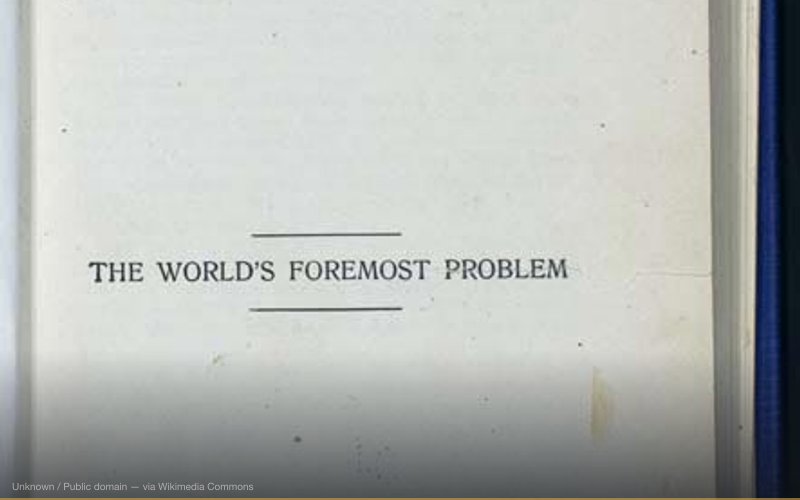
In the United States, the Protocols found their most powerful amplifier in Henry Ford. Beginning in May 1920, Ford’s newspaper The Dearborn Independent ran a 91-issue series titled “The International Jew: The World’s Foremost Problem.” The articles recycled claims from the Protocols and accused Jewish people of controlling American finance, entertainment, and agriculture.
Ford’s reach was enormous. The Dearborn Independent had a circulation of roughly 700,000 at its peak, and copies were distributed through Ford dealerships nationwide. The articles were compiled into four volumes and translated into German, where they found an enthusiastic readership among the emerging Nazi movement. Adolf Hitler kept a portrait of Ford in his office and cited him by name in Mein Kampf.
Under legal pressure and public backlash, Ford issued an apology in 1927 and ceased publication of the Independent. But the damage was done. The material had already been absorbed into the global antisemitic canon.
Nazi Germany and the Holocaust
The Nazi regime elevated the “international Jewish conspiracy” from fringe theory to state ideology. Hitler’s Mein Kampf (1925) presented the conspiracy as settled fact, and Nazi propaganda minister Joseph Goebbels built an entire media apparatus around it. The Protocols were taught in German schools. Films like The Eternal Jew (1940) depicted Jewish people as parasites controlling global finance.
This ideology provided the justification for the Holocaust — the systematic murder of six million Jewish people between 1941 and 1945. The conspiracy theory was not an incidental feature of Nazism; it was the engine. The claim that Jews were secretly orchestrating Germany’s destruction was used to rationalize their extermination.
Key Claims
The “international Jewish conspiracy” narrative, across its many variations, typically includes some combination of the following assertions:
- Financial control: Jewish bankers and families (the Rothschilds are the perennial example) secretly control the world’s central banks, monetary policy, and financial markets
- Media manipulation: Jewish people own and control major media organizations and use them to shape public opinion in their favor
- Political manipulation: Jewish individuals and organizations exercise disproportionate influence over governments through lobbying, campaign donations, and covert networks
- Cultural subversion: Jewish intellectuals deliberately undermine traditional values, religion, and national identity to weaken non-Jewish societies
- Dual loyalty: Jewish citizens of various nations are secretly loyal to Israel or to a transnational Jewish agenda rather than to their home countries
- Orchestrated crises: Wars, revolutions, and economic crashes are deliberately engineered by Jewish conspirators for profit or power
Evidence
There is no credible evidence supporting the existence of an international Jewish conspiracy. The theory’s evidentiary foundation consists of:
The Protocols of the Elders of Zion — conclusively proven to be a forgery. The plagiarism from Joly’s work was documented by Philip Graves in 1921 and confirmed by numerous scholars since. A 1935 trial in Bern, Switzerland formally ruled the Protocols fraudulent. Russian historian Mikhail Lepekhine identified Okhrana agent Mathieu Golovinski as the likely forger.
Selective statistics — proponents cite the presence of Jewish individuals in banking, media, and entertainment as evidence of conspiracy. This ignores the historical context (restricted career options driving concentration in certain industries), the far larger number of non-Jewish people in those same industries, and the basic logical fallacy of equating individual success with coordinated conspiracy.
Confirmation bias — every action by any Jewish individual or organization is interpreted through the lens of the conspiracy, while contradictory evidence is ignored.
Debunking
The “international Jewish conspiracy” has been debunked from virtually every angle:
- The foundational document is a proven forgery. The Protocols of the Elders of Zion were plagiarized from a non-Jewish source and fabricated by the Russian secret police
- No meeting of “Elders” has ever been documented. No evidence of any coordinating body matching the Protocols’ description has ever been found
- Jewish communities are not monolithic. Jewish people hold widely divergent political, economic, and religious views. The idea of a single coordinated agenda is contradicted by the enormous diversity within Jewish communities worldwide
- The theory requires impossible coordination. The alleged conspiracy would require millions of people across dozens of countries, speaking different languages, with different political allegiances, to maintain perfect secrecy for centuries
- Multiple independent investigations — including by The Times of London (1921), a Swiss court (1935), the United States Senate (1964), and numerous academic studies — have found no evidence supporting the theory
Cultural Impact
Enduring Political Weapon
The “international Jewish conspiracy” narrative has served as a political weapon for movements across the ideological spectrum. Right-wing and fascist movements have historically been its primary vehicle, but versions of the theory have appeared in Soviet propaganda, Islamist rhetoric, and certain strands of left-wing anti-Zionism that cross into antisemitism.
The theory’s adaptability is part of its danger. It can be grafted onto virtually any grievance: economic inequality becomes evidence of Jewish financial manipulation; media criticism becomes evidence of Jewish media control; political decisions become evidence of Jewish lobbying power. This all-purpose quality makes it extraordinarily resilient.
Modern Manifestations
In the twenty-first century, the theory circulates through social media, often in coded language. References to “globalists,” “international bankers,” “the cabal,” or specific families like the Rothschilds frequently serve as thinly veiled antisemitic dog whistles. The New World Order conspiracy theory and QAnon both incorporate elements of antisemitic conspiracy thinking, even when they do not explicitly name Jewish people.
The Anti-Defamation League and other monitoring organizations report consistent levels of antisemitic conspiracy content online, with spikes during economic downturns and political crises — a pattern that mirrors the historical record.
Academic Study
The theory has become a major subject of academic research in fields including psychology, sociology, political science, and Holocaust studies. Scholars like Norman Cohn (Warrant for Genocide, 1967), Hadassa Ben-Itto (The Lie That Wouldn’t Die, 2005), and Stephen Bronner (A Rumor about the Jews, 2000) have produced definitive analyses of its origins, mechanics, and consequences.
In Popular Culture
- The Protocols of the Elders of Zion (2005) — documentary by Marc Levin tracing the history and contemporary influence of the forgery
- Denial (2016) — film depicting historian Deborah Lipstadt’s legal battle against Holocaust denier David Irving
- Conspiracy (2001) — HBO film dramatizing the Wannsee Conference where the Holocaust was planned
- Philip Roth’s The Plot Against America (2004) — alternate history novel exploring American antisemitism
- Umberto Eco’s The Prague Cemetery (2010) — novel fictionalizing the creation of the Protocols
Key Figures
- Mathieu Golovinski — Russian agent identified as the probable author of the Protocols of the Elders of Zion
- Sergei Nilus — Russian mystic who published the Protocols as an appendix to his book in 1905
- Henry Ford — American industrialist who funded and distributed “The International Jew” series
- Adolf Hitler — Used the conspiracy theory as foundational ideology for the Nazi regime and the Holocaust
- Philip Graves — Times of London journalist who exposed the Protocols as a forgery in 1921
- Norman Cohn — Historian whose Warrant for Genocide (1967) provided a definitive academic analysis of the Protocols
Timeline
| Date | Event |
|---|---|
| 12th century | Blood libel accusations emerge in medieval England |
| 1348-1351 | Jews blamed for the Black Death across Europe; massacres follow |
| 1864 | Maurice Joly publishes The Dialogue in Hell Between Machiavelli and Montesquieu |
| 1868 | Hermann Goedsche publishes Biarritz, containing a fictional “Rabbi’s Speech” |
| 1903 | Protocols of the Elders of Zion first published in serialized form in Russia |
| 1905 | Sergei Nilus publishes full Protocols text as appendix to his mystical book |
| 1920 | Henry Ford’s Dearborn Independent begins publishing “The International Jew” |
| 1921 | Philip Graves exposes the Protocols as a forgery in The Times of London |
| 1925 | Hitler publishes Mein Kampf, citing Ford and recycling Protocols claims |
| 1927 | Henry Ford issues public apology and ceases publication of The Dearborn Independent |
| 1933 | Nazi regime begins implementing antisemitic policies based on conspiracy ideology |
| 1935 | Bern trial in Switzerland formally rules the Protocols fraudulent |
| 1940 | Nazi propaganda film The Eternal Jew released |
| 1941-1945 | The Holocaust — six million Jewish people murdered |
| 1964 | U.S. Senate Judiciary Committee report debunks the Protocols |
| 1993 | Russian court declares the Protocols a forgery |
| 2005 | Marc Levin’s documentary The Protocols of the Elders of Zion released |
Sources & Further Reading
- Cohn, Norman. Warrant for Genocide: The Myth of the Jewish World Conspiracy and the Protocols of the Elders of Zion. Serif, 1967.
- Ben-Itto, Hadassa. The Lie That Wouldn’t Die: The Protocols of the Elders of Zion. Vallentine Mitchell, 2005.
- Bronner, Stephen Eric. A Rumor about the Jews: Antisemitism, Conspiracy, and the Protocols of Zion. Oxford University Press, 2000.
- Eco, Umberto. The Prague Cemetery. Houghton Mifflin Harcourt, 2010.
- Graves, Philip. “The Truth about the Protocols: A Literary Forgery.” The Times (London), August 16-18, 1921.
- Levy, Richard S. Antisemitism: A Historical Encyclopedia of Prejudice and Persecution. ABC-CLIO, 2005.
- Eisner, Will. The Plot: The Secret Story of the Protocols of the Elders of Zion. W.W. Norton, 2005.
- United States Holocaust Memorial Museum. “Protocols of the Elders of Zion.” Holocaust Encyclopedia.
Related Theories
- Judeo-Masonic Conspiracy — a fusion of antisemitic and anti-Masonic paranoia
- Zionist Occupation Government — the claim that Jewish people secretly control Western governments
- Blood Libel — medieval antisemitic accusations of ritual murder
- New World Order — a broader conspiracy theory that often incorporates antisemitic elements
- Freemasonry Conspiracy — frequently entangled with antisemitic conspiracy narratives
Frequently Asked Questions
What are the Protocols of the Elders of Zion?
Has the international Jewish conspiracy theory been debunked?
Why does the international Jewish conspiracy theory persist?
What role did Henry Ford play in spreading antisemitic conspiracy theories?

Infographic
Share this visual summary. Right-click to save.
