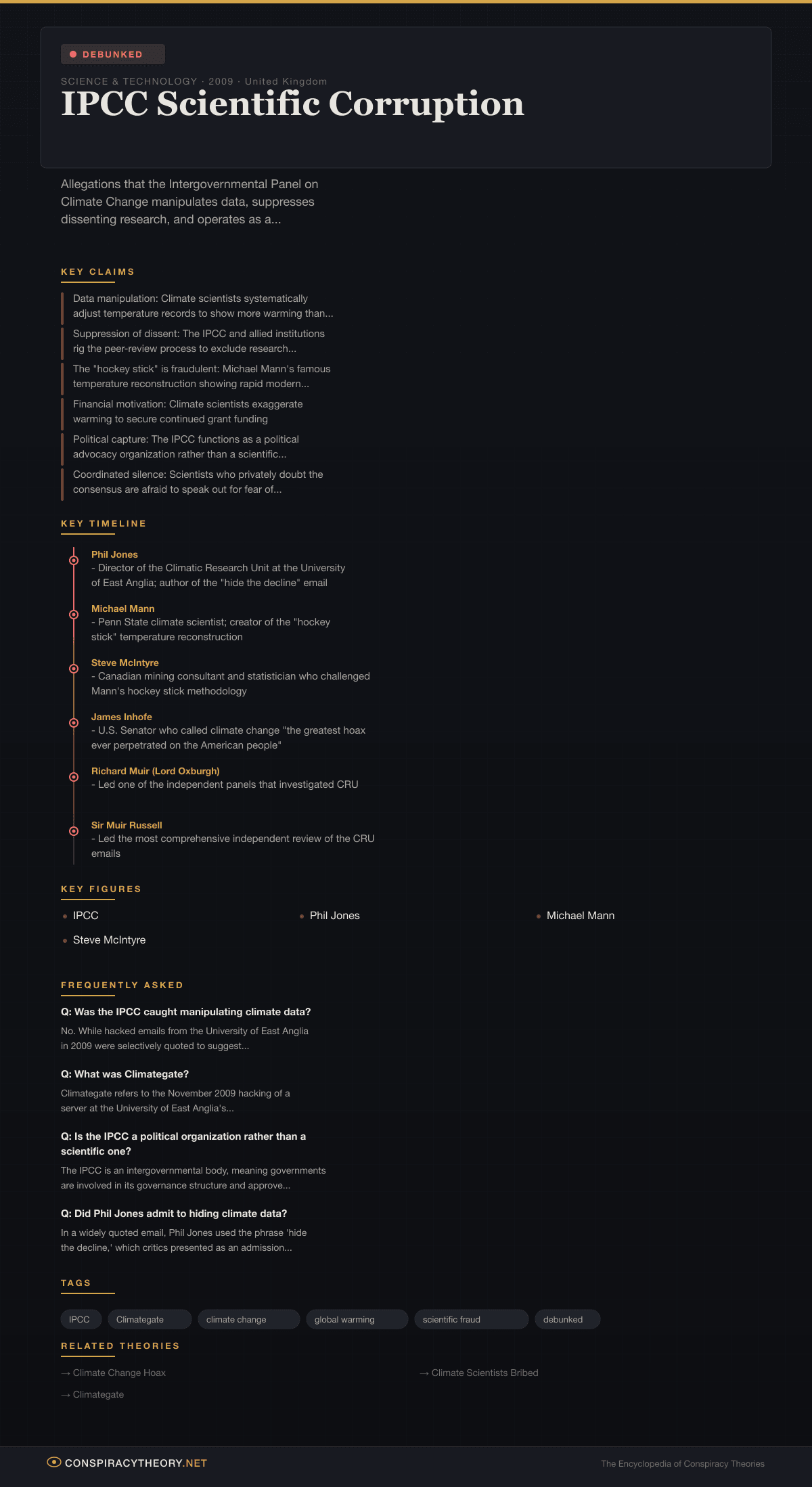
IPCC Scientific Corruption

Overview
In November 2009, hackers breached a server at the University of East Anglia’s Climatic Research Unit and released thousands of private emails between prominent climate scientists. Within days, skeptics of human-caused climate change declared they had found proof of a vast scientific fraud. The Intergovernmental Panel on Climate Change — the UN body responsible for assessing climate science — was corrupt, they said. The data was cooked. The peer-review process was rigged. The entire edifice of climate science was a house of cards built by grant-hungry academics and power-hungry bureaucrats.
The scandal, immediately branded “Climategate” by critics, became one of the most consequential science controversies of the twenty-first century. It arrived just weeks before the Copenhagen climate summit, and its timing was almost certainly not coincidental.
Nine independent investigations later, the scientists were cleared of fraud. But the conspiracy theory they spawned — that the IPCC is a fundamentally corrupt institution engaged in systematic data manipulation — has proven far more durable than the evidence ever warranted. This article examines how the theory emerged, what the investigations actually found, and why the narrative persists despite its debunking.
Origins & History
The IPCC’s Structure and Purpose
The Intergovernmental Panel on Climate Change was established in 1988 by the World Meteorological Organization and the United Nations Environment Programme. Its purpose was not to conduct original research but to assess the existing scientific literature on climate change and present findings to policymakers.
The IPCC operates through three working groups: Working Group I (physical science), Working Group II (impacts and adaptation), and Working Group III (mitigation). Assessment reports are produced approximately every six to seven years, with thousands of scientists volunteering their time as authors and reviewers. The reports go through multiple rounds of review, including by governments.
Critics have long pointed to this governmental involvement as evidence of political contamination. The distinction matters: governments negotiate the exact language of the “Summary for Policymakers” documents, but the underlying full scientific reports are authored by scientists through peer review.
The Climategate Hack
On November 17, 2009, approximately 1,000 emails and 3,000 other documents were stolen from the Climatic Research Unit (CRU) at the University of East Anglia and posted to a Russian server. The stolen materials spanned more than a decade of correspondence between leading climate scientists, including CRU director Phil Jones, Penn State’s Michael Mann, and several IPCC lead authors.
Climate skeptics and political commentators rapidly mined the emails for damaging-sounding phrases. The most quoted was from a 1999 email by Phil Jones: “I’ve just completed Mike’s Nature trick of adding in the real temps to each series for the last 20 years (i.e., from 1981 onwards) and from 1961 for Keith’s to hide the decline.”
Out of context, “trick” and “hide the decline” sounded like admissions of fraud. In context, “trick” referred to a clever methodological approach (a common usage in science and mathematics), and “hide the decline” referred to the well-documented “divergence problem” — the fact that certain tree-ring proxy data diverge from instrumental temperature records after approximately 1960, making them unreliable for that period. The decision to use instrumental data instead of unreliable proxy data for recent decades was a standard, published, and transparent methodological choice.
Other emails showed scientists discussing how to respond to Freedom of Information requests, expressing frustration with skeptics, and debating how to handle dissenting papers in the peer-review process. These revealed scientists behaving, frankly, like humans — sometimes petty, sometimes defensive — but did not demonstrate fraud.
The Political Firestorm
The timing of the leak — three weeks before the UN Climate Change Conference in Copenhagen — ensured maximum political impact. Conservative media, particularly in the United States and United Kingdom, ran the story intensively. Republican Senator James Inhofe called it “the greatest hoax ever perpetrated on the American people.” Fox News covered it as a major scandal. Skeptic blogs dissected every email.
The narrative crystallized quickly: climate scientists were colluding to fabricate warming data, suppress dissenting research, and manipulate the peer-review process. The IPCC, as the primary consumer and synthesizer of this research, was either complicit or duped. Either way, climate policy built on IPCC findings was illegitimate.
The Investigations
Between 2010 and 2011, nine separate investigations examined the Climategate allegations:
- UK House of Commons Science and Technology Committee (March 2010) — found no evidence that Jones had subverted the peer-review process or manipulated data
- Independent Climate Change Email Review (Muir Russell Report) (July 2010) — found CRU’s “rigor and honesty as scientists are not in doubt” but criticized failure to share data openly
- International Science Assessment Panel (Oxburgh Report) (April 2010) — found “no evidence of any deliberate scientific malpractice”
- Penn State University investigation (February and June 2010) — cleared Michael Mann of research misconduct
- U.S. Environmental Protection Agency (2010) — found the emails did not undermine the scientific basis for its endangerment finding
- U.S. Department of Commerce Inspector General (2011) — found no evidence of data manipulation
- National Science Foundation Office of Inspector General (2011) — closed its investigation, finding no research misconduct
- University of East Anglia Scientific Assessment Panel (2010) — found no deliberate malpractice
- UK Information Commissioner’s Office — found that CRU had breached Freedom of Information Act requirements but that the statute of limitations had expired
The consistent finding across all investigations: no evidence of scientific fraud or data manipulation. The criticisms that stuck were procedural — insufficient data sharing and poor handling of FOI requests — not scientific.
Key Claims
Proponents of the IPCC corruption theory typically argue:
- Data manipulation: Climate scientists systematically adjust temperature records to show more warming than has actually occurred
- Suppression of dissent: The IPCC and allied institutions rig the peer-review process to exclude research that contradicts the warming consensus
- The “hockey stick” is fraudulent: Michael Mann’s famous temperature reconstruction showing rapid modern warming was manufactured through flawed statistical methods
- Financial motivation: Climate scientists exaggerate warming to secure continued grant funding
- Political capture: The IPCC functions as a political advocacy organization rather than a scientific assessment body, with conclusions predetermined to support carbon regulation
- Coordinated silence: Scientists who privately doubt the consensus are afraid to speak out for fear of career destruction
Evidence
What the Emails Actually Showed
The hacked emails revealed scientists who were frustrated with skeptics, sometimes discussed keeping dissenting papers out of IPCC reports, and were resistant to sharing data with people they viewed as acting in bad faith. This is unprofessional behavior in some cases, but it is not evidence of a coordinated conspiracy to fabricate global warming.
The “hide the decline” email — the single most cited piece of evidence — was about a documented, published methodological issue (the tree-ring divergence problem) that had been openly discussed in the scientific literature since the mid-1990s. The “trick” in question was published in Nature in 1998 and was not hidden.
The Hockey Stick Controversy
Michael Mann’s 1998 “hockey stick” temperature reconstruction became a lightning rod for criticism. Statistician Steve McIntyre and economist Ross McKitrick published critiques arguing that Mann’s statistical methods would produce a hockey-stick shape from random data. A 2006 National Research Council panel found that the hockey stick had certain statistical shortcomings but that its fundamental conclusion — that late-twentieth-century warming was unusual in the context of the past millennium — was supported by multiple independent lines of evidence. Subsequent reconstructions by different teams using different methods have consistently confirmed the basic hockey-stick pattern.
Temperature Record Adjustments
Skeptics point to adjustments in temperature datasets as evidence of manipulation. Climate scientists adjust raw temperature data for well-documented reasons: station relocations, changes in measurement time, equipment upgrades, and the urban heat island effect. These adjustments are made transparently, with methodologies published in peer-reviewed journals. In the United States, adjustments actually reduce the warming trend slightly. Independent analyses — including the Berkeley Earth Surface Temperature project, initially funded by climate skeptics — have confirmed the instrumental temperature record.
Debunking
- Nine independent investigations cleared the Climategate scientists of data manipulation and scientific fraud
- The hockey stick has been replicated by multiple independent teams using different data and methods
- Temperature adjustments are transparent and, if anything, conservative
- The IPCC assessment process involves thousands of scientists, multiple rounds of review, and published reviewer comments — making sustained fraud logistically implausible
- The Berkeley Earth project, initially funded by skeptics including the Koch Foundation, independently confirmed the warming trend
- Scientific consensus on human-caused warming has only strengthened since Climategate, with every major scientific organization in the world affirming it
- The “financial motivation” claim collapses under scrutiny: climate scientists earn modest academic salaries, and the fossil fuel industry dwarfs climate research funding by orders of magnitude
Cultural Impact
Impact on Climate Policy
Climategate’s most significant impact was political, not scientific. The Copenhagen climate summit in December 2009 failed to produce a binding agreement, and while Climategate was not the sole reason, it provided ammunition for governments reluctant to commit to emissions reductions. Public opinion polling in the United States and United Kingdom showed measurable declines in belief in human-caused climate change in the months following the scandal.
The “Manufactured Doubt” Playbook
Historians of science have placed Climategate within a longer tradition of manufactured doubt, drawing parallels to the tobacco industry’s strategy of attacking scientific consensus to delay regulation. Naomi Oreskes and Erik Conway’s Merchants of Doubt (2010) documented how some of the same individuals and think tanks involved in climate skepticism had previously challenged the science on tobacco, acid rain, and the ozone hole.
A Second Hack
In November 2011, a second batch of emails from the same hack was released (sometimes called “Climategate 2.0”). By this point, the investigations were complete and had cleared the scientists. The second release generated far less media attention, and no new evidence of scientific misconduct emerged.
Ongoing Influence
The IPCC corruption narrative remains central to climate skepticism. It is regularly invoked by politicians, commentators, and online communities opposed to climate regulation. Every new IPCC assessment report triggers a fresh wave of claims about data manipulation and political bias.
In Popular Culture
- The Great Global Warming Swindle (2007) — Channel 4 documentary arguing that climate change is a scientific fraud, predating Climategate but laying groundwork for the narrative
- Merchants of Doubt (2014) — documentary based on Oreskes and Conway’s book, examining the manufactured doubt strategy
- An Inconvenient Truth (2006) and An Inconvenient Sequel (2017) — Al Gore’s climate documentaries, which became targets of IPCC corruption claims
- Michael Crichton’s State of Fear (2004) — novel depicting climate scientists as participants in a vast conspiracy
Key Figures
- Phil Jones — Director of the Climatic Research Unit at the University of East Anglia; author of the “hide the decline” email
- Michael Mann — Penn State climate scientist; creator of the “hockey stick” temperature reconstruction
- Steve McIntyre — Canadian mining consultant and statistician who challenged Mann’s hockey stick methodology
- James Inhofe — U.S. Senator who called climate change “the greatest hoax ever perpetrated on the American people”
- Richard Muir (Lord Oxburgh) — Led one of the independent panels that investigated CRU
- Sir Muir Russell — Led the most comprehensive independent review of the CRU emails
Timeline
| Date | Event |
|---|---|
| 1988 | IPCC established by WMO and UNEP |
| 1990 | IPCC First Assessment Report published |
| 1998 | Michael Mann publishes “hockey stick” temperature reconstruction in Nature |
| 2003 | Steve McIntyre and Ross McKitrick publish critique of the hockey stick |
| 2006 | National Research Council panel reviews hockey stick; finds basic conclusion supported |
| Nov 17, 2009 | Hackers breach CRU server; emails posted to Russian server |
| Nov 20, 2009 | ”Climategate” story breaks in mainstream media |
| Dec 7-18, 2009 | Copenhagen climate summit fails to produce binding agreement |
| Feb-Jun 2010 | Penn State investigation clears Michael Mann |
| Mar 2010 | UK House of Commons committee finds no evidence of data subversion |
| Apr 2010 | Oxburgh panel finds no evidence of deliberate malpractice |
| Jul 2010 | Muir Russell review clears CRU scientists of dishonesty |
| Oct 2011 | Berkeley Earth project confirms warming trend |
| Nov 2011 | ”Climategate 2.0” — second batch of stolen emails released |
| 2013 | IPCC Fifth Assessment Report strengthens confidence in human-caused warming |
| 2021-2023 | IPCC Sixth Assessment Report confirms accelerating warming |
Sources & Further Reading
- Muir Russell et al. “The Independent Climate Change E-mails Review.” July 2010.
- Oxburgh et al. “Report of the International Panel Set Up by the University of East Anglia to Examine the Research of the Climatic Research Unit.” April 2010.
- UK House of Commons Science and Technology Committee. “The Disclosure of Climate Data from the Climatic Research Unit at the University of East Anglia.” March 2010.
- National Research Council. Surface Temperature Reconstructions for the Last 2,000 Years. National Academies Press, 2006.
- Oreskes, Naomi, and Erik M. Conway. Merchants of Doubt. Bloomsbury Press, 2010.
- Mann, Michael E. The Hockey Stick and the Climate Wars. Columbia University Press, 2012.
- Pearce, Fred. The Climate Files: The Battle for the Truth about Global Warming. Guardian Books, 2010.
- Rohde, Richard, et al. “A New Estimate of the Average Earth Surface Land Temperature Spanning 1753 to 2011.” Geoinformatics & Geostatistics, 2013.
Related Theories
- Climate Change Hoax — the broader claim that human-caused global warming is fabricated
- Climategate — the email scandal itself as a standalone conspiracy theory topic
- Climate Scientists Bribed — the claim that grant funding corrupts climate research
Frequently Asked Questions
Was the IPCC caught manipulating climate data?
What was Climategate?
Is the IPCC a political organization rather than a scientific one?
Did Phil Jones admit to hiding climate data?
Infographic
Share this visual summary. Right-click to save.