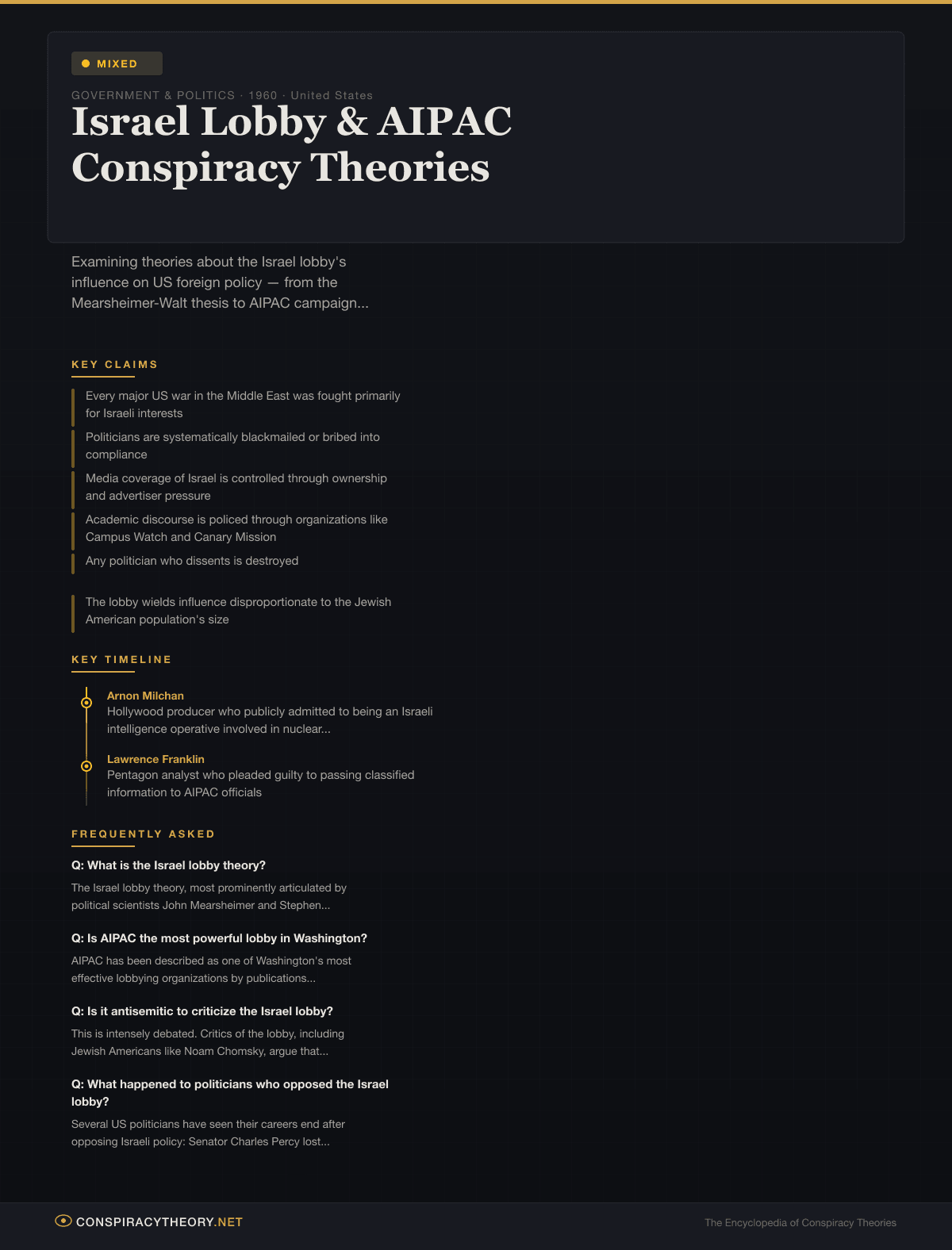
Israel Lobby & AIPAC Conspiracy Theories
Overview
Few topics in American political discourse are as contentious as the influence of the pro-Israel lobby on US foreign policy. The debate spans a spectrum from mainstream political science analysis — exemplified by John Mearsheimer and Stephen Walt’s 2007 book The Israel Lobby and U.S. Foreign Policy — to conspiratorial claims about shadowy Jewish control of the American government that recycle centuries-old antisemitic tropes.
The core policy question is legitimate and important: Does the pro-Israel lobby, led by AIPAC (the American Israel Public Affairs Committee), exert disproportionate influence on US Middle East policy in ways that may not serve American national interests? This question involves documented campaign spending, measurable policy outcomes, and the observable careers of politicians who have challenged the lobby. It is a question of political science, not conspiracy.
Where it enters conspiracy territory is when the analysis extends beyond documented lobbying activities to claims of comprehensive control — that the lobby dictates all US Middle East policy, that politicians are blackmailed into compliance, or that American foreign policy is fundamentally subordinated to Israeli interests. The truth, as with most complex political phenomena, involves multiple competing interests, genuine ideological alignment, strategic calculation, and yes, significant lobbying influence.
Origins & History
Early Pro-Israel Advocacy
American support for Israel predates AIPAC and draws from multiple sources:
- Christian Zionism: Evangelical Protestant theology supporting Jewish sovereignty in the Holy Land has deep roots in American religious culture, predating modern political Zionism
- Cold War alignment: Israel’s positioning as a Western-aligned democracy in the Middle East created genuine strategic interest
- Holocaust memory: The moral imperative of supporting Jewish self-determination after the Holocaust resonated broadly
- Domestic politics: Jewish Americans, while only 2% of the US population, have been disproportionately active in politics, media, academia, and philanthropy
AIPAC was founded in 1951 as the American Zionist Committee for Public Affairs, becoming AIPAC in 1959 under the leadership of Si Kenen. It grew from a modest operation into what Fortune magazine called the second-most powerful lobby in Washington (after the AARP) and what The Economist described as the most powerful lobby.
The Mearsheimer-Walt Thesis
In 2006, political scientists John Mearsheimer (University of Chicago) and Stephen Walt (Harvard) published a paper — later expanded into a 2007 book — titled The Israel Lobby and U.S. Foreign Policy. Their thesis:
- A loose coalition of organizations and individuals works to push US policy in a pro-Israel direction
- This lobby’s influence exceeds what would be expected based on the size of the Jewish American population
- US Middle East policy often serves Israeli interests at the expense of broader American interests
- The Iraq War was significantly influenced by pro-Israel neoconservatives
- Open debate about US-Israel policy is constrained by accusations of antisemitism directed at critics
The paper provoked immediate and intense controversy. Critics called it antisemitic; supporters called it a long-overdue analysis of a taboo subject. The academic credentials of the authors made it impossible to dismiss as fringe conspiracy theorizing.
Congressional Influence
The lobbying operation’s influence on Congress is extensively documented:
Campaign Spending: AIPAC itself does not make direct campaign contributions (as a 501(c)(4) organization), but it coordinates a network of pro-Israel PACs. In 2022, AIPAC launched a super PAC, United Democracy Project, which spent over $100 million in the 2024 election cycle — one of the largest super PAC expenditures in American political history.
Targeting Critics: The pattern of defeated Israel-critical politicians is documented:
- Senator Charles Percy (R-IL) — Lost his 1984 re-election after pro-Israel groups mobilized against him. AIPAC director Tom Dine reportedly said, “All the Jews in America, from coast to coast, gathered to oust Percy. And the American politicians — Loss of office.”
- Representative Paul Findley (R-IL) — Defeated in 1982 after opposing Israeli policy; wrote They Dare to Speak Out about the lobby’s power
- Representative Cynthia McKinney (D-GA) — Defeated in 2002 after criticizing Israeli policy
- Representative Jamaal Bowman (D-NY) — Defeated in 2024 primary after AIPAC’s super PAC spent $14.5 million supporting his opponent, the most expensive House primary in US history
- Representative Cori Bush (D-MO) — Defeated in 2024 primary with significant AIPAC super PAC spending
Legislative Success: AIPAC boasts a 98%+ success rate on legislation it supports. US aid to Israel — currently approximately $3.8 billion annually in military assistance, plus supplemental packages — has continued across administrations of both parties, making Israel the largest cumulative recipient of US foreign aid since World War II.
Key Claims
The “Control” Theory (Conspiratorial)
The most extreme version of the theory holds that the Israel lobby effectively controls US foreign policy:
- Every major US war in the Middle East was fought primarily for Israeli interests
- Politicians are systematically blackmailed or bribed into compliance
- Media coverage of Israel is controlled through ownership and advertiser pressure
- Academic discourse is policed through organizations like Campus Watch and Canary Mission
- Any politician who dissents is destroyed
This version is generally considered conspiratorial because it overstates the lobby’s power, ignores competing interests, and often relies on antisemitic frameworks.
The “Disproportionate Influence” Theory (Academic)
The more measured version, associated with Mearsheimer and Walt, argues:
- The lobby wields influence disproportionate to the Jewish American population’s size
- This influence distorts policy in ways that don’t always serve US interests
- The taboo on criticizing Israeli policy prevents healthy democratic debate
- But the lobby operates within normal democratic processes — it’s not a conspiracy, it’s effective politics
- Other factors (Christian Zionism, defense industry interests, genuine strategic alignment) also drive US-Israel relations
The Espionage Claims
Several documented espionage cases feed the conspiracy narrative:
- Jonathan Pollard (1985) — US Navy analyst convicted of spying for Israel; sentenced to life but released in 2015, moved to Israel in 2020
- AIPAC espionage case (2005) — Two AIPAC officials, Steve Rosen and Keith Weissman, were charged with passing classified information to Israel. Charges were eventually dropped due to concerns about classified information exposure at trial
- Arnon Milchan — Hollywood producer who publicly admitted to being an Israeli intelligence operative involved in nuclear technology procurement
- Lawrence Franklin — Pentagon analyst who pleaded guilty to passing classified information to AIPAC officials
The Media Influence Theory
Critics allege that pro-Israel perspectives dominate US media coverage:
- Major media owners and executives include prominent pro-Israel figures
- Coverage of the Israeli-Palestinian conflict consistently frames events from an Israeli perspective
- Journalists who write critically about Israel face professional consequences
- The term “antisemitism” is strategically deployed to silence criticism
- Social media platforms have been pressured to suppress pro-Palestinian content
Defenders counter that media coverage has become increasingly critical of Israel, particularly since 2023, and that claims of media “control” echo antisemitic conspiracy tropes.
Evidence
Documented Spending
AIPAC-affiliated campaign spending is a matter of public record:
- 2024 election cycle: AIPAC’s super PAC spent $100+ million
- Pro-Israel PACs contributed millions to candidates across both parties
- Spending successfully defeated multiple Israel-critical incumbents
- No other foreign policy lobby spends at comparable levels
Legislative Outcomes
The correlation between AIPAC positions and legislative outcomes is documented:
- Annual aid packages pass with overwhelming bipartisan support
- Anti-BDS legislation has been enacted in 35+ states
- Congressional resolutions supporting Israeli military operations pass near-unanimously
- Supplemental military aid packages during conflicts receive rapid approval
The Overton Window Effect
The observable boundaries of acceptable discourse on Israel in US politics:
- No major party presidential candidate has ever called for conditioning aid to Israel
- Congress members who criticize Israel face immediate, organized backlash
- The few exceptions (Bernie Sanders, Ilhan Omar, Rashida Tlaib) face sustained campaigns questioning their loyalty or motivations
- Think tanks that publish Israel-critical analysis face donor pressure
Debunking / Counterarguments
The Strategic Alliance Argument
Defenders of US-Israel relations argue the relationship serves genuine American interests:
- Israel provides significant intelligence sharing in the Middle East
- Israeli military technology benefits US defense capabilities
- Israel serves as a testing ground for US military equipment
- Democratic values alignment in a region dominated by authoritarian regimes
- Counterterrorism cooperation is extensive and bilateral
Other Lobbies Are Equally Powerful
Critics of the “Israel lobby” focus argue it’s singled out unfairly:
- The pharmaceutical lobby spends more on lobbying than AIPAC
- The defense industry lobby shapes foreign policy across the board
- Saudi Arabia and other Gulf states spend heavily on US influence operations
- Focusing on the Jewish lobby while ignoring others reflects selective attention
Christian Zionism Is the Bigger Factor
Some analysts argue that evangelical Christian support for Israel — involving tens of millions of voters — is more politically significant than AIPAC:
- Christians United for Israel (CUFI) claims 10+ million members
- Evangelical voters in key swing states create electoral incentives
- Religious conviction provides a non-lobbying explanation for policy alignment
- Republican support for Israel is driven more by the evangelical base than by AIPAC
The Antisemitism Problem
Many critics of the Israel lobby theory argue it relies on or feeds antisemitic tropes:
- Claims of hidden Jewish control parallel historic antisemitic conspiracy theories
- The “dual loyalty” accusation has been used against Jewish communities for centuries
- Singling out Jewish political participation as uniquely conspiratorial is discriminatory
- The theory can serve as a gateway to more extreme antisemitic beliefs
Cultural Impact
The Free Speech Debate
The Israel lobby debate has become central to free speech discussions:
- Anti-BDS laws requiring government contractors to pledge not to boycott Israel have been challenged as First Amendment violations
- Representative Ilhan Omar’s 2019 comment about AIPAC’s influence (“It’s all about the Benjamins”) was condemned by her own party leadership
- University campuses have become battlegrounds over pro-Palestinian speech and protest
- Social media moderation of Israel-Palestine content is intensely scrutinized
The Generational Shift
Public opinion on Israel, particularly among younger Americans, has shifted dramatically:
- Polls show declining support for unconditional US backing of Israel among millennials and Gen Z
- The 2023-2025 Gaza conflict accelerated this trend
- University protest movements demanding divestment from Israel have grown
- Jewish American opinion is itself divided, with organizations like Jewish Voice for Peace opposing unconditional US support
The 2023-2025 Transformation
The Gaza conflict beginning in October 2023 fundamentally transformed the discourse:
- Record AIPAC spending in 2024 elections drew unprecedented scrutiny
- Massive pro-Palestinian demonstrations occurred across Western cities
- The International Court of Justice considered genocide allegations against Israel
- US campus protests became a major political issue
- The traditional bipartisan consensus on Israel showed significant cracks for the first time
In Popular Culture
- Mearsheimer and Walt, The Israel Lobby and U.S. Foreign Policy (2007)
- Paul Findley, They Dare to Speak Out: People and Institutions Confront Israel’s Lobby (1985)
- Grant Smith, Big Israel: How Israel’s Lobby Moves America (2016)
- Al Jazeera investigative documentary, The Lobby (2018)
- Norman Finkelstein, The Holocaust Industry (2000)
- Noam Chomsky, The Fateful Triangle: The United States, Israel, and the Palestinians (1983)
Timeline
| Date | Event |
|---|---|
| 1951 | AIPAC predecessor founded |
| 1967 | Six-Day War deepens US-Israel alliance |
| 1973 | AIPAC’s influence grows during Yom Kippur War |
| 1982 | Paul Findley defeated; attributes loss to lobby |
| 1984 | Senator Charles Percy defeated |
| 1985 | Jonathan Pollard arrested for spying for Israel |
| 2003 | Iraq War; neoconservative influence debated |
| 2005 | AIPAC espionage case |
| 2006 | Mearsheimer-Walt paper published |
| 2007 | The Israel Lobby book published |
| 2019 | Ilhan Omar “Benjamins” controversy |
| 2022 | AIPAC launches super PAC |
| 2023 | Gaza conflict transforms discourse |
| 2024 | AIPAC spends $100M+ defeating Israel critics |
| 2025 | Iran conflict reignites debate about lobby influence |
Sources & Further Reading
- Mearsheimer, John J., and Stephen M. Walt. The Israel Lobby and U.S. Foreign Policy. Farrar, Straus and Giroux, 2007.
- Findley, Paul. They Dare to Speak Out. Lawrence Hill Books, 1985.
- Petras, James. The Power of Israel in the United States. Clarity Press, 2006.
- Smith, Grant F. Big Israel: How Israel’s Lobby Moves America. Institute for Research, 2016.
- Federal Election Commission filings, AIPAC-affiliated PACs.
- OpenSecrets.org, pro-Israel lobbying data.
- Chomsky, Noam. The Fateful Triangle. South End Press, 1983.
Related Theories
- Greater Israel Conspiracy — Theories about Israeli territorial expansion
- Iraq WMD Conspiracy — Neoconservative influence on the Iraq War
- 9/11 Inside Job — Theories connecting 9/11 to neoconservative agendas
- Gaddafi Assassination Conspiracy — Regime change and geopolitical motives
Frequently Asked Questions
What is the Israel lobby theory?
Is AIPAC the most powerful lobby in Washington?
Is it antisemitic to criticize the Israel lobby?
What happened to politicians who opposed the Israel lobby?
Infographic
Share this visual summary. Right-click to save.