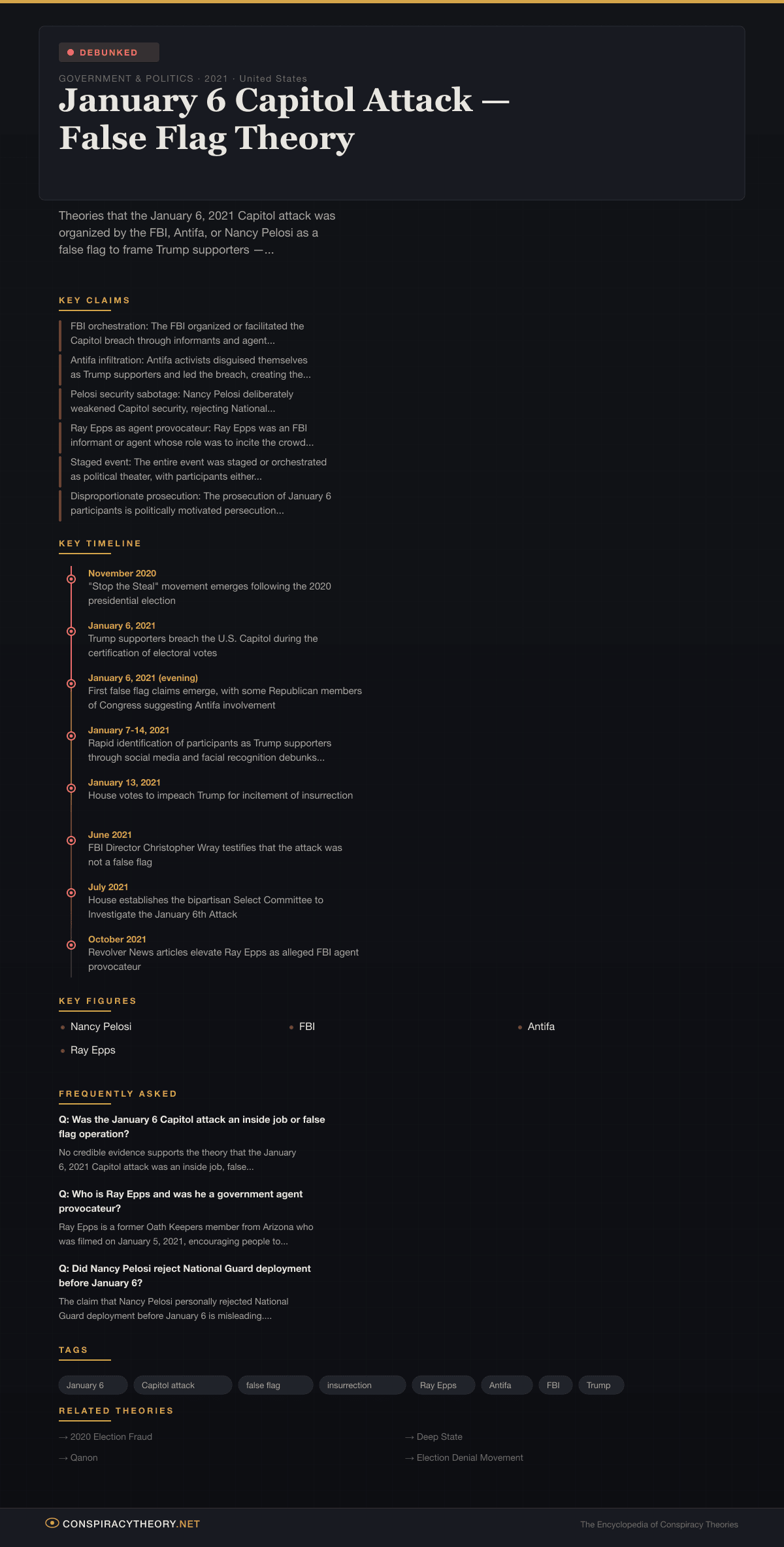
January 6 Capitol Attack — False Flag Theory

Overview
The false flag theory of the January 6, 2021 Capitol attack encompasses a range of claims alleging that the breach of the United States Capitol was not a genuine event driven by supporters of President Donald Trump but was instead orchestrated, facilitated, or staged by the FBI, Antifa (anti-fascist activists), House Speaker Nancy Pelosi, or other actors hostile to Trump, with the goal of discrediting Trump, his supporters, and the broader movement to challenge the results of the 2020 presidential election.
These theories emerged almost immediately as events unfolded on January 6 and evolved rapidly as new information — and new speculation — became available. Despite being contradicted by an overwhelming body of evidence including thousands of hours of video footage, the social media posts and text messages of the participants themselves, trial testimony from over a thousand defendants, the findings of the bipartisan January 6 Committee, and the investigative conclusions of the Department of Justice, the false flag narrative has maintained a significant following, particularly among Americans who believe the 2020 election was stolen and who view the prosecution of January 6 participants as politically motivated persecution.
The theory is classified as debunked because every version of the false flag narrative — FBI orchestration, Antifa infiltration, Pelosi security sabotage — has been investigated and contradicted by evidence. The participants in the Capitol breach have been extensively identified through their own social media accounts, cell phone data, video footage, and statements to law enforcement and the media. Their political affiliations, motivations, and identities as Trump supporters are documented not only by investigators but by the participants themselves, many of whom expressed pride in their actions in real-time social media posts and subsequent media interviews.
Origins & History
The false flag narrative began circulating within hours of the Capitol breach on January 6, 2021. As images of the attack spread through media and social media, some supporters of President Trump immediately began claiming that the attackers were not genuine Trump supporters but Antifa members disguised in MAGA clothing and accessories. This claim was amplified by several Republican members of Congress on the evening of January 6, even as the Capitol was still being secured.
The “Antifa did it” version of the theory was the first to gain traction but was also the first to be substantially debunked. Facial recognition technology, social media analysis, and old-fashioned investigative journalism rapidly identified the most prominent figures at the breach — including Jacob Chansley (the “QAnon Shaman”), Ashli Babbitt, and numerous others — as long-standing Trump supporters and far-right activists with extensive public records. No credible evidence of Antifa involvement was found by the FBI, the January 6 Committee, or any other investigative body.
The theory evolved as new focal points emerged. The case of Ray Epps became central to the narrative in late 2021 when the conservative news outlet Revolver News published a series of articles alleging that Epps was an FBI informant or agent provocateur. Epps had been filmed on the evening of January 5 urging people to “go into the Capitol” and was seen at the Capitol perimeter on January 6. His initial inclusion on the FBI’s most-wanted list for January 6, followed by his removal without charges, was cited as evidence that he was a protected government asset. Epps denied the allegation under oath, the FBI confirmed he was not an agent or informant, and he was ultimately charged with a misdemeanor in September 2023.
The “Pelosi did it” variant emerged primarily from claims that House Speaker Nancy Pelosi had deliberately weakened Capitol security to allow the breach to occur. Proponents alleged that Pelosi had rejected offers of National Guard support before January 6 and bore responsibility for the inadequate security response. This narrative gained political traction when House Republicans, after taking the majority in 2023, released selectively edited security footage and communications they alleged demonstrated Pelosi’s culpability.
Former President Trump himself promoted various versions of the false flag theory, describing January 6 participants as political prisoners and suggesting that the FBI had orchestrated the event. In his 2024 presidential campaign, Trump pledged to pardon January 6 defendants, whom he characterized as “hostages.”
Key Claims
- FBI orchestration: The FBI organized or facilitated the Capitol breach through informants and agent provocateurs embedded in the crowd, with the goal of creating a pretext for cracking down on Trump supporters and the broader populist movement
- Antifa infiltration: Antifa activists disguised themselves as Trump supporters and led the breach, creating the false impression that Trump supporters were responsible for the violence
- Pelosi security sabotage: Nancy Pelosi deliberately weakened Capitol security, rejecting National Guard deployments and leaving the Capitol vulnerable, to ensure the breach would succeed and provide justification for impeaching Trump
- Ray Epps as agent provocateur: Ray Epps was an FBI informant or agent whose role was to incite the crowd and lead them into the Capitol, and his lenient treatment proves his protected status
- Staged event: The entire event was staged or orchestrated as political theater, with participants either unknowingly manipulated or actively cooperating with the staging
- Disproportionate prosecution: The prosecution of January 6 participants is politically motivated persecution of political dissidents, not legitimate law enforcement, and the sentences imposed are excessive compared to those given for similar conduct by left-wing protesters
- Selective evidence: The January 6 Committee selectively presented evidence to support a predetermined narrative, suppressing exculpatory evidence and testimony that would undermine the insurrection characterization
Evidence
Evidence against the false flag theory:
The evidence establishing that the January 6 Capitol breach was carried out by genuine Trump supporters acting on their own political convictions is overwhelming and comes from multiple independent sources.
Over 1,200 individuals have been charged in connection with the Capitol breach. Their identities, political affiliations, and motivations have been established through their own social media accounts, text messages, emails, and communications — many of which were posted publicly on the day of the events. Defendants’ own statements, both in real-time social media posts and in subsequent trial testimony, consistently express support for Trump, belief that the election was stolen, and intent to prevent the certification of Biden’s electoral victory.
Video footage from multiple sources — security cameras, body cameras, media cameras, and the participants’ own devices — documents the events in extraordinary detail. This footage shows individuals wearing MAGA clothing and accessories, carrying Trump flags, and chanting pro-Trump slogans as they entered the Capitol.
The trials of the Proud Boys and Oath Keepers — the most serious prosecutions arising from January 6 — produced extensive evidence of advance planning, coordination, and intent. Former Proud Boys leader Enrique Tarrio and several associates were convicted of seditious conspiracy based on evidence including encrypted communications showing detailed planning for confrontation at the Capitol. Oath Keepers founder Stewart Rhodes was similarly convicted based on evidence of advance planning and coordination.
The bipartisan January 6 Committee (consisting of seven Democrats and two Republicans) conducted an 18-month investigation involving over 1,000 witness interviews and the review of hundreds of thousands of documents. The committee’s findings, published in an 845-page final report, documented in detail how the attack was planned, organized, and executed by Trump supporters motivated by the belief that the election had been stolen.
Evidence cited by false flag proponents:
Proponents of the FBI orchestration theory point to confirmed reporting that the FBI had informants within the Proud Boys and Oath Keepers organizations prior to January 6. This is factually correct — the FBI regularly maintains informants within domestic extremist organizations. However, the existence of informants does not establish that the FBI orchestrated the events; rather, it suggests the FBI was monitoring groups it had already identified as potential threats.
The delayed deployment of the National Guard is a documented fact. The Capitol Police Board’s request for National Guard assistance was not approved by the Pentagon for over three hours. However, multiple investigations have attributed this delay to bureaucratic caution and concerns about military-civilian optics at the Capitol, not to deliberate sabotage by Pelosi or anyone else.
Selectively edited security footage released by House Republicans in 2023 appeared to show some participants walking calmly through the Capitol, which proponents cited as evidence that the event was not violent. However, this footage represented a small fraction of the total, and the broader body of video evidence documents extensive violence, including assaults on police officers that resulted in injuries requiring hospitalization.
Debunking / Verification
This theory is debunked. Every major variant of the false flag narrative has been investigated and contradicted by evidence:
FBI orchestration: While the FBI did have informants within the Proud Boys and Oath Keepers, no evidence has been presented that these informants instigated or organized the Capitol breach. The defendants themselves, through their own communications and trial testimony, documented their motivations and planning. FBI Director Christopher Wray testified under oath that the FBI did not orchestrate January 6.
Antifa infiltration: No Antifa members have been identified among the January 6 defendants. The participants have been identified through extensive records as Trump supporters, many with long histories of far-right political activism documented on social media and in organizational memberships.
Pelosi security sabotage: The Speaker of the House does not have authority over Capitol Police or National Guard deployment. The delays in security response have been attributed to institutional failures and bureaucratic processes at the Department of Defense and Capitol Police Board, not to deliberate sabotage.
Ray Epps: Epps denied being an FBI agent under oath, the FBI confirmed he was not an informant, and he was ultimately charged and pleaded guilty to a misdemeanor. His relatively lenient treatment was consistent with his limited role (he entered the restricted Capitol grounds but not the building) and with plea agreements offered to hundreds of other defendants with comparable conduct.
The persistence of the false flag theory despite overwhelming contrary evidence reflects broader patterns in conspiracy thinking, in which disconfirming evidence is reinterpreted as further proof of the conspiracy’s scope and power. The theory serves an important psychological function for its adherents, allowing them to maintain support for Trump and sympathy for the January 6 participants without having to confront the implications of the attack on democratic institutions.
Cultural Impact
The January 6 false flag theories have had profound effects on American political life, contributing to the deepening polarization of the electorate and the erosion of shared factual frameworks between partisan communities.
The theories have become a defining feature of Republican politics. Former President Trump’s characterization of January 6 defendants as “hostages” and “political prisoners” reflects the false flag framework, and his pledge to pardon defendants became a central element of his 2024 presidential campaign. Multiple Republican members of Congress have promoted or amplified false flag claims, and the narrative has become a litmus test for Republican primary candidates.
The dispute over the characterization of January 6 has contributed to the broader epistemological crisis in American public life — the growing inability of citizens across the political spectrum to agree on basic facts about current events. Polls consistently show that significant majorities of Republicans believe the false flag narrative or some version of it, while overwhelming majorities of Democrats accept the findings of the January 6 Committee and the Department of Justice.
The theories have influenced legal proceedings. Defense attorneys for January 6 defendants have incorporated elements of the false flag narrative into their trial strategies, and some defendants have explicitly claimed they were victims of government entrapment. These arguments have been largely unsuccessful in court but have influenced public perception of the prosecutions.
The false flag narrative has also affected how future political protests and events are understood and responded to. Law enforcement agencies have acknowledged that the difficulty of distinguishing genuine security threats from conspiracy-theory-driven false flag claims complicates their threat assessment processes.
Timeline
- November 2020 — “Stop the Steal” movement emerges following the 2020 presidential election
- January 6, 2021 — Trump supporters breach the U.S. Capitol during the certification of electoral votes
- January 6, 2021 (evening) — First false flag claims emerge, with some Republican members of Congress suggesting Antifa involvement
- January 7-14, 2021 — Rapid identification of participants as Trump supporters through social media and facial recognition debunks Antifa claims
- January 13, 2021 — House votes to impeach Trump for incitement of insurrection
- June 2021 — FBI Director Christopher Wray testifies that the attack was not a false flag
- July 2021 — House establishes the bipartisan Select Committee to Investigate the January 6th Attack
- October 2021 — Revolver News articles elevate Ray Epps as alleged FBI agent provocateur
- 2021-2023 — Over 1,200 individuals charged; trials of Proud Boys and Oath Keepers produce extensive evidence of genuine planning and intent
- November 2022 — Oath Keepers founder Stewart Rhodes convicted of seditious conspiracy
- May 2023 — Proud Boys leader Enrique Tarrio convicted of seditious conspiracy
- September 2023 — Ray Epps charged with misdemeanor; testifies under oath he was not an FBI informant
- December 2022 — January 6 Committee releases 845-page final report
- January 2023 — House Republicans gain majority, begin releasing alternative January 6 footage
- 2024 — Trump campaigns on promise to pardon January 6 defendants
- January 2025 — Trump inaugurated; begins issuing pardons and commutations for January 6 defendants
Sources & Further Reading
- U.S. House Select Committee to Investigate the January 6th Attack on the United States Capitol. Final Report. Washington, D.C.: Government Publishing Office, December 2022.
- U.S. Senate Committee on Homeland Security and Governmental Affairs and Committee on Rules and Administration. “Examining the U.S. Capitol Attack: A Review of the Security, Planning, and Response Failures on January 6.” Joint report, June 2021.
- Department of Justice. January 6 prosecution data and case documents, available at justice.gov.
- Feuer, Alan, and Adam Goldman. “Among Those Who Stormed the Capitol on Jan. 6.” New York Times, January 2021 (ongoing investigation series).
- Dreisbach, Tom, and Meg Anderson. “Nearly 1 in 5 Defendants in Capitol Riot Cases Served in the Military.” NPR, January 21, 2021.
- Leonnig, Carol, and Philip Rucker. I Alone Can Fix It: Donald J. Trump’s Catastrophic Final Year. New York: Penguin Press, 2021.
- Cheney, Liz. Oath and Honor: A Memoir and a Warning. New York: Little, Brown, 2023.

Frequently Asked Questions
Was the January 6 Capitol attack an inside job or false flag operation?
Who is Ray Epps and was he a government agent provocateur?
Did Nancy Pelosi reject National Guard deployment before January 6?

Infographic
Share this visual summary. Right-click to save.