JFK Assassination Conspiracy Theories
Overview
The assassination of President John F. Kennedy on November 22, 1963, in Dallas, Texas, is arguably the most scrutinized and debated event in modern American history. While the official government investigation conducted by the Warren Commission concluded in 1964 that lone gunman Lee Harvey Oswald fired three shots from the sixth floor of the Texas School Book Depository, killing the president and wounding Texas Governor John Connally, a significant majority of Americans have consistently expressed doubt about this conclusion in polls spanning more than six decades.
The doubts surrounding the Kennedy assassination are fueled by a constellation of factors: the shocking murder of the accused assassin Lee Harvey Oswald by nightclub owner Jack Ruby just two days after the president’s death, the controversial “single-bullet theory” (derisively called the “magic bullet theory” by critics), contradictory witness testimony about the number and direction of gunshots, alleged connections between Oswald and U.S. intelligence agencies, and the documented hostility toward Kennedy from powerful institutional actors including the CIA, the Mafia, anti-Castro Cuban exiles, and elements within the military-industrial complex.
In 1979, the United States House Select Committee on Assassinations (HSCA) concluded, based on acoustic evidence that has since been disputed, that Kennedy was “probably assassinated as a result of a conspiracy” and that there were likely two gunmen. This finding from an official government body stands in direct contradiction to the Warren Commission’s lone-gunman conclusion, leaving the matter in a state of unresolved tension within the official record itself.
Origins & History
The Assassination
On November 22, 1963, President Kennedy’s motorcade traveled through Dealey Plaza in downtown Dallas. At approximately 12:30 p.m. Central Standard Time, shots rang out. Kennedy was struck in the upper back and head, suffering fatal injuries. Governor Connally, seated in front of the president, was also wounded. Kennedy was rushed to Parkland Memorial Hospital, where he was pronounced dead at 1:00 p.m.
Within 80 minutes of the shooting, Dallas police arrested Lee Harvey Oswald, a 24-year-old former Marine and defector to the Soviet Union who worked at the Texas School Book Depository overlooking the motorcade route. A Mannlicher-Carcano rifle was found on the sixth floor of the building. Oswald denied shooting anyone and proclaimed himself a “patsy” before television cameras — a statement that would become one of the most quoted phrases in conspiracy theory history.
The Oswald Murder and Immediate Aftermath
On November 24, 1963, while being transferred from the city jail to the county jail, Oswald was shot and killed on live national television by Jack Ruby, a Dallas nightclub owner with documented connections to organized crime figures. Ruby’s ability to access the heavily guarded police basement, and his apparent motivation (he claimed he wanted to spare Jacqueline Kennedy the ordeal of a trial), immediately provoked suspicion. The murder of the accused assassin before he could stand trial eliminated any possibility of a full public legal proceeding and created an evidentiary void that conspiracy theories have filled ever since.
The Warren Commission
President Lyndon B. Johnson established the President’s Commission on the Assassination of President Kennedy, commonly known as the Warren Commission after its chairman, Chief Justice Earl Warren, on November 29, 1963. After a ten-month investigation, the Commission published its 888-page report on September 24, 1964, concluding that Oswald acted alone and that Ruby acted alone in killing Oswald. The report found no evidence of a conspiracy, foreign or domestic.
The Warren Commission’s methodology and conclusions drew criticism almost immediately. Early critics such as attorney Mark Lane (author of Rush to Judgment, 1966), journalist Harold Weisberg, and philosopher Bertrand Russell challenged the Commission’s handling of evidence, its reliance on the FBI for investigative work (despite the FBI’s own potential culpability), and what they characterized as a predetermined conclusion designed to prevent public panic and international crisis.
The Garrison Investigation
In 1967, New Orleans District Attorney Jim Garrison launched the only criminal prosecution related to the Kennedy assassination, charging local businessman Clay Shaw with conspiracy to murder the president. Garrison alleged that Shaw, Oswald, and anti-Castro activist David Ferrie were part of a conspiracy linked to the CIA. Shaw was acquitted in 1969 after less than an hour of jury deliberation. Garrison’s case was widely criticized as unfounded, though some researchers have pointed to later-released CIA documents confirming Shaw’s associations with the agency.
The House Select Committee on Assassinations
In 1976, following the Church Committee revelations about CIA assassination plots against foreign leaders, the U.S. House of Representatives established the House Select Committee on Assassinations (HSCA) to reinvestigate the Kennedy and Martin Luther King Jr. assassinations. The HSCA’s final report in 1979 agreed with the Warren Commission that Oswald fired three shots from the Depository, two of which struck the president. However, based on acoustic analysis of a Dallas police dictabelt recording, the committee concluded that four shots were fired, that the fourth shot came from the grassy knoll, and that Kennedy was “probably assassinated as a result of a conspiracy.” The committee was unable to identify the other gunman or the scope of the conspiracy. The acoustic evidence was later challenged by a 1982 National Academy of Sciences panel, which concluded the sounds on the recording were not gunshots, though this counter-analysis has itself been disputed.
Key Claims
The CIA Theory
One of the most prominent conspiracy theories holds that elements within the Central Intelligence Agency orchestrated or facilitated Kennedy’s assassination. Proponents point to several factors:
Motive: Kennedy had a deeply adversarial relationship with the CIA following the disastrous Bay of Pigs invasion in April 1961. Kennedy reportedly told an aide he wanted to “splinter the CIA into a thousand pieces and scatter it to the winds.” He fired CIA Director Allen Dulles and Deputy Directors Charles Cabell and Richard Bissell. Kennedy also signed National Security Action Memorandum 263 in October 1963, which some researchers interpret as the beginning of a withdrawal from Vietnam — a policy reversal that would have conflicted with CIA interests.
Oswald’s Intelligence Connections: Oswald’s biography contains anomalies that suggest intelligence connections. His defection to the Soviet Union and return to the United States occurred with unusual ease. He associated with George de Mohrenschildt, a Russian emigre with documented CIA ties. Oswald’s activities in New Orleans in the summer of 1963 placed him in proximity to CIA-connected anti-Castro operations. Declassified documents have revealed that the CIA withheld information about its monitoring of Oswald from the Warren Commission.
Key Proponents: Researchers such as James Douglass (JFK and the Unspeakable), David Talbot (The Devil’s Chessboard), and former HSCA investigator Gaeton Fonzi (The Last Investigation) have advanced versions of the CIA theory.
The Mafia Theory
The organized crime theory posits that Mafia leaders ordered Kennedy’s assassination in retaliation for the aggressive anti-organized-crime campaign waged by Attorney General Robert F. Kennedy.
Motive: The Kennedy Justice Department had dramatically escalated federal prosecutions of organized crime. Mob leaders such as Carlos Marcello (New Orleans), Santo Trafficante Jr. (Tampa), and Sam Giancana (Chicago) were reportedly furious, particularly because they believed they had helped deliver the critical 1960 election to Kennedy through their political influence. Wiretaps captured Marcello and Trafficante making threatening statements about the president.
Jack Ruby’s Connections: Ruby’s ties to organized crime are well documented. The HSCA found that Ruby had significant associations with organized crime figures, undermining the Warren Commission’s characterization of him as an unconnected local eccentric. Critics argue that Ruby silenced Oswald to prevent him from revealing the conspiracy’s sponsors.
Key Proponents: Investigative reporters Dan Moldea (The Hoffa Wars), David Scheim (Contract on America), and HSCA chief counsel G. Robert Blakey have advocated versions of the Mafia theory. Blakey concluded that the mob, specifically Marcello and Trafficante, were behind the assassination.
The LBJ Theory
The theory that Vice President Lyndon B. Johnson was involved in or orchestrated the assassination is one of the more controversial claims.
Motive: Johnson had the most obvious political motive, ascending immediately to the presidency. Some researchers point to allegations that Kennedy planned to drop Johnson from the 1964 ticket amid the Bobby Baker scandal. Johnson biographer Robert Caro has documented the intense personal animosity between the Kennedys and Johnson, though Caro has not endorsed the conspiracy theory.
Claims: Proponents cite alleged statements by Johnson’s mistress Madeleine Duncan Brown, who claimed Johnson told her the night before the assassination that “those SOBs will never embarrass me again.” The reliability of Brown’s testimony is disputed. Other proponents point to Johnson’s role in shaping the Warren Commission and his selection of Allen Dulles — the CIA director Kennedy had fired — as a commissioner.
Key Proponents: Author Barr McClellan (Blood, Money & Power) and political operative Roger Stone (The Man Who Killed Kennedy: The Case Against LBJ) have promoted the Johnson theory.
The Cuban Connection
The Cuban connection theory exists in two variants:
Anti-Castro Cuban Exiles: Cuban exile groups, furious at Kennedy for the failed Bay of Pigs invasion and what they perceived as his betrayal of the anti-Castro cause, had both motive and operational capability. Many exiles were CIA-trained paramilitary operatives. Oswald’s contacts in New Orleans intersected with anti-Castro networks. The HSCA investigated anti-Castro groups extensively and found that certain individuals had “the motive, means, and opportunity” to assassinate the president.
Pro-Castro / Cuban Government: This theory suggests that Fidel Castro ordered the assassination, possibly in retaliation for the CIA’s multiple assassination attempts against him. Oswald’s visit to the Cuban and Soviet embassies in Mexico City in September 1963 fuels this theory. Former President Johnson himself reportedly believed Castro might have been involved. The CIA’s concealment of its anti-Castro assassination plots from the Warren Commission complicated investigation of this angle, as the agency could not reveal Castro’s potential motive without exposing its own illegal operations.
The Multiple Shooters / Grassy Knoll Theory
Perhaps the most widely held alternative theory is that more than one gunman fired at the motorcade. This is the theory most directly supported by the HSCA’s 1979 findings.
Witness Testimony: Numerous witnesses in Dealey Plaza reported hearing shots from the direction of a grassy knoll to the right front of the motorcade. Some witnesses reported seeing a puff of smoke or suspicious individuals in that area. Railroad workers on the triple overpass reported that shots appeared to come from behind the wooden fence on the knoll.
The Zapruder Film: The famous home movie filmed by Abraham Zapruder appears to show Kennedy’s head moving backward and to the left upon the fatal impact — a motion that critics argue is inconsistent with a shot from behind and above (the Depository) and more consistent with a shot from the right front (the grassy knoll). Defenders of the lone-gunman theory cite the “jet effect” and neuromuscular reaction to explain the head movement.
The Single-Bullet Theory: The Warren Commission’s conclusion that a single bullet caused seven wounds in both Kennedy and Connally (CE 399, the so-called “pristine bullet”) remains one of the most contested aspects of the official account. Critics argue the trajectory is implausible and the bullet impossibly undamaged. Defenders, including forensic experts who have participated in computer reconstructions, maintain the trajectory is geometrically sound given the men’s actual seating positions.
Evidence
Evidence Cited by Conspiracy Proponents
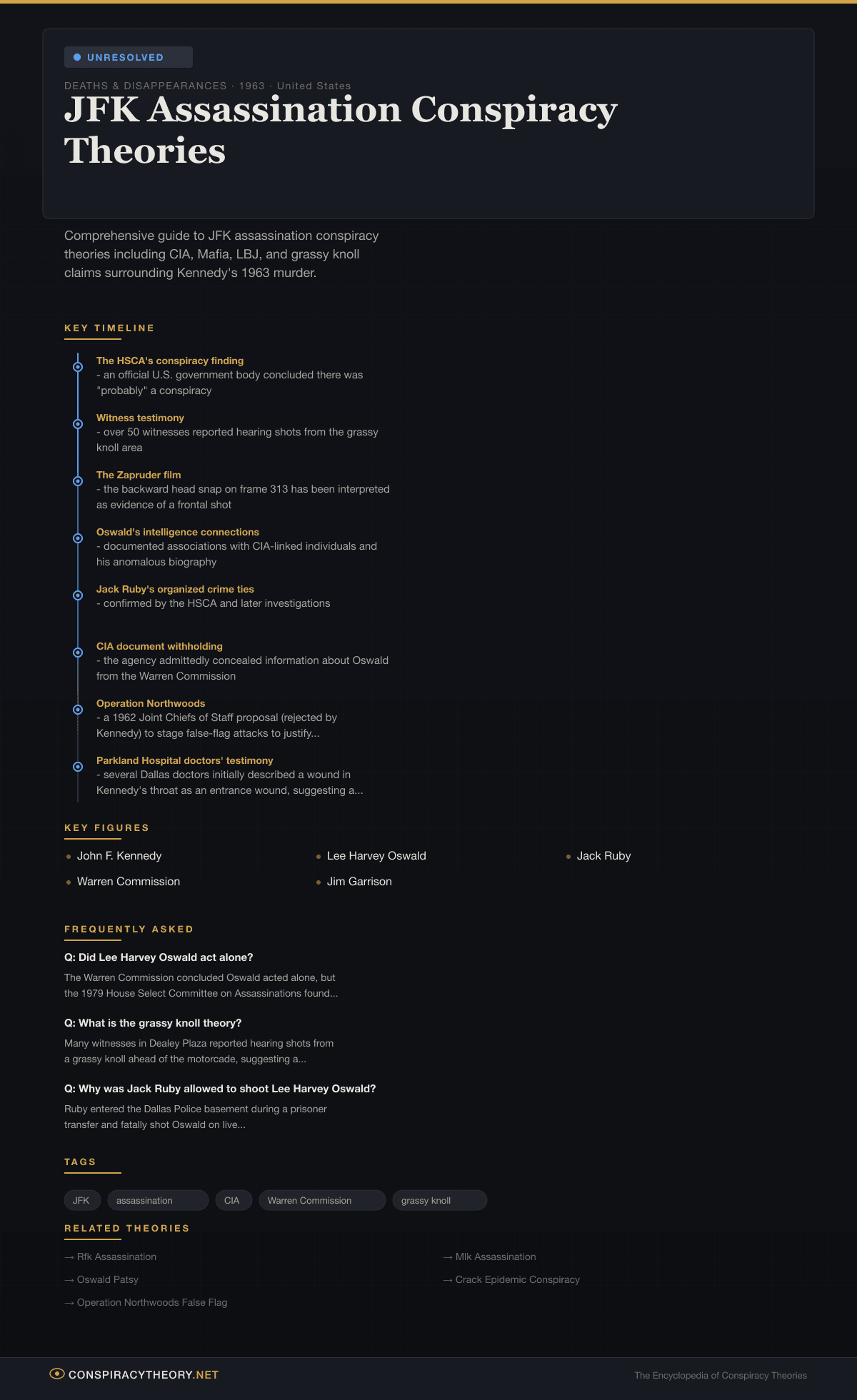
- The HSCA’s conspiracy finding — an official U.S. government body concluded there was “probably” a conspiracy
- Witness testimony — over 50 witnesses reported hearing shots from the grassy knoll area
- The Zapruder film — the backward head snap on frame 313 has been interpreted as evidence of a frontal shot
- Oswald’s intelligence connections — documented associations with CIA-linked individuals and his anomalous biography
- Jack Ruby’s organized crime ties — confirmed by the HSCA and later investigations
- CIA document withholding — the agency admittedly concealed information about Oswald from the Warren Commission
- Operation Northwoods — a 1962 Joint Chiefs of Staff proposal (rejected by Kennedy) to stage false-flag attacks to justify invading Cuba, demonstrating institutional willingness to consider extreme measures
- The “pristine bullet” (CE 399) — skepticism about the condition of the bullet alleged to have caused seven wounds
- Parkland Hospital doctors’ testimony — several Dallas doctors initially described a wound in Kennedy’s throat as an entrance wound, suggesting a shot from the front, though they later deferred to the autopsy findings
- Irregularities in the autopsy — the autopsy was performed at Bethesda Naval Hospital by pathologists inexperienced in gunshot wound cases, and some autopsy photographs and X-rays have been questioned
Evidence Supporting the Lone-Gunman Conclusion
- Physical evidence at the scene — three spent cartridges and a rifle traced to Oswald were found on the sixth floor of the Depository
- Ballistic evidence — bullet fragments recovered from the limousine and the governor’s wrist were matched to Oswald’s rifle to the exclusion of all other weapons
- Oswald’s movements — he was placed on the sixth floor around the time of the shooting and fled the building immediately after
- The Tippit murder — Oswald shot and killed Dallas Police Officer J.D. Tippit approximately 45 minutes after the assassination, demonstrating consciousness of guilt
- Forensic reconstructions — multiple modern forensic analyses, including Dale Myers’ computer animation and the work of failure analysis expert Luke Haag, have supported the single-bullet theory
- Acoustic evidence rebuttal — the National Academy of Sciences panel concluded the dictabelt sounds were not gunshots, undermining the HSCA’s primary basis for its conspiracy conclusion
- No credible second gunman — despite decades of investigation, no second shooter has ever been identified, and no physical evidence (bullets, shell casings) from a second weapon has been recovered from Dealey Plaza
- Oswald’s prior assassination attempt — in April 1963, Oswald attempted to assassinate retired Major General Edwin Walker with the same rifle, establishing a pattern of political violence
Cultural Impact
The Kennedy assassination and its attendant conspiracy theories have profoundly shaped American culture and political consciousness. The event is often cited as a turning point that ended a period of relative public trust in government institutions and ushered in an era of skepticism that intensified through the Vietnam War, Watergate, and subsequent scandals.
Impact on Government Transparency
Public pressure stemming from assassination conspiracy theories directly contributed to the passage of the President John F. Kennedy Assassination Records Collection Act of 1992, which established the Assassination Records Review Board (ARRB). The ARRB oversaw the release of millions of pages of previously classified documents from the CIA, FBI, Secret Service, and other agencies. While supporters of the official narrative argue that these releases have not revealed evidence of a conspiracy, researchers note that certain documents remain classified or heavily redacted, and that the releases have confirmed the CIA’s concealment of relevant information from the Warren Commission.
Influence on Media and Popular Culture
Oliver Stone’s 1991 film JFK, starring Kevin Costner as Jim Garrison, brought assassination conspiracy theories to a mass audience and is widely credited with catalyzing the passage of the 1992 JFK Records Act. The film’s dramatic portrayal of a vast government conspiracy became a cultural touchstone, despite significant criticism from historians regarding its factual liberties.
The assassination has been the subject of hundreds of books, dozens of documentaries, and numerous fictional works. Notable nonfiction includes Gerald Posner’s Case Closed (1993), which defends the lone-gunman theory, and James Douglass’ JFK and the Unspeakable (2008), which argues for a CIA-driven conspiracy rooted in Kennedy’s turn toward peace during the Cold War. Don DeLillo’s novel Libra (1988) and Stephen King’s 11/22/63 (2011) are among the most acclaimed fictional treatments.
The “Conspiracy Theory” Label
The JFK assassination played a central role in popularizing the term “conspiracy theory” as a pejorative label. A 1967 CIA dispatch (Document 1035-960), declassified in 1976, instructed CIA media assets to use the term “conspiracy theorists” to discredit critics of the Warren Commission. While debate exists about the extent of the CIA’s success in weaponizing the term, the document’s existence has itself become an important data point in discussions about institutional suppression of dissent.
Polling and Public Opinion
Gallup polls have consistently shown that a majority of Americans believe the assassination involved a conspiracy. The percentage peaked at 81% in 1976 following the Church Committee revelations and remained at 61% as recently as 2013, on the 50th anniversary. Even at its lowest recent measurement, more Americans believed in a conspiracy than accepted the lone-gunman conclusion, making the JFK assassination one of the rare cases where the “conspiracy theory” position represents the mainstream public view.
Timeline
- November 22, 1963 — President Kennedy is assassinated in Dealey Plaza, Dallas, Texas. Lee Harvey Oswald is arrested and charged.
- November 24, 1963 — Jack Ruby shoots and kills Oswald during a live televised prisoner transfer.
- November 29, 1963 — President Johnson establishes the Warren Commission.
- September 24, 1964 — The Warren Commission releases its report, concluding Oswald acted alone.
- 1966-1967 — First wave of critical books published, including Mark Lane’s Rush to Judgment and Josiah Thompson’s Six Seconds in Dallas.
- 1967 — CIA dispatch 1035-960 instructs media assets to counter “conspiracy theorists” critical of the Warren Report. New Orleans DA Jim Garrison opens his investigation.
- March 1969 — Clay Shaw is acquitted of conspiracy charges brought by Garrison.
- 1975 — The Zapruder film is shown on national television for the first time on ABC’s Good Night America. The Church Committee reveals CIA assassination plots against foreign leaders.
- 1976-1979 — The House Select Committee on Assassinations reinvestigates the Kennedy assassination.
- January 1979 — The HSCA releases its final report concluding Kennedy was “probably assassinated as a result of a conspiracy.”
- 1982 — A National Academy of Sciences panel disputes the HSCA’s acoustic evidence.
- 1991 — Oliver Stone’s film JFK reignites public interest and political pressure for document release.
- 1992 — Congress passes the President John F. Kennedy Assassination Records Collection Act, mandating release of assassination-related documents.
- 1994-1998 — The Assassination Records Review Board oversees the declassification of millions of pages of documents.
- October 2017 — President Trump orders the release of remaining JFK files, though agencies withhold some documents on national security grounds.
- December 2022 — President Biden orders the release of additional documents, with nearly 98% of the collection now publicly available.
- 2023 — The 60th anniversary of the assassination prompts renewed media coverage and continued calls for full document release.
- January 2025 — President Trump signs executive order directing full declassification of all remaining JFK, RFK, and MLK assassination records
- March 18, 2025 — National Archives releases over 77,000 pages of previously classified JFK files, including CIA operational records
- April 2025 — Additional 704 pages released; FBI transfers remaining records to National Archives
- January 30, 2026 — Final batch of 11,022 pages released
Latest Developments (2025–2026)
Trump Orders Full Declassification
On January 23, 2025, President Trump signed an executive order directing the complete declassification of all remaining records related to the assassinations of President John F. Kennedy, Senator Robert F. Kennedy, and Reverend Dr. Martin Luther King Jr. The order required all agencies to transfer their records to the National Archives within 15 days.
The March 2025 Release
On March 18, 2025, the National Archives released over 77,000 pages of previously classified documents, the most significant single release in the collection’s history. The FBI delivered its remaining JFK records in February 2025, with additional transfers between March and June 2025. All released documents are available online and at the National Archives in College Park, Maryland.
What the Files Reveal
According to historians who have reviewed the documents, the releases provide “enhanced clarity” on covert CIA operations during the Cold War era, including:
- Previously redacted details about CIA efforts to influence foreign elections, sabotage economies, and overthrow governments
- New information about CIA operational activities in the period surrounding the assassination
- Additional documentation of the agency’s concealment of information from the Warren Commission
However, the more than 77,000 pages released do not appear to contradict the Warren Commission’s central conclusion that Lee Harvey Oswald acted alone. No “smoking gun” document pointing to an organized conspiracy has emerged from the releases.
Ongoing Significance
The full declassification represents the end of a 60-year fight for government transparency that began with the assassination itself. While conspiracy proponents had hoped the final files would contain definitive evidence of a broader plot, the releases have instead provided a more detailed picture of the intelligence community’s operations and institutional failures during the Cold War. The confirmed pattern of CIA concealment from the Warren Commission continues to fuel legitimate questions about what the agency knew and when.
Sources & Further Reading
Official Government Reports
- Report of the President’s Commission on the Assassination of President Kennedy (Warren Commission Report), 1964.
- Report of the Select Committee on Assassinations of the U.S. House of Representatives, 1979.
- Final Report of the Assassination Records Review Board, 1998.
Books Arguing for Conspiracy
- Douglass, James W. JFK and the Unspeakable: Why He Died and Why It Matters. Maryknoll, NY: Orbis Books, 2008.
- Fonzi, Gaeton. The Last Investigation: What Insiders Know about the Assassination of JFK. New York: Thunder’s Mouth Press, 1993.
- Lane, Mark. Rush to Judgment: A Critique of the Warren Commission’s Inquiry. New York: Holt, Rinehart & Winston, 1966.
- Talbot, David. The Devil’s Chessboard: Allen Dulles, the CIA, and the Rise of America’s Secret Government. New York: Harper, 2015.
- Marrs, Jim. Crossfire: The Plot That Killed Kennedy. New York: Carroll & Graf, 1989.
Books Arguing Against Conspiracy
- Bugliosi, Vincent. Reclaiming History: The Assassination of President John F. Kennedy. New York: W.W. Norton, 2007.
- Posner, Gerald. Case Closed: Lee Harvey Oswald and the Assassination of JFK. New York: Random House, 1993.
- McAdams, John. JFK Assassination Logic: How to Think about Claims of Conspiracy. Washington, D.C.: Potomac Books, 2011.
Primary Source Collections
- Mary Ferrell Foundation (maryferrell.org) — the largest online archive of JFK assassination documents.
- National Archives JFK Assassination Records Collection (archives.gov/research/jfk).
Documentaries
- JFK: What the Doctors Saw (Paramount+, 2023).
- JFK Revisited: Through the Looking Glass (dir. Oliver Stone, 2021).
- JFK: The Smoking Gun (Reelz, 2013).
- The Men Who Killed Kennedy (History Channel, 1988-2003).
Related Theories
- RFK Assassination — Robert F. Kennedy was assassinated in 1968 under similarly disputed circumstances.
- MLK Assassination — Martin Luther King Jr.’s 1968 assassination has also been the subject of conspiracy allegations, including a 1999 civil trial verdict finding government conspiracy.
- Oswald as Patsy — The specific theory that Oswald was set up as a fall guy by intelligence agencies.
- CIA Drug Trafficking — Alleged CIA involvement in narcotics trafficking, linked to the same covert operations networks implicated in JFK theories.
- Operation Northwoods — A confirmed 1962 proposal for false-flag operations that demonstrates the institutional mindset of the era.

Watch: Documentaries & Videos
Related documentaries available on YouTube.
Evidence of Revision
Frequently Asked Questions
Did Lee Harvey Oswald act alone?
What is the grassy knoll theory?
Why was Jack Ruby allowed to shoot Lee Harvey Oswald?
Infographic
Share this visual summary. Right-click to save.