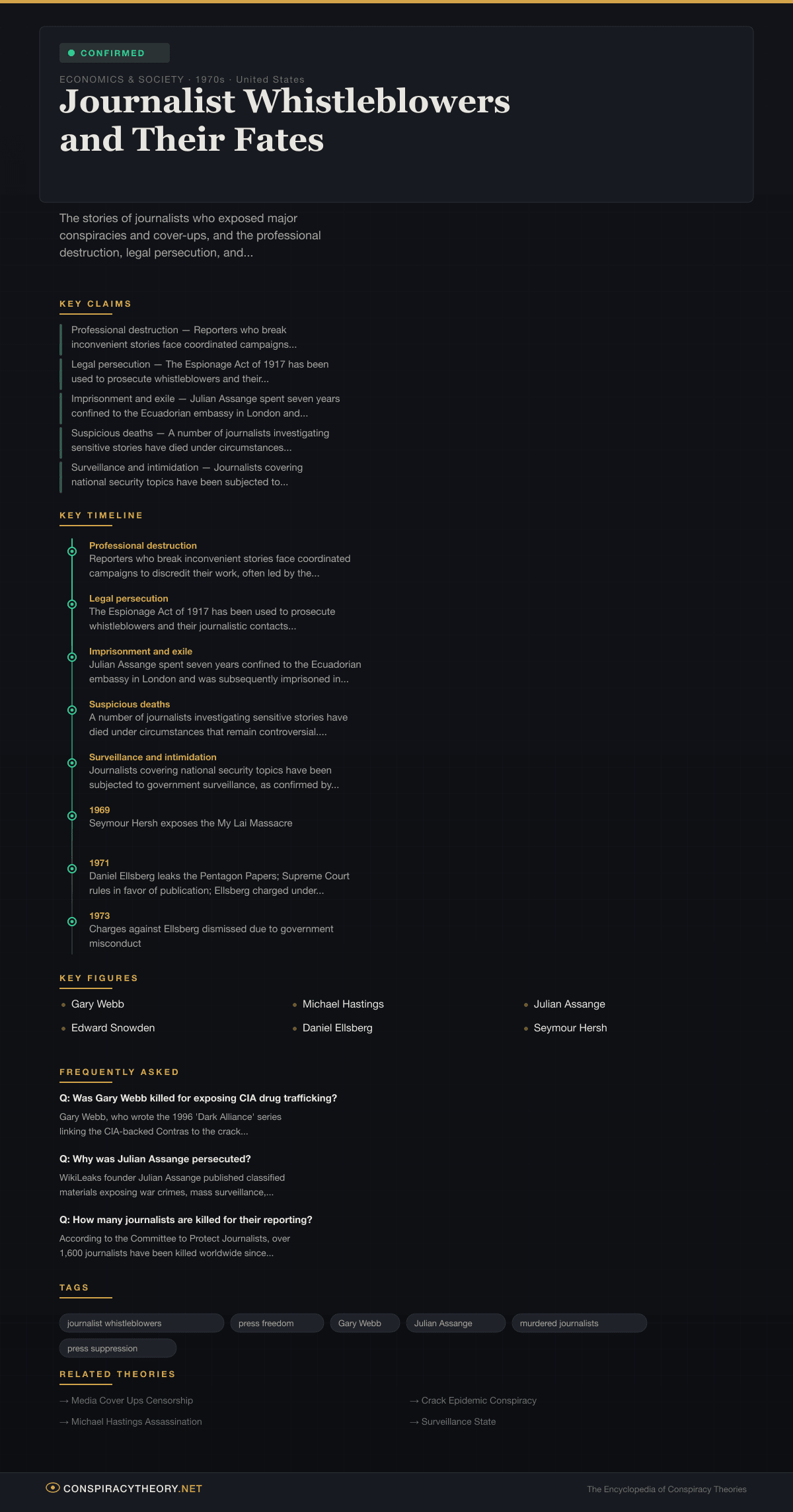
Journalist Whistleblowers and Their Fates

Overview
Across the modern history of investigative journalism, a recurring pattern has emerged: reporters and whistleblowers who expose government misconduct, corporate malfeasance, or institutional corruption face severe consequences. These consequences range from professional destruction — blacklisting, firings, and career-ending retaliation — to legal persecution under espionage and secrecy statutes, and in some cases, suspicious or violent deaths. The pattern is not speculative. It is documented across decades, countries, and institutions, supported by congressional records, court filings, declassified intelligence documents, and the public record of what happened to the individuals involved.
This entry is classified as confirmed because the core phenomenon — that journalists and whistleblowers who expose powerful institutions face organized retaliation — is established by extensive documentary evidence. Individual cases vary in their specifics. Some involve proven government programs of suppression (such as COINTELPRO’s targeting of journalists). Others involve professional retaliation that, while not orchestrated by a single conspiracy, follows a consistent institutional pattern. A smaller number involve deaths under circumstances that remain disputed or unresolved.
The subject intersects with press freedom, national security law, intelligence operations, and the broader question of whether democratic societies tolerate the exposure of their own misconduct. Organizations including the Committee to Protect Journalists, Reporters Without Borders, and the Freedom of the Press Foundation track these cases systematically, providing an empirical foundation for what might otherwise be dismissed as paranoia.
Origins & History
The Pentagon Papers and the Modern Template (1971)
The modern era of journalist-whistleblower persecution arguably begins with Daniel Ellsberg’s leak of the Pentagon Papers in 1971. Ellsberg, a RAND Corporation military analyst, copied 7,000 pages of classified documents revealing that the U.S. government had systematically lied to the public about the Vietnam War — its scope, its prospects, and the rationale for escalation. The documents showed that four successive presidential administrations had privately concluded the war was likely unwinnable while publicly claiming progress.
Ellsberg provided the documents to The New York Times, which began publishing them on June 13, 1971. The Nixon administration obtained a federal injunction to halt publication — the first instance of prior restraint against a newspaper in American history. The case went to the Supreme Court, which ruled 6-3 in New York Times Co. v. United States that the government had not met the burden required to justify prior restraint.
Ellsberg was charged under the Espionage Act of 1917, facing up to 115 years in prison. The charges were dismissed in 1973 after it was revealed that the Nixon administration had engaged in illegal actions against him, including burglarizing his psychiatrist’s office and wiretapping his phone. The unit that carried out the break-in — the “White House Plumbers” — later conducted the Watergate burglary. Ellsberg’s case established a precedent that would echo for decades: the government’s primary tool for punishing disclosures of embarrassing information would be the Espionage Act, a statute originally designed to prosecute spies, not journalists or sources.
Seymour Hersh and the Exposure Tradition (1969-Present)
Investigative journalist Seymour Hersh exemplifies both the power and the cost of adversarial reporting. In 1969, Hersh broke the story of the My Lai Massacre, in which U.S. soldiers killed between 347 and 504 unarmed Vietnamese civilians. The story, which the Army had covered up for over a year, earned Hersh the Pulitzer Prize and fundamentally altered public perception of the Vietnam War.
Hersh went on to expose CIA domestic spying operations (the “Family Jewels” revelations of 1974-1975, which led to the Church Committee investigations), aspects of the U.S. bombing campaign in Cambodia, the Abu Ghraib prisoner abuse scandal in 2004, and numerous other stories that powerful institutions preferred to keep hidden. Throughout his career, Hersh faced sustained efforts to discredit his reporting, including public attacks by government officials and attempts to pressure editors against publishing his work. He was not killed or imprisoned, but his later career illustrates another form of retaliation: marginalization. As his reporting challenged increasingly powerful consensus narratives, major publications became less willing to run his work, pushing him toward smaller outlets and self-publication.
COINTELPRO and Documented Government Targeting of Press (1956-1971)
The FBI’s Counter Intelligence Program (COINTELPRO), which operated from 1956 to 1971, included documented efforts to surveil, discredit, and neutralize journalists who reported critically on the Bureau or its targets. Declassified FBI files reveal that the Bureau maintained files on journalists, attempted to plant negative stories about reporters it considered hostile, and used media contacts to shape coverage favorable to the Bureau’s interests.
While COINTELPRO primarily targeted civil rights organizations, anti-war groups, and political dissidents, its operations against journalists established that the U.S. government had both the willingness and the institutional infrastructure to suppress press freedom when it conflicted with institutional interests.
Key Claims
The overarching claim is that journalists and whistleblowers who expose misconduct by powerful institutions face a predictable spectrum of retaliation:
- Professional destruction — Reporters who break inconvenient stories face coordinated campaigns to discredit their work, often led by the same mainstream outlets that failed to report the story themselves. Gary Webb, who exposed CIA-Contra drug connections, was attacked by The Washington Post, The New York Times, and The Los Angeles Times, and lost his career despite his core findings being vindicated by the CIA Inspector General.
- Legal persecution — The Espionage Act of 1917 has been used to prosecute whistleblowers and their journalistic contacts with increasing frequency. More individuals were charged under the Espionage Act during the Obama administration (2009-2017) than under all previous administrations combined.
- Imprisonment and exile — Julian Assange spent seven years confined to the Ecuadorian embassy in London and was subsequently imprisoned in HMP Belmarsh. Edward Snowden has lived in exile in Russia since 2013. Chelsea Manning served seven years in military prison.
- Suspicious deaths — A number of journalists investigating sensitive stories have died under circumstances that remain controversial. While some cases have prosaic explanations, the pattern has drawn attention from press freedom organizations.
- Surveillance and intimidation — Journalists covering national security topics have been subjected to government surveillance, as confirmed by the Snowden disclosures and by the Associated Press phone records scandal of 2013, in which the Department of Justice secretly obtained two months of phone records for AP reporters and editors.
Evidence
Gary Webb (1955-2004)
Gary Webb’s case is the most extensively documented example of professional destruction following investigative reporting on intelligence community misconduct. His 1996 “Dark Alliance” series in the San Jose Mercury News traced connections between CIA-backed Nicaraguan Contras and the crack cocaine epidemic in American cities. The series provoked a coordinated backlash from major newspapers. The Mercury News retracted elements of the series under pressure, and Webb was demoted and eventually resigned.
In 1998, CIA Inspector General Frederick Hitz released reports that confirmed the CIA had maintained relationships with Contra drug traffickers, had not reported their activities to law enforcement, and had obtained a secret agreement with the Department of Justice exempting it from drug-trafficking reporting requirements. Webb’s core reporting was vindicated, but his career had already been destroyed.
Webb died on December 10, 2004, from two gunshot wounds to the head, ruled a suicide by the Sacramento County Coroner. While two-shot suicides are rare, they are medically documented. Webb had been struggling financially and personally in the years following his professional destruction.
Michael Hastings (1980-2013)
Journalist Michael Hastings, best known for his 2010 Rolling Stone profile of General Stanley McChrystal that led to McChrystal’s resignation, died in a single-car crash in Los Angeles on June 18, 2013. Hastings’ Mercedes struck a tree at high speed and burst into flames in the Hancock Park neighborhood.
In the hours before his death, Hastings had sent an email to colleagues stating he was working on a “big story” and needed to “go off the radar for a bit.” He also told a neighbor he believed his car had been tampered with. Former U.S. National Coordinator for Security Richard Clarke stated publicly that Hastings’ crash was “consistent with a car cyber attack,” though he added that this did not prove one had occurred. The LAPD investigation concluded there was no evidence of foul play, and the coroner’s report indicated Hastings had traces of amphetamine and marijuana in his system.
The case remains unresolved in public discourse. No evidence of an assassination has been established, but the combination of Hastings’ adversarial national security reporting, his stated concerns about surveillance, and the unusual circumstances of the crash have sustained questions.
Julian Assange and WikiLeaks (2006-Present)
WikiLeaks, founded by Julian Assange in 2006, published millions of classified documents including the “Collateral Murder” video showing a U.S. Apache helicopter killing civilians and Reuters journalists in Baghdad (2010), the Afghan War Logs, the Iraq War Logs, and over 250,000 U.S. diplomatic cables. The publications exposed civilian casualties that had been concealed, diplomatic double-dealing, and surveillance programs.
Assange was charged by the United States under the Espionage Act — the first time a publisher had been indicted under the statute for publishing classified information. He spent seven years (2012-2019) in the Ecuadorian embassy in London to avoid extradition to Sweden on sexual assault allegations (which he denied, and which were eventually dropped). In 2019, Ecuador revoked his asylum, and he was arrested by British police and held at HMP Belmarsh, a maximum-security prison.
In June 2024, Assange reached a plea agreement with the U.S. Department of Justice, pleading guilty to a single count of conspiracy to obtain and disclose national defense information. He was sentenced to time served and released. Press freedom organizations including Reporters Without Borders, the Committee to Protect Journalists, and the American Civil Liberties Union had opposed his prosecution, arguing it set a precedent that could criminalize standard journalistic practices — receiving and publishing classified information that serves the public interest.
Edward Snowden (1983-Present)
Edward Snowden, a former NSA contractor, disclosed thousands of classified documents to journalists Glenn Greenwald, Laura Poitras, and Barton Gellman in 2013. The documents revealed the existence of mass surveillance programs including PRISM (which collected data from major internet companies), XKeyscore (a system for searching virtually all internet activity), and the bulk collection of telephone metadata from millions of Americans under Section 215 of the Patriot Act.
Snowden was charged under the Espionage Act and has lived in Russia since 2013, having been granted permanent residency. The disclosures led to the USA FREEDOM Act of 2015, which curtailed some surveillance practices, and to a federal court ruling that the bulk metadata collection program was illegal. A report by the Privacy and Civil Liberties Oversight Board found that the phone metadata program had not been essential in preventing any terrorist attacks.
Daphne Caruana Galizia (1964-2017)
Maltese investigative journalist Daphne Caruana Galizia was killed by a car bomb on October 16, 2017. She had been investigating corruption among Maltese political leaders, including connections revealed by the Panama Papers leak. Her reporting linked senior government officials to offshore financial structures and alleged money laundering.
Three men were convicted of carrying out the assassination. Businessman Yorgen Fenech was convicted of commissioning the murder in 2023. A public inquiry concluded that the Maltese state bore responsibility for creating a “culture of impunity” that made the assassination possible. Caruana Galizia’s case is internationally recognized as one of the clearest examples of a journalist being murdered for investigative reporting within the European Union.
Jamal Khashoggi (1958-2018)
Saudi journalist and Washington Post columnist Jamal Khashoggi was murdered inside the Saudi consulate in Istanbul on October 2, 2018. Turkish intelligence obtained audio recordings of the killing, which was carried out by a team of Saudi operatives. A U.S. intelligence assessment concluded that Saudi Crown Prince Mohammed bin Salman had approved the operation.
Khashoggi had been writing critically about the Saudi government and its war in Yemen. His murder demonstrated that even journalists operating under the protection of prominent Western publications could be targeted by state actors, and it exposed the limits of international accountability when strategic alliances are at stake.
Anna Politkovskaya (1958-2006)
Russian investigative journalist Anna Politkovskaya, a reporter for Novaya Gazeta, was shot dead in the elevator of her Moscow apartment building on October 7, 2006 — Vladimir Putin’s birthday. She had spent years documenting human rights abuses by Russian forces in Chechnya, including extrajudicial killings, torture, and kidnappings.
Five men were eventually convicted in connection with her murder, but the question of who ordered the killing has never been officially resolved. The European Court of Human Rights found that Russia had failed to adequately investigate the murder. Politkovskaya’s case is one of numerous killings of journalists in Russia — the Committee to Protect Journalists has documented dozens of confirmed murders of journalists in Russia since 1992.
Debunking / Verification
This entry’s confirmed status applies to the overarching pattern, not to every specific conspiracy theory about individual journalists’ deaths. The following elements are confirmed by documentary evidence:
- Government retaliation against whistleblowers is systematic. The use of the Espionage Act against sources and publishers is documented in court records. The escalation under the Obama and Trump administrations is a matter of public record.
- Professional destruction of journalists is documented. Gary Webb’s case, in which his vindicated reporting was attacked by major newspapers, is thoroughly documented. Similar patterns affected other reporters including James Risen, who was threatened with jail for refusing to reveal a source.
- State-sponsored killing of journalists occurs. The murders of Caruana Galizia, Khashoggi, and Politkovskaya are established facts, with convictions and government inquiries confirming state involvement or complicity.
- Government surveillance of journalists is confirmed. The Snowden disclosures, the AP phone records seizure, and the James Rosen case (in which the DOJ named a Fox News reporter as a criminal co-conspirator to obtain a warrant for his records) are documented.
What remains unresolved or disputed:
- Whether Gary Webb’s death was suicide or homicide. The coroner’s ruling of suicide has not been overturned, and the physical evidence is consistent with the ruling, despite its unusual features.
- Whether Michael Hastings’ crash was an accident or an assassination. No evidence of tampering has been established.
- The full scope of intelligence community efforts to manipulate media. While COINTELPRO and Operation Mockingbird demonstrate historical willingness, the extent of current operations is unknown.
Cultural Impact
The fates of journalist whistleblowers have had a measurable chilling effect on investigative reporting, particularly in the national security space. A 2015 survey by the Pew Research Center found that investigative journalists covering national security reported significant changes in their practices after the Snowden disclosures, including increased use of encryption, reluctance to contact sources by phone, and in some cases, decisions not to pursue certain stories.
The Assange case generated a global debate about whether publishing classified information constitutes journalism or espionage. Press freedom organizations warned that the Espionage Act prosecution set a precedent that could be applied to any journalist who publishes leaked government documents — a standard practice in investigative journalism. The case exposed a fault line between national security establishments, which view unauthorized disclosures as threats, and press freedom advocates, who view them as essential democratic accountability.
Gary Webb’s story has become a parable about institutional power and media complicity. The fact that his reporting was attacked by the same newspapers that had ignored the Kerry Committee’s findings years earlier raised uncomfortable questions about whether major media outlets function as checks on power or as participants in its maintenance. The 2014 film Kill the Messenger, starring Jeremy Renner, brought Webb’s story to a broader audience.
The murders of Caruana Galizia and Khashoggi prompted international reform efforts. The European Parliament established the Daphne Caruana Galizia Prize for Journalism. The Khashoggi killing led to sanctions against Saudi officials and intensified scrutiny of arms sales to Saudi Arabia, though it did not fundamentally alter the U.S.-Saudi relationship.
Snowden’s disclosures reshaped the global technology industry. Major companies adopted end-to-end encryption, in part due to the reputational damage of being associated with government surveillance programs. The disclosures also informed public debate about the balance between security and privacy, contributing to legal reforms in the United States and European Union.
Key Figures
- Daniel Ellsberg (1931-2023) — Former military analyst who leaked the Pentagon Papers in 1971, revealing systematic government deception about the Vietnam War. Charged under the Espionage Act; charges dismissed due to government misconduct.
- Seymour Hersh (1937-present) — Investigative journalist who exposed the My Lai Massacre (1969), CIA domestic spying (1974), and Abu Ghraib abuse (2004). Pulitzer Prize winner; marginalized from mainstream publications in later career.
- Gary Webb (1955-2004) — Investigative reporter whose “Dark Alliance” series exposed CIA-Contra drug connections. Professionally destroyed by media backlash; died from two gunshot wounds to the head, ruled suicide.
- Anna Politkovskaya (1958-2006) — Russian journalist who documented human rights abuses in Chechnya. Shot dead in her Moscow apartment building.
- Jamal Khashoggi (1958-2018) — Saudi journalist and Washington Post columnist murdered by Saudi operatives inside the Istanbul consulate.
- Daphne Caruana Galizia (1964-2017) — Maltese investigative journalist killed by car bomb while investigating political corruption linked to the Panama Papers.
- Michael Hastings (1980-2013) — Journalist whose Rolling Stone profile ended General McChrystal’s career. Died in a high-speed car crash under disputed circumstances.
- Julian Assange (1971-present) — WikiLeaks founder who published classified materials exposing war crimes and surveillance. Charged under the Espionage Act; spent years in embassy confinement and prison before a 2024 plea deal.
- Edward Snowden (1983-present) — Former NSA contractor who disclosed mass surveillance programs. Charged under the Espionage Act; living in exile in Russia.
- Chelsea Manning (1987-present) — U.S. Army intelligence analyst who provided classified materials to WikiLeaks. Served seven years in military prison; sentence commuted by President Obama.
Timeline
- 1969 — Seymour Hersh exposes the My Lai Massacre
- 1971 — Daniel Ellsberg leaks the Pentagon Papers; Supreme Court rules in favor of publication; Ellsberg charged under the Espionage Act
- 1973 — Charges against Ellsberg dismissed due to government misconduct
- 1974-1975 — Hersh reveals CIA domestic spying; Church Committee investigations follow
- 1996 — Gary Webb publishes “Dark Alliance” series on CIA-Contra drug connections
- 1996-1997 — Major newspapers attack Webb’s reporting; San Jose Mercury News retracts elements of the series
- 1998 — CIA Inspector General reports substantially vindicate Webb’s core findings
- 2004 — Gary Webb dies; death ruled suicide. Hersh exposes Abu Ghraib prisoner abuse
- 2006 — Anna Politkovskaya murdered in Moscow. WikiLeaks founded by Julian Assange
- 2010 — WikiLeaks publishes “Collateral Murder” video, Afghan War Logs, Iraq War Logs, and diplomatic cables. Chelsea Manning arrested
- 2012 — Julian Assange enters the Ecuadorian embassy in London
- 2013 — Edward Snowden discloses NSA mass surveillance programs. Michael Hastings dies in car crash. DOJ seizes Associated Press phone records
- 2015 — USA FREEDOM Act curtails some NSA surveillance authorities
- 2017 — Daphne Caruana Galizia killed by car bomb in Malta
- 2018 — Jamal Khashoggi murdered in Saudi consulate in Istanbul
- 2019 — Assange arrested at Ecuadorian embassy; held at HMP Belmarsh
- 2023 — Daniel Ellsberg dies. Yorgen Fenech convicted of commissioning Caruana Galizia’s murder
- 2024 — Julian Assange released after plea deal with U.S. Department of Justice
Sources & Further Reading
- Ellsberg, Daniel. Secrets: A Memoir of Vietnam and the Pentagon Papers. Viking, 2002
- Webb, Gary. Dark Alliance: The CIA, the Contras, and the Cocaine Explosion. Seven Stories Press, 1998
- Schou, Nick. Kill the Messenger: How the CIA’s Crack-Cocaine Controversy Destroyed Journalist Gary Webb. Nation Books, 2006
- Greenwald, Glenn. No Place to Hide: Edward Snowden, the NSA, and the U.S. Surveillance State. Metropolitan Books, 2014
- Harding, Luke. The Snowden Files: The Inside Story of the World’s Most Wanted Man. Vintage Books, 2014
- Politkovskaya, Anna. A Russian Diary: A Journalist’s Final Account of Life, Corruption, and Death in Putin’s Russia. Random House, 2007
- Caruana Galizia Foundation. Public Inquiry into the Assassination of Daphne Caruana Galizia. 2021
- Committee to Protect Journalists. Global Impunity Index. Published annually at cpj.org
- Reporters Without Borders. World Press Freedom Index. Published annually at rsf.org
- Hersh, Seymour. Reporter: A Memoir. Knopf, 2018
- Satter, David. The Less You Know, the Better You Sleep: Russia’s Road to Terror and Dictatorship under Yeltsin and Putin. Yale University Press, 2016
- Leigh, David, and Luke Harding. WikiLeaks: Inside Julian Assange’s War on Secrecy. PublicAffairs, 2011
Related Theories
- CIA Drug Trafficking — Gary Webb’s “Dark Alliance” series and the retaliation he faced
- Media Cover-Ups and Censorship — Institutional media complicity in suppressing inconvenient reporting
- Michael Hastings Assassination — The disputed circumstances of Hastings’ death
- Surveillance State — The mass surveillance apparatus exposed by Snowden and others

Frequently Asked Questions
Was Gary Webb killed for exposing CIA drug trafficking?
Why was Julian Assange persecuted?
How many journalists are killed for their reporting?

Infographic
Share this visual summary. Right-click to save.