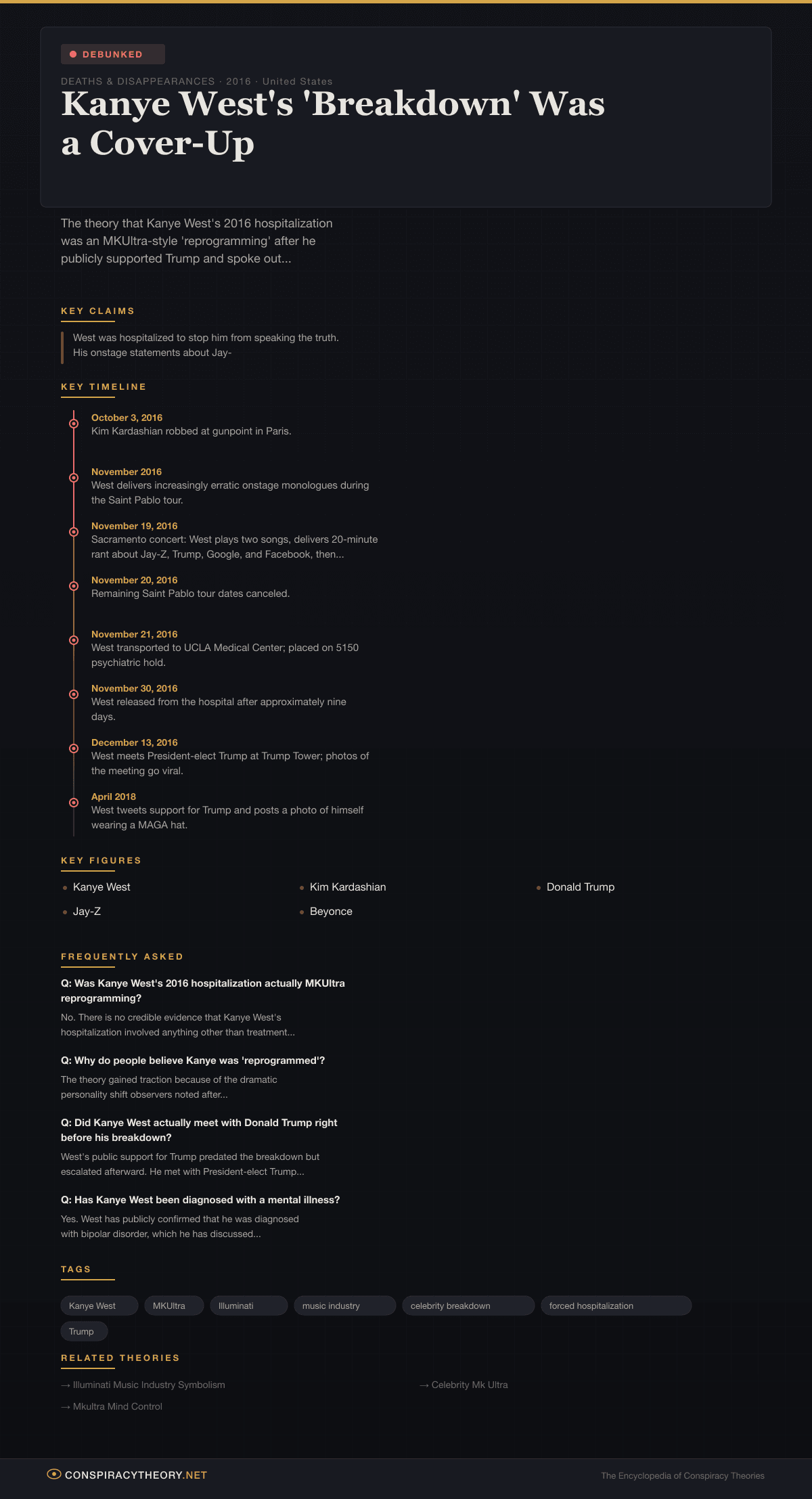
Kanye West's 'Breakdown' Was a Cover-Up
Overview
On the night of November 19, 2016, Kanye West took the stage at the Golden 1 Center in Sacramento for his Saint Pablo tour and did something that, in retrospect, looked less like a concert and more like a controlled detonation. He played two and a half songs, then stopped the music and launched into a rambling, agitated monologue that covered, among other things: his belief that Jay-Z had sent people to kill him, his support for Donald Trump, his criticism of Beyonce’s ego, his accusation that Google and Facebook were liars, and his declaration that he would have voted for Trump had he bothered to vote. After approximately 20 minutes, he dropped the microphone and walked off stage. The remaining 17 dates of the Saint Pablo tour were canceled.
Two days later, on November 21, paramedics arrived at the home of West’s personal trainer in Los Angeles and transported him, handcuffed to a stretcher, to the psychiatric unit at UCLA Medical Center. He was placed on a 5150 psychiatric hold — a 72-hour involuntary commitment for individuals deemed a danger to themselves or others — and remained hospitalized for approximately nine days.
Within hours, the internet had a theory: Kanye West had been “taken out” — subjected to an MKUltra-style reprogramming operation by shadowy forces (the Illuminati, the music industry, the government, or some combination thereof) as punishment for speaking the truth about industry control and for supporting Donald Trump. The theory proposed that his erratic behavior was not mental illness but a response to breaking free from his programming, and that his hospitalization was not treatment but a reset — a forcible return to the approved script.
The theory is not supported by credible evidence. What it is supported by is a deep and not entirely unreasonable cultural skepticism about the music industry’s treatment of Black artists, a history of actual government programs that used psychiatric institutions for political purposes, and the undeniable fact that Kanye West’s public persona underwent significant changes after the hospitalization.
Origins & History
The Buildup: 2016 and the Unraveling
To understand why the MKUltra theory resonated, you need to understand the Kanye West of late 2016 — a man who appeared to be coming apart in public, in ways that felt too dramatic to be merely personal.
West had been under extraordinary strain for months. His wife, Kim Kardashian, had been robbed at gunpoint in Paris on October 3, an event that West described as deeply traumatic. His Life of Pablo album, released in February 2016, had been accompanied by erratic public behavior, including a stream of tweets that veered between self-aggrandizement, grievance, and vulnerability. His Yeezy fashion line was financially troubled. His relationships with Jay-Z and Beyonce — the most powerful couple in the music industry — had visibly deteriorated.
The Sacramento rant, while shocking to the general public, was the culmination of a pattern. West had been delivering increasingly unhinged onstage monologues throughout the Saint Pablo tour, covering topics from his frustrations with the music industry to his views on race and politics. The Sacramento appearance was simply the one where the trajectory reached its terminus.
The rant included statements that became central to the conspiracy narrative:
“Jay-Z, call me, bruh. You still ain’t called me. Jay-Z, I know you got killers. Please don’t send them at my head.”
“I didn’t vote… but if I voted, I would have voted for Trump.”
“Google lied to you. Facebook lied to you. Radio lied to you.”
For conspiracy theorists, these statements were not the ramblings of a man in mental health crisis — they were revelations. West was naming his controllers (Jay-Z, the tech companies, the media) and aligning himself with an outsider political figure (Trump). The hospitalization, in this reading, was the punishment.
The MKUltra Framework
The theory that Kanye was “MKUltra’d” draws on a well-established conspiracy framework in which the music industry — and the entertainment industry more broadly — is controlled by a shadowy cabal that programs artists to serve its agenda. This framework has roots in the documented reality of Project MKUltra, the CIA’s actual Cold War-era program of mind control experimentation using LSD, hypnosis, sensory deprivation, and other techniques.
The leap from documented MKUltra (which ended in 1973 and targeted intelligence assets, not pop stars) to modern celebrity mind control is enormous and unsupported by evidence. But the theory’s appeal is not difficult to understand. The music industry does exert enormous control over artists’ images, output, and public personas. Record contracts are famously exploitative. Artists who deviate from industry expectations — who say the wrong things, align with the wrong politics, or simply become unmanageable — do face professional consequences that can look, from the outside, like punishment.
The Illuminati music industry conspiracy theory had been circulating for years before West’s breakdown, applied to everyone from Rihanna to Lady Gaga. These theories typically point to music video imagery — pyramids, all-seeing eyes, occult symbolism — as evidence of Illuminati control, and interpret artists’ public struggles as evidence of either programming failure or deliberate punishment.
West’s case fit the template almost too perfectly: a powerful artist who had been making increasingly transgressive statements was suddenly hospitalized against his will and emerged changed.
The Dave Chappelle Parallel
Conspiracy theorists frequently cite comedian Dave Chappelle’s abrupt departure from Chappelle’s Show in 2005 as a parallel case. Chappelle walked away from a $50 million Comedy Central contract and traveled to South Africa, prompting widespread speculation about his mental health. Chappelle later explained that he left because he felt the show was being produced in ways he was uncomfortable with and that industry pressures were affecting his wellbeing.
Chappelle himself has spoken about the entertainment industry’s pattern of labeling Black men who resist industry control as “crazy” — a pattern with deep historical roots in American psychiatry’s weaponization against Black people, from the diagnosis of “drapetomania” (a supposed mental illness causing enslaved people to flee) to the disproportionate commitment of Black men to psychiatric institutions during the civil rights era.
This history gives the Kanye MKUltra theory a context that is more substantive than its surface-level claims might suggest. The theory may be wrong about the mechanism (there is no evidence of literal mind control programming), but it touches on something real: the entertainment industry’s power to define deviance, and America’s history of using psychiatric diagnoses to pathologize Black resistance.
Key Claims
-
West was hospitalized to stop him from speaking the truth. His onstage statements about Jay-Z, the media, and Trump were revelations that threatened powerful interests, and the hospitalization was a silencing operation.
-
MKUltra-style programming is used on celebrities. The theory proposes that the CIA’s mind control techniques were never discontinued but were adopted by the entertainment industry to create compliant, controllable artists.
-
West’s personality change proves reprogramming. The contrast between the defiant, politically outspoken West of November 2016 and the more subdued West of early 2017 is cited as evidence that his mental processes were altered.
-
The handcuffs on the stretcher were unusual. The image of West being strapped down during his transfer to the hospital is cited as evidence of a forced operation rather than standard medical procedure.
-
Jay-Z and the industry orchestrated the intervention. West’s explicit statements about Jay-Z “having killers” and not calling him are interpreted as evidence that Jay-Z was part of the operation to bring West to heel.
Debunking
Bipolar Disorder and the Sacramento Rant
The most straightforward explanation for West’s behavior in November 2016 is the one he has confirmed himself: he has bipolar disorder. The condition, which affects approximately 2.8% of the U.S. adult population, features alternating episodes of mania and depression. Manic episodes are characterized by elevated mood, decreased need for sleep, racing thoughts, grandiosity, increased goal-directed activity, and impulsive behavior — a description that maps closely onto West’s public behavior in the weeks before his hospitalization.
Sleep deprivation, which West has acknowledged experiencing during this period, both triggers and exacerbates manic episodes. The Saint Pablo tour was a grueling schedule of performances, and West’s behavior escalated progressively throughout it. The Sacramento rant — with its racing, tangential speech, grandiose claims, and paranoid ideation (Jay-Z sending killers) — is textbook presentation of a manic episode with psychotic features.
The 5150 psychiatric hold is a standard California legal mechanism for involuntary commitment of individuals who present an imminent danger to themselves or others. It requires evaluation by a qualified mental health professional. The procedure — including physical restraint during transport — is standard medical practice for patients who are agitated or at risk of self-harm, not evidence of a covert operation.
The Personality “Change”
The argument that West emerged from hospitalization as a fundamentally different person — evidence of reprogramming — does not hold up to scrutiny. In the years following his hospitalization, West:
- Continued to publicly support Donald Trump, including a widely covered visit to the Oval Office in October 2018 where he delivered another rambling monologue while wearing a MAGA hat
- Released the album Ye in 2018 with the cover text “I hate being Bi-Polar its awesome,” publicly acknowledging his diagnosis
- Ran for president in 2020 in a campaign widely viewed as another manic episode
- Made increasingly extreme public statements on topics from slavery to antisemitism
- Was dropped by multiple corporate partners in 2022 after making antisemitic remarks
This is not the trajectory of a man who was successfully reprogrammed into compliance. If anything, West became more erratic and more transgressive after his hospitalization, not less. The theory requires ignoring the vast majority of West’s post-2016 public behavior.
The Industry Control Question
The weakest and the strongest parts of the Kanye MKUltra theory are the same: the music industry does, in fact, exert enormous control over artists’ lives. Record contracts can be exploitative. Artists can face career consequences for political statements or personal behavior that conflicts with their brand. The industry’s power to shape public narratives about artists — including narratives about mental health — is real.
But the gap between “the music industry is a controlling and sometimes exploitative business” and “the music industry uses CIA mind control techniques to program artists” is a canyon. The first is a documented feature of capitalism applied to creative work. The second is a claim for which there is no evidence.
Cultural Impact
The Kanye MKUltra theory has become one of the most recognizable examples of celebrity conspiracy theories and is frequently referenced in discussions about the intersection of mental health, race, and the entertainment industry. It has contributed to a broader cultural conversation about several important topics:
Mental health stigma. The theory implicitly rejects the legitimacy of psychiatric diagnosis, reframing mental illness as either a cover story for external forces or a response to speaking truth to power. This framing, while wrong about the specific mechanism, reflects real and valid concerns about the over-pathologization of Black men and the historical weaponization of psychiatry against marginalized communities.
Celebrity autonomy. The theory raises questions — which do not require conspiracy answers — about the degree to which celebrities control their own narratives, the industry’s power to define what constitutes acceptable behavior, and the consequences for artists who deviate from expectations.
The Trump alignment. West’s support for Trump was genuinely transgressive in the context of Black celebrity culture. His willingness to break from the liberal political consensus expected of successful Black artists was one of the reasons the conspiracy theory resonated — it provided an explanation for behavior that many of his fans found inexplicable other than mental illness.
The theory remains widely discussed on social media, in hip-hop forums, and in the broader conspiracy theory community. It has become a template applied to other celebrities whose public behavior has changed dramatically, reinforcing the celebrity MKUltra framework as a general-purpose explanation for any famous person’s erratic behavior or apparent personality shift.
Timeline
- October 3, 2016 — Kim Kardashian robbed at gunpoint in Paris.
- November 2016 — West delivers increasingly erratic onstage monologues during the Saint Pablo tour.
- November 19, 2016 — Sacramento concert: West plays two songs, delivers 20-minute rant about Jay-Z, Trump, Google, and Facebook, then leaves the stage.
- November 20, 2016 — Remaining Saint Pablo tour dates canceled.
- November 21, 2016 — West transported to UCLA Medical Center; placed on 5150 psychiatric hold.
- November 30, 2016 — West released from the hospital after approximately nine days.
- December 13, 2016 — West meets President-elect Trump at Trump Tower; photos of the meeting go viral.
- April 2018 — West tweets support for Trump and posts a photo of himself wearing a MAGA hat.
- June 2018 — Album Ye released with cover referencing his bipolar diagnosis.
- October 2018 — West visits Trump in the Oval Office, delivers rambling monologue on live television.
- July 2020 — West announces presidential campaign; holds erratic rally in South Carolina.
- October 2022 — West makes antisemitic statements; dropped by Adidas, Gap, and other corporate partners.
- 2023-2024 — West continues to make controversial public statements, undermining the “reprogrammed into compliance” theory.
Sources & Further Reading
- Carmichael, Rodney. “Kanye West, Mental Health, and the Dangers of Celebrity Diagnosis.” NPR Music, 2018
- Petridis, Alexis. “Kanye West: Why His Breakdown May Have Been the Most Important Musical Event of 2016.” The Guardian, 2016
- Caramanica, Jon. “The Kanye West Saga Shows How the Internet Has Changed Celebrity Mental Health.” New York Times, 2018
- Marks, Craig. “Kanye West’s Sacramento Rant: A Transcript.” Billboard, November 2016
- Latson, Jennifer. “The Racist Roots of ‘Drapetomania’ — And What the History of Mental Health Can Teach Us.” Time, 2015
- West, Kanye. Various public interviews and social media statements, 2016-2024
- National Institute of Mental Health. “Bipolar Disorder.” NIH publication, updated 2023
Related Theories
- MKUltra — the documented CIA mind control program that the theory references
- Illuminati Music Industry — the broader theory of occult control over the entertainment industry
- Celebrity MKUltra — the general framework of celebrity mind control applied to various artists
- Dave Chappelle Africa Theory — a parallel theory about a celebrity’s retreat being evidence of industry punishment

Frequently Asked Questions
Was Kanye West's 2016 hospitalization actually MKUltra reprogramming?
Why do people believe Kanye was 'reprogrammed'?
Did Kanye West actually meet with Donald Trump right before his breakdown?
Has Kanye West been diagnosed with a mental illness?

Infographic
Share this visual summary. Right-click to save.