Karen Read Trial Conspiracy
Overview
On the morning of January 29, 2022, Boston Police Officer John O’Keefe was found face-down in the snow outside 34 Fairview Road in Canton, Massachusetts, a quiet suburb south of Boston. His body was battered. He was hypothermic. He was dying. Within hours, he was dead.
His girlfriend, Karen Read, a financial analyst with no criminal history, was eventually charged with second-degree murder. The prosecution’s theory was straightforward enough: Read, intoxicated after a night of bar-hopping, struck O’Keefe with her black Lexus SUV as she dropped him off at the house, then drove away, leaving him to freeze to death in a nor’easter. Case closed.
Except nothing about this case has been closed. Not even close.
The defense mounted what may be the most explosive counter-narrative in a modern American murder trial: that O’Keefe never made it to the lawn by way of a moving vehicle. That he walked into that house — the home of fellow Boston police officer Brian Albert — and was beaten to death inside. That Karen Read was framed by a web of cops, friends, and family members who constructed an elaborate cover story to protect their own. That the injuries on O’Keefe’s body tell the story of a fight and a dog attack, not a car accident. That evidence was planted. That phones were wiped. That the lead investigator was so personally invested in destroying Karen Read that he texted colleagues about it in terms that would make a frat boy blush.
The first trial ended in a mistrial in July 2024 after the jury could not reach a unanimous verdict. Jurors later came forward to say they had voted unanimously to acquit on murder — it was lesser charges that tripped them up. Outside the courthouse, hundreds of supporters waved “Free Karen Read” signs. Cable news went wall to wall. Social media turned the case into a cause.
This isn’t a conspiracy theory built on conjecture and YouTube videos. It’s a conspiracy theory built on cell phone records, Google search histories, suspicious dog rehomings, texting cops, wiped phones, and a broken taillight that might be the most contested piece of automotive debris in American legal history. Whether Karen Read killed John O’Keefe or was framed for it, something deeply wrong happened at 34 Fairview Road — and the official investigation has done more to deepen the mystery than resolve it.
The Night of January 28–29, 2022
To understand the Karen Read case, you have to reconstruct the evening hour by hour, because the timeline is where the whole thing starts to fall apart.
John O’Keefe and Karen Read had been dating for about two years. On the evening of January 28, 2022, they went out drinking. The couple visited several bars in the Canton area, including the Waterfall Bar & Grille, a local spot popular with the law enforcement crowd. By most accounts, both had been drinking heavily. At some point in the evening, they learned of an after-party at the home of Brian Albert, a Boston police officer who lived at 34 Fairview Road in Canton.
Here’s where the two competing narratives diverge into parallel universes.
The Prosecution’s Version
According to prosecutors, Read drove O’Keefe to the Albert residence sometime around 12:30 AM. O’Keefe got out of the car. Read, drunk and angry after an argument, reversed her Lexus SUV and struck O’Keefe, leaving him in the snow. She then drove home. O’Keefe lay in the yard through a brutal January night, temperatures dropping well below freezing, accumulating injuries from both the impact and the cold. His body was discovered the next morning around 6:00 AM by Read herself, along with Jennifer McCabe (a friend of the Albert family) and Kerry Roberts (another friend).
The Defense’s Version
The defense tells a radically different story. In this version, Read dropped O’Keefe at the house and drove away — without hitting him. O’Keefe walked inside and joined the party. At some point during the night, an altercation broke out. O’Keefe was beaten — possibly by multiple people. Brian Albert’s German Shepherd may have attacked him. His body was then carried outside and deposited on the lawn to stage the scene. Read, who had been calling and texting O’Keefe all night with no response, returned in the morning worried sick. She found him in the snow and thought she might have hit him. In her panic and guilt, she provided investigators with the very narrative they would use against her.
The defense argues that a network of people at the party — police officers, their families, their friends — then conspired to frame Read, planting evidence and manipulating the investigation to ensure she took the fall.
The House at 34 Fairview Road
The guest list at 34 Fairview Road on the night of January 28 reads like a law enforcement reunion. The homeowner, Brian Albert, was a Boston police officer. His brother, Kevin Albert, also had ties to law enforcement. Among the attendees was Brian Higgins, a federal agent with the Bureau of Alcohol, Tobacco, Firearms and Explosives (ATF). Other guests included friends and family of the Albert clan, many with connections to Boston-area law enforcement.
This detail is not incidental. It is foundational to the conspiracy theory. If John O’Keefe was killed inside that house, the people who would have witnessed it — or participated in it — were precisely the people with the training, connections, and institutional power to construct an alternative narrative and make it stick.
Brian Albert’s nephew, Colin Albert, was a teenager at the time. The defense has alleged that Colin Albert was involved in a physical confrontation with O’Keefe inside the house. The nature and extent of that confrontation remains disputed, but the defense has pointed to social media activity and witness statements suggesting Colin had a hostile encounter with O’Keefe that night.
What is not disputed is what Brian Albert did with his dog.
The Dog
Brian Albert owned a large German Shepherd. Shortly after John O’Keefe’s death, Albert got rid of the dog — rehoming it to another family. The defense seized on this fact like a prosecutorial gift from heaven.
John O’Keefe’s body bore scratches and lacerations that the prosecution attributed to being struck by a vehicle and dragged or rolled across pavement and ice. The defense brought in forensic experts who testified that the injuries were more consistent with animal scratches and bites — specifically, the kind of wounds inflicted by a large, aggressive dog.
If O’Keefe was attacked by the Albert family’s German Shepherd inside the house, the dog becomes a witness of sorts — a piece of living evidence linking O’Keefe’s injuries to the interior of 34 Fairview Road rather than to the undercarriage of Karen Read’s Lexus. Getting rid of the dog, in the defense’s telling, was not a coincidence. It was evidence destruction.
The prosecution argued the rehoming was unrelated. But the timing was, at minimum, unfortunate optics for the Albert family. You don’t usually give away the family dog in the immediate aftermath of a fatal incident on your property unless that dog is somehow part of a story you’d rather not tell.
”Hos Long to Die in Cold”
If the Karen Read case has a single most damning piece of evidence against the cover-up narrative’s targets, it might be a Google search.
Jennifer McCabe was a close friend of the Albert family. She was one of the people who helped “discover” O’Keefe’s body in the snow on the morning of January 29. According to phone records introduced at trial, McCabe’s phone showed a search query — “hos long to die in cold” (the typo preserved from the original) — timestamped at 2:27 AM on January 29, 2022.
The body was not officially discovered until approximately 6:00 AM.
Think about that for a moment. Three and a half hours before Karen Read and others arrived at 34 Fairview Road and found John O’Keefe in the snow, someone inside the circle of people who would later claim to know nothing about what happened was Googling how long it takes a person to die from cold exposure.
McCabe has offered varying explanations for the search. Her defense has centered on the claim that the timestamp was inaccurate, or that the search occurred later, around the time of discovery, when people were wondering if O’Keefe could still be saved. Digital forensic experts have sparred over the metadata. But the search exists. The phone records are real. And the prosecution never provided a fully satisfying explanation for why Jennifer McCabe would be researching hypothermia timelines in the dead of night if she didn’t already know someone was lying outside dying.
For conspiracy theorists — and for Karen Read’s defense team — that Google search is the smoking gun. It suggests foreknowledge. It suggests someone inside the house knew O’Keefe was outside in the freezing cold and, rather than calling 911, pulled out their phone to calculate a timeline.
Trooper Michael Proctor: The Investigator Problem
If the Google search is the conspiracy’s smoking gun, Massachusetts State Police Trooper Michael Proctor is its smoking dumpster fire.
Proctor was the lead investigator assigned to the Karen Read case. During the trial, his personal text messages were introduced into evidence. What those texts revealed was not the dispassionate professionalism of a detective following the evidence wherever it led. It was the venom of a man who had already decided the outcome.
In texts to friends, family, and fellow officers, Proctor called Read a “whack job.” He made vulgar sexual comments about her. He texted that he was going to “f*** her” — meaning, in context, that he intended to build a case that would destroy her. He commented on her physical appearance. He speculated about her personal life. He shared details of the investigation with people who had no business knowing them.
Most critically, Proctor had personal connections to the Albert family. He was not some neutral outsider assigned to investigate a suspicious death. He was a guy who knew the people at the party, who texted like he was rooting for a particular outcome, and who treated the investigation not as a search for truth but as a mission to nail Karen Read.
The texts were devastating in the courtroom. When Proctor took the stand and was confronted with his own words, the damage was visible. Jurors saw a lead investigator who was biased, unprofessional, and personally entangled with key figures in the case. Even people who believe Karen Read is guilty have struggled to defend Proctor’s conduct. He was later suspended from the state police and faced an internal affairs investigation.
The Proctor texts didn’t just undermine the prosecution’s case — they validated the defense’s entire theory. If you’re arguing that corrupt cops framed your client, and then the lead investigator’s own messages show him behaving like a corrupt cop with a personal vendetta, the defense narrative starts looking less like courtroom theater and more like documentary filmmaking.
The Wiped Phone
Brian Higgins was an ATF agent who attended the party at 34 Fairview Road. His presence is significant for two reasons: first, because a federal law enforcement agent was at the scene on the night in question, and second, because of what happened to his phone.
Higgins’s phone was factory-reset after O’Keefe’s death. A factory reset doesn’t just delete text messages — it wipes everything. Contacts, photos, search history, app data, location records. It returns the phone to its out-of-the-box state. It is, from a digital forensics perspective, about as close as you can get to destruction of evidence without physically smashing the device.
Higgins has stated that the reset was unrelated to the case. But the timing — again, the timing — raised eyebrows in the courtroom and set the internet on fire. An ATF agent who was at the party where a man may have been beaten to death just happened to perform a complete data wipe on his phone in the aftermath? In a case where cell phone records have been central to reconstructing the timeline and identifying suspicious behavior?
For the defense, Higgins’s phone wipe was part of a broader pattern of evidence destruction and obstruction: the dog being rehomed, phone data disappearing, the McCabe Google search being disputed, taillight fragments appearing at the scene under questionable circumstances.
The Taillight
The prosecution’s physical evidence centered significantly on Karen Read’s Lexus SUV. The vehicle had a broken right rear taillight. Pieces of that taillight were found at 34 Fairview Road, on the lawn where O’Keefe’s body was discovered.
On its face, this seems like strong evidence. A broken taillight at the scene where a man was allegedly struck by a car — that’s the kind of physical evidence that typically seals a conviction. But the defense turned the taillight into one of the most hotly contested pieces of evidence in the trial.
The core of the defense’s challenge: the taillight pieces were not found during the initial search of the scene. They appeared later, during subsequent visits by investigators. Defense attorneys argued that the fragments were planted — broken off Read’s vehicle at some other time and deposited on the lawn to build the prosecution’s case. They pointed to inconsistencies in the chain of custody, questions about when and how the fragments were collected, and the broader context of an investigation they argued was corrupt from the start.
The prosecution countered that the fragments were initially missed due to snow cover and were uncovered as conditions changed. Forensic experts testified on both sides. But the taillight, which should have been an open-and-shut piece of physical evidence, instead became a Rorschach test for the case itself: proof of a car accident, or proof of a frame job, depending on which story you believed.
The Injuries
The medical evidence in the Karen Read case was as contested as everything else. John O’Keefe died from a combination of hypothermia and blunt force trauma. But the source of that trauma — a car, or human fists and a German Shepherd — became one of the trial’s central battlegrounds.
The prosecution presented O’Keefe’s injuries as consistent with being struck by a vehicle moving at a significant speed. The pattern of blunt force trauma, they argued, matched the mechanics of a pedestrian impact: the initial strike, the body’s contact with the vehicle, and the subsequent fall onto a hard surface.
The defense brought in their own forensic experts who painted a very different picture. Dr. Marie Russell, a biomechanical engineer, testified that the injuries were inconsistent with a vehicle impact at the speeds suggested by the prosecution. The scratches on O’Keefe’s arms and torso, she argued, were more consistent with animal claw marks than with road abrasion or vehicle contact. The pattern of bruising didn’t match what you’d expect from a rear-end car strike.
O’Keefe also had a significant head wound. The prosecution said this was from hitting the ground after being struck by Read’s SUV. The defense suggested it was from being punched or struck with an object inside the house. Without definitive forensic consensus, the injuries became another piece of evidence that both sides could claim supported their narrative.
The First Trial and Mistrial
Karen Read’s first trial began in April 2024 in Norfolk County Superior Court, presided over by Judge Beverly Cannone. It lasted approximately two months and became one of the most closely watched criminal trials in Massachusetts history — and one of the most watched anywhere in the country.
The trial featured dramatic testimony from dozens of witnesses. Proctor’s text messages were the bombshell moment, but the trial was filled with smaller detonations: disputes over phone records, forensic testimony that contradicted other forensic testimony, witnesses who seemed evasive or inconsistent, and a constant undercurrent of tension between the prosecution’s straightforward murder narrative and the defense’s sprawling conspiracy counter-narrative.
On July 1, 2024, the jury informed Judge Cannone that they were deadlocked and could not reach a unanimous verdict. A mistrial was declared.
What happened next was unusual. Multiple jurors came forward — some anonymously, some publicly — to say that the jury had voted unanimously to acquit Read on the two most serious charges: second-degree murder and leaving the scene of an accident resulting in death. The deadlock, they said, was on a lesser charge of manslaughter. If true, this meant that all twelve jurors agreed the prosecution had failed to prove Read deliberately killed O’Keefe with her car, but some believed she may have caused his death through reckless behavior.
The distinction matters enormously. Acquittal on murder would mean the prosecution’s core theory — that Read intentionally struck O’Keefe and left him to die — was rejected by every single juror who heard the evidence. The defense immediately raised double jeopardy concerns, arguing that Read could not be retried on charges the jury had already decided.
The “Free Karen Read” Movement
The Karen Read case didn’t just produce a courtroom drama. It produced a social movement.
“Free Karen Read” became a rallying cry that extended far beyond the typical true-crime fandom. Supporters showed up at the courthouse by the hundreds, wearing t-shirts and waving signs. The movement had its own merchandise, social media accounts, and organizational infrastructure. At its peak, the crowd outside the Norfolk County courthouse looked more like a political rally than a trial spectator line.
The movement drew energy from several sources. True crime enthusiasts were drawn to the case’s genuine mystery and the competing narratives. Civil liberties advocates saw a potential wrongful prosecution. Anti-corruption activists saw a case study in law enforcement accountability. And a significant contingent of the public simply looked at the evidence and concluded that something about the prosecution’s story didn’t add up.
Aidan Kearney, a blogger known as “Turtleboy,” became one of the most prominent voices advocating for Read’s innocence. His aggressive coverage of the case — which included confronting witnesses and publishing personal information about people connected to the prosecution — earned him his own criminal charges for witness intimidation and harassment. Kearney’s legal troubles added another layer to an already baroque saga and raised uncomfortable questions about the line between aggressive journalism and obstruction.
The movement also attracted criticism. Supporters of the O’Keefe family argued that the “Free Karen Read” crowd was turning a man’s death into entertainment and harassing grieving relatives. Some legal analysts cautioned that the public’s certainty about Read’s innocence was running ahead of the evidence and that the defense’s conspiracy theory, while compelling in parts, required believing in a cover-up of extraordinary scope and coordination.
The Scope of the Alleged Conspiracy
If the defense’s theory is correct, the conspiracy to frame Karen Read would require the coordination and silence of a remarkable number of people. Consider what would have to be true:
Brian Albert, a Boston police officer, would have had to participate in or witness a fatal beating inside his own home — and then help stage the scene outside. His family members present at the party would have had to agree to the cover story. Jennifer McCabe would have had to conceal her foreknowledge of O’Keefe’s situation, as suggested by her Google search. Brian Higgins, a federal ATF agent, would have had to destroy evidence on his phone and remain silent. Michael Proctor, the lead state police investigator, would have had to deliberately steer the investigation toward Read while ignoring evidence pointing elsewhere. Other partygoers would have had to maintain the lie through interrogations and, eventually, under oath at trial. Taillight fragments would have had to be planted at the scene. The medical examiner’s findings would have had to be steered or at least not challenged by investigators who knew better.
That’s a lot of people keeping a very big secret. Conspiracies of this scope tend to unravel — someone talks, someone’s conscience breaks, someone cuts a deal. The fact that no insider has come forward to confirm the defense’s theory is, for skeptics, the strongest argument against it.
But defenders of the conspiracy theory point to something equally uncomfortable: the alternative. If the prosecution’s theory is correct, then a long list of strange coincidences all happen to be innocent. The Google search is a timestamp error. The dog rehoming is unrelated. The phone wipe is routine. The lead investigator’s texts are unprofessional but don’t indicate bias. The taillight fragments were simply missed initially. The injuries that look like animal scratches are actually road rash.
Each individual explanation is possible. Together, they form a pattern that many people find harder to accept than the conspiracy itself. As one legal commentator put it: “At some point, you have to decide which is more unlikely — a coordinated cover-up, or this many coincidences all landing in the same case.”
The Federal Investigation
In a development that added significant credibility to the defense’s theory, the FBI and the U.S. Attorney’s Office opened a federal investigation into the Karen Read case. The scope of the federal probe has not been fully disclosed, but reports indicate it has examined the conduct of the investigation, potential civil rights violations, and the behavior of law enforcement officials involved in the case.
The federal investigation is significant because it means that law enforcement agencies outside the local and state apparatus have looked at this case and found enough concerning material to warrant their involvement. Federal investigators don’t open probes into state murder cases as a matter of routine. Something in the evidence — the Proctor texts, the Higgins phone wipe, the Albert family connections, the broader pattern of irregularities — was apparently sufficient to trigger federal scrutiny.
For Karen Read’s supporters, the federal investigation is validation. For the prosecution, it’s an uncomfortable shadow hanging over their case. For everyone watching, it’s a signal that the questions raised by the defense are being taken seriously by people with the authority and resources to pursue them — an echo of federal interventions in other cases where local law enforcement was alleged to be operating beyond accountability.
Canton: A Small Town Under a Microscope
Canton, Massachusetts — population roughly 24,000 — was not built for this kind of attention. The town sits about 15 miles south of Boston, a commuter suburb with good schools and a town center that could be the backdrop for any number of New England postcards. It is, by most measures, an unremarkable place.
But the Karen Read case has turned Canton into a symbol of something much larger: the question of whether small-town networks of power — cops who drink with cops, families who protect families, investigators who text like frat boys — can close ranks around a terrible secret and get away with it.
The Freemason-police-judicial network theory has existed for as long as law enforcement has existed: the idea that officers protect their own through informal networks of loyalty that supersede their duty to the law. Canton’s tight-knit law enforcement community — where the victim was a cop, the homeowner was a cop, the investigator knew the cops, and the party was full of cops — looks like that theory rendered in miniature.
This isn’t entirely speculative. The history of American policing includes well-documented instances of officers covering for one another, from the NYPD’s Mollen Commission revelations in the 1990s to the Chicago Police Department’s handling of the Laquan McDonald shooting. The COINTELPRO program demonstrated that law enforcement agencies were capable of systematic deception and evidence manipulation at the highest levels. The question in the Karen Read case isn’t whether police cover-ups happen — they demonstrably do — but whether one happened here, in this town, on this night, involving these people.
The Retrial and What Comes Next
Following the mistrial, Karen Read’s defense team moved aggressively on several fronts. They filed motions arguing that the double jeopardy clause of the Fifth Amendment prohibited retrial on the murder and leaving-the-scene charges, based on the jurors’ statements that they had voted to acquit on those counts. The legal arguments around this question are genuinely novel — the intersection of jury deadlock, juror disclosures, and double jeopardy protections in this specific configuration has limited precedent.
The retrial remains a looming event in the Massachusetts legal calendar. Both sides have continued investigating and preparing. The defense has signaled that it will double down on the conspiracy theory, potentially introducing new evidence and witnesses. The prosecution has had to reckon with the damage done by the Proctor texts and the other revelations of the first trial — their challenge is to present the same essential case to a new jury while somehow distancing themselves from the investigative misconduct that defined the first trial.
Meanwhile, Michael Proctor faces his own legal and professional reckoning. His suspension from the state police and the internal affairs investigation represent a rare instance of an active investigator being held accountable for conduct during a case. Whatever happens to Karen Read, Proctor’s career as a state trooper appears to be over.
Cultural Impact
The Karen Read case has become a lens through which Americans are examining several overlapping anxieties: distrust of law enforcement, skepticism about the justice system’s ability to police its own, the power of social media to reshape legal narratives, and the fine line between citizen journalism and mob justice.
The case bears structural similarities to other high-profile conspiracy theories involving suspicious deaths and potential government cover-ups. Like the Jeffrey Epstein case, it features institutional actors with apparent motives to suppress the truth. Like the Boston Marathon bombing conspiracy theories, it emerged from the specific culture and power dynamics of the Boston-area law enforcement community. Like many entries in the long history of FBI entrapment operations, it raises questions about when the people investigating a crime become part of the crime itself.
What makes the Karen Read case distinctive is that the conspiracy theory isn’t coming from the fringe. It’s coming from the defense table in an active murder trial, backed by forensic experts, digital evidence, and the lead investigator’s own text messages. This isn’t a Reddit thread speculating about crisis actors. This is a legal team with subpoena power arguing in open court that their client was framed by a network of corrupt cops — and nearly winning.
Whether Karen Read killed John O’Keefe or was framed for his murder, the case has already exposed something true and uncomfortable: that the systems we trust to investigate violent death are only as reliable as the people running them. When the investigator is texting about destroying the suspect, when the witnesses are wiping their phones, when the homeowner is rehoming the dog, and when someone is Googling hypothermia timelines at 2:27 in the morning — the system isn’t working. And if the system isn’t working, then the most dangerous conspiracy theory of all might be the belief that it is.
Timeline
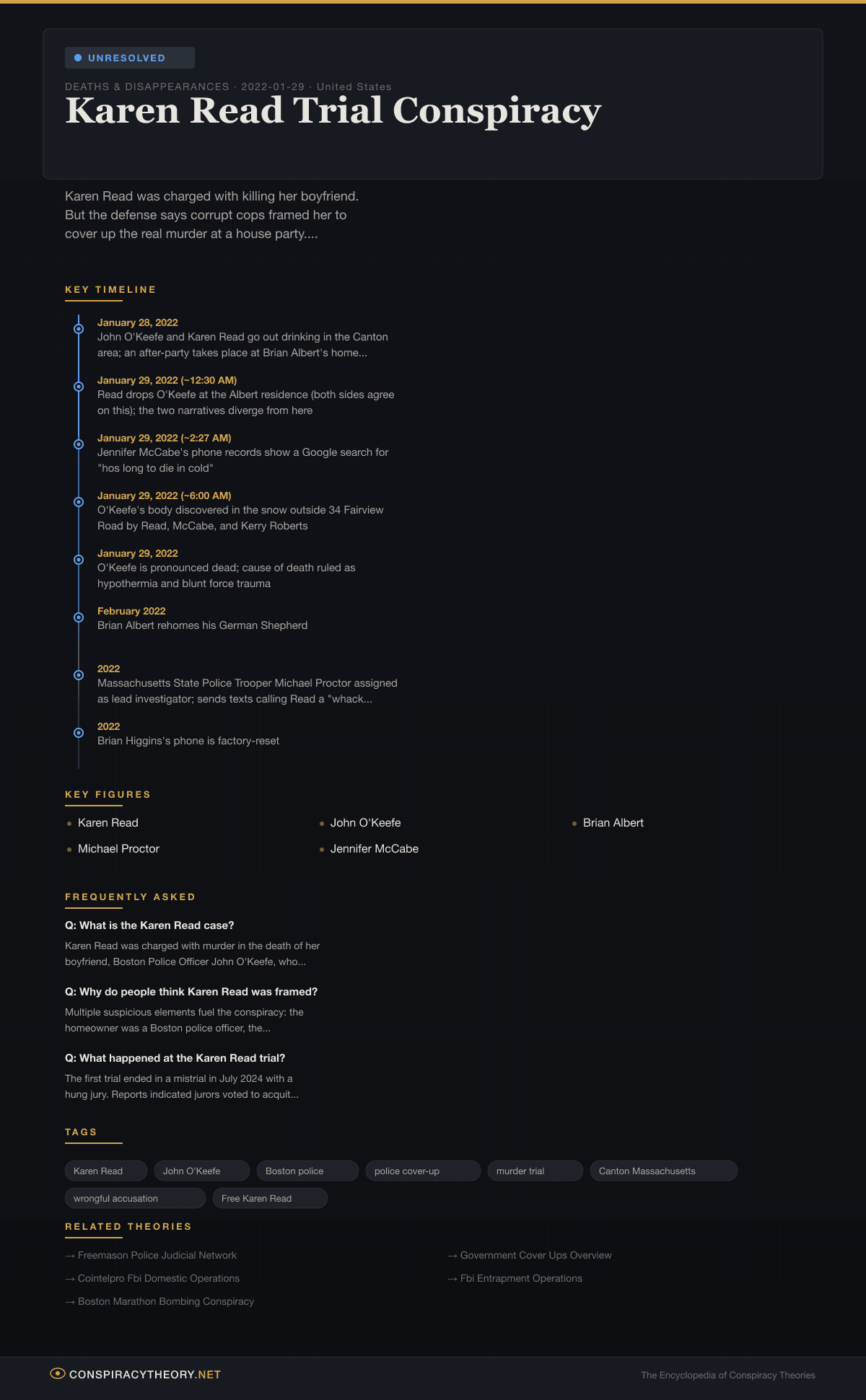
- January 28, 2022 — John O’Keefe and Karen Read go out drinking in the Canton area; an after-party takes place at Brian Albert’s home at 34 Fairview Road
- January 29, 2022 (~12:30 AM) — Read drops O’Keefe at the Albert residence (both sides agree on this); the two narratives diverge from here
- January 29, 2022 (~2:27 AM) — Jennifer McCabe’s phone records show a Google search for “hos long to die in cold”
- January 29, 2022 (~6:00 AM) — O’Keefe’s body discovered in the snow outside 34 Fairview Road by Read, McCabe, and Kerry Roberts
- January 29, 2022 — O’Keefe is pronounced dead; cause of death ruled as hypothermia and blunt force trauma
- February 2022 — Brian Albert rehomes his German Shepherd
- 2022 — Massachusetts State Police Trooper Michael Proctor assigned as lead investigator; sends texts calling Read a “whack job” and making vulgar comments
- 2022 — Brian Higgins’s phone is factory-reset
- 2023 — Karen Read indicted on charges of second-degree murder, motor vehicle manslaughter, and leaving the scene of an accident causing death
- April 2024 — First trial begins in Norfolk County Superior Court before Judge Beverly Cannone
- July 1, 2024 — Mistrial declared after jury deadlock; jurors later reveal they voted unanimously to acquit on murder and leaving the scene
- 2024 — Federal investigation into the case opened by FBI and U.S. Attorney’s Office
- 2024–2025 — Michael Proctor suspended from Massachusetts State Police pending internal affairs investigation
- 2025 — Defense files double jeopardy motions to block retrial on murder and leaving-the-scene charges
Sources & Further Reading
- Commonwealth of Massachusetts v. Karen Read, Norfolk County Superior Court case records
- The Boston Globe — extensive coverage of the trial, mistrial, and ongoing proceedings
- NBC Boston / WCVB / Boston 25 News — daily trial coverage and analysis
- Court TV — full trial broadcasts and legal commentary
- “The Karen Read Case: A Timeline,” WGBH News
- Turtleboy (Aidan Kearney) blog — defense-sympathetic citizen journalism (note: Kearney faces criminal charges related to his coverage)
- Massachusetts State Police internal affairs records regarding Trooper Michael Proctor
- Digital forensic testimony regarding Jennifer McCabe’s phone records, presented at trial
- Biomechanical testimony of Dr. Marie Russell regarding O’Keefe’s injuries
- Federal investigation reporting by The Boston Globe and Boston Herald
Frequently Asked Questions
What is the Karen Read case?
Why do people think Karen Read was framed?
What happened at the Karen Read trial?
Infographic
Share this visual summary. Right-click to save.