Knights Templar Baphomet Worship Accusations
Overview
On Friday, October 13, 1307 — a date some credit as the origin of the Friday the 13th superstition — King Philip IV of France ordered the simultaneous arrest of every Knight Templar in his kingdom. The charges were spectacular: the Templars, those celebrated warrior-monks of the Crusades, stood accused of denying Christ, spitting on the cross, engaging in homosexual acts, and worshipping a mysterious idol called Baphomet.
The confessions came quickly. Under torture, Templar after Templar admitted to the charges. They described kissing the posterior of a cat, worshipping a severed head, and performing blasphemous rituals. But the descriptions were wildly inconsistent. Some said Baphomet was a skull. Others said it was a head with three faces. Still others described a bearded head, a cat, or a wooden idol. When Templars were removed from torture, many immediately recanted.
Seven centuries later, the question remains genuinely unresolved: Were the Templar confessions evidence of secret heterodox practices, or were they the fabricated product of a king who owed the Templars money and saw a convenient way to eliminate his creditors? The historical evidence overwhelmingly favors the latter interpretation, but the Baphomet accusations have taken on a life far beyond their medieval origins, seeding centuries of conspiracy theories about secret societies, occult worship, and the hidden history of Christianity.
Origins & History
The Rise of the Templars
The Poor Fellow-Soldiers of Christ and of the Temple of Solomon — the Knights Templar — were founded around 1119 in the aftermath of the First Crusade. Initially a small band of knights pledged to protect Christian pilgrims traveling to the Holy Land, the order grew with astonishing speed. Papal endorsement, royal patronage, and donations from across Christendom transformed the Templars into one of the wealthiest and most powerful organizations in medieval Europe.
By the late thirteenth century, the Templars possessed a network of estates, castles, and commanderies spanning from Britain to the Levant. They had essentially invented international banking, allowing pilgrims to deposit funds in one country and withdraw them in another. They lent money to kings, including Philip IV of France.
But the Crusades were failing. Acre, the last major Crusader stronghold, fell to the Mamluks in 1291. The Templars’ original military purpose was gone. They were wealthy, powerful, secretive, and increasingly without a clear mission — a combination that made them vulnerable.
Philip IV’s Motives
Philip IV of France was perpetually short of money. He had already expelled and confiscated the property of the Jews and the Lombard bankers. The Templars, who were his largest creditors, presented an irresistible target.
Philip’s chief minister, Guillaume de Nogaret, had previously orchestrated the humiliation of Pope Boniface VIII (literally assaulting him in 1303). Nogaret was a skilled political operator with no reverence for institutions he considered obstacles to royal power. The plan to destroy the Templars was likely developed between Philip and Nogaret over the course of several years.
The charges were ready-made. Accusations of heresy provided both a legal framework (the Inquisition had jurisdiction over heresy) and a moral justification that placed the attackers above reproach. Philip presented himself not as a debtor seizing his creditors’ assets but as a pious king defending the faith.
The Arrests and Trials
The arrests of October 13, 1307, were planned with military precision. Sealed orders were distributed throughout France, to be opened simultaneously. Thousands of Templars were arrested in a single day.
The interrogations that followed were conducted by Dominican inquisitors using the standard methods of the medieval Inquisition — which is to say, torture. The techniques included the strappado (suspending the prisoner by bound wrists behind the back), burning the soles of the feet, sleep deprivation, starvation, and the rack.
Under these conditions, confessions poured forth. Jacques de Molay, the Grand Master, initially confessed to denying Christ and spitting on the cross. Other Templars confessed to the same, plus the worship of Baphomet.
But the confessions were strikingly inconsistent:
- Some Templars described Baphomet as a severed head, sometimes bearded, sometimes with two or three faces
- Others described a wooden or metal idol
- Some said it was a cat
- Some said they had never heard of Baphomet at all
- Descriptions varied so wildly that modern scholars have concluded the Templars were either inventing details to satisfy their torturers or repeating allegations that had been fed to them
When Pope Clement V sent his own investigators to examine the Templars in 1308, many of the accused recanted their confessions, stating they had been extracted under torture. In regions outside France — where Philip’s political pressure was weaker — far fewer Templars confessed. In Aragon, Cyprus, and England, investigations produced little or no evidence of heresy.
The Etymology of Baphomet
The origin of the name “Baphomet” itself is a mystery. The leading theories include:
-
Corruption of “Muhammad”: The most common scholarly explanation is that “Baphomet” is a medieval French corruption of “Mahomet” (Muhammad). The Crusaders had spent nearly two centuries fighting Muslims, and the accusation of worshipping Muhammad would have been a recognizable charge of apostasy. This does not mean the Templars actually worshipped Muhammad — it means Philip’s propagandists used a familiar bogeymen.
-
The Atbash Cipher: In 1980, Hugh Schonfeld proposed that “Baphomet,” decoded through the Atbash cipher (a simple Hebrew substitution cipher), yields “Sophia” — Greek for “wisdom.” This would connect Baphomet to Gnostic traditions of divine wisdom. The theory is ingenious but speculative.
-
Greek compound: Some occultists have argued the name derives from Greek baphe metous (“baptism of wisdom”), though this etymology is not well-supported linguistically.
The Dissolution of the Templars
Pope Clement V, under intense pressure from Philip, dissolved the Templar order at the Council of Vienne in 1312 through the papal bull Vox in excelso. The order was not formally condemned for heresy — Clement dissolved it on administrative grounds, acknowledging that the scandal had made the order unsustainable.
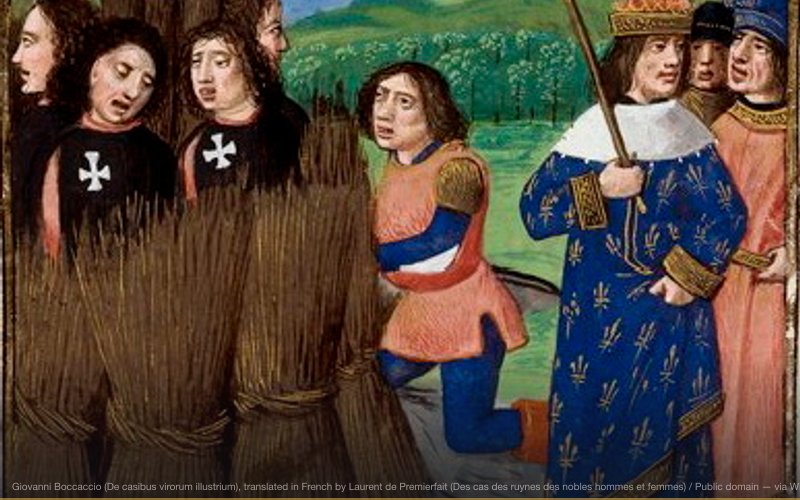
Templar properties were transferred to the Knights Hospitaller (though Philip managed to skim substantial amounts). Jacques de Molay, who had recanted his confession, was burned at the stake on March 18, 1314, on an island in the Seine. According to legend, he cursed Philip and Clement from the flames, declaring they would both face God’s judgment within the year. Both died within months — Clement in April, Philip in November — though this is likely coincidental.
Key Claims
- The Templars secretly worshipped an idol called Baphomet as part of heterodox religious rites conducted in private chapter meetings
- Baphomet was a physical object — a severed head, a skull, or an idol — kept in Templar commanderies
- Templar initiation rituals involved blasphemy: denying Christ, spitting on the cross, and kissing the posterior of a fellow knight or an animal
- The Templars had absorbed heretical beliefs through their contact with Muslim and Eastern Christian cultures during the Crusades
- The charges were fabricated by Philip IV and Guillaume de Nogaret to justify seizing Templar wealth
- Modern occult traditions inherited authentic Templar secret knowledge through hidden lines of transmission
Evidence
Evidence the Charges Were Fabricated
- Confessions were extracted under extreme torture and frequently recanted when torture stopped
- Descriptions of Baphomet and the alleged rituals were wildly inconsistent across different confessions
- Trials outside France, where Philip had less influence, produced far fewer convictions
- Pope Clement V dissolved the order administratively rather than condemning it for heresy, suggesting even the papacy was not convinced
- Philip IV had overwhelming financial motives to destroy the order
- Philip’s chief minister, Nogaret, had a documented history of fabricating charges against political enemies
- No physical Baphomet idol has ever been found in any Templar site
Evidence of Possible Heterodox Practices
- The sheer number of confessions, even accounting for torture, suggests the charges were not entirely invented from nothing
- Some Templar chapter meetings were conducted in strict secrecy, which invited suspicion
- The Templars’ long exposure to Muslim and Eastern Christian cultures may have introduced syncretic elements into their practices
- Some historians have noted that certain confession details (the denial of Christ at initiation) have parallels in other military-religious orders’ hazing rituals, suggesting a kernel of distorted truth
- The Chinon Parchment, discovered in the Vatican archives in 2001, showed that Clement V secretly absolved the Templar leaders of heresy in 1308 — but this suggests he believed the confessions had some substance, even if coerced
Cultural Impact
The Levi Baphomet
The image that most people now associate with Baphomet — a winged, goat-headed hermaphrodite with a torch between its horns — was not medieval at all. It was created in 1856 by French occultist Eliphas Levi for his book Dogme et Rituel de la Haute Magie. Levi’s Baphomet was a symbol of the “totality of the universe” and the reconciliation of opposites — male and female, good and evil, human and animal. It was an esoteric philosophical symbol, not a portrait of something the Templars worshipped.
But Levi’s image was so striking that it became permanently attached to both the Templar legend and to modern occultism. The Church of Satan adopted a modified version — the Sigil of Baphomet, a goat’s head inscribed in an inverted pentagram — as its official symbol in 1966.
Templarism in Freemasonry
Several Masonic rites, particularly the York Rite’s Knights Templar degree, claim symbolic descent from the medieval Templars. While there is no historical evidence of organizational continuity between the medieval order and modern Freemasonry, the Templar mystique has been a powerful element in Masonic tradition since the eighteenth century. This perceived connection has fed into Judeo-Masonic conspiracy theories.
The Friday the 13th Legend
The mass arrest of the Templars on Friday, October 13, 1307, is sometimes cited as the origin of the Western superstition that Friday the 13th is unlucky. While this connection is popular in conspiracy literature and fiction (notably Dan Brown’s The Da Vinci Code), historians have found no evidence linking the Templar arrests to the superstition, which appears to be of more recent (nineteenth-century) origin.
Conspiracy Theories and Popular Fiction
The Templar-Baphomet connection has become a staple of conspiracy fiction and alternative history. Dan Brown’s The Da Vinci Code and its sequels, Umberto Eco’s Foucault’s Pendulum, and numerous video games (the Assassin’s Creed series prominently features the Templars) have kept the narrative alive in popular culture.
In Popular Culture
- Dan Brown, The Da Vinci Code (2003) — bestselling novel featuring the Templars as guardians of a sacred secret
- Umberto Eco, Foucault’s Pendulum (1988) — satirical novel about conspiracy theories involving the Templars
- Assassin’s Creed video game series (2007-present) — the Templars are the primary antagonists
- Indiana Jones and the Last Crusade (1989) — features a Templar guardian of the Holy Grail
- Knightfall (2017-2019) — History Channel series dramatizing the fall of the Templars
- Eliphas Levi, Dogme et Rituel de la Haute Magie (1856) — source of the iconic Baphomet image
- The Name of the Rose by Umberto Eco (1980) — while focused on Franciscans, set in the same era and exploring similar themes of heresy and Inquisition
Key Figures
- Jacques de Molay (c. 1243-1314) — Last Grand Master of the Knights Templar; burned at the stake in Paris
- Philip IV of France (1268-1314) — King who orchestrated the destruction of the Templars
- Pope Clement V (1264-1314) — Pope who dissolved the Templar order under pressure from Philip
- Guillaume de Nogaret (c. 1260-1313) — Philip’s chief minister who organized the arrests and trials
- Eliphas Levi (1810-1875) — French occultist who created the modern Baphomet image
- Hugh Schonfeld (1901-1988) — Scholar who proposed the Atbash cipher interpretation of “Baphomet”
- Barbara Frale — Vatican archivist who discovered the Chinon Parchment in 2001
Timeline
| Date | Event |
|---|---|
| c. 1119 | Knights Templar founded in Jerusalem |
| 1139 | Pope Innocent II grants the Templars independence from local authorities |
| 1291 | Fall of Acre; Templars lose their military purpose in the Holy Land |
| Oct 13, 1307 | Philip IV orders mass arrest of Templars in France |
| Oct-Nov 1307 | Confessions extracted under torture, including Baphomet worship |
| 1308 | Pope Clement V sends investigators; many Templars recant confessions |
| Aug 1308 | Chinon Parchment: Clement secretly absolves Templar leaders |
| 1312 | Council of Vienne: Clement dissolves the Templar order |
| Mar 18, 1314 | Jacques de Molay burned at the stake in Paris |
| Nov 29, 1314 | Philip IV dies (within the year of de Molay’s alleged curse) |
| 1856 | Eliphas Levi publishes iconic Baphomet image |
| 1966 | Church of Satan adopts modified Baphomet as official symbol |
| 2001 | Barbara Frale discovers Chinon Parchment in Vatican archives |
| 2007 | Vatican publishes the Chinon Parchment |
Sources & Further Reading
- Barber, Malcolm. The Trial of the Templars. Cambridge University Press, 1978 (2nd ed. 2006).
- Barber, Malcolm. The New Knighthood: A History of the Order of the Temple. Cambridge University Press, 1994.
- Frale, Barbara. “The Chinon Chart: Papal Absolution to the Last Templar, Master Jacques de Molay.” Journal of Medieval History, 2004.
- Partner, Peter. The Murdered Magicians: The Templars and Their Myth. Oxford University Press, 1981.
- Nicholson, Helen. The Knights Templar: A New History. Sutton Publishing, 2001.
- Levi, Eliphas. Dogme et Rituel de la Haute Magie. 1856.
- Schonfeld, Hugh. The Essene Odyssey. Element Books, 1984.
- Haag, Michael. The Templars: The History and the Myth. Profile Books, 2008.
Related Theories
- Knights Templar Treasure — theories about hidden Templar wealth and relics
- Freemasonry Conspiracy — Masonic traditions claiming Templar descent
- Holy Grail — the Templars as alleged guardians of the Grail
Frequently Asked Questions
What is Baphomet?
Did the Knights Templar really worship Baphomet?
Why did King Philip IV of France arrest the Templars?
What is the connection between Baphomet and Satanism?
Infographic
Share this visual summary. Right-click to save.