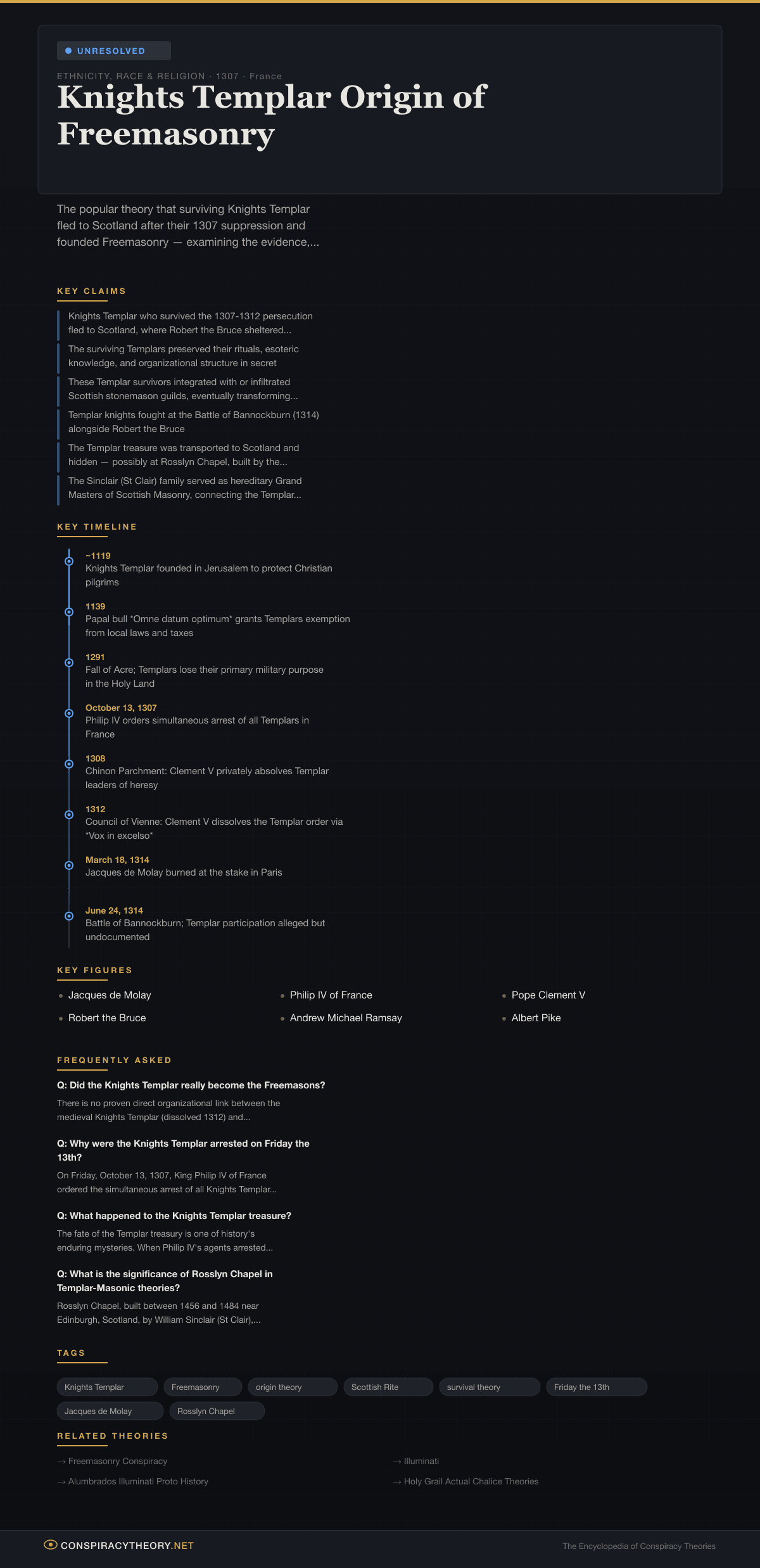
Knights Templar Origin of Freemasonry

Overview
The Knights Templar origin of Freemasonry is a theory proposing that the medieval order of the Knights Templar, officially dissolved in 1312 after arrests and trials orchestrated by King Philip IV of France and Pope Clement V, survived in secret and eventually gave rise to the fraternal organization known as Freemasonry. The theory holds that Templar survivors fled to Scotland — where King Robert the Bruce, himself excommunicated, offered protection from papal authority — and preserved their rituals, knowledge, and organizational structure within the stonemasonry guilds that would eventually become speculative Freemasonry.
This theory has been one of the most enduring and influential ideas in the history of secret societies, shaping not only conspiracy culture but Masonic self-understanding. Several Masonic bodies, particularly the Scottish Rite and the Knights Templar degree of the York Rite, have formally adopted Templar symbolism, ritual, and narrative into their degree systems. The relationship between the Templars and Freemasonry thus occupies an unusual space: the historical evidence for a direct connection is thin, but the cultural and ritual connection — created by Masons themselves over the past three centuries — is substantial.
The theory is classified as unresolved because while no documentary evidence confirms an organizational link between the dissolved Templar order and the earliest Masonic lodges, neither can the possibility be categorically excluded. The critical period — approximately 1312 to 1599 (when the earliest documented Masonic lodge records appear in Scotland) — is poorly documented, and the absence of evidence from this period is not conclusive evidence of absence. The question is further complicated by the fact that Masonic organizations have deliberately constructed a Templar heritage narrative, making it difficult to distinguish between historical transmission and retrospective mythmaking.
Origins & History
The Knights Templar
The Poor Fellow-Soldiers of Christ and of the Temple of Solomon — the Knights Templar — were founded around 1119 in the aftermath of the First Crusade. The order was established to protect Christian pilgrims traveling to the Holy Land and was granted quarters on the Temple Mount in Jerusalem, from which their name derives.
Over the following two centuries, the Templars grew from a small band of warrior monks into one of the most powerful institutions in medieval Christendom. They developed an extensive network of estates, farms, and preceptories across Europe, operated a sophisticated banking system (pilgrims could deposit funds at one Templar house and withdraw them at another, an early form of international banking), and accumulated enormous wealth and political influence.
At their peak, the Templars were answerable only to the Pope, exempt from local taxes and laws, and possessed military capabilities that made them a significant force in Crusader politics. Their combination of military prowess, financial power, and papal independence made them simultaneously indispensable and resented.
The Fall of the Templars
The downfall of the Templars was precipitated by the loss of the last Crusader stronghold of Acre in 1291, which eliminated their primary military rationale, and by the ambitions of King Philip IV of France (Philip the Fair), who owed the Templars substantial debts and coveted their wealth.
On Friday, October 13, 1307, Philip ordered the simultaneous arrest of all Knights Templar in France. The coordinated operation — one of the most dramatic mass arrests in medieval history — succeeded in capturing most of the French Templars, including Grand Master Jacques de Molay. The arrested knights were charged with heresy, blasphemy, idol worship (including the worship of a mysterious head called “Baphomet”), spitting on the cross during initiation ceremonies, and sodomy.
Under torture, many Templars confessed to the charges. Jacques de Molay himself initially confessed but later recanted. Pope Clement V, who was under heavy French political pressure, issued the bull Pastoralis Praeeminentiae in November 1307 ordering all Christian monarchs to arrest the Templars in their territories. The response varied significantly by country:
- In France, the arrests were thorough and the persecution brutal
- In England, King Edward II initially resisted but eventually complied under papal pressure
- In Portugal, the Templars were effectively reconstituted as the Order of Christ, retaining their property and personnel
- In Scotland, King Robert the Bruce — himself excommunicated — is believed to have largely ignored the papal order
- In Germany and other regions, many Templars were acquitted or simply transitioned to other military orders
At the Council of Vienne in 1312, Clement V formally dissolved the Templar order through the bull Vox in excelso. Their property was transferred to the Knights Hospitaller, though much of it was seized by secular rulers. On March 18, 1314, Jacques de Molay and Geoffrey de Charny were burned at the stake in Paris. According to legend, de Molay cursed both Philip IV and Clement V from the flames, and both died within the year — Philip in November 1314, Clement in April 1314.
The Survival Question
The central question for the Templar-Freemasonry theory is whether any organized remnant of the Templar order survived its dissolution and transmitted its traditions forward in time.
Arguments for survival:
Several factors make survival plausible:
-
The dissolution was not uniformly enforced. In Scotland, Portugal, and parts of Germany, Templars were not aggressively pursued and may have continued to operate under different names or without formal organizational structure.
-
The order’s dissolution was administrative, not a physical annihilation. Most Templars were not executed; they were released, pensioned, or absorbed into other orders. Their knowledge, habits, and social networks did not simply disappear.
-
In Scotland specifically, the Bruce’s excommunication meant that papal authority — which had ordered the Templar dissolution — had limited reach. Scotland during the Wars of Independence was a plausible refuge for Templars fleeing other jurisdictions.
-
A tradition exists (though it is disputed) that Templar knights fought alongside Robert the Bruce at the Battle of Bannockburn in 1314, just two months after de Molay’s execution.
Arguments against organized survival:
-
No documentary evidence from the 14th, 15th, or 16th centuries records a surviving Templar organization in Scotland or anywhere else.
-
The Templars who were released or transferred to other orders had no obvious reason to maintain a secret organization.
-
The Bannockburn tradition is unattested in any contemporary account of the battle and first appears centuries later.
-
The leap from a dissolved military-religious order of the early 14th century to operative stonemason guilds of the late 16th century lacks any documented intermediary stage.
The Masonic Connection
The earliest documented Masonic lodges appear in Scotland in the late 16th century. The Lodge of Edinburgh (Mary’s Chapel) has minutes dating to 1599. The Schaw Statutes of 1598-1599, issued by William Schaw, Master of the Work to James VI of Scotland, established regulations for stonemason lodges, suggesting an organized lodge system was already in existence.
These early lodges were operative — they consisted of actual stonemasons and regulated the craft of masonry. The transition to speculative Freemasonry — in which non-stonemasons were admitted as members and the lodge became a fraternal and philosophical organization — occurred gradually during the 17th century. The earliest recorded admission of a non-operative member is that of John Boswell, Laird of Auchinleck, at the Lodge of Edinburgh in 1600.
The Grand Lodge of England, the first national Masonic governing body, was founded in 1717. The Grand Lodge of Scotland followed in 1736.
The Ramsay Oration (1737)
The explicit connection between the Templars and Freemasonry first appeared not in medieval documents but in an 18th-century Masonic speech. In 1737, Andrew Michael Ramsay, a Scottish-born Jacobite and tutor to French noble families, delivered an oration to French Masonic lodges in which he claimed that Freemasonry had originated not among English stonemasons but among the crusading knights of the Holy Land. While Ramsay referenced the Knights of St. John (Hospitallers) rather than the Templars specifically, his oration established the framework for associating Freemasonry with crusading orders.
The Ramsay Oration catalyzed the creation of what became known as “higher degrees” in French Freemasonry — additional degrees beyond the three “Craft” degrees (Entered Apprentice, Fellow Craft, Master Mason) that explicitly incorporated Crusader and Templar themes. The Rite of Strict Observance, founded by Karl Gotthelf von Hund in the 1750s, took this further by claiming direct descent from the Templars through a documented chain of Grand Masters.
Von Hund claimed he had been initiated into a Templar Masonic order by a mysterious “Unknown Superior” and possessed a list of Templar Grand Masters continuing from Jacques de Molay to the present. This list has never been verified, and von Hund was eventually discredited within Masonic circles. However, the degree system he created influenced subsequent Masonic rites, including the Scottish Rite and the York Rite, both of which incorporate Templar degrees.
Key Claims
- Knights Templar who survived the 1307-1312 persecution fled to Scotland, where Robert the Bruce sheltered them from papal authority
- The surviving Templars preserved their rituals, esoteric knowledge, and organizational structure in secret
- These Templar survivors integrated with or infiltrated Scottish stonemason guilds, eventually transforming them into the fraternal organization of Freemasonry
- Templar knights fought at the Battle of Bannockburn (1314) alongside Robert the Bruce
- The Templar treasure was transported to Scotland and hidden — possibly at Rosslyn Chapel, built by the Sinclair family (who had Templar and Masonic connections)
- The Sinclair (St Clair) family served as hereditary Grand Masters of Scottish Masonry, connecting the Templar and Masonic traditions through a single family lineage
- Masonic ritual, symbolism, and organizational structure derive from Templar practices rather than from operative stonemasonry
- The Templar-Masonic tradition preserves esoteric knowledge dating to the Temple of Solomon, possibly including the location of the Holy Grail or the Ark of the Covenant
- The Scottish Rite and York Rite Templar degrees represent genuine preservation of Templar tradition, not later invention
Evidence
Evidence Cited by Proponents
Masonic Templar degrees: Multiple Masonic bodies incorporate Templar themes, titles, and ritual. The Knights Templar degree of the York Rite, the Scottish Rite’s higher degrees, and historical rites like the Strict Observance all reference the Templars. Proponents argue this reflects genuine transmission of Templar tradition.
Rosslyn Chapel: The chapel, built 1456-1484 by William Sinclair, features elaborate stone carvings including imagery that some interpret as Masonic and Templar symbols. The Sinclair family held hereditary positions in Scottish Masonry. The chapel’s construction, approximately 150 years after the Templar dissolution, could represent a memorial to or continuation of Templar tradition.
Scotland as refuge: Scotland under Robert the Bruce (excommunicated in 1306) was outside effective papal jurisdiction. The papal bull dissolving the Templars may not have been enforced there. Archaeological evidence of Templar gravestones in Scotland — some featuring both Templar and Masonic-style symbols — has been cited as evidence of Templar survival.
The Kirkwall Scroll: A large painted floor cloth found in a Masonic lodge in Kirkwall, Orkney, has been dated by some researchers to the 15th century. Its imagery has been interpreted as combining Masonic and Templar symbolism, though its dating and interpretation are disputed.
The Chinon Parchment: Discovered in the Vatican archives in 2001, this document from 1308 shows that Clement V actually absolved the Templar leaders of heresy before the order was dissolved — suggesting the dissolution was politically motivated rather than theologically justified, strengthening the case that survivors had no genuine reason for shame or dissolution.
Evidence Against the Theory
No medieval documentation: No document from the 14th, 15th, or 16th centuries — a period spanning 300 years — connects the Templars to Freemasonry or to stonemason guilds. Given the volume of medieval record-keeping (particularly in Scotland, which has extensive burgh and church records), this silence is significant.
The Ramsay origin: The explicit Templar-Masonic connection first appears in 1737, in a speech by a man with Jacobite political motivations. The most parsimonious explanation is that Ramsay (or his circle) created the connection to lend prestige to Freemasonry, not that he was revealing a centuries-old secret.
Operative origins of Masonry: The earliest Masonic lodges are documented as operative stonemason organizations. Their terminology, ritual, and organizational structure derive from the craft of stone construction — not from a military-religious order. The tools of Masonry (square, compass, level, plumb) are stonemason’s tools, not knight’s weapons.
Templar dissolution was not total: The Templars were not exterminated; they were released, pensioned, or transferred. Former Templars in Scotland had no need for a secret survival organization — they could live openly as former members of a dissolved order.
The Bannockburn tradition is late: No contemporary or near-contemporary account of Bannockburn (1314) mentions Templar participation. The tradition appears centuries later and may be a retrospective invention designed to support the Templar-Scottish connection.
Rosslyn Chapel’s imagery is conventional: Art historians have demonstrated that the chapel’s carvings are consistent with late Gothic decorative programs found elsewhere in Europe. Imagery interpreted as “Masonic” by proponents (such as the “apprentice pillar”) can be explained within standard Gothic architectural tradition without invoking Templar or Masonic symbolism.
Debunking / Verification
The theory is classified as unresolved because:
-
The critical 300-year gap (1312-1599) is poorly documented and cannot be definitively assessed. The absence of evidence is suggestive but not conclusive.
-
Plausibility exists for some form of Templar survival in Scotland, even if the organizational continuity to Freemasonry cannot be documented.
-
Masonic bodies themselves have adopted the Templar narrative, making it part of the living tradition regardless of its historical accuracy. The question of whether the connection is “real” depends on whether one means historically accurate or culturally authentic.
-
The Chinon Parchment demonstrates that the conventional narrative of the Templar suppression is more complex than previously understood, leaving room for revised interpretations.
-
Definitive debunking would require proving that no Templar-Masonic connection existed — proving a negative across a 300-year documentary gap.
However, the theory is best characterized as historically unsubstantiated. The available evidence is more consistent with 18th-century invention than with medieval transmission. The most likely explanation is that Freemasonry developed from operative stonemason guilds, and the Templar connection was retroactively constructed by 18th-century Masons seeking to ennoble their organization’s origins.
Cultural Impact
The Templar-Freemasonry connection is one of the most culturally influential conspiracy theories in Western history, shaping literature, film, religion, and fraternal organization.
Within Freemasonry: The Templar narrative has profoundly shaped Masonic identity and ritual. The Knights Templar degree remains one of the most prestigious in the York Rite. The Scottish Rite’s higher degrees are saturated with Templar imagery. Whether historically accurate or not, the Templar connection gives Masonry a dramatic origin story involving persecution, secret survival, and the preservation of sacred knowledge.
The Friday the 13th superstition: The popular association of Friday the 13th with bad luck is sometimes attributed to the Templar arrests on Friday, October 13, 1307. While this attribution is disputed by folklorists (the superstition may have separate origins), it has become widely accepted in popular culture, making the Templar story one of the few medieval events that directly influences contemporary daily life.
Literature and film: The Templar-Masonic connection has been the basis for countless novels, films, and television series. Dan Brown’s The Da Vinci Code (2003) made Rosslyn Chapel internationally famous and brought the Templar-Grail-Masonic narrative to an audience of tens of millions. Umberto Eco’s Foucault’s Pendulum (1988) offered a more sophisticated literary treatment. Indiana Jones and the Last Crusade (1989), National Treasure (2004), and Assassin’s Creed (2007 video game franchise) all draw on the Templar mythology.
Conspiracy culture: The Templar-Masonic theory is a foundational element of modern conspiracy culture. It establishes the template of the “secret society that preserves hidden knowledge across centuries” — a template that has been applied to dozens of subsequent conspiracy theories. The theory’s influence can be seen in narratives about the Illuminati, the Priory of Sion, the Rosicrucians, and numerous other alleged secret organizations.
Tourism and heritage: The theory has created significant tourism economies around sites like Rosslyn Chapel, Temple Church in London, Templar-associated sites in the Holy Land, and Masonic lodges in Scotland. Rosslyn Chapel alone receives hundreds of thousands of visitors annually, the vast majority attracted by its Templar-Masonic-Da Vinci Code associations rather than its genuine architectural merit.
In Popular Culture
- Dan Brown, The Da Vinci Code (2003) — Brought the Templar-Masonic-Grail narrative to a global audience of over 80 million readers
- Umberto Eco, Foucault’s Pendulum (1988) — Literary satire of Templar conspiracy theories
- National Treasure (2004 film) — Nicolas Cage vehicle built around Templar-Masonic treasure mythology
- Indiana Jones and the Last Crusade (1989) — The Holy Grail quest incorporates Templar guardianship
- Assassin’s Creed (video game franchise, 2007-present) — Templars as the primary antagonist organization
- Knightfall (History Channel, 2017-2019) — Television drama depicting the fall of the Templars
- Michael Baigent, Richard Leigh, and Henry Lincoln, The Holy Blood and the Holy Grail (1982) — Influential non-fiction work proposing Templar connections to the bloodline of Christ
- Albert Pike, Morals and Dogma (1871) — Influential Masonic text incorporating Templar history and symbolism
Key Figures
Jacques de Molay (c. 1243-1314) — Last Grand Master of the Knights Templar. Arrested in 1307, confessed under torture, recanted, and was burned at the stake in Paris in 1314. According to legend, he cursed Philip IV and Clement V from the flames.
Philip IV of France (1268-1314) — King who orchestrated the Templar arrests. His motivations were primarily financial and political — he owed the Templars enormous debts and sought their wealth and property.
Pope Clement V (c. 1264-1314) — Pope who dissolved the Templar order under pressure from Philip IV. The Chinon Parchment reveals he privately absolved the Templar leaders of heresy.
Robert the Bruce (1274-1329) — King of Scotland who, according to the theory, sheltered fleeing Templars. His excommunication placed Scotland outside effective papal authority during the critical period.
Andrew Michael Ramsay (1686-1743) — Scottish Jacobite and Freemason who first publicly linked Freemasonry to the crusading orders in his 1737 oration. Considered the originator of “higher degree” Masonic traditions incorporating Templar themes.
Karl Gotthelf von Hund (1722-1776) — German nobleman who founded the Rite of Strict Observance, claiming direct Templar descent through an unbroken chain of Grand Masters.
Albert Pike (1809-1891) — American Freemason, Confederate general, and author of Morals and Dogma, which extensively incorporated Templar history and symbolism into Scottish Rite philosophy.
William Sinclair (c. 1410-1484) — Scottish nobleman who built Rosslyn Chapel. His family had historical connections to Scottish Masonry.
Timeline
- ~1119 — Knights Templar founded in Jerusalem to protect Christian pilgrims
- 1139 — Papal bull Omne datum optimum grants Templars exemption from local laws and taxes
- 1291 — Fall of Acre; Templars lose their primary military purpose in the Holy Land
- October 13, 1307 — Philip IV orders simultaneous arrest of all Templars in France
- 1308 — Chinon Parchment: Clement V privately absolves Templar leaders of heresy
- 1312 — Council of Vienne: Clement V dissolves the Templar order via Vox in excelso
- March 18, 1314 — Jacques de Molay burned at the stake in Paris
- June 24, 1314 — Battle of Bannockburn; Templar participation alleged but undocumented
- 1456-1484 — Rosslyn Chapel built by William Sinclair
- 1598-1599 — Schaw Statutes regulate Scottish stonemason lodges
- 1599 — Earliest surviving minutes of the Lodge of Edinburgh (Mary’s Chapel)
- 1717 — Grand Lodge of England founded
- 1737 — Ramsay delivers his oration connecting Freemasonry to crusading orders
- 1750s — Von Hund founds the Rite of Strict Observance, claiming direct Templar descent
- 1871 — Albert Pike publishes Morals and Dogma, incorporating extensive Templar material
- 1982 — The Holy Blood and the Holy Grail popularizes Templar conspiracy theories
- 2001 — Chinon Parchment rediscovered in Vatican archives
- 2003 — Dan Brown’s The Da Vinci Code brings Templar-Masonic theories to mass audience
Sources & Further Reading
- Barber, Malcolm. The Trial of the Templars. 2nd edition. Cambridge University Press, 2006.
- Barber, Malcolm. The New Knighthood: A History of the Order of the Temple. Cambridge University Press, 1994.
- Stevenson, David. The Origins of Freemasonry: Scotland’s Century, 1590-1710. Cambridge University Press, 1988.
- Hamill, John. The Craft: A History of English Freemasonry. Crucible, 1986.
- Ralls, Karen. Knights Templar Encyclopedia. Career Press, 2007.
- Partner, Peter. The Murdered Magicians: The Templars and Their Myth. Oxford University Press, 1982.
- Roberts, J.M. The Mythology of the Secret Societies. Charles Scribner’s Sons, 1972.
- Baigent, Michael, Richard Leigh, and Henry Lincoln. The Holy Blood and the Holy Grail. Jonathan Cape, 1982.
- Nicholson, Helen. The Knights Templar: A New History. Sutton Publishing, 2001.
Related Theories
- Freemasonry — The fraternal organization allegedly descended from the Templars
- Illuminati — Another secret society sometimes linked to Templar and Masonic traditions
- Alumbrados — Spanish Illuminati Precursor — Another alleged link in the chain of secret societies
- Holy Grail Conspiracy — The Templar guardianship of the Grail is a key element of the broader conspiracy narrative
- Oak Island Treasure — One proposed location for the alleged Templar treasure

Frequently Asked Questions
Did the Knights Templar really become the Freemasons?
Why were the Knights Templar arrested on Friday the 13th?
What happened to the Knights Templar treasure?
What is the significance of Rosslyn Chapel in Templar-Masonic theories?

Infographic
Share this visual summary. Right-click to save.