Stanley Kubrick Filmed the Moon Landing

Overview
In the Danny Torrance sweater scene, it all comes together — or so the believers say. Young Danny, wearing an Apollo 11 sweater, rises from the carpet of the Overlook Hotel and walks toward Room 237. For a certain breed of film obsessive, this is not a child actor in a costume. It is Stanley Kubrick’s coded confession that he directed the most elaborate hoax in human history: the faking of the Apollo moon landings.
The theory is seductive in its elegance. Kubrick, having just demonstrated godlike command of visual effects in 2001: A Space Odyssey (1968), was — the story goes — recruited by NASA to film convincing footage of astronauts bouncing across the lunar surface. The agency needed a genius who could make the impossible look real. Kubrick needed unlimited funding for his next projects. A deal was struck. And then, consumed by guilt, Kubrick spent the rest of his career hiding confessions in his films, most elaborately in The Shining (1980).
It is one of the most cinematically literate conspiracy theories ever devised. It is also completely, demonstrably wrong.
Origins & History
The Kubrick-specific angle of moon landing denial did not emerge until well after the broader hoax theory had taken root. Bill Kaysing’s 1976 self-published pamphlet We Never Went to the Moon: America’s Thirty Billion Dollar Swindle laid the groundwork, arguing that NASA lacked the technical capability to land on the Moon and instead filmed everything in a studio. Kaysing, a former technical writer for Rocketdyne (a company that built rocket engines for the Saturn V), never mentioned Kubrick.
The Kubrick connection appears to have crystallized in the late 1990s and early 2000s, gaining traction on early internet forums where film buffs overlapped with conspiracy communities. The theory’s most influential proponent was Jay Weidner, a filmmaker and self-described “hermetic scholar” who published a detailed essay in 2009 titled “Secrets of The Shining, or How Faking the Moon Landings Nearly Cost Stanley Kubrick His Marriage and His Life.” Weidner argued that Kubrick’s use of front-screen projection in 2001 proved he possessed the technical skill to fake lunar footage, and that The Shining was a frame-by-frame confession.
The theory got its biggest mainstream boost in 2012 with Rodney Ascher’s documentary Room 237, which featured Weidner and other obsessive Kubrick interpreters laying out their readings of The Shining. Though Ascher presented the theories without endorsement — the film is really about the nature of interpretation itself — many viewers took the arguments at face value. Suddenly, “Kubrick faked the moon landing” went from niche internet theory to dinner party conversation topic.
In 2015, a video circulated online purporting to show Kubrick in a deathbed interview confessing to the hoax. The clip was quickly debunked as a staged performance by filmmaker T. Patrick Murray, who used an actor resembling Kubrick. But by then, the theory had achieved escape velocity. It had become one of those ideas that people repeat half-jokingly, not quite believing it but finding it too delicious to dismiss entirely.
Key Claims
The theory rests on several interlocking assertions:
-
Kubrick had the skill. His groundbreaking visual effects work on 2001: A Space Odyssey, particularly his use of front-screen projection with 3M Scotchlite reflective screens, demonstrated he could create convincingly realistic extraterrestrial environments in a studio.
-
NASA had the motive. In the geopolitical pressure of the Space Race, the argument goes, actually landing on the Moon was too risky or technically impossible. Faking it was cheaper, safer, and guaranteed success against the Soviet Union.
-
The Shining is a confession. Proponents identify dozens of supposed clues: Danny’s Apollo 11 sweater, Room 237 (237,000 miles being the approximate Earth-Moon distance), the twin girls representing Gemini (the program before Apollo), the typewriter changing from an Adler to a differently colored model (Adler means “eagle” in German, Eagle being the name of the Apollo 11 lunar module), the pattern on the hotel carpet resembling a launchpad, and Jack Torrance’s line “All work and no play makes Jack a dull boy” representing the repetitive, soul-destroying work of maintaining the lie.
-
Kubrick was rewarded. The theory suggests NASA gave Kubrick access to a special NASA-developed Zeiss f/0.7 lens for Barry Lyndon (1975), allowing him to film scenes lit only by candlelight. This, proponents argue, was payment for services rendered.
-
Kubrick died suspiciously. The director died of a heart attack on March 7, 1999, just days after showing the final cut of Eyes Wide Shut to Warner Bros. Theorists suggest he was silenced because Eyes Wide Shut — with its themes of elite secret societies — came too close to revealing the truth.
Evidence
What Proponents Cite
The case is built almost entirely on symbolic interpretation of Kubrick’s films. Weidner’s analysis of The Shining is remarkably detailed: he identifies the Overlook Hotel as a stand-in for America itself, the ghosts as representatives of the government conspiracy, and Jack Torrance’s descent into madness as Kubrick’s own psychological deterioration under the weight of his secret.
The front-screen projection argument has a surface plausibility. Kubrick did pioneer the technique at unprecedented scale for 2001, using large transparencies projected onto a highly reflective Scotchlite screen to create the African savanna and alien landscapes in the “Dawn of Man” sequence. The results were, by 1968 standards, remarkably convincing.
The Zeiss lens for Barry Lyndon is a real fact — NASA did develop the f/0.7 lens for photographing the dark side of the Moon, and Kubrick did acquire three of them. This is the hardest piece of evidence for the theory, because the connection between Kubrick and NASA equipment is documented.
Why It Falls Apart
The theory collapses under even moderate scrutiny from multiple directions:
The Room 237 problem. In Stephen King’s novel, the room is 217. Kubrick changed it to 237 because the Timberline Lodge in Oregon, used for exterior shots, asked him to change the number so guests would not avoid the real Room 217. This is well-documented and confirmed by the hotel management.
Front-screen projection could not do it. While the technique worked beautifully for 2001, it could not replicate the specific visual characteristics of Apollo footage. The lunar surface footage includes continuous long takes, parallax movement consistent with actual three-dimensional environments, and lighting from a single distant point source (the Sun) casting perfectly parallel shadows across uneven terrain. Front-screen projection produces flat background images with no parallax — objects do not move relative to each other as the camera moves, which they clearly do in Apollo footage.
The footage itself. The Apollo missions transmitted live television signals that were received not only by NASA but by independent tracking stations around the world, including in countries that had no reason to help the United States fake a Cold War victory — notably Australia’s Honeysuckle Creek station and the Parkes Observatory. The Soviet Union, which had every motive to expose a hoax, tracked the missions and confirmed their authenticity.
Physical evidence. The Apollo missions left retroreflectors on the lunar surface that scientists worldwide use to this day for laser ranging experiments. They brought back 842 pounds of lunar samples that have been studied by thousands of independent scientists across dozens of countries. The landing sites have been photographed by the Lunar Reconnaissance Orbiter, showing the descent stages, tracks, and equipment exactly where NASA said they would be.
The Zeiss lens. Kubrick obtained the lenses through a legitimate commercial channel. Zeiss manufactured ten f/0.7 lenses for NASA; Kubrick purchased three surplus units. No quid pro quo was necessary — Kubrick was a wealthy, famous filmmaker who could afford exotic equipment.
Kubrick’s own character. Anyone who has studied Kubrick’s personality knows the theory is psychologically implausible. Kubrick was a legendary perfectionist and control freak who spent years on each film. The idea that he would secretly work on a massive government project while simultaneously developing 2001 — and then spend the next three decades leaving breadcrumb confessions rather than simply going public — contradicts everything known about his temperament.
Cultural Impact
The Kubrick moon hoax theory occupies a unique position in conspiracy culture: it is the conspiracy theory as film criticism. Its persistence says less about skepticism toward NASA than it does about the human compulsion to find hidden patterns and secret meanings in art.
Room 237 (2012) is the theory’s cultural high-water mark. Rodney Ascher’s documentary treats the obsessive Kubrick interpreters with a kind of bemused respect, letting them unspool their arguments at length while the camera drifts through the hallways of the Overlook Hotel. The film became a Sundance sensation and introduced the theory to audiences who might never have encountered it on conspiracy forums. Critics noted that the documentary was not really about the moon landing hoax at all — it was about the nature of obsessive interpretation, the human need to find meaning in chaos, and the way great art invites (and sometimes resists) endless analysis.
The theory has also become a kind of shorthand in comedy and popular culture. Peter Hyams’ 1977 film Capricorn One, about a faked Mars landing, predates the Kubrick-specific theory but fed the broader cultural anxiety. The 2016 mockumentary Operation Avalanche directly dramatized the Kubrick scenario. Countless comedians, late-night hosts, and meme-makers have riffed on the premise.
In an ironic twist, the theory may have actually increased public appreciation for Kubrick’s filmmaking. The close attention paid to every frame of The Shining by conspiracy theorists mirrors the close reading practiced by legitimate film scholars. Both groups agree that Kubrick was a meticulous, intentional filmmaker — they just disagree about what the intentions were.
Timeline
- 1968 — Stanley Kubrick releases 2001: A Space Odyssey, demonstrating groundbreaking front-screen projection techniques
- 1969 — Apollo 11 lands on the Moon; live television broadcast watched by an estimated 600 million people worldwide
- 1975 — Kubrick releases Barry Lyndon, filmed using the NASA-developed Zeiss f/0.7 lens
- 1976 — Bill Kaysing publishes We Never Went to the Moon, the foundational moon hoax text (no Kubrick mention)
- 1977 — Capricorn One dramatizes a faked space mission
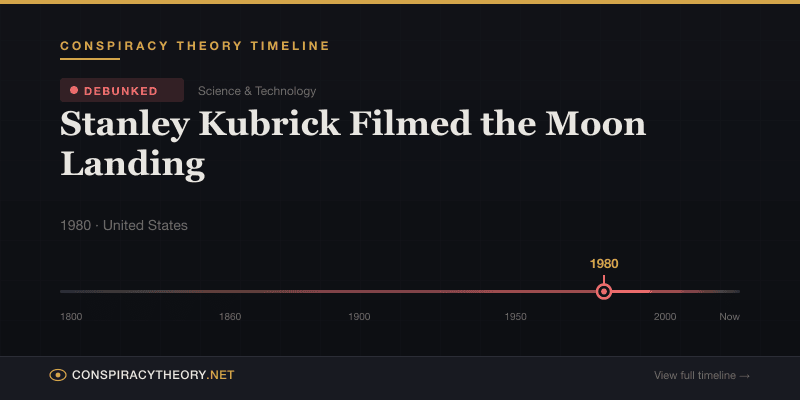
- 1980 — Kubrick releases The Shining, which will later become the primary “evidence” for the theory
- Late 1990s — The Kubrick-moon connection emerges on internet forums
- 1999 — Kubrick dies of a heart attack on March 7, four days after screening Eyes Wide Shut
- 2009 — Jay Weidner publishes “Secrets of The Shining,” the theory’s most detailed articulation
- 2012 — Rodney Ascher’s Room 237 premieres at Sundance, bringing the theory to mainstream audiences
- 2015 — A fake “Kubrick confession” video circulates online and is debunked
- 2016 — Operation Avalanche dramatizes the Kubrick scenario as a found-footage thriller
Sources & Further Reading
- Kaysing, Bill. We Never Went to the Moon: America’s Thirty Billion Dollar Swindle. Self-published, 1976.
- Weidner, Jay. “Secrets of The Shining, or How Faking the Moon Landings Nearly Cost Stanley Kubrick His Marriage and His Life.” jayweidner.com, 2009.
- Ascher, Rodney, dir. Room 237. IFC Films, 2012.
- LoBrutto, Vincent. Stanley Kubrick: A Biography. Da Capo Press, 1999.
- Plait, Philip. Bad Astronomy: Misconceptions and Misuses Revealed. Wiley, 2002.
- NASA Lunar Reconnaissance Orbiter imaging of Apollo landing sites: lroc.sese.asu.edu
- Jones, Eric M. and Ken Glover. The Apollo Lunar Surface Journal. NASA, continuously updated.
Related Theories
- Moon Landing Hoax — The broader theory that the Apollo landings were faked
- Van Allen Belt Radiation — Claims that radiation belts make lunar travel impossible
- Simulation Theory — The idea that all of perceived reality is constructed
Frequently Asked Questions
Did Stanley Kubrick film the Apollo moon landing?
What is the Room 237 connection to the moon landing theory?
What is front-screen projection and why is it relevant?
Did Kubrick confess to faking the moon landing before he died?
Infographic
Share this visual summary. Right-click to save.
