2017 Las Vegas Shooting Conspiracy Theories
Overview
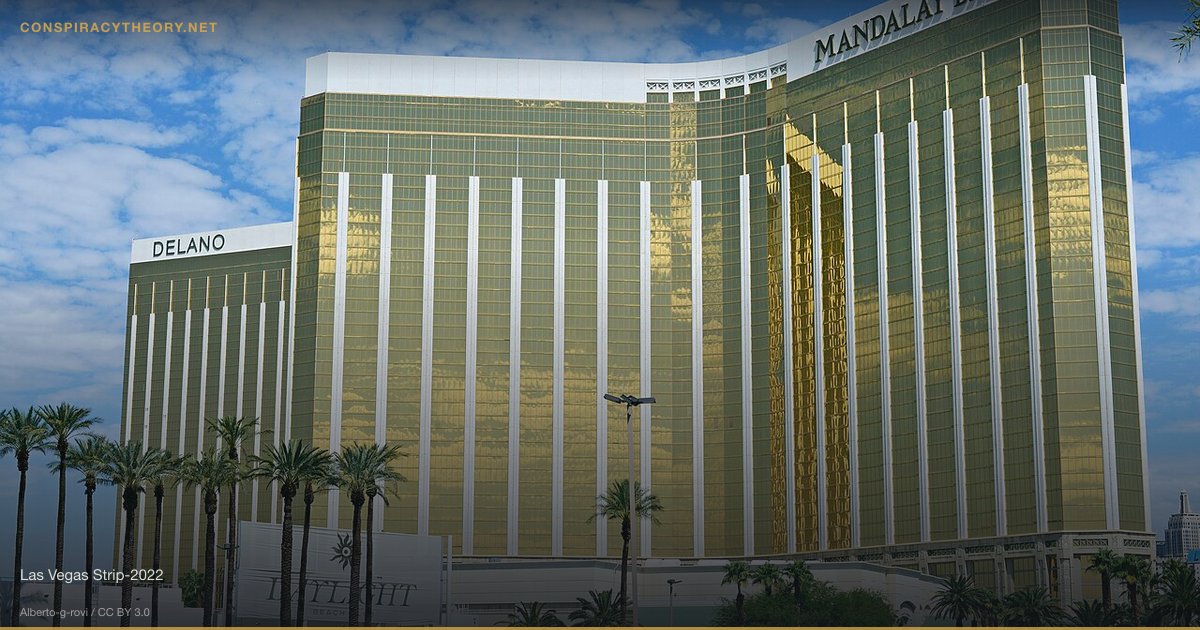
On the evening of October 1, 2017, 22,000 people were watching country music star Jason Aldean perform at the Route 91 Harvest music festival on the Las Vegas Strip. The venue was an open-air lot across from the Mandalay Bay hotel — one of the massive casino-hotels that define the Strip’s skyline. The crowd was enjoying the final night of a three-day festival. The weather was warm. The beer was flowing.
At 10:05 p.m., what sounded like fireworks erupted. It wasn’t fireworks.
Stephen Paddock, a 64-year-old retired accountant and real estate investor occupying a suite on the 32nd floor of the Mandalay Bay, had opened fire on the crowd below with a modified semi-automatic rifle. Over the next ten minutes, he fired more than 1,100 rounds, raking the festival grounds from an elevated position that offered no cover to the victims below.
Sixty people died. Four hundred and eleven were wounded by gunfire. Hundreds more were injured in the stampede. It was the deadliest mass shooting in modern American history — a record that, in a nation that holds this particular competition far too frequently, still stands.
Paddock killed himself before SWAT officers breached his room. They found 23 firearms, bump stocks (devices that allow semi-automatic rifles to simulate automatic fire), and thousands of rounds of ammunition. His meticulous preparation was evident. His motive was not.
Sixteen months later, the FBI closed its investigation. Its conclusion on motive: they couldn’t determine one. No manifesto. No suicide note. No political ideology. No religious extremism. No vendetta. No discernible reason. A man killed 60 people and the most powerful law enforcement agency in the world could not explain why.
That void — the absence of a why — is the single most powerful generator of conspiracy theories about the shooting. The human brain cannot accept that 60 people died for no reason. If the FBI can’t provide a reason, others will.
The Official Account
What’s Known
The basic facts are not in dispute:
- Paddock checked into the Mandalay Bay on September 25, six days before the shooting, in a corner suite on the 32nd floor with a view of the festival grounds
- Over several days, he brought 23 firearms to his room in suitcases, using the hotel’s luggage carts
- He set up cameras in the hallway to monitor law enforcement approach
- At 10:05 p.m. on October 1, he broke the suite’s windows with a hammer and began firing
- He used bump stocks on semi-automatic rifles to achieve a rate of fire approaching that of fully automatic weapons
- The firing lasted approximately 10 minutes, with pauses (likely to change weapons or magazines)
- Hotel security guard Jesus Campos was shot through the door when he approached the room during the attack
- Paddock killed himself before SWAT entered the room at 11:20 p.m.
The Motive Gap
Stephen Paddock was, by every available account, unremarkable. He was a retired accountant who made money in real estate. He was a regular at Las Vegas casinos — a high-stakes video poker player who received comps and VIP treatment. He had a girlfriend, Marilou Danley, who was in the Philippines at the time of the shooting. He had no social media presence. He had no criminal record. He had no known mental health diagnosis.
The FBI’s Behavioral Analysis Unit investigated his life extensively — interviewing family, friends, casino employees, neighbors, and anyone who had contact with him. They examined his finances, his internet activity, his medical records, and his travel patterns. They found nothing that explained the shooting.
This is genuinely unusual. Mass shooters almost always leave behind some trail of explanation — a manifesto, social media posts, a history of grievances, statements to friends or family. Paddock left nothing. His brother Eric, in a media scrum outside his home after the shooting, appeared genuinely bewildered: “There’s absolutely no way I can even conceive that my brother did this.”
The Conspiracy Theories
The Second Shooter Theory
The most persistent conspiracy theory holds that Paddock did not act alone — that there was a second shooter, possibly on a lower floor of the Mandalay Bay or in another building entirely.
The “evidence” cited:
- Muzzle flashes on lower floors: Videos appeared to show flashes from lower Mandalay Bay windows. Analysis showed these were reflections and strobe lights, not gunfire.
- Audio analysis claims: Some amateur analysts claimed the gunfire audio was inconsistent with a single firing position. Professional acoustic analysis by experts including the FBI and independent researchers confirmed a single position consistent with the 32nd floor.
- Taxi driver video: A video taken by a taxi driver outside the Mandalay Bay seemed to capture gunfire from two different locations. Audio forensics experts explained this as echo and acoustic propagation in the concrete canyon of the Strip.
- Witness accounts: Several witnesses reported hearing gunfire from multiple directions. In an urban environment with hard surfaces that create echoes, this is expected — gunfire bouncing off buildings creates the illusion of multiple sources.
The Arms Deal Theory
One of the more elaborate theories holds that Paddock was actually an arms dealer — either for the FBI, CIA, or an independent operation — and that the shooting was an arms deal gone wrong. In this version, Paddock was meeting buyers in his hotel room, the deal went sideways, and the buyers either killed him and staged the shooting or forced him to fire on the crowd.
This theory is entirely speculative. There is no evidence that Paddock was involved in arms dealing. His firearms were legally purchased. His financial records showed no payments consistent with illegal arms sales. The theory exists because it provides a motive where none has been established.
The ISIS Connection
ISIS claimed responsibility for the shooting, calling Paddock a “soldier of the Islamic State” who had recently converted. The FBI investigated this claim and found no evidence of any connection between Paddock and ISIS. There was no evidence of conversion, no contact with ISIS members, no travel to conflict zones, and no ideological material in his possessions.
ISIS has a documented practice of claiming responsibility for attacks it had no role in — a propaganda strategy designed to exaggerate the organization’s reach. The claim was not taken seriously by any intelligence agency.
The False Flag Theory
The standard false flag narrative was applied: the shooting was staged or allowed to happen by the government to create support for gun control legislation. As with all false flag theories applied to mass shootings, this requires believing that the government is simultaneously competent enough to execute a complex operation and incompetent enough to leave obvious clues for YouTube investigators to find.
The theory also runs into the practical problem that the shooting produced no significant gun control legislation. If the goal was to create political support for gun control, it failed spectacularly.
The Cover-Up Theory
A more moderate theory holds that while Paddock was the sole shooter, the FBI determined a motive but classified it — either because it implicates government agencies or because it’s too politically sensitive to disclose. Proponents point to the length of the investigation, the limited information released, and the abrupt nature of the FBI’s closure of the case as evidence that something is being hidden.
This theory is the hardest to definitively dismiss because it’s impossible to prove a negative — you can’t prove the FBI isn’t hiding something. But the theory conflicts with the FBI’s own institutional incentives: identifying a motive would have demonstrated investigative competence. Failing to identify one was embarrassing. If the FBI had found a motive, they had every reason to disclose it.
The Timeline Problem
One detail that fed conspiracy theories was the changing timeline of events in the hours after the shooting. Initial reports placed hotel security guard Jesus Campos’s encounter with Paddock after the shooting began. Later, the LVMPD revised the timeline to show that Campos was shot before Paddock opened fire on the crowd — raising questions about why the shooting wasn’t prevented after hotel security was aware of gunfire on the 32nd floor.
The timeline revision was attributed to the chaos of the initial investigation and the difficulty of reconciling multiple accounts. But for conspiracy theorists, changing timelines are always suspicious — evidence of a narrative being constructed rather than facts being reported.
The MGM Factor
MGM Resorts International, which owns the Mandalay Bay, faced enormous legal liability from the shooting. The company’s response — including an unusual legal strategy of suing the victims to force the case into federal court under anti-terrorism statutes — was widely criticized. MGM eventually settled with victims for $800 million.
Some conspiracy theories have centered on MGM’s behavior, suggesting the company had advance knowledge or was involved in a cover-up. More prosaically, MGM’s legal maneuvers reflected the desperate strategies of a company facing potentially billions in liability, not evidence of foreknowledge.
What the Void Teaches
The Las Vegas shooting conspiracy theories are instructive because they emerge from a genuine gap in the official record. Unlike Sandy Hook or 9/11 conspiracy theories, which contradict extensive evidence, the Vegas theories grow from the absence of evidence — specifically, the absence of a motive.
The human brain is a meaning-making machine. When confronted with random, senseless violence on this scale, it rebels. It demands a narrative. A reason. If the FBI won’t provide one, conspiracy theories fill the void with arms deals, government plots, and ISIS connections — stories that are almost certainly wrong but that satisfy the deep human need for causality.
The uncomfortable truth may be simpler and more terrifying: sometimes, people do monstrous things for reasons that can’t be determined, or for no reason at all.
Timeline
| Date | Event |
|---|---|
| Sept 25, 2017 | Paddock checks into Mandalay Bay |
| Sept 25-Oct 1 | Paddock brings 23 firearms to room in suitcases |
| Oct 1, 10:05 PM | Shooting begins |
| Oct 1, 10:15 PM | Shooting ends (approximately) |
| Oct 1, 11:20 PM | SWAT breaches room; Paddock found dead |
| Oct 2, 2017 | ISIS claims responsibility (debunked) |
| Oct 2017 | Multiple conspiracy theories emerge |
| Oct 2017 | LVMPD revises shooting timeline multiple times |
| Jan 2018 | Bump stocks used in shooting banned by ATF |
| Jan 2019 | FBI closes investigation; no motive determined |
| 2019 | MGM settles with victims for $800 million |
Sources & Further Reading
- FBI Behavioral Analysis Unit. Key Findings of the Federal Investigation of the October 1, 2017 Shooting in Las Vegas. January 2019.
- Las Vegas Metropolitan Police Department. 1 October After Action Review. 2018.
- Clark County Office of the Coroner. Autopsy reports, October 2017.
- Karimi, Faith. “Las Vegas shooting: Timeline of what happened.” CNN, October 2017.
- Brown, Jeremy. “Why the Las Vegas Shooting Produced So Many Conspiracy Theories.” The Atlantic, 2017.
Related Theories
- Crisis Actors — False claims about mass shooting victims
- False Flag Operations — The broader theory of government-staged events
- Sandy Hook Conspiracy — Similar false flag claims about a school shooting
Frequently Asked Questions
What happened at the Las Vegas shooting?
Why did Stephen Paddock do it?
Was there a second shooter?
Why did the FBI investigation take so long and find so little?
Infographic
Share this visual summary. Right-click to save.