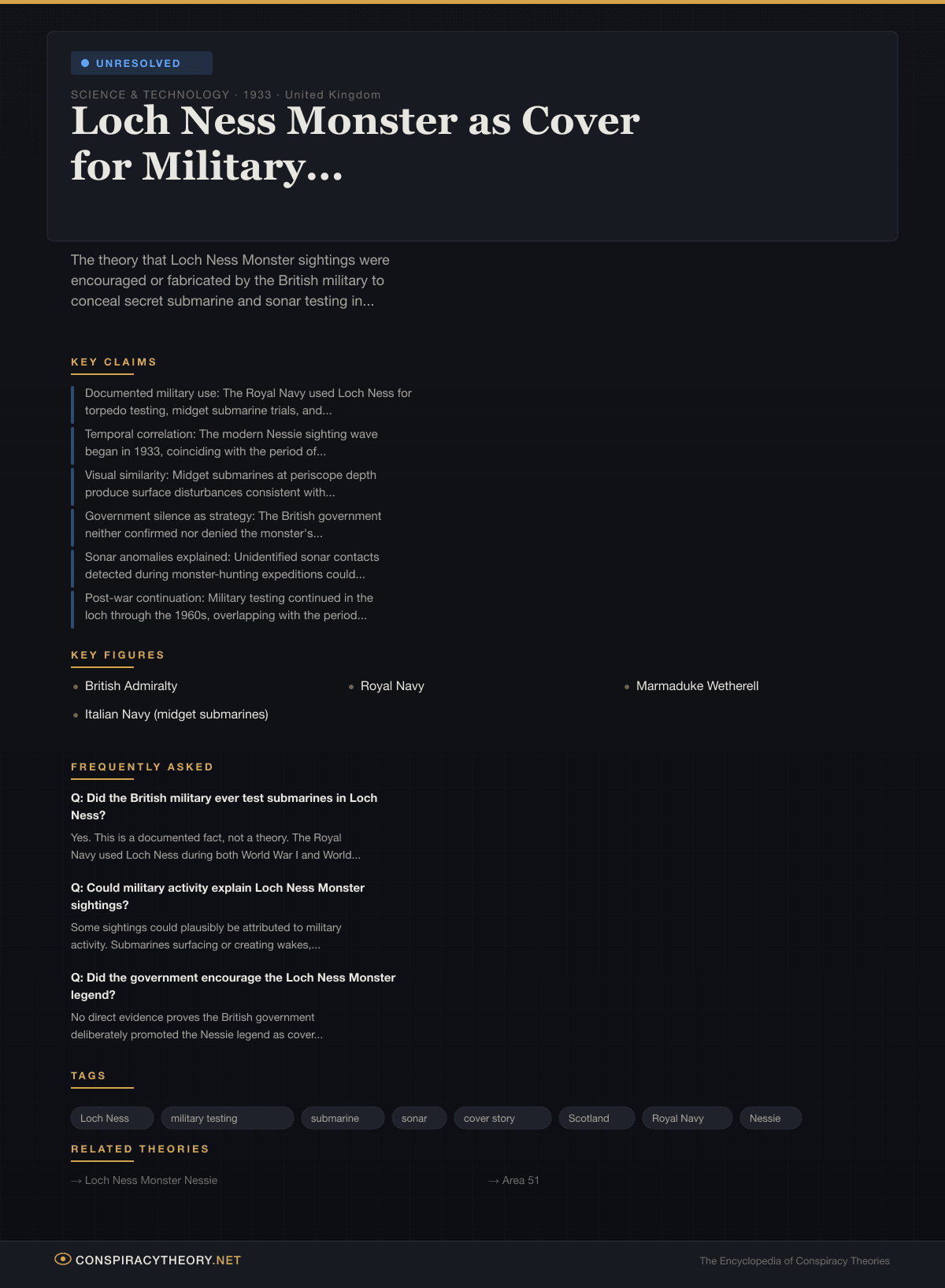
Loch Ness Monster as Cover for Military Submarine Testing

Overview
While the mainstream Loch Ness Monster debate focuses on whether an unknown creature inhabits Scotland’s largest freshwater lake, a parallel theory proposes a more mundane but equally secretive explanation: that some or all of the famous sightings were actually observations of classified military hardware being tested in the loch’s deep, dark waters — and that the monster legend was tolerated, if not actively encouraged, because it provided convenient cover for operations the British government wanted to keep hidden.
Origins & History
The theory begins with an inconvenient fact that the British government kept quiet for decades: the Royal Navy used Loch Ness as a military testing facility.
This is not speculation. During World War I, the Admiralty recognized the loch’s strategic value. At 37 kilometers long and up to 230 meters deep, with steep sides dropping sharply from the shoreline, Loch Ness offered deep-water conditions in a body of water completely shielded from enemy submarines and aerial reconnaissance. It was, in effect, a natural testing tank of enormous proportions, connected to the sea via the Caledonian Canal but protected from the open ocean where German U-boats patrolled.
By World War II, the military presence had expanded significantly. The Royal Navy established facilities near Drumnadrochit and Fort Augustus. HMS Doris, a depot ship, was stationed on the loch. The Special Operations Executive (SOE) had training facilities in the area. Most significantly, the Admiralty used the loch for testing torpedoes, experimental sonar equipment, and midget submarines — including captured Italian CB-class midget subs that had been seized in the Mediterranean.
The theory crystallized when researchers began noting the temporal overlap between military activity and the modern Nessie phenomenon. The first major wave of Loch Ness Monster sightings began in 1933 — precisely the period when the British government was ramping up its rearmament program and beginning to use the loch for weapons testing. The A82 road along the northern shore, completed that same year, provided a viewing platform for motorists — but also for military logistics.
Italian journalist and researcher Luca Palamara argued in his research that sightings of “humps” moving through the water could correspond to the profiles of midget submarines running at periscope depth. The wake pattern of a small submarine moving slowly beneath the surface — a low hump with a slight disturbance trailing behind — bears a striking resemblance to eyewitness descriptions of the Loch Ness Monster as seen from the shoreline road.
After the war, the military presence on Loch Ness diminished but did not entirely vanish. The loch continued to be used for occasional naval exercises and sonar calibration into the 1960s and 1970s. During this same period, the most organized scientific searches for the monster were conducted — including Operations Deepstar and Deepscan — sometimes using the very same sonar technology the military had developed and tested in those waters.
The theory was further developed by researchers who noted that the British government’s response to the monster legend during WWII was notable for its silence. No official denial was issued, no investigation was conducted, and the Admiralty — which had every reason to discourage public interest in the loch — said nothing. To theorists, this silence was strategic: a monster legend that kept civilian observers focused on looking at the water surface was far less dangerous than investigative journalists or foreign intelligence agents taking an interest in what was happening beneath it.
Key Claims
- Documented military use: The Royal Navy used Loch Ness for torpedo testing, midget submarine trials, and sonar experiments during both World Wars — a confirmed fact, not a theory
- Temporal correlation: The modern Nessie sighting wave began in 1933, coinciding with the period of increased military activity on the loch
- Visual similarity: Midget submarines at periscope depth produce surface disturbances consistent with many eyewitness descriptions of a long, humped creature moving through the water
- Government silence as strategy: The British government neither confirmed nor denied the monster’s existence, potentially because the legend provided useful cover for classified testing
- Sonar anomalies explained: Unidentified sonar contacts detected during monster-hunting expeditions could be military hardware, calibration equipment, or acoustic artifacts from decades of naval activity
- Post-war continuation: Military testing continued in the loch through the 1960s, overlapping with the period of most intensive scientific monster searches
- Captured enemy hardware: Italian midget submarines tested in the loch were of unknown provenance to most observers, and their presence was classified
Evidence
The evidence supporting the military-cover theory is a mixture of confirmed facts and circumstantial inference.
The confirmed facts are substantial. Ministry of Defence records, partially declassified, document the Royal Navy’s use of Loch Ness during WWII. The torpedo testing range, the presence of HMS Doris, and the testing of captured Italian midget submarines are matters of historical record, reported by naval historians including David K. Brown in his work on Royal Navy wartime technology. SOE training facilities in the Great Glen area are documented in official histories of British special operations.
The circumstantial case rests on correlation. The 1933 sighting wave coincides with rearmament-era military activity. The loch’s characteristics that make it attractive to cryptozoologists — its depth, darkness, and length — are precisely the characteristics that made it attractive to the Navy. The physical profile of objects described by witnesses (low humps, wakes without visible boats, objects surfacing and submerging) is consistent with submarine activity.
Against the theory, several points must be weighed. Nessie sightings continued long after military testing in the loch ceased, suggesting that whatever witnesses were seeing was not exclusively military hardware. Many sightings occurred in daylight during periods when military testing was conducted at night to avoid observation. The most famous piece of Nessie “evidence” — the Surgeon’s Photograph — was a confirmed hoax using a toy submarine, not a misidentification of a real one. And no whistleblower from the Royal Navy or Ministry of Defence has ever claimed that the government deliberately promoted the monster legend as cover.
The 2019 environmental DNA study found no evidence of any large unknown animal in the loch — but of course, it would not detect a submarine either. Interestingly, sonar surveys of the loch over the decades have occasionally detected large objects at depth that could not be identified, which proponents note is consistent with either a large animal or submerged hardware.
The theory remains unresolved because the core military activity is confirmed while the alleged cover-story function remains unproven.
Cultural Impact
The military submarine theory occupies an unusual niche in Loch Ness Monster discourse. It appeals to skeptics who reject the plesiosaur hypothesis but are intrigued by the consistency and volume of sightings over nearly a century. It offers a “rational conspiracy” explanation — one grounded in documented government behavior rather than cryptozoology or paranormal claims.
The theory has gained traction in military history circles, where researchers have documented the Navy’s use of Scottish lochs more broadly. Loch Ness was not the only body of water used for wartime testing; Loch Long, Loch Goil, and other Scottish lochs also hosted military operations, some of which generated their own local legends of unusual aquatic disturbances.
For the Nessie tourism industry, the military theory presents an interesting paradox: it debunks the monster while replacing it with a different mystery, potentially sustaining visitor interest. Drumnadrochit’s Loch Ness Centre has incorporated some military history into its exhibits, acknowledging the wartime use of the loch without explicitly connecting it to the monster legend.
The theory also speaks to a broader pattern in conspiracy research: the recognition that governments do use cover stories, that classified military operations do occur in public spaces, and that the most effective disinformation sometimes involves letting a more colorful falsehood flourish rather than actively constructing one. Whether that principle applies to Loch Ness specifically remains an open question.
Sources & Further Reading
- Brown, David K. The Royal Navy and the Loch: Naval Operations in Scottish Inland Waters. Various naval history journals.
- Binns, Ronald. The Loch Ness Mystery Solved. Open Books, 1983.
- Shine, Adrian. “Loch Ness.” The Loch Ness Project, ongoing research documentation.
- Campbell, Steuart. The Loch Ness Monster: The Evidence. Birlinn, 2002.
- Loxton, Daniel, and Donald Prothero. Abominable Science! Origins of the Yeti, Nessie, and Other Famous Cryptids. Columbia University Press, 2013.
- Mackenzie, S. P. The Home Guard: A Military and Political History. Oxford University Press, 1995. (Includes discussion of wartime Scottish loch usage)
- Ministry of Defence (UK). Declassified records relating to wartime testing facilities in Scottish waterways. National Archives, Kew.
Frequently Asked Questions
Did the British military ever test submarines in Loch Ness?
Could military activity explain Loch Ness Monster sightings?
Did the government encourage the Loch Ness Monster legend?

Infographic
Share this visual summary. Right-click to save.