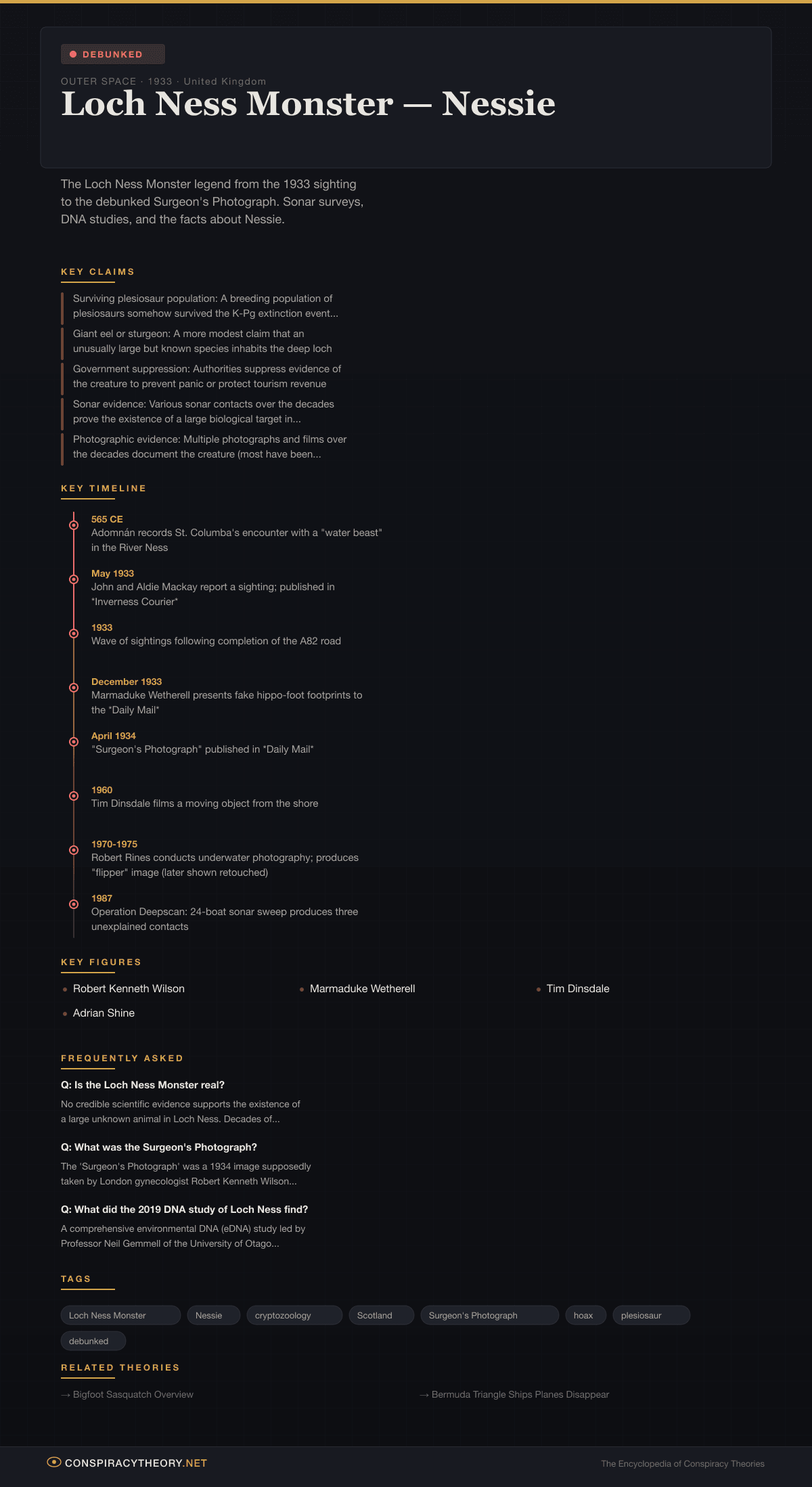
Loch Ness Monster — Nessie

Overview
The Loch Ness Monster — affectionately known as “Nessie” — is perhaps the world’s most famous cryptid. Since 1933, when a sighting was reported by a couple driving along the newly built road beside Scotland’s Loch Ness, thousands of people have claimed to see a large, unidentified creature in the deep, dark waters of the lake. The legend has generated countless photographs, sonar investigations, scientific expeditions, and an enduring tourism industry worth millions of pounds annually to the Scottish Highlands.
The most persistent claim is that the loch harbors a surviving population of plesiosaurs — marine reptiles that went extinct approximately 66 million years ago. Alternative hypotheses have included giant sturgeon, oversized eels, and various other aquatic creatures. Despite nearly a century of searching, no conclusive evidence has been found. The most famous photograph was exposed as a hoax, sonar surveys have produced ambiguous results at best, and a 2019 environmental DNA study found no trace of any large unknown species.
The theory is classified as debunked. While Loch Ness is a real and remarkably deep body of water with genuinely unusual characteristics, the scientific evidence overwhelmingly indicates that no large unknown animal inhabits it.
Origins & History
Early Reports
While proponents sometimes cite the 6th-century account of St. Columba encountering a “water beast” in the River Ness in 565 CE, this story — recorded over a century later by hagiographer Adomnán — was a conventional miracle narrative of the type common in saints’ lives and bears no meaningful connection to the modern Nessie legend.
Modern Loch Ness Monster history begins on May 2, 1933, when the Inverness Courier published an account by John and Aldie Mackay, who claimed to have seen an enormous creature disturbing the surface of the loch. The report coincided with the completion of the A82 road along the loch’s northern shore, which provided the first easy access to views of the water for passing motorists. A wave of sightings followed throughout 1933.
The Surgeon’s Photograph
The image that defined the Loch Ness Monster in the public imagination appeared in the Daily Mail on April 21, 1934. Attributed to London gynecologist Robert Kenneth Wilson (who refused to have his name associated with it, hence “the Surgeon’s Photograph”), it showed what appeared to be a long-necked creature rising from the water. For sixty years, it was considered the best photographic evidence of the monster.
In 1994, the photograph was exposed as a hoax. Christian Spurling, stepson of big-game hunter Marmaduke Wetherell, revealed on his deathbed that he, Wetherell, and Wilson had staged the image using a toy submarine fitted with a sculpted plastic and wood head. Wetherell had been motivated by revenge against the Daily Mail, which had hired him in 1933 to find the monster and then publicly humiliated him when he presented fake footprints (made with a hippopotamus-foot umbrella stand).
Major Expeditions
Numerous organized searches have been conducted:
- Tim Dinsdale (1960): Filmed what appeared to be a large object moving through the water. Enhanced analysis by the Royal Air Force’s Joint Air Reconnaissance Intelligence Centre initially supported Dinsdale’s claim, though later digital analysis suggested it could be a boat
- Operation Deepstar (1970): Underwater camera surveys producing ambiguous photographs, including the “flipper photograph” by Robert Rines — later shown to have been heavily retouched
- Operation Deepscan (1987): The largest sonar sweep of the loch, using 24 boats with sonar equipment. The operation detected three sonar contacts that could not be identified as known fish, but nothing conclusive
- The 2019 eDNA Study: Professor Neil Gemmell of the University of Otago led a comprehensive environmental DNA study, testing 250 water samples from across the loch at multiple depths
The eDNA Results
The 2019 study found DNA from over 3,000 species including humans, dogs, sheep, deer, and many fish species — but no reptile DNA, no plesiosaur DNA, and no DNA from any large unknown animal. The study did detect significant quantities of European eel (Anguilla anguilla) DNA throughout the loch. Gemmell suggested that unusually large eels, which can grow to substantial size in deep, food-rich waters, might account for some sightings.
Key Claims
- Surviving plesiosaur population: A breeding population of plesiosaurs somehow survived the K-Pg extinction event 66 million years ago and persists in Loch Ness
- Giant eel or sturgeon: A more modest claim that an unusually large but known species inhabits the deep loch
- Government suppression: Authorities suppress evidence of the creature to prevent panic or protect tourism revenue
- Sonar evidence: Various sonar contacts over the decades prove the existence of a large biological target in the loch
- Photographic evidence: Multiple photographs and films over the decades document the creature (most have been debunked as hoaxes, misidentifications, or manipulated images)
Evidence & Debunking
The Plesiosaur Problem
A plesiosaur population in Loch Ness faces insurmountable biological problems. Plesiosaurs were air-breathing reptiles that would need to surface frequently, making them highly visible. A viable breeding population would require dozens of individuals. Loch Ness, while deep (230 meters at maximum depth), contains insufficient biomass to support large marine predators — the loch is relatively nutrient-poor due to the cold, peaty water. Additionally, Loch Ness was completely covered by glaciers during the last Ice Age (ending approximately 10,000 years ago), meaning any population would have had to colonize the loch within the last 10 millennia — from where?
Sonar Evidence Is Inconclusive
While various sonar surveys have detected unexplained contacts, none has produced a clear image of a large biological target. Many contacts have been attributed to deep-water thermoclines, fish schools, floating debris, or sonar artifacts. Operation Deepscan’s three unexplained contacts, while intriguing at the time, were isolated returns that could not be reproduced.
Photographic Evidence Debunked
Every major photograph offered as Nessie evidence has been debunked or explained:
- The Surgeon’s Photograph (1934) — confirmed hoax
- The Rines “flipper photograph” (1972) — heavily retouched; original shows nothing identifiable
- The Frank Searle photographs (1970s) — exposed as hoaxes
- Various tourist photographs — typically identified as boat wakes, logs, swimming deer, or otters
What Sightings Actually Are
Researchers have identified several natural phenomena that account for sightings: boat wakes viewed from a distance on the long, narrow loch; standing waves caused by seiche effects (internal water oscillation); swimming deer, otters, and seals that occasionally enter the loch from the sea via the River Ness; floating logs in the dark, peaty water; and optical illusions caused by the loch’s unusual light conditions.
Cultural Impact
Tourism
The Loch Ness Monster is Scotland’s most commercially valuable legend, generating an estimated £25-£41 million annually for the Highland economy. The Loch Ness Centre and Exhibition (formerly the Official Loch Ness Monster Exhibition) attracts hundreds of thousands of visitors. Monster-themed businesses, tour operators, and merchandise shops line the A82. This economic incentive creates a structural motivation to sustain the legend regardless of evidence.
Cryptozoology
Nessie is the flagship case for cryptozoology — the pseudoscientific study of animals whose existence is not proven. The monster’s cultural prominence has sustained broader interest in lake monsters worldwide, from Lake Champlain’s “Champ” to Sweden’s “Storsjöodjuret.”
Science Communication
The 2019 eDNA study was widely praised as an example of how to address cryptozoological claims with genuine science. Rather than dismissing the question, Gemmell’s team used rigorous methodology to test the hypothesis and communicate results accessibly, generating massive public interest in environmental DNA technology.
Timeline
- 565 CE — Adomnán records St. Columba’s encounter with a “water beast” in the River Ness
- May 1933 — John and Aldie Mackay report a sighting; published in Inverness Courier
- 1933 — Wave of sightings following completion of the A82 road
- December 1933 — Marmaduke Wetherell presents fake hippo-foot footprints to the Daily Mail
- April 1934 — “Surgeon’s Photograph” published in Daily Mail
- 1960 — Tim Dinsdale films a moving object from the shore
- 1970-1975 — Robert Rines conducts underwater photography; produces “flipper” image (later shown retouched)
- 1987 — Operation Deepscan: 24-boat sonar sweep produces three unexplained contacts
- 1994 — Christian Spurling confesses the Surgeon’s Photograph was a hoax
- 2003 — BBC-sponsored sonar and satellite survey finds no evidence of large animals
- 2019 — eDNA study tests 250 water samples; finds no unknown large species; suggests giant eels
- 2023 — Largest coordinated surface watch since 1987 organized using thermal drones; no conclusive sightings
Sources & Further Reading
- Binns, Ronald. The Loch Ness Mystery Solved. Open Books, 1983.
- Shine, Adrian. “Loch Ness.” The Loch Ness Project, ongoing research.
- Gemmell, Neil J., et al. “Environmental DNA Study of Loch Ness.” University of Otago, 2019.
- Campbell, Steuart. The Loch Ness Monster: The Evidence. Birlinn, 2002.
- Loxton, Daniel, and Donald Prothero. Abominable Science! Origins of the Yeti, Nessie, and Other Famous Cryptids. Columbia University Press, 2013.
- Bauer, Henry H. The Enigma of Loch Ness. University of Illinois Press, 1986.
- Martin, David, and Alastair Boyd. Nessie: The Surgeon’s Photograph Exposed. 1999.
Frequently Asked Questions
Is the Loch Ness Monster real?
What was the Surgeon's Photograph?
What did the 2019 DNA study of Loch Ness find?

Infographic
Share this visual summary. Right-click to save.