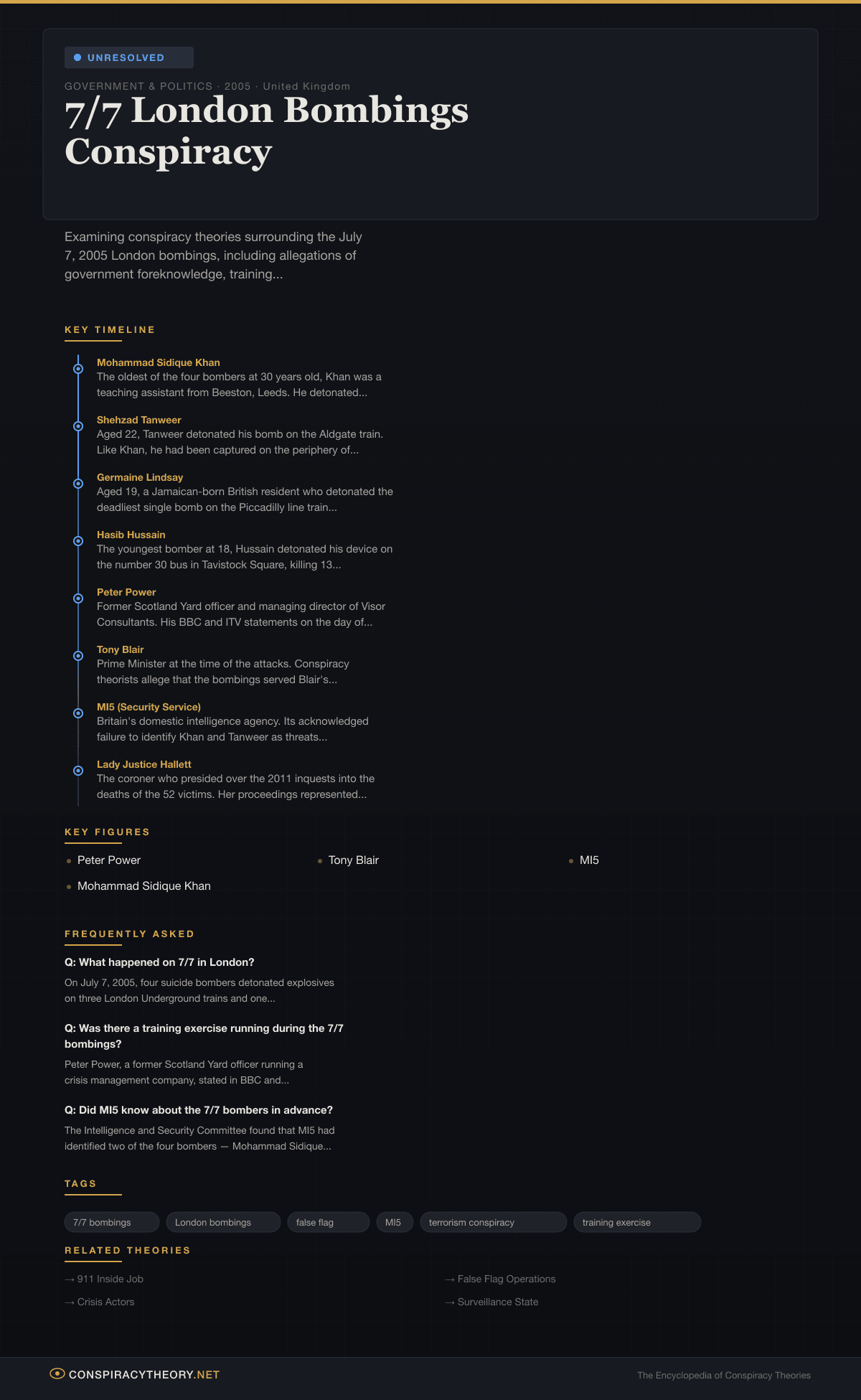
7/7 London Bombings Conspiracy
![7/7 London Bombings Conspiracy (2005) — NHS Spending 1948/49-2014/15[1]](/images/theories/london-77-bombings-conspiracy/header.jpg)
Overview
On the morning of 7 July 2005, four coordinated suicide bombings struck central London’s public transport system during the height of the morning rush hour. Three bombs detonated on Underground trains within fifty seconds of each other at 8:50 a.m. — at Aldgate, Edgware Road, and between King’s Cross and Russell Square stations — and a fourth exploded on the upper deck of a number 30 double-decker bus in Tavistock Square nearly an hour later at 9:47 a.m. The attacks killed 52 civilians and the four bombers themselves, and injured more than 700 people. The British government identified the perpetrators as four British-born men — Mohammad Sidique Khan, Shehzad Tanweer, Germaine Lindsay, and Hasib Hussain — who had been influenced by al-Qaeda ideology.
In the weeks and months following the attacks, a range of conspiracy theories emerged alleging that the official account was incomplete or fabricated. These theories have coalesced around several core claims: that the British security services had foreknowledge of the attacks and deliberately allowed them to proceed; that the simultaneous occurrence of a private-sector crisis management exercise simulating bombings at the same stations constituted evidence of state orchestration; that the bombers were patsies or intelligence assets rather than genuine self-directed terrorists; and that the attacks constituted a false flag operation designed to justify British participation in the Iraq War and the expansion of domestic surveillance powers.
Unlike many conspiracy theories surrounding terrorist attacks, the 7/7 theories are complicated by documented failures within British intelligence. Official inquiries confirmed that MI5 had prior contact with two of the four bombers during surveillance operations targeting other suspects but had failed to identify them as threats. This acknowledged intelligence failure has provided a foundation upon which more elaborate theories of deliberate complicity have been constructed. The theory is classified as unresolved — not because the false flag claims have credible evidentiary support, but because legitimate questions about the extent of intelligence failures and possible informant relationships have never been fully answered by public inquiries.
Origins & History
The Attacks
The 7 July 2005 bombings took place one day after London had won its bid to host the 2012 Olympic Games, and during a G8 summit being hosted by Prime Minister Tony Blair at Gleneagles in Scotland. The timing was immediately noted by commentators. The four bombers had travelled together by car from Leeds to Luton, where they boarded a Thameslink train to London King’s Cross station. CCTV footage captured the four men entering the station at 8:26 a.m., appearing calm and carrying large rucksacks containing homemade organic peroxide-based explosives.
The three Underground bombs detonated almost simultaneously. The explosion between King’s Cross and Russell Square, on a Piccadilly line train in a deep tunnel, was the deadliest single attack, killing 26 passengers. The Aldgate and Edgware Road explosions killed 7 and 6 people respectively. Hasib Hussain, the youngest bomber at 18 years old, was believed to have originally intended to detonate his device on a Northern line train but was diverted when that service was disrupted. He boarded the number 30 bus and detonated his bomb at 9:47 a.m. in Tavistock Square, killing 13 passengers.
Early Conspiracy Theories
Conspiracy theories surfaced almost immediately. On the day of the attacks, Peter Power, managing director of Visor Consultants and a former Scotland Yard officer, gave interviews to BBC Radio 5 Live and ITV News in which he stated that his company had been running a crisis management exercise that morning for a private client. Power stated that the exercise was “based on simultaneous bombs going off precisely at the railway stations where it happened this morning.” This statement, broadcast live on national television and radio, became the foundational piece of evidence for conspiracy theorists, who drew parallels to claims that military exercises simulating hijacked aircraft were being conducted on the morning of the September 11, 2001 attacks in the United States.
Within weeks, internet forums and early social media platforms were circulating detailed alternative narratives. The documentary film “Ludicrous Diversion,” released anonymously online in 2006, presented a compressed argument that the bombings were a false flag operation. It was followed in 2009 by “7/7 Ripple Effect,” a more elaborate documentary produced by Muad’Dib (the pseudonym of Anthony John Hill), which alleged that the four bombers were innocent patsies and that the bombs had been planted under the floors of the trains by security services. Hill was subsequently extradited from Ireland to the United Kingdom and tried for attempting to pervert the course of justice by mailing copies of his film to the jury in the trial connected to a failed follow-up attack on 21 July 2005. He was acquitted in 2011.
The publication of the official narrative by the Home Office in May 2006 — a document that was not a full independent public inquiry but rather a descriptive account of events — failed to satisfy critics. Survivors, bereaved families, and opposition politicians had called for a full independent public inquiry similar to the 9/11 Commission in the United States, but the Blair government and subsequent governments under Gordon Brown and David Cameron resisted these calls until the coroner’s inquests were concluded in 2011. The absence of a comprehensive public inquiry became, for many, further evidence of a cover-up.
Key Claims
The Peter Power Exercise Coincidence
The single most cited piece of evidence in 7/7 conspiracy theories is Peter Power’s statement about the Visor Consultants training exercise. Conspiracy theorists argue that the probability of a private company independently choosing to simulate bombings at the exact same stations on the exact same morning is so astronomically low that it can only be explained by foreknowledge or coordination with the actual attackers.
Power subsequently clarified that the exercise was a small tabletop discussion for a mid-sized company, not a live deployment, and that it involved only about six or seven people sitting around a table. He stated that the scenario was based on broad assumptions about likely targets rather than specific intelligence, and that after the real bombings began his team immediately abandoned the exercise and switched to genuine crisis response. Critics of the conspiracy theory note that the London Underground has 270 stations and that major hub stations like King’s Cross, Edgware Road, and Aldgate would be obvious targets in any terrorism scenario planning exercise.
MI5 Foreknowledge and the Khan-Tanweer Surveillance
The Intelligence and Security Committee’s report, published in May 2006, confirmed that MI5 had encountered Mohammad Sidique Khan and Shehzad Tanweer during surveillance operations targeting other known extremists in early 2004, more than a year before the attacks. MI5 had photographed both men and recorded Khan’s vehicle registration but had assessed them as peripheral figures — associates of the primary surveillance targets rather than threats in their own right — and had not pursued further investigation.
Conspiracy theorists argue that this acknowledged contact was far more extensive than officially admitted and that Khan and possibly other bombers were in fact MI5 informants or assets who were being handled as part of a larger operation. This claim draws on historical precedent — MI5 and its predecessor agencies have a documented history of running informants within extremist groups, including during the Northern Ireland conflict, where some informants were involved in or had knowledge of violent acts.
Bombs Under the Trains
A specific technical claim, popularized by “7/7 Ripple Effect” and various online forums, alleges that the explosions came from beneath the floors of the Underground trains rather than from devices carried in the bombers’ rucksacks. Early eyewitness statements from survivors described the floor of the carriage being blown upward, which proponents argue is inconsistent with a bomb detonated at seat or floor level inside the carriage. Conspiracy theorists claim this indicates that pre-planted explosive devices were attached to the underside of the trains, and that the four men identified as bombers were either unwitting participants or entirely fabricated perpetrators.
False Flag Motive
The broader conspiracy narrative frames the bombings as a false flag operation designed to achieve specific political objectives for the Blair government. The attacks occurred during a period of intense public opposition to British involvement in the Iraq War, and conspiracy theorists argue that the bombings were intended to reinforce the government’s narrative that terrorism posed an imminent domestic threat, thereby justifying continued military operations abroad and the introduction of expanded surveillance and counter-terrorism legislation at home. The Prevention of Terrorism Act 2005, which introduced control orders, had been passed earlier that year, and the Terrorism Act 2006, which extended pre-charge detention for terror suspects, was introduced in the months following the bombings.
The Failure to Hold a Public Inquiry
The Blair government’s refusal to convene an independent public inquiry, despite sustained campaigning by survivors and bereaved families, is cited by conspiracy theorists as evidence of a deliberate effort to suppress information. Successive governments maintained that the coroner’s inquests and the Intelligence and Security Committee review were sufficient, but critics argued that neither mechanism had the scope or powers to fully examine intelligence failures and the broader circumstances of the attacks.
Evidence
Evidence Cited by Conspiracy Proponents
- Peter Power’s statements: His BBC and ITV interviews on 7 July 2005 confirming a crisis simulation at the same stations on the same morning remain the most frequently cited piece of circumstantial evidence
- MI5’s prior contact with Khan and Tanweer: Official acknowledgment that two of the four bombers had been encountered during surveillance operations but were not pursued
- Eyewitness testimony about the explosions: Survivor accounts describing the floor of the train carriage being ripped upward, interpreted by some as evidence of bombs placed beneath the train rather than inside it
- Historical precedent of false flag operations: Conspiracy proponents draw parallels to confirmed historical incidents such as Operation Gladio (NATO-linked stay-behind operations in Italy linked to terrorist attacks during the Cold War) and the Gulf of Tonkin incident
- CCTV gaps: The absence of any released CCTV footage showing the four bombers boarding the Underground trains at King’s Cross, despite the station being one of the most heavily surveilled in London. The only widely released image shows the four men entering Luton station
- Mohammad Sidique Khan’s MI5 file: Freedom of Information requests and subsequent legal proceedings revealed that MI5 held more information on Khan than was initially disclosed, fueling claims of a deeper relationship between the bomber and the security services
- The political context: The bombings occurred at a moment of maximum political utility for a government facing growing opposition to its foreign and domestic security policies
Evidence Supporting the Official Account
- Forensic evidence: Extensive forensic analysis by Metropolitan Police and independent experts confirmed that the explosions were consistent with devices detonated inside the train carriages, not beneath them. Traces of TATP (triacetone triperoxide) were found at all four blast sites and in the bombers’ car and a bomb-making facility in Leeds
- The bombers’ “martyrdom” videos: Mohammad Sidique Khan and Shehzad Tanweer recorded video statements before the attacks in which they explained their motivations in explicitly ideological terms, referencing British foreign policy and expressing commitment to violent jihad. These videos were subsequently broadcast by Al Jazeera
- The Leeds bomb factory: Police discovered a bomb-making facility in a rented flat at 18 Alexandra Grove, Leeds, containing residues of the same peroxide-based explosives used in the attacks, along with other bomb-making materials
- CCTV and communications evidence: Extensive CCTV footage and mobile phone records documented the bombers’ movements from Leeds to Luton and into London, their purchase of materials, and their reconnaissance trips to London in the months before the attack
- The failed 21 July attacks: A near-identical copycat attack was attempted exactly two weeks later on 21 July 2005, using the same type of peroxide-based explosives. All four devices failed to fully detonate, and the perpetrators were arrested, tried, and convicted. The existence of a closely linked follow-up attack by a separate cell strongly supports the official narrative of organic, al-Qaeda-inspired terrorism rather than a state-orchestrated false flag
- Expert analysis of blast damage: Independent blast analysis experts consulted during the coroner’s inquest testified that the pattern of damage was entirely consistent with devices detonated at floor level inside the carriages. Survivors’ perceptions of the floor rising were explained as the natural effect of a blast wave in an enclosed space, where pressure acts in all directions
Debunking / Verification
The 7/7 conspiracy theories occupy an uncomfortable middle ground. The core false flag and “bombs under the trains” claims have been substantially undermined by forensic evidence, the bombers’ own recorded statements, the discovery of the bomb factory, and the corroborating evidence of the failed 21 July attacks. No credible forensic or documentary evidence has been presented to support the claim that the bombings were a state-orchestrated operation.
However, legitimate questions about the extent of MI5’s prior knowledge remain only partially answered. The coroner’s inquest in 2011, led by Lady Justice Hallett, examined intelligence issues in some depth and concluded that MI5 could not reasonably have been expected to prevent the attacks given the information available and the resource constraints it faced. But the inquest also heard evidence that MI5’s assessment of Khan as a peripheral figure may have been a more significant error than initially acknowledged. A 2009 Intelligence and Security Committee report revealed that MI5 had five separate points of contact with Khan between 2001 and 2005, a higher number than originally disclosed.
Peter Power’s exercise has been investigated by journalists and researchers who have broadly accepted his explanation that it was a small-scale tabletop discussion using plausible London targets, not a live exercise or one based on intelligence. Power himself has consistently maintained his original account and has pointed out that crisis management companies routinely use realistic scenarios based on publicly available threat assessments. Nevertheless, his initial on-air statements remain a potent piece of conspiracy folklore, in part because no independent verification of the exercise’s client, scope, or documentation has been publicly released.
The refusal to hold a full public inquiry remains the most substantive grievance of both conspiracy theorists and legitimate critics of the official response. While the coroner’s inquest was thorough, it did not have the same powers or scope as a statutory public inquiry and could not compel the production of classified intelligence material. The families of victims who campaigned for a public inquiry — including the July 7th Truth Campaign and the broader survivor community — were not, for the most part, conspiracy theorists; they were individuals seeking accountability and transparency from institutions that they felt had failed to protect them.
Cultural Impact
The 7/7 conspiracy theories have had a more limited cultural footprint than their 9/11 counterparts but have nonetheless played a significant role in British political and media discourse. The theories became closely intertwined with the broader anti-war movement, which viewed the bombings as a direct consequence of the Blair government’s decision to invade Iraq — a position articulated by the bombers themselves in their recorded statements, and one that blurred the line between mainstream political criticism and conspiratorial thinking.
The documentary “7/7 Ripple Effect” became one of the most widely viewed conspiracy films in the United Kingdom, circulating extensively online and generating significant media coverage during Anthony John Hill’s extradition and trial. The film’s acquittal on perverting-the-course-of-justice charges was interpreted by supporters as vindication of its claims, though the acquittal related to the legal question of intent rather than the factual accuracy of the film’s allegations.
The conspiracy theories also contributed to a broader erosion of public trust in British institutions during the 2000s, alongside the Iraq War intelligence failures, the expenses scandal, and the phone-hacking revelations. For some communities, particularly among British Muslims who felt disproportionately targeted by counter-terrorism policies introduced after the bombings, the theories offered an alternative framework for understanding events that they felt the government had instrumentalized against them.
The attacks and their aftermath directly influenced British counter-terrorism legislation and surveillance policy. The Terrorism Act 2006 and the expansion of CCTV and electronic surveillance capabilities in the United Kingdom were both accelerated by the political environment created by the bombings — a fact that conspiracy theorists point to as evidence of motive and that critics of government overreach cite as a cautionary tale about the security state.
Key Figures
-
Mohammad Sidique Khan — The oldest of the four bombers at 30 years old, Khan was a teaching assistant from Beeston, Leeds. He detonated his device on the Edgware Road train. MI5 had photographed him during surveillance of other suspects in 2004 but assessed him as a peripheral figure. His pre-attack “martyrdom” video was broadcast by Al Jazeera in September 2005.
-
Shehzad Tanweer — Aged 22, Tanweer detonated his bomb on the Aldgate train. Like Khan, he had been captured on the periphery of MI5 surveillance operations. His video statement was released by Al Jazeera in July 2006, on the first anniversary of the attacks.
-
Germaine Lindsay — Aged 19, a Jamaican-born British resident who detonated the deadliest single bomb on the Piccadilly line train between King’s Cross and Russell Square, killing 26 people. He had no known prior contact with MI5.
-
Hasib Hussain — The youngest bomber at 18, Hussain detonated his device on the number 30 bus in Tavistock Square, killing 13 people. His bomb detonated nearly an hour after the three Underground explosions.
-
Peter Power — Former Scotland Yard officer and managing director of Visor Consultants. His BBC and ITV statements on the day of the attacks about a simultaneous crisis exercise became the single most cited element of 7/7 conspiracy theories. Power has consistently maintained his account and has cooperated with journalists investigating the coincidence.
-
Tony Blair — Prime Minister at the time of the attacks. Conspiracy theorists allege that the bombings served Blair’s political interests by reinforcing the domestic terrorism threat and justifying continued involvement in Iraq and Afghanistan.
-
MI5 (Security Service) — Britain’s domestic intelligence agency. Its acknowledged failure to identify Khan and Tanweer as threats despite prior surveillance contact is the most substantive element underlying conspiracy claims of foreknowledge or complicity.
-
Lady Justice Hallett — The coroner who presided over the 2011 inquests into the deaths of the 52 victims. Her proceedings represented the most thorough public examination of the attacks and included scrutiny of MI5’s intelligence failures.
-
Anthony John Hill (Muad’Dib) — Producer of the conspiracy documentary “7/7 Ripple Effect.” He was extradited from Ireland and tried for attempting to pervert the course of justice by sending copies of his film to the jury in the 21/7 trial. He was acquitted in 2011.
Timeline
- 7 July 2005 — Four coordinated suicide bombings strike three London Underground trains and one double-decker bus during morning rush hour, killing 52 people and injuring over 700
- 7 July 2005 — Peter Power gives BBC and ITV interviews stating his company was running a crisis exercise simulating bombings at the same stations that morning
- 12 July 2005 — Police identify the four bombers from CCTV footage and forensic evidence recovered from the blast sites
- 21 July 2005 — A copycat attack is attempted on three Underground trains and a bus using similar peroxide-based explosives; all four devices fail to fully detonate
- 1 September 2005 — Al Jazeera broadcasts Mohammad Sidique Khan’s pre-attack video statement
- 11 May 2006 — The Home Office publishes its official narrative of the attacks, a descriptive account rather than an independent inquiry
- May 2006 — The Intelligence and Security Committee publishes its report, confirming MI5 had prior contact with Khan and Tanweer but assessing that the attacks could not reasonably have been prevented
- 2006 — The anonymous documentary “Ludicrous Diversion” is released online, presenting a compressed false flag argument
- November 2007 — “7/7 Ripple Effect” documentary by Muad’Dib is released online, alleging the bombers were innocent and the bombs were planted under the trains
- 6 July 2006 — Al Jazeera broadcasts Shehzad Tanweer’s pre-attack video on the first anniversary of the attacks
- 2009 — A follow-up Intelligence and Security Committee report reveals MI5 had five separate points of contact with Khan between 2001 and 2005, more than originally disclosed
- 2009 — Anthony John Hill is arrested in Ireland for mailing copies of “7/7 Ripple Effect” to the jury in the 21/7 bombers’ trial
- May 2011 — Hill is acquitted of attempting to pervert the course of justice at Southwark Crown Court
- October 2010 - May 2011 — Coroner’s inquests into the 52 deaths are conducted by Lady Justice Hallett at the Royal Courts of Justice
- 6 May 2011 — Lady Justice Hallett delivers her inquest rulings, concluding the victims were unlawfully killed by the four bombers and criticizing aspects of the emergency response, while finding that MI5 could not reasonably have been expected to prevent the attacks
- 2011-present — Calls for a full statutory public inquiry continue from some survivors’ groups and civil liberties organizations but have not been granted by successive governments
Sources & Further Reading
- Intelligence and Security Committee. “Report into the London Terrorist Attacks on 7 July 2005.” Her Majesty’s Stationery Office, May 2006
- Intelligence and Security Committee. “Could 7/7 Have Been Prevented? Review of the Intelligence on the London Terrorist Attacks on 7 July 2005.” Her Majesty’s Stationery Office, May 2009
- Home Office. “Report of the Official Account of the Bombings in London on 7th July 2005.” Her Majesty’s Stationery Office, May 2006
- Lady Justice Hallett. “Coroner’s Inquests into the London Bombings of 7 July 2005.” Royal Courts of Justice, 2010-2011
- Srivastava, Kiran. “7/7 London Bombings: The Unanswered Questions.” The Guardian, July 2010
- BBC News. “7 July Bombings: Overview.” BBC, 2005-2011
- Quilty-Harper, Conrad. “The 7/7 Conspiracy Theories.” The Daily Telegraph, July 2009
- Malik, Shiv. “My Brother the Bomber.” Prospect Magazine, June 2007
- Casciani, Dominic. “MI5 and the 7/7 Bombers: What Did They Know?” BBC News, May 2011
- Power, Peter. Interviews with BBC Radio 5 Live and ITV News, 7 July 2005
- “7/7 Ripple Effect.” Documentary film directed by Muad’Dib (Anthony John Hill), 2007
- Staniforth, Andrew. The Routledge Companion to UK Counter-Terrorism. Routledge, 2012
Frequently Asked Questions
What happened on 7/7 in London?
Was there a training exercise running during the 7/7 bombings?
Did MI5 know about the 7/7 bombers in advance?
Infographic
Share this visual summary. Right-click to save.