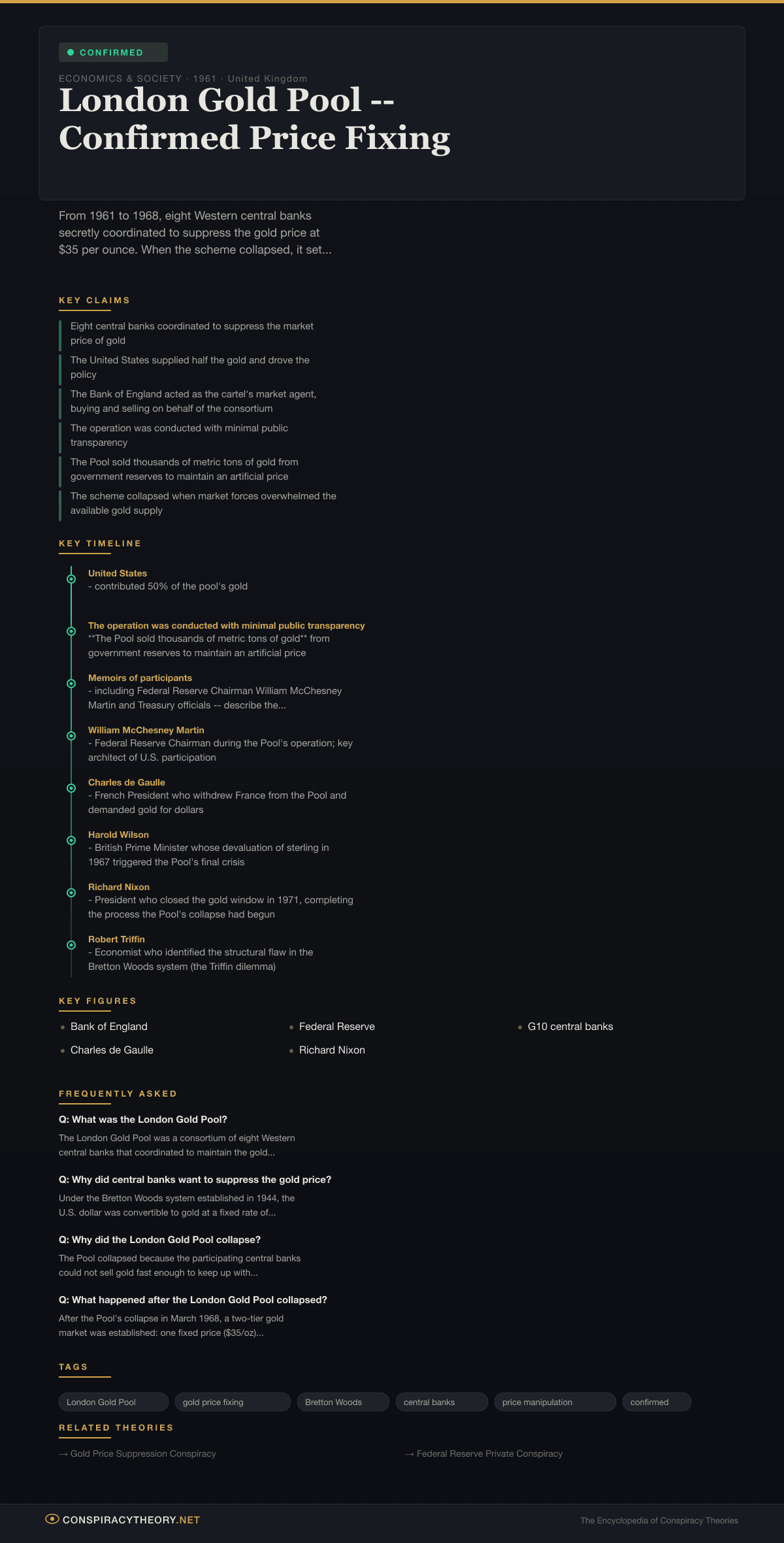
London Gold Pool -- Confirmed Price Fixing

Overview
When gold conspiracy theorists claim that central banks manipulate the gold price, they are sometimes dismissed as paranoid. But they have at least one powerful data point on their side: from 1961 to 1968, eight of the world’s most powerful central banks did exactly that. They formed a secret cartel called the London Gold Pool, sold massive quantities of gold onto the open market to suppress its price, and maintained the fiction of a $35-per-ounce gold price for seven years until the scheme spectacularly collapsed.
This is not a conspiracy theory. This is a confirmed conspiracy, documented in central bank archives, Federal Reserve meeting minutes, and the memoirs of the policymakers who ran it. The London Gold Pool is the rare case where the “they’re manipulating the markets” crowd is demonstrably correct about the historical precedent — the question is only whether they are correct about what is happening today.
The Pool’s collapse in 1968 set off a chain of events that would reshape the global monetary system: the end of the Bretton Woods gold standard, Nixon’s closure of the gold window in 1971, and the transition to the fiat currency system that governs the world economy today.
Origins & History
The Bretton Woods System
To understand why central banks conspired to fix the gold price, you need to understand the system they were trying to protect.
In July 1944, delegates from 44 Allied nations met at the Mount Washington Hotel in Bretton Woods, New Hampshire, to design a new international monetary system for the postwar world. The system they created was anchored to gold through the U.S. dollar:
- The United States agreed to redeem dollars for gold at a fixed rate of $35 per ounce
- Other countries pegged their currencies to the dollar at fixed exchange rates
- The International Monetary Fund (IMF) was created to manage the system
This arrangement worked because the United States held the world’s largest gold reserves — approximately 20,000 metric tons at the system’s peak — and its economy was dominant. But the system contained a structural flaw that economist Robert Triffin identified in 1960: for the dollar to function as the world’s reserve currency, the United States had to run persistent trade deficits, pumping dollars into the global economy. But the more dollars were in circulation, the less credible the promise to redeem them for gold at $35 per ounce became. Eventually, there would be far more dollars abroad than gold in Fort Knox to back them.
This was the “Triffin dilemma,” and by the early 1960s, it was becoming acute.
The 1960 Gold Crisis
In October 1960, the market price of gold on the London gold market spiked to $40 per ounce — $5 above the official Bretton Woods price. The spike was triggered by fears that incoming U.S. President John F. Kennedy might devalue the dollar. Although the Bank of England intervened to push the price back down, the episode sent a clear signal: the market did not believe $35 gold was sustainable.
The crisis prompted action. In late 1960 and early 1961, the United States proposed a coordinated intervention mechanism to prevent future price spikes.
Formation of the Pool (1961)
The London Gold Pool was formally established in November 1961. Eight central banks agreed to pool their gold resources and intervene in the London market to maintain the $35 price:
- United States — contributed 50% of the pool’s gold
- United Kingdom (Bank of England) — contributed approximately 9%
- West Germany (Bundesbank)
- France (Banque de France)
- Italy (Banca d’Italia)
- Belgium (National Bank of Belgium)
- Netherlands (De Nederlandsche Bank)
- Switzerland (Swiss National Bank)
The Bank of England acted as the Pool’s agent in the London market, buying or selling gold on behalf of the consortium to maintain the target price. When market demand pushed the price up, the Bank of England sold gold from the Pool’s reserves. When the price dropped, it bought gold to replenish reserves.
The operation was conducted with minimal public disclosure. While the Pool’s existence was known to market insiders, its scale, mechanics, and internal deliberations were not public knowledge at the time.
The Early Years: Success
For the first several years, the Pool functioned smoothly. Global gold production was rising (South African mining output was at record levels), and demand was manageable. The Pool occasionally needed to sell gold to defend the price, but the quantities were modest, and it was able to buy gold back during quieter periods to rebuild reserves.
Between 1961 and 1965, the Pool even turned a small profit for its member banks on some transactions.
The Vietnam War and Rising Pressure
The pressures began mounting in 1965. The United States was escalating its involvement in Vietnam, and President Lyndon Johnson was simultaneously expanding domestic spending through the Great Society programs. The resulting budget deficits and monetary expansion undermined confidence in the dollar.
Foreign holders of dollars — particularly European central banks — began to question whether the United States could honor its commitment to redeem dollars at $35 per ounce. The rational response was to exchange dollars for gold while the promise still held. The irrational response — from the Pool’s perspective — was to try to buy gold on the open market at $35 before the price went higher.
The Pool found itself selling increasing quantities of gold to absorb this demand.
France Withdraws (1967)
President Charles de Gaulle of France was an outspoken critic of what he called the “exorbitant privilege” of the dollar’s reserve currency status. He believed the Bretton Woods system unfairly benefited the United States, which could print dollars that other countries were obliged to accept.
In June 1967, France withdrew from the London Gold Pool and began actively converting its dollar reserves into gold, demanding physical delivery from the U.S. Treasury. France’s withdrawal removed a significant contributor from the Pool and signaled to the market that the system was fracturing.
The November 1967 Crisis
On November 18, 1967, the British government devalued the pound sterling by 14.3% — the first devaluation since 1949. The devaluation, driven by Britain’s persistent balance-of-payments problems, triggered a massive wave of gold buying as investors fled currencies they perceived as vulnerable.
In the weeks following the devaluation, the London Gold Pool sold approximately 1,000 metric tons of gold — an enormous quantity — to defend the $35 price. The Pool’s reserves were being rapidly depleted.
The Final Collapse (March 1968)
The end came swiftly. In early March 1968, gold demand surged again, driven by:
- Continued U.S. budget deficits and Vietnam War spending
- Speculation that the dollar would be devalued
- Recognition that the Pool was running out of gold to sell
On a single day — March 14, 1968 — the London gold market traded 400 metric tons, an unprecedented volume. The Pool’s agents were overwhelmed. The Bank of England telexed the Federal Reserve: the market was out of control.
On March 15, 1968, the British government closed the London gold market at the request of the United States. It remained closed for two weeks.
When it reopened, the gold standard had been fundamentally altered. The Pool was dissolved, and a “two-tier” system was announced:
- Central banks would continue to transact with each other at $35 per ounce
- The private market would be allowed to find its own price
The fiction of a unified $35 gold price was over.
Key Claims
This is a confirmed conspiracy with established facts:
- Eight central banks coordinated to suppress the market price of gold
- The United States supplied half the gold and drove the policy
- The Bank of England acted as the cartel’s market agent, buying and selling on behalf of the consortium
- The operation was conducted with minimal public transparency
- The Pool sold thousands of metric tons of gold from government reserves to maintain an artificial price
- The scheme collapsed when market forces overwhelmed the available gold supply
- The collapse accelerated the end of the Bretton Woods system
Evidence
The evidence is documentary and undisputed:
- Federal Reserve meeting minutes discuss the Pool’s operations, strategy, and eventually its collapse
- Bank of England archives document the Pool’s day-to-day trading operations
- U.S. Treasury records show gold outflows from Fort Knox and other depositories
- Diplomatic cables between participating governments discuss the Pool’s management
- Memoirs of participants — including Federal Reserve Chairman William McChesney Martin and Treasury officials — describe the Pool’s operations
- Market data from the London gold fixing confirm the price suppression and its eventual failure
- French government statements by de Gaulle and his finance minister publicly criticized the arrangement
Verification
This conspiracy is confirmed and is not disputed by any of the participating institutions. The Federal Reserve, the Bank of England, and other central banks have acknowledged the Pool’s existence and operations. It is documented in mainstream economic history textbooks and central bank archives.
Cultural Impact
Gold Bug Vindication
The London Gold Pool is frequently cited by “gold bugs” — advocates of gold-backed currency and critics of central banking — as proof that central banks are willing and able to manipulate gold markets. The argument runs: if they did it from 1961 to 1968, what makes you think they stopped?
This argument is not unreasonable on its face, though the specific mechanisms and motivations of modern gold market intervention (if any) would differ substantially from the Pool’s open-market sales.
The End of Bretton Woods
The Pool’s collapse was the beginning of the end for the Bretton Woods system. The two-tier gold market established in March 1968 was an unstable compromise. Central banks were supposed to transact at $35, but the private market price quickly diverged upward, creating arbitrage opportunities and further pressure on the official price.
On August 15, 1971, President Richard Nixon unilaterally suspended dollar-gold convertibility — the “Nixon Shock.” The Bretton Woods system was effectively dead. By 1976, the Jamaica Accords formally ended the gold standard, and the world transitioned to the floating exchange rate system that persists today.
Lessons for Financial Regulation
The London Gold Pool is studied in economics and finance as a case study in the limits of market intervention. It demonstrates that even the most powerful actors — in this case, the central banks of eight major economies — cannot indefinitely maintain an artificial price against fundamental market forces. The Pool’s failure is invoked in debates about currency pegs, commodity price supports, and central bank intervention generally.
The GATA Argument
The Gold Anti-Trust Action Committee (GATA), founded in 1999, has argued for decades that central banks continue to suppress the gold price through various mechanisms. GATA cites the London Gold Pool as historical precedent and argues that modern interventions — through derivatives, gold leasing, and coordinated central bank sales — achieve similar results through less visible means. Mainstream economists generally dismiss GATA’s claims, but the organization has obtained documents through FOIA requests that it argues support ongoing intervention.
In Popular Culture
- The Big Short (2015) — while focused on the 2008 financial crisis, the film’s themes of market manipulation and institutional deception resonate with the Gold Pool story
- James Rickards, Currency Wars (2011) — discusses the London Gold Pool as part of a history of currency and gold market manipulation
- Ferdinand Lips, Gold Wars (2001) — book examining the history of gold suppression, including the London Gold Pool
- Peter Bernstein, The Power of Gold (2000) — comprehensive history of gold’s role in global finance, including detailed treatment of the Pool
Key Figures
- William McChesney Martin — Federal Reserve Chairman during the Pool’s operation; key architect of U.S. participation
- Charles de Gaulle — French President who withdrew France from the Pool and demanded gold for dollars
- Harold Wilson — British Prime Minister whose devaluation of sterling in 1967 triggered the Pool’s final crisis
- Richard Nixon — President who closed the gold window in 1971, completing the process the Pool’s collapse had begun
- Robert Triffin — Economist who identified the structural flaw in the Bretton Woods system (the Triffin dilemma)
- Jacques Rueff — French economist and de Gaulle’s advisor who advocated a return to the gold standard
Timeline
| Date | Event |
|---|---|
| Jul 1944 | Bretton Woods conference establishes dollar-gold convertibility at $35/oz |
| Oct 1960 | Gold price spikes to $40/oz on London market; Bank of England intervenes |
| 1960 | Robert Triffin identifies the structural flaw in the Bretton Woods system |
| Nov 1961 | London Gold Pool formally established by eight central banks |
| 1961-1965 | Pool operates smoothly; gold production is sufficient to maintain price |
| 1965 | Vietnam War escalation and Great Society spending increase pressure on the dollar |
| Jun 1967 | France withdraws from the London Gold Pool |
| Nov 18, 1967 | British pound devalued by 14.3%; massive gold buying wave follows |
| Nov-Dec 1967 | Pool sells approximately 1,000 metric tons of gold to defend the price |
| Mar 14, 1968 | London gold market trades 400 tons in a single day; Pool overwhelmed |
| Mar 15, 1968 | London gold market closed at U.S. request |
| Mar 17, 1968 | Two-tier gold market announced; London Gold Pool dissolved |
| Aug 15, 1971 | Nixon closes the gold window; dollar-gold convertibility suspended |
| 1976 | Jamaica Accords formally end the gold standard |
Sources & Further Reading
- Eichengreen, Barry. Globalizing Capital: A History of the International Monetary System. Princeton University Press, 2008.
- Bordo, Michael D. “The Bretton Woods International Monetary System: A Historical Overview.” A Retrospective on the Bretton Woods System. University of Chicago Press, 1993.
- Bernstein, Peter L. The Power of Gold: The History of an Obsession. Wiley, 2000.
- Rickards, James. Currency Wars: The Making of the Next Global Crisis. Portfolio/Penguin, 2011.
- Lips, Ferdinand. Gold Wars: The Battle Against Sound Money as Seen from a Swiss Perspective. FAME, 2001.
- Federal Reserve Bank of New York. Historical archives on the London Gold Pool (various documents).
- Gavin, Francis J. Gold, Dollars, and Power: The Politics of International Monetary Relations, 1958-1971. University of North Carolina Press, 2004.
Related Theories
- Gold Price Suppression — ongoing claims that central banks continue to manipulate gold markets
- Federal Reserve Conspiracy — broader conspiracy theories about the Federal Reserve’s role and motives

Frequently Asked Questions
What was the London Gold Pool?
Why did central banks want to suppress the gold price?
Why did the London Gold Pool collapse?
What happened after the London Gold Pool collapsed?

Infographic
Share this visual summary. Right-click to save.