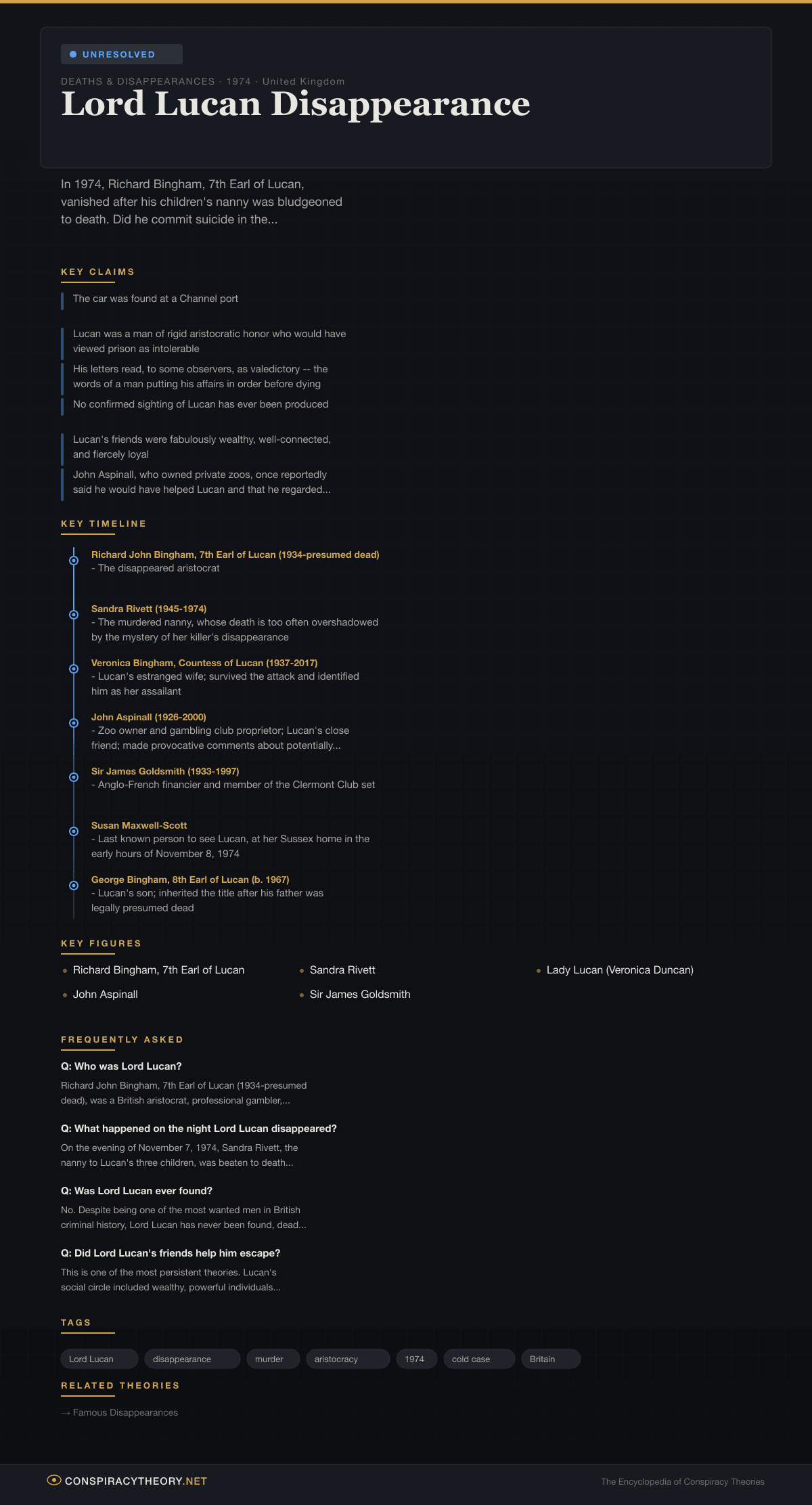
Lord Lucan Disappearance
Overview
Shortly before 10 p.m. on November 7, 1974, a bloodied woman burst into the Plumbers Arms pub on Lower Belgrave Street in London’s exclusive Belgravia neighborhood. “Help me, help me,” she screamed. “I’ve just escaped being murdered. He’s in the house. He’s murdered the nanny.”
The woman was Veronica Bingham, Countess of Lucan. The house was number 46 Lower Belgrave Street. The nanny was Sandra Rivett, twenty-nine years old, beaten to death with a length of lead pipe. And the “he” — according to Lady Lucan — was her estranged husband, Richard John Bingham, the 7th Earl of Lucan.
What happened next turned a domestic murder into one of Britain’s most enduring mysteries. Lord Lucan did not wait for the police. He drove to the home of friends in Sussex, wrote two letters to a family member, and then vanished. His car was found days later in Newhaven, a port town on the English Channel. The car’s interior was stained with blood. Lord Lucan himself was gone.
He has never been seen again — at least, not definitively. Over five decades of reported sightings from Africa, Australia, South America, India, and Ireland have produced nothing confirmed. The question that has captivated Britain ever since is deceptively simple: what happened to Lord Lucan? Did he kill himself and slip into the Channel? Or did his wealthy, well-connected friends — the gambling aristocrats of the Clermont Club — smuggle him to safety somewhere beyond the reach of British justice?
Origins & History
The Man
Richard John Bingham was born on December 18, 1934, into one of England’s oldest aristocratic families. The Binghams held the Earldom of Lucan, an Irish peerage dating to 1795. The most famous previous holder was the 3rd Earl, who ordered the disastrous Charge of the Light Brigade at Balaclava in 1854.
The 7th Earl — known to friends as “Lucky” Lucan, though the nickname would prove grimly ironic — was educated at Eton, served in the Coldstream Guards, and worked briefly in a merchant bank before discovering his true vocation: gambling. Lucan became a professional backgammon and chemin de fer player at the Clermont Club, the exclusive Mayfair gambling house owned by John Aspinall. He was handsome, well-bred, and charming in the manner of the English upper class: socially confident, emotionally opaque, and increasingly desperate.
By the early 1970s, Lucan’s luck had turned. He was losing heavily at the tables — estimates of his gambling debts range from tens of thousands to hundreds of thousands of pounds. His marriage to Veronica Duncan had deteriorated into bitter hostility. They separated in January 1973, and a vicious custody battle ensued. Lucan lost custody of his three children in June 1973, a decision that devastated him. He became obsessed with regaining them, hiring private detectives to follow his wife and recording her phone conversations.
The Murder
The events of November 7, 1974, have been reconstructed from Lady Lucan’s testimony, forensic evidence, and Lord Lucan’s own letters:
Sandra Rivett, the family’s nanny, went to the basement kitchen at approximately 8:45 p.m. to make tea. The basement light was not working — the bulb had been removed. In the darkness, someone attacked her with a lead pipe wrapped in surgical tape, beating her to death. Her body was placed in a canvas mailbag.
When Rivett did not return with the tea, Lady Lucan went downstairs to look for her. She was attacked in the darkened basement by a man she identified as her husband. He struck her with the pipe, attempted to strangle her, and thrust his fingers down her throat. She fought back, grabbing his testicles, and he eventually stopped.
According to Lady Lucan’s account, her husband then confessed to killing the nanny. He said he had gone downstairs after hearing a noise and had slipped in a pool of blood, encountering a man attacking his wife. (This was the version he would later write in his letters — that he had interrupted an attacker, not that he was the attacker.) He tried to calm her, took her upstairs, and laid wet towels on her injuries. When he went to the bathroom to wring out a cloth, she bolted from the house and ran to the pub.
The Police Response
Police arrived at 46 Lower Belgrave Street at approximately 10:05 p.m. They found Sandra Rivett’s body in the canvas mailbag in the basement. The lightbulb had been removed. A length of lead pipe — the murder weapon — was found, bent from the force of the blows. A second, undamaged piece of lead pipe was found in the hall, suggesting the killer had brought a backup weapon.
Lord Lucan was not in the house. He had already left.
Lucan’s Movements After the Murder
What is known about Lucan’s movements after the murder comes primarily from his own letters and the testimony of the people he contacted:
At approximately 11:15 p.m., Lucan telephoned his mother, the Dowager Countess, from a phone box. He told her there had been “a terrible catastrophe” at the house and asked her to collect the children.
He then drove approximately forty miles south to the home of Ian and Susan Maxwell-Scott at Uckfield in Sussex. He arrived at approximately 11:30 p.m. Susan Maxwell-Scott (Ian was away) later told police that Lucan was distressed and described walking past the house on Lower Belgrave Street, seeing a man attacking his wife through the basement window, and rushing inside. He said he had slipped in blood, that the attacker had fled, and that his wife had accused him of hiring the attacker.
At the Maxwell-Scott home, Lucan wrote two letters to his brother-in-law, Bill Shand Kydd. In the letters, he repeated the “interrupted an attacker” story and expressed concern for his children. He wrote: “The circumstantial evidence against me is strong in that V [Veronica] will say it was all my doing.”
He left the Maxwell-Scotts’ house at approximately 1:15 a.m. He was never reliably seen again.
The Abandoned Car
Two days later, on November 10, Lucan’s Ford Corsair was found abandoned in Norman Road, Newhaven — a town with ferry service across the English Channel to Dieppe, France. The car’s interior was stained with blood matching both Sandra Rivett’s and Lady Lucan’s blood types. A second piece of lead pipe, wrapped in surgical tape identical to the murder weapon, was found in the trunk.
The car’s location suggested that Lucan might have taken the ferry to France or drowned himself in the Channel. But no one matching his description was seen boarding a ferry that night, and no body was recovered from the sea.
The Inquest
In June 1975, a coroner’s inquest — the last of its kind to be permitted to name a murder suspect — found that Lord Lucan had murdered Sandra Rivett. This was the formal legal finding, though it was issued in Lucan’s absence. A warrant for his arrest on charges of murder was issued.
Key Claims
Theory 1: Suicide in the English Channel
The most straightforward theory holds that Lucan, realizing his situation was hopeless, drove to Newhaven, weighted himself down, and threw himself into the sea. His body was never recovered because the English Channel is deep, cold, and swept by powerful tides.
Supporting evidence:
- The car was found at a Channel port
- Lucan was a man of rigid aristocratic honor who would have viewed prison as intolerable
- His letters read, to some observers, as valedictory — the words of a man putting his affairs in order before dying
- No confirmed sighting of Lucan has ever been produced
Theory 2: Aristocratic Escape Network
The more sensational theory holds that Lucan’s wealthy friends — the Clermont Club set, including John Aspinall, Sir James Goldsmith, and others — organized his escape from England. Variations of this theory place Lucan in Africa (particularly Mozambique, Kenya, or Botswana), Australia, India, or South America.
Supporting evidence:
- Lucan’s friends were fabulously wealthy, well-connected, and fiercely loyal
- John Aspinall, who owned private zoos, once reportedly said he would have helped Lucan and that he regarded what Lucan did as “understandable” (Aspinall had notoriously unconventional moral views)
- Several of Lucan’s friends are alleged to have been involved in a meeting at Aspinall’s home on the night of the murder
- No body has ever been found
- Some reported sightings have come from locations where Lucan’s friends had connections
Theory 3: The Wrong Victim
This widely accepted interpretation holds that Lucan intended to murder his wife, not the nanny. Sandra Rivett had the same approximate build as Lady Lucan, and the basement was dark (the lightbulb had been deliberately removed). Rivett usually had Thursday evenings off but had changed her night off that week. Lucan, who had been stalking his wife’s movements obsessively, may not have known about the schedule change.
This theory is not mutually exclusive with either the suicide or escape theories — it concerns the motive, not the aftermath.
Evidence
- Forensic evidence: Blood matching Sandra Rivett’s type was found in the basement, on the lead pipe, in Lucan’s car, and at the Maxwell-Scott house
- Lady Lucan’s testimony: She identified her husband as her attacker
- The letters: Lucan’s letters to Bill Shand Kydd, while self-serving, place him at the scene and acknowledge damning circumstances
- The removed lightbulb: Evidence of premeditation — the killer had darkened the basement deliberately
- The lead pipe: A second, unused pipe in the car suggested the killer had brought spare weapons
- The car location: Found at a Channel port with blood evidence
- No body: Despite extensive searches, no remains have been identified as Lucan’s
Cultural Impact
Class and Justice
The Lucan case became a lightning rod for class resentment in 1970s Britain. The spectacle of aristocrats closing ranks to protect one of their own — while a working-class woman lay dead — struck a nerve in a country already riven by social tensions. Whether or not Lucan’s friends actually helped him escape, the perception that they did became a powerful symbol of upper-class impunity.
The nanny, Sandra Rivett, has often been treated as a footnote in the Lucan story — a narrative imbalance that reflects the class dynamics of the case itself.
The Clermont Club Set
John Aspinall, Sir James Goldsmith, and the other members of Lucan’s gambling circle became famous — or infamous — through the case. Aspinall’s reported comments about helping Lucan, combined with his generally provocative public persona (he once said he would prefer his zookeepers to risk their lives for his animals), made him a regular figure in Lucan coverage for decades.
Reported Sightings
Lord Lucan has been “spotted” on every inhabited continent. Reported sightings have placed him in:
- Mozambique (multiple reports over several decades)
- Australia (various locations)
- South Africa
- Botswana
- Ireland
- India (Goa, particularly)
- New Zealand
- South America (Colombia, Brazil)
None has been confirmed. The volume of sightings reflects both the case’s fame and the human tendency to see famous faces in crowds.
Legal Declaration of Death
In 1999, the High Court granted a petition to presume Lord Lucan dead, allowing his son George to inherit the title. A formal death certificate was issued in 2016 by the court, though the date and cause of death remain unknown.
In Popular Culture
- Lucan (2013) — ITV drama starring Rory Kinnear as Lord Lucan
- John Pearson, The Gamblers (2005) — book about the Clermont Club set
- Patrick Marnham, Trail of Havoc: In the Steps of Lord Lucan (1987)
- The Lucan Mystery — multiple documentaries on British television
- Various dramatizations in Agatha Christie-style mystery formats
- Referenced in British comedy and satire for decades as shorthand for upper-class privilege and disappearance
Key Figures
- Richard John Bingham, 7th Earl of Lucan (1934-presumed dead) — The disappeared aristocrat
- Sandra Rivett (1945-1974) — The murdered nanny, whose death is too often overshadowed by the mystery of her killer’s disappearance
- Veronica Bingham, Countess of Lucan (1937-2017) — Lucan’s estranged wife; survived the attack and identified him as her assailant
- John Aspinall (1926-2000) — Zoo owner and gambling club proprietor; Lucan’s close friend; made provocative comments about potentially helping Lucan
- Sir James Goldsmith (1933-1997) — Anglo-French financier and member of the Clermont Club set
- Susan Maxwell-Scott — Last known person to see Lucan, at her Sussex home in the early hours of November 8, 1974
- George Bingham, 8th Earl of Lucan (b. 1967) — Lucan’s son; inherited the title after his father was legally presumed dead
Timeline
| Date | Event |
|---|---|
| Dec 18, 1934 | Richard John Bingham born |
| 1963 | Marries Veronica Duncan; later has three children |
| 1960s-1970s | Lucan becomes a regular at John Aspinall’s Clermont Club; gambling debts mount |
| Jan 1973 | Lucan and Veronica separate |
| Jun 1973 | Lucan loses custody of his children; becomes obsessed with regaining them |
| Nov 7, 1974 | Sandra Rivett murdered at 46 Lower Belgrave Street; Lady Lucan attacked |
| Nov 7, 1974, ~10 p.m. | Lady Lucan escapes to the Plumbers Arms pub; police called |
| Nov 7-8, 1974 | Lucan calls his mother, then drives to the Maxwell-Scotts’ home in Sussex |
| Nov 8, 1974, ~1:15 a.m. | Lucan leaves the Maxwell-Scott home; never reliably seen again |
| Nov 10, 1974 | Lucan’s Ford Corsair found abandoned in Newhaven, near the Channel ferry port |
| Jun 1975 | Coroner’s inquest finds that Lucan murdered Sandra Rivett |
| 1975-present | Numerous reported sightings worldwide; none confirmed |
| 1999 | High Court presumes Lucan dead; son George inherits title |
| 2016 | Death certificate formally issued |
Sources & Further Reading
- Pearson, John. The Gamblers. Century, 2005.
- Marnham, Patrick. Trail of Havoc: In the Steps of Lord Lucan. Viking, 1987.
- Moore, Laura Thompson. A Different Class of Murder: The Story of Lord Lucan. Head of Zeus, 2014.
- Ranson, Roy. Looking for Lucan. Smith Gryphon, 1994.
- Sturgis, Matthew. The Gamblers. 2005.
- Various Metropolitan Police records (partially declassified).
- BBC. “Lord Lucan: The Mystery of Britain’s Most Wanted Man.” Various documentaries.
Related Theories
- Famous Disappearances — the broader category of mysterious vanishings
Frequently Asked Questions
Who was Lord Lucan?
What happened on the night Lord Lucan disappeared?
Was Lord Lucan ever found?
Did Lord Lucan's friends help him escape?

Infographic
Share this visual summary. Right-click to save.