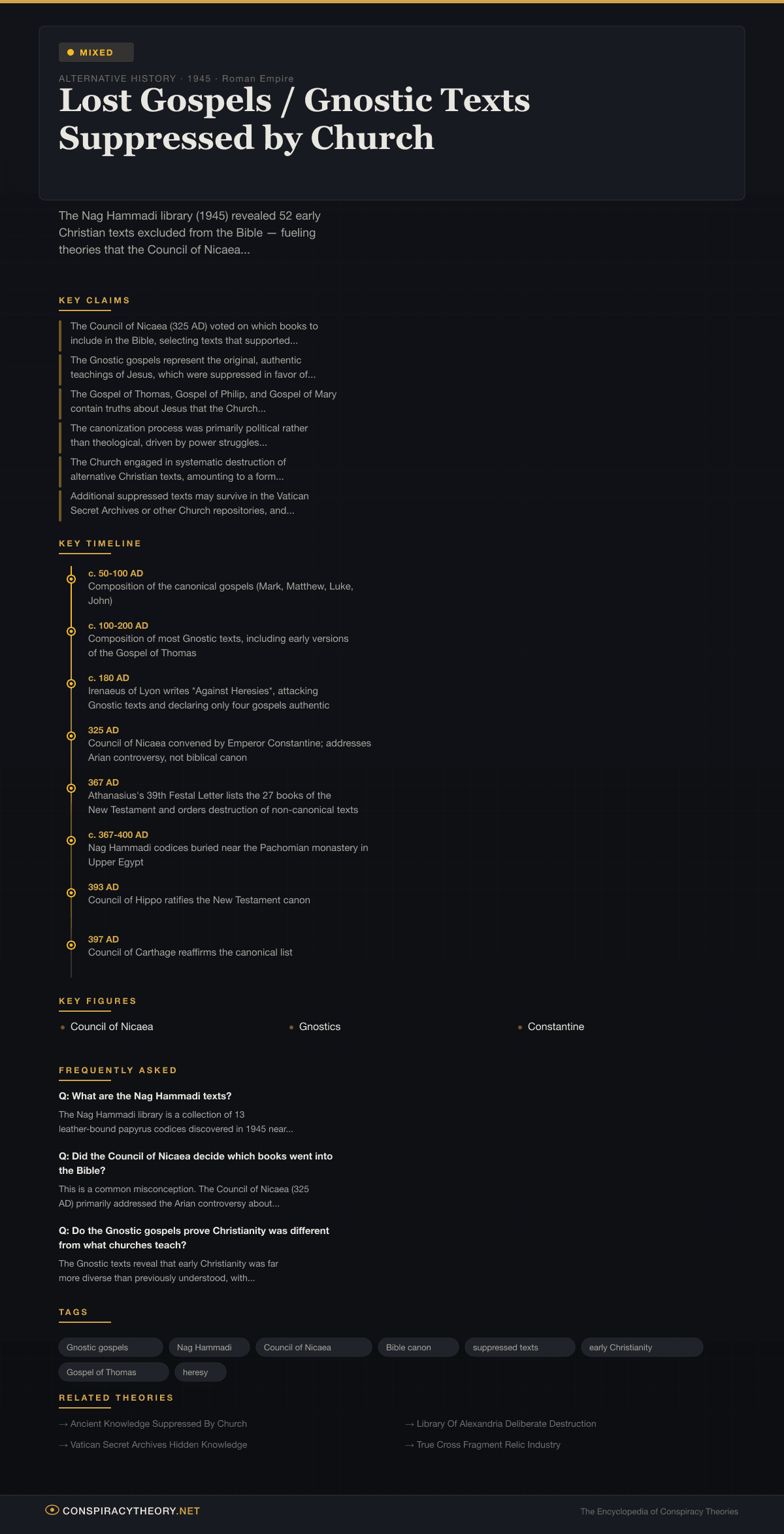
Lost Gospels / Gnostic Texts Suppressed by Church
Overview
In December 1945, an Egyptian farmer named Muhammad Ali al-Samman discovered a sealed earthenware jar near the cliffs of Nag Hammadi in Upper Egypt. Inside were thirteen leather-bound papyrus codices containing fifty-two texts, most of them Gnostic Christian writings that had been lost to history for nearly 1,600 years. The discovery would fundamentally reshape scholarly understanding of early Christianity and fuel one of the most persistent conspiracy theories in religious history: that the early Church deliberately suppressed authentic Christian texts that contradicted the version of Christianity it chose to promote.
The theory posits that the books included in the New Testament were selected not because they were the most authentic or authoritative accounts of Jesus’s life and teachings, but because they supported the particular theological and political agenda of the bishops who consolidated Church power in the fourth century. According to this view, the Gnostic gospels and other excluded texts represent suppressed alternative Christian traditions that were violently stamped out — and their disappearance was not a natural process of theological evolution but an act of deliberate censorship.
The theory occupies mixed status because its core claim is partially true. The early Church did actively suppress Gnostic and other heterodox texts, and the canonization process was influenced by political as well as theological considerations. However, the popular version of this theory, especially as amplified by works like Dan Brown’s The Da Vinci Code, dramatically oversimplifies the complex, centuries-long process by which the biblical canon emerged and misrepresents both the Council of Nicaea and the nature of the Gnostic texts themselves.
Origins & History
The question of which texts belonged in the Christian Bible has been debated since the religion’s earliest days. The apostle Paul, writing in the mid-first century, already warned against “different gospels” being preached by rival teachers. By the second century, dozens of gospels, acts, epistles, and apocalypses circulated among Christian communities throughout the Roman Empire, each reflecting different theological emphases and sometimes radically different understandings of Jesus and his message.
The Gnostic movement, which flourished from the second through fourth centuries, produced many of these alternative texts. Gnosticism was not a single unified system but a constellation of related beliefs that generally held that the material world was created by an ignorant or malevolent deity (the Demiurge), that the true God was a remote, unknowable spiritual being, and that salvation came through secret knowledge (gnosis) rather than faith or works. Gnostic Christians produced their own gospels, often attributed to apostles like Thomas, Philip, and Mary Magdalene, which presented Jesus as a teacher of esoteric wisdom rather than a sacrificial savior.
The early Church responded to Gnosticism with increasing hostility. Bishop Irenaeus of Lyon wrote Against Heresies around 180 AD, a five-volume attack on Gnostic teachings that described and refuted numerous Gnostic texts. Irenaeus argued that only four gospels — Matthew, Mark, Luke, and John — were authentic, drawing an analogy to the four corners of the earth and the four winds. Other Church fathers, including Tertullian, Hippolytus, and Epiphanius, continued this campaign against Gnostic literature over the following centuries.
The decisive moment came in the fourth century, when Christianity became the Roman Empire’s state religion. Emperor Constantine convened the Council of Nicaea in 325 AD, though contrary to popular belief, this council focused on Christological disputes rather than the biblical canon. The canon was shaped over subsequent decades through a combination of episcopal authority, theological consensus, and imperial pressure. Bishop Athanasius of Alexandria’s 39th Festal Letter of 367 AD is the earliest surviving document listing exactly the twenty-seven books that now comprise the New Testament, and it explicitly ordered the destruction of non-canonical texts.
The Nag Hammadi discovery in 1945 brought this history into vivid focus. The texts had apparently been buried by monks from the nearby Pachomian monastery, likely in response to Athanasius’s order. Their survival was essentially accidental — a case of disobedient or sympathetic monks choosing burial over destruction.
Key Claims
Proponents of the suppression theory make several interconnected claims:
- The Council of Nicaea (325 AD) voted on which books to include in the Bible, selecting texts that supported the political agenda of Emperor Constantine and rejecting those that did not
- The Gnostic gospels represent the original, authentic teachings of Jesus, which were suppressed in favor of a version of Christianity more amenable to institutional control
- The Gospel of Thomas, Gospel of Philip, and Gospel of Mary contain truths about Jesus that the Church has deliberately hidden, including a possible marriage to Mary Magdalene
- The canonization process was primarily political rather than theological, driven by power struggles among competing factions within the early Church
- The Church engaged in systematic destruction of alternative Christian texts, amounting to a form of historical censorship that continues to shape religious understanding today
- Additional suppressed texts may survive in the Vatican Secret Archives or other Church repositories, and the Church continues to withhold them from the public
Evidence
Documentary evidence of suppression: The evidence that the early Church actively suppressed alternative texts is strong and well-documented. Irenaeus’s Against Heresies, Athanasius’s Festal Letter, and imperial edicts from the fourth and fifth centuries all explicitly ordered the identification and destruction of heretical writings. The Council of Laodicea (c. 363-364 AD) issued canons restricting which texts could be read in churches. The Gelasian Decree (sixth century) listed numerous texts as “apocryphal” and condemned their use.
Archaeological evidence: The Nag Hammadi library itself is the most powerful piece of evidence. The fact that these texts were buried rather than destroyed suggests that their possessors recognized the danger of keeping them and the tragedy of losing them. The Dead Sea Scrolls, discovered two years later in 1947, further demonstrated that important religious texts had been hidden from institutional authorities.
Textual evidence: The discovered texts do present significantly different versions of Christian theology. The Gospel of Thomas contains 114 sayings attributed to Jesus, some paralleling the canonical gospels but others presenting radically different theological perspectives. The Gospel of Philip refers to Mary Magdalene as Jesus’s “companion” and describes spiritual practices absent from orthodox Christianity. The Apocryphon of John presents an elaborate Gnostic cosmology that contradicts Genesis.
Counter-evidence: The most important counterargument is chronological. Most scholars date the Gnostic texts to the second through fourth centuries — significantly later than the canonical gospels, which are generally dated to 65-100 AD. This undermines the claim that Gnostic texts represent the original teachings suppressed in favor of later inventions. The canonical gospels appear to be earlier compositions, not later fabrications. Additionally, the diversity of Gnostic systems — which often contradicted each other — makes it difficult to argue they represent a single suppressed original Christianity.
Debunking / Verification
Verified: The early Church did engage in deliberate, organized suppression of texts it deemed heretical. Church councils did issue binding decrees about which texts were acceptable. Imperial power was used to enforce these decisions. Texts were physically destroyed on a large scale. The canonization process was influenced by political considerations alongside theological ones.
Debunked: The Council of Nicaea did not vote on the biblical canon — this is a modern myth popularized by Voltaire and reinforced by Dan Brown. The Gnostic gospels are not earlier than the canonical gospels and do not represent suppressed “original Christianity.” The claim of Jesus’s marriage to Mary Magdalene is not directly supported even by the Gnostic texts, which use spiritual rather than literal language about companionship. The Vatican is not known to be hiding additional lost gospels.
Unresolved: The exact relationship between Gnostic Christianity and the earliest forms of the religion remains debated. Some scholars, including Elaine Pagels, argue that Gnostic traditions preserve authentic early elements that were later excluded, while others view them as later theological innovations. The question of whether the canonical process selected the “best” texts or merely the most politically convenient ones remains a matter of perspective and scholarly disagreement.
Cultural Impact
The Nag Hammadi discovery and the theory of suppressed gospels have had an enormous cultural impact. The publication of English translations beginning in the 1970s, particularly through the work of James M. Robinson, made these texts accessible to the general public for the first time and sparked widespread popular interest in alternative Christianity.
Elaine Pagels’s The Gnostic Gospels (1979) won both the National Book Award and the National Book Critics Circle Award, introducing millions of readers to the idea that early Christianity was far more diverse than commonly understood. The book’s argument that the orthodox victory was as much about institutional power as theological truth became deeply influential.
Dan Brown’s The Da Vinci Code (2003) transformed these scholarly debates into a global cultural phenomenon. The novel’s claims about the Council of Nicaea, the suppression of the sacred feminine, and Jesus’s marriage to Mary Magdalene — while largely inaccurate — sold over 80 million copies and spawned a film franchise. The book’s popularity led to a cottage industry of both supportive and debunking publications.
The theory has also influenced contemporary spiritual movements. Many New Age and progressive Christian groups have embraced the Gnostic texts as sources of alternative spiritual wisdom, incorporating Gnostic ideas about divine knowledge, the feminine divine, and spiritual liberation into their practices.
Timeline
- c. 50-100 AD — Composition of the canonical gospels (Mark, Matthew, Luke, John)
- c. 100-200 AD — Composition of most Gnostic texts, including early versions of the Gospel of Thomas
- c. 180 AD — Irenaeus of Lyon writes Against Heresies, attacking Gnostic texts and declaring only four gospels authentic
- 325 AD — Council of Nicaea convened by Emperor Constantine; addresses Arian controversy, not biblical canon
- 367 AD — Athanasius’s 39th Festal Letter lists the 27 books of the New Testament and orders destruction of non-canonical texts
- c. 367-400 AD — Nag Hammadi codices buried near the Pachomian monastery in Upper Egypt
- 393 AD — Council of Hippo ratifies the New Testament canon
- 397 AD — Council of Carthage reaffirms the canonical list
- 1945 — Muhammad Ali al-Samman discovers the Nag Hammadi library in Upper Egypt
- 1947 — Dead Sea Scrolls discovered at Qumran
- 1977 — First complete English translation of the Nag Hammadi library published
- 1979 — Elaine Pagels publishes The Gnostic Gospels
- 2003 — Dan Brown’s The Da Vinci Code brings suppressed gospels theory to mass audience
- 2006 — National Geographic publishes the Gospel of Judas, adding another recovered text to the public conversation
Sources & Further Reading
- Pagels, Elaine. The Gnostic Gospels. Random House, 1979
- Robinson, James M., ed. The Nag Hammadi Library in English. Harper & Row, 1977
- Ehrman, Bart D. Lost Christianities: The Battles for Scripture and the Faiths We Never Knew. Oxford University Press, 2003
- King, Karen L. What Is Gnosticism? Harvard University Press, 2003
- Meyer, Marvin, ed. The Nag Hammadi Scriptures. HarperOne, 2007
- Brakke, David. The Gnostics: Myth, Ritual, and Diversity in Early Christianity. Harvard University Press, 2010
- Metzger, Bruce M. The Canon of the New Testament. Oxford University Press, 1987
Frequently Asked Questions
What are the Nag Hammadi texts?
Did the Council of Nicaea decide which books went into the Bible?
Do the Gnostic gospels prove Christianity was different from what churches teach?
Infographic
Share this visual summary. Right-click to save.