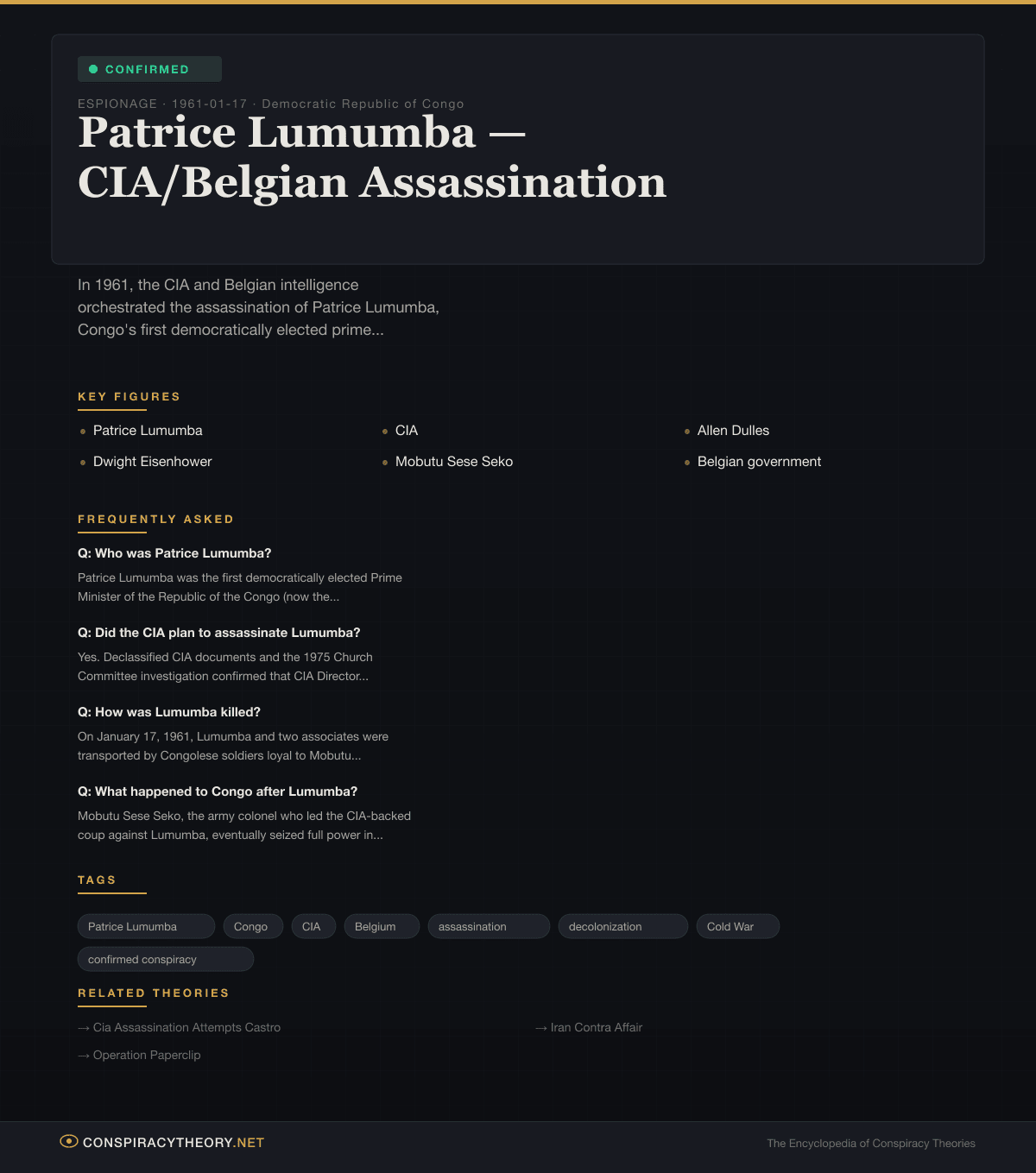
Patrice Lumumba — CIA/Belgian Assassination

Overview
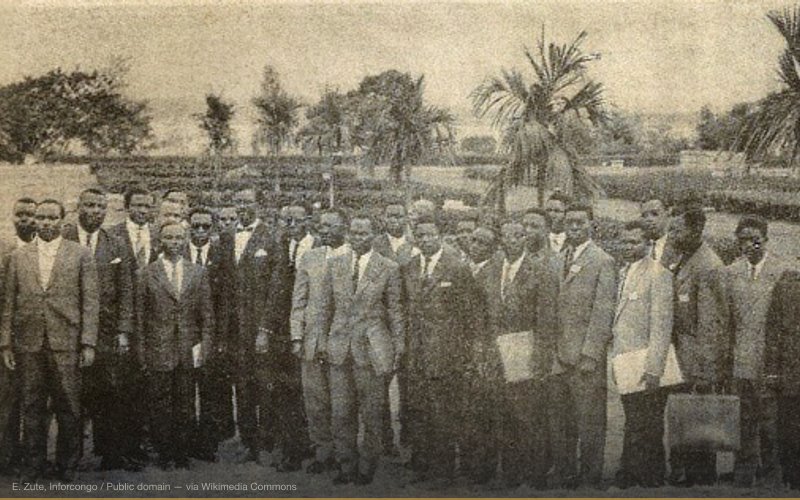
On June 30, 1960, the Republic of the Congo achieved independence from Belgium. Patrice Lumumba, the newly elected prime minister, gave a speech that Belgian King Baudouin and his entourage did not want to hear. While the king had praised Belgium’s “civilizing mission” in Congo, Lumumba spoke directly about the reality of colonial rule:
“We have known ironies, insults, blows that we endured morning, noon, and night, because we are Negroes… We have known that our lands were spoiled in the name of laws that only recognized the right of the strongest… We have known that the law was never the same for a white and a Black.”
It was a magnificent speech. It was also a death sentence. Within days, Lumumba was the target of assassination plots by both the CIA and Belgian intelligence. Within weeks, he was deposed by a coup. Within seven months, he was dead — beaten, shot, and dissolved in acid.
The murder of Patrice Lumumba is one of the Cold War’s defining crimes. It was not a conspiracy theory — it was a conspiracy, confirmed by the CIA’s own documents, by the Church Committee’s investigation, and by a Belgian parliamentary inquiry that formally acknowledged Belgium’s “moral responsibility” for the killing. It installed a dictator who looted the country for three decades. And it established a pattern of Western intervention in Africa that continues to shape the continent today.
The Context
Congo’s Resources
To understand why the CIA wanted Lumumba dead, you need to understand what was underneath Congo.
The Congo is one of the most resource-rich territories on Earth. In 1960, it held vast deposits of copper, cobalt, diamonds, gold, tin, uranium, and other strategic minerals. The uranium that fueled the atomic bomb dropped on Hiroshima came from the Shinkolobwe mine in Congo’s Katanga province. Congo’s cobalt reserves were (and remain) essential for aerospace and electronics manufacturing.
Belgium had ruled Congo as a colony since 1908 (and as King Leopold II’s personal property before that, during which an estimated 10 million Congolese died under a regime of forced labor and mutilation). Belgian companies — particularly Union Miniere du Haut Katanga — controlled the mineral extraction and reaped enormous profits.
When independence came, the question was: who would control the resources? Lumumba’s answer — the Congolese people — was unacceptable to Belgium, to the mining companies, and to the United States.
The Cold War Lens
Washington viewed Lumumba through a single lens: the Cold War. Lumumba was not a communist — he was a nationalist and Pan-Africanist whose ideology owed more to Frantz Fanon than to Marx. But he was willing to accept support from wherever it was offered, including the Soviet Union. When Belgium and the United States refused to help Congo deal with a mutiny in its army and a secessionist crisis in Katanga, Lumumba turned to the Soviets for assistance.
That was enough. In the binary logic of Cold War Washington, accepting Soviet help made you a Soviet tool. CIA Director Allen Dulles told the National Security Council in August 1960 that Lumumba was “a Castro or worse.” President Eisenhower — in language that the Church Committee would later examine with care — said something at an NSC meeting that attendees interpreted as an order to assassinate Lumumba. The exact words remain disputed; the intent does not.
The Assassination
The CIA’s Poison Plot
The CIA’s assassination plan was remarkably direct. In September 1960, CIA scientist Sidney Gottlieb — the same man who ran MKUltra and Operation Midnight Climax — traveled to Leopoldville (now Kinshasa) carrying a kit containing a biological agent designed to produce a fatal disease that would appear natural. The poison was intended to be placed on Lumumba’s toothbrush or in his food.
The poison was never used. CIA Station Chief Larry Devlin later claimed he couldn’t find an opportunity to deploy it and eventually destroyed it. Whether Devlin genuinely couldn’t find an opportunity or simply developed qualms about using a CIA-designed pathogen to murder an elected leader is a question Devlin answered differently at different times.
But the CIA’s role didn’t end with the unused poison. The agency actively worked to destabilize Lumumba’s government and facilitate his removal:
- The CIA funded and organized Congolese opposition to Lumumba
- CIA operatives provided financial and logistical support to Colonel Joseph-Desire Mobutu, the army chief of staff
- The CIA supported the secessionist movement in Katanga, which was backed by Belgian mining interests
- CIA officers maintained contact with the Congolese forces that eventually captured and killed Lumumba
The Mobutu Coup
On September 14, 1960, Colonel Mobutu staged a coup, suspending the parliament and the government. Lumumba was placed under house arrest, guarded by UN peacekeepers who were theoretically protecting him.
Mobutu’s coup was supported by the CIA. The agency had identified Mobutu as a useful asset — a military officer who could be counted on to oppose Soviet influence and who, conveniently, was primarily interested in money and power rather than ideology. The CIA funneled payments to Mobutu through various channels, establishing a relationship that would last for decades.
The Murder
On November 27, 1960, Lumumba escaped house arrest and attempted to reach Stanleyville (now Kisangani), where his supporters still held power. He was captured by Mobutu’s forces on December 1 after being betrayed by villagers who had been offered rewards for his capture.
Lumumba was held in various locations, beaten repeatedly, and displayed to journalists and diplomats as a prisoner. The treatment was a deliberate humiliation — designed to destroy his mystique and demonstrate that the nationalist leader was powerless.
On January 17, 1961, Lumumba and two associates — Maurice Mpolo and Joseph Okito — were flown to Elisabethville (now Lubumbashi) in secessionist Katanga. They were beaten severely during the flight, arriving bloodied and barely conscious. That evening, they were driven to a remote location, stood before a firing squad that included Belgian officers and Katangese soldiers, and shot.
Their bodies were buried, then exhumed, dismembered, and dissolved in sulfuric acid. A Belgian police commissioner, Gerard Soete, later admitted to removing Lumumba’s teeth as souvenirs. He kept them for forty years.
The Investigations
The Church Committee (1975)
The Senate Select Committee on Intelligence Activities investigated CIA assassination plots against foreign leaders as part of its 1975-76 investigation. The committee found that:
- The CIA had plotted to assassinate Lumumba
- Sidney Gottlieb had delivered poison to Leopoldville
- CIA Director Allen Dulles had authorized the assassination
- President Eisenhower had made statements that were interpreted as authorization
- The CIA had provided support to Congolese forces that ultimately killed Lumumba
The committee’s report established the CIA’s intent and operational involvement, though it noted that the actual killing was carried out by Congolese and Belgian forces rather than directly by CIA personnel.
The Belgian Parliamentary Inquiry (2001-2002)
In November 2001, the Belgian parliament established a commission to investigate Belgium’s role in Lumumba’s assassination. The commission’s February 2002 report was devastating:
- Belgian government officials had actively planned and facilitated Lumumba’s transfer to Katanga, knowing he would be killed
- Belgian military and intelligence officers were present at the execution
- Belgian officers participated in the disposal of the body
- The Belgian government bore “moral responsibility” for the assassination
Belgium formally apologized for its role in 2002 — 41 years after the fact. In 2022, Belgium returned Lumumba’s gold-capped tooth (the one Soete had kept) to his family.
The Aftermath
Mobutu’s Zaire
The man the CIA installed in Lumumba’s place, Mobutu Sese Seko, ruled Congo (which he renamed Zaire) from 1965 to 1997 — 32 years of dictatorship during which he:
- Looted an estimated $5 billion from the national treasury
- Maintained a personal fortune that rivaled the country’s national debt
- Allowed infrastructure, education, and healthcare to collapse
- Suppressed all political opposition through violence
- Received consistent U.S. support as a “bulwark against communism”
The United States supported Mobutu throughout the Cold War. President Reagan hosted him at the White House. The CIA maintained its relationship with him for decades. When Mobutu was finally overthrown in 1997, he fled to Morocco, where he died of prostate cancer.
The Democratic Republic of Congo has remained one of the poorest and most unstable countries in the world — a direct consequence of the destruction of its first democratic government and the installation of a kleptocratic dictator by Western intelligence agencies.
Lumumba’s Legacy
Patrice Lumumba served as prime minister for 67 days. In those 67 days, he became the most important symbol of African independence — and of its betrayal. His assassination demonstrated that Western powers would not permit African nations to control their own resources or choose their own political path if that path diverged from Western interests.
Lumumba’s legacy shaped African politics for generations. His assassination fueled anticolonial movements across the continent and contributed to the widespread African distrust of Western institutions that persists today.
Timeline
| Date | Event |
|---|---|
| June 30, 1960 | Congo achieves independence; Lumumba becomes prime minister |
| July 1960 | Congolese army mutiny; Belgian troops intervene |
| July 1960 | Katanga province secedes with Belgian support |
| Aug 1960 | Eisenhower NSC meeting: apparent authorization to eliminate Lumumba |
| Sept 1960 | Gottlieb delivers poison to CIA station in Leopoldville |
| Sept 14, 1960 | Mobutu stages CIA-backed coup |
| Nov 27, 1960 | Lumumba escapes house arrest |
| Dec 1, 1960 | Lumumba captured by Mobutu’s forces |
| Jan 17, 1961 | Lumumba assassinated in Katanga |
| 1965 | Mobutu seizes full power in second coup |
| 1975 | Church Committee investigates CIA assassination plots |
| 1997 | Mobutu overthrown |
| 2002 | Belgian parliamentary inquiry confirms Belgian responsibility |
| 2022 | Belgium returns Lumumba’s tooth to his family |
Sources & Further Reading
- De Witte, Ludo. The Assassination of Lumumba. Verso, 2001.
- Nzongola-Ntalaja, Georges. Patrice Lumumba. Ohio University Press, 2014.
- Devlin, Larry. Chief of Station, Congo: Fighting the Cold War in a Hot Zone. PublicAffairs, 2007.
- Church Committee. Alleged Assassination Plots Involving Foreign Leaders. U.S. Senate, 1975.
- Belgian Parliamentary Commission. Report of the Parliamentary Inquiry into the Circumstances of the Assassination of Patrice Lumumba. February 2002.
- Weissman, Stephen R. “An Extraordinary Rendition.” Intelligence and National Security, 2010.
Related Theories
- CIA Assassination Plots — CIA attempts to kill foreign leaders
- Operation Paperclip — Another confirmed CIA program using morally compromised methods
- Iran-Contra Affair — Later CIA covert operations in the developing world
Frequently Asked Questions
Who was Patrice Lumumba?
Did the CIA plan to assassinate Lumumba?
How was Lumumba killed?
What happened to Congo after Lumumba?
Infographic
Share this visual summary. Right-click to save.