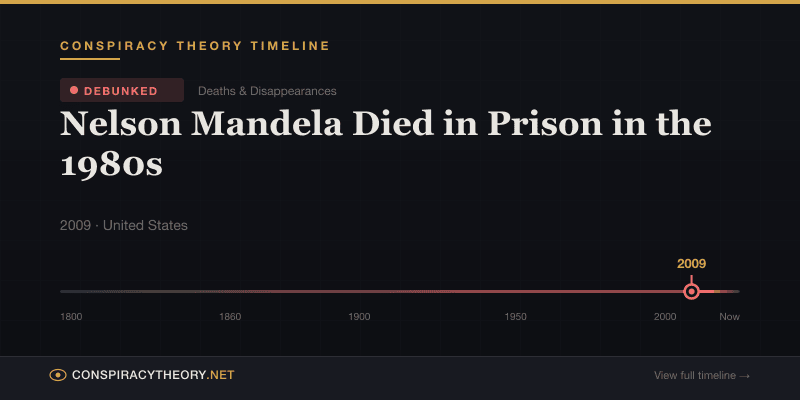
Nelson Mandela Died in Prison in the 1980s

Overview
At some point in the early 2000s, a paranormal researcher named Fiona Broome had a conversation at a conference — the kind of conversation where you mention something you remember clearly, and the person you’re talking to says “me too,” and then a third person says “me too,” and suddenly you’re all standing in a circle realizing that you share a vivid, detailed, emotionally resonant memory of something that never happened.
The memory was this: Nelson Mandela died in a South African prison in the 1980s. Broome remembered it clearly. She remembered news coverage of his death. She remembered a funeral. She remembered a grieving widow giving a speech. The people she was talking to remembered the same things. It was not a vague impression; it was a specific, textured recollection of an event that had not occurred.
Nelson Mandela was, at that moment, very much alive. He had been released from prison in 1990, had won the Nobel Peace Prize in 1993, had served as President of South Africa from 1994 to 1999, and would not die until December 5, 2013, at the age of 95. Every element of Broome’s memory was wrong. And yet enough people shared it that when Broome wrote about the experience on her website in 2009, coining the term “Mandela Effect,” it became a cultural phenomenon — one that has since been applied to dozens of other shared false memories and has spawned an entire ecosystem of theories about parallel universes, timeline shifts, and the fundamental unreliability of human perception.
The Mandela Effect is debunked as a theory about reality (no, you are not experiencing bleed-through from a parallel universe where Nelson Mandela died in prison). But it is profoundly interesting as a phenomenon of human cognition — a window into how memory actually works, which is nothing like how we think it works.
Origins & History
Fiona Broome and the Conference Moment
Fiona Broome was not a cognitive scientist or a memory researcher. She was a writer and consultant on paranormal topics — ghosts, hauntings, and related phenomena. Her website, mandelaeffect.com, had been focused on supernatural subjects before the Mandela moment. When she experienced the shared false memory about Mandela’s death, she interpreted it through a paranormal lens: not as a malfunction of human memory but as evidence that reality itself had shifted — that she and others had somehow slipped from a timeline in which Mandela died in prison into one in which he survived.
Broome’s 2009 blog post describing the experience attracted an immediate and enthusiastic response. Commenters flooded in to share their own versions of the memory. Many described specific details — the funeral broadcast, the widow’s speech, the international mourning — that aligned closely with each other but not with reality. The convergence of details seemed, to believers, to rule out simple confusion. How could unrelated strangers share the same false memory with the same specific details, unless something real had happened?
The answer, as cognitive psychologists have explained at length, is that shared false memories are exactly what you would expect from human brains working the way human brains work. But that explanation, while scientifically robust, lacks the narrative satisfaction of parallel universes.
The Expansion: A Catalog of Misremembering
Once the concept of the Mandela Effect had a name, examples multiplied with remarkable speed. People began cataloguing instances of widespread false memories, and the list grew long:
The Berenstain Bears. Millions of people remember the beloved children’s book series as “The Berenstein Bears.” The actual spelling — always, since the series was created by Stan and Jan Berenstain in 1962 — is “Berenstain.” The false memory is so widespread and so fervently held that it has become perhaps the most cited example of the Mandela Effect after the original.
“Luke, I am your father.” The iconic line from The Empire Strikes Back (1980) is universally quoted this way. The actual line, spoken by Darth Vader, is “No, I am your father.” The misquote has been reproduced so many times — in parodies, references, and casual conversation — that the false version has overwritten the real one in collective memory.
The Monopoly Man’s monocle. Many people remember Rich Uncle Pennybags, the mascot of the Monopoly board game, wearing a monocle. He has never worn one. The false memory is likely contaminated by confusion with Mr. Peanut, the Planters mascot, who does wear a monocle.
“Mirror, mirror on the wall.” The Evil Queen’s famous line from Disney’s Snow White and the Seven Dwarfs (1937) is actually “Magic mirror on the wall.” The “mirror, mirror” version comes from the original Brothers Grimm fairy tale, and the two sources have been blended in popular memory.
Curious George’s tail. Many people remember the children’s book character Curious George having a tail. He has never had one — he is an ape (likely a chimpanzee), not a monkey, and apes do not have tails.
“We are the champions… of the world.” Many people remember the Queen song ending with “of the world.” The studio version does not — the song ends with “we are the champions” followed by silence. (The live performance versions often include “of the world,” which may explain the confusion.)
Each of these examples has a mundane explanation. Each is also, to Mandela Effect believers, evidence that reality is not what we think it is.
Key Claims
-
Parallel universe bleed-through. The strongest version of the Mandela Effect theory proposes that multiple parallel universes exist simultaneously and that individuals or groups sometimes shift between them, retaining memories from a timeline that is no longer their own.
-
CERN caused timeline shifts. Some theorists blame the Large Hadron Collider at CERN for disrupting the fabric of spacetime, allegedly causing merges between previously separate timelines. This claim connects to the broader CERN dimensional shift theory.
-
Reality is a simulation being updated. Under the simulation theory framework, the Mandela Effect represents patches or updates to the simulation, with “residual” memories from previous versions persisting in some participants.
-
Government or elite manipulation of the timeline. A less common variant suggests that powerful entities (government, Illuminati, etc.) have access to time travel or reality-altering technology and are making changes that most people don’t notice — but that surface as the Mandela Effect.
-
The memories are too consistent to be errors. The convergence of specific details in shared false memories — the funeral, the widow’s speech, the specific time period — is argued to exceed what random confabulation could produce.
Debunking
How Memory Actually Works
The most important thing to understand about the Mandela Effect is that it is not a mystery about reality. It is a demonstration of how memory works — and memory does not work the way most people think it does.
Human memory is not a video recording. It is a reconstructive process. Every time you recall a memory, you are not playing back a recording; you are rebuilding the memory from fragments — sensory details, emotional associations, narrative schemas, and contextual clues. Each reconstruction is influenced by your current knowledge, beliefs, and the social context in which you’re remembering. Memories are not stored; they are constructed and reconstructed.
This has several well-documented consequences relevant to the Mandela Effect:
Confabulation. The brain fills in gaps in memory with plausible details. If you half-remember something — say, that a famous political prisoner in South Africa was in danger — your brain may construct a detailed memory of his death based on what would make narrative sense, complete with funeral footage and a grieving widow.
Schema-driven memory. People remember things in accordance with their expectations and mental models. If you expect a word to end in “-stein” (a common suffix in English surnames), you will remember “Berenstain” as “Berenstein.” If you expect a wealthy, old-fashioned cartoon character to have a monocle, you will remember the Monopoly Man with one.
Source monitoring errors. People regularly remember information correctly but misattribute its source. You might remember a funeral broadcast for a South African leader — because you saw coverage of Steve Biko’s death (1977) or Chris Hani’s assassination (1993) — and incorrectly attribute that memory to Nelson Mandela.
Social contagion of memory. This is perhaps the most relevant mechanism. When someone tells you they remember Mandela dying in prison, and you have a vague sense that this might be right, the social confirmation transforms uncertainty into confidence. In experimental settings, researchers have repeatedly demonstrated that people will adopt false memories when told that others share them. Elizabeth Loftus’s decades of research on false memory have shown that detailed, vivid, emotionally compelling memories of events that never happened can be implanted through suggestion alone.
The Specificity Argument
Mandela Effect believers often argue that the specificity and consistency of the false memories cannot be explained by random errors. How can thousands of unrelated people all remember a funeral broadcast?
The answer is that the memories are not as specific or consistent as they appear. When researchers have actually surveyed people about their “memories” of Mandela’s death, the details diverge significantly. Some remember the death in the 1980s, others in the 1990s. Some remember a prison death, others an assassination. The specific details — the widow’s speech, the funeral coverage — are exactly the kind of narrative elements that the brain would construct to flesh out a vague impression, because they are what funerals of famous people look like on television. The memories feel specific because they are constructed from generic templates.
Furthermore, the internet creates a powerful feedback loop. Once the Mandela Effect was named and examples were catalogued, millions of people were exposed to specific false memories and asked whether they shared them. Many people who had no strong prior memory of the subject adopted the false version after reading about it — a well-documented phenomenon in memory research called “post-event information effect.”
The Parallel Universe Problem
The parallel universe explanation faces a fundamental logical problem: it requires that physical transfers between universes leave no trace except changed memories in a subset of the population. There is no physical evidence of timeline shifts — no documents from the “other” timeline, no objects that shouldn’t exist, no scientific anomalies that physicists have detected. The theory requires that entire universes merged seamlessly, changing the spelling of a children’s book series but leaving everything else identical. The multiverse interpretation of quantum mechanics, often cited by Mandela Effect believers, does not actually predict or describe the kind of macro-scale universe-hopping the theory requires.
Cultural Impact
The Mandela Effect has become one of the most recognizable concepts in internet culture, spawning thousands of YouTube videos, Reddit threads, and social media discussions. The subreddit r/MandelaEffect has over 300,000 members who document and debate examples.
The phenomenon’s cultural resonance reflects a deeper anxiety about the reliability of perception and the stability of shared reality — an anxiety that has only intensified in an era of deepfakes, misinformation, and “alternative facts.” The Mandela Effect provides a framework for a feeling that many people have in the information age: that reality itself is shifting, that what you knew to be true is no longer true, that you can’t trust your own memory or your own senses.
In this sense, the Mandela Effect is less a conspiracy theory than a folk epistemology — a popular way of grappling with the genuinely disorienting experience of living in a world where information is unstable and consensus reality feels fragile. The theory’s explanations (parallel universes, simulation glitches) are wrong, but the feeling they are trying to explain — the vertigo of a world that doesn’t quite match your expectations — is real.
The Mandela Effect has also been productively strange for cognitive science. The phenomenon has provided researchers with natural experiments in false memory on a scale that would be impossible to create in a laboratory. Studies of Mandela Effect examples have contributed to understanding of how schema-driven errors propagate through social networks and how the internet amplifies memory conformity.
The concept has appeared in television (The X-Files, South Park), films, podcasts, and novels. It has become a standard reference point in discussions of memory, perception, and the nature of reality — one of those rare internet-born concepts that has crossed into mainstream cultural vocabulary.
Timeline
- September 12, 1977 — Steve Biko dies in South African police custody, generating significant international media coverage (a likely source of confused Mandela memories).
- February 11, 1990 — Nelson Mandela released from Victor Verster Prison after 27 years of imprisonment.
- 1993 — Nelson Mandela and F.W. de Klerk jointly awarded the Nobel Peace Prize.
- 1994 — Mandela elected President of South Africa.
- 1999 — Mandela steps down as President.
- 2009 — Fiona Broome coins the term “Mandela Effect” on her blog mandelaeffect.com after discovering shared false memories of Mandela dying in prison.
- 2010-2012 — The Mandela Effect gains traction on paranormal and conspiracy forums.
- 2012 — CERN announces the discovery of the Higgs boson; some Mandela Effect theorists blame CERN for timeline shifts.
- December 5, 2013 — Nelson Mandela dies at age 95 in Johannesburg, prompting widespread discussion of the Mandela Effect.
- 2015-2016 — The Berenstain Bears example goes viral on social media, bringing the Mandela Effect to mainstream awareness.
- 2016 — r/MandelaEffect subreddit experiences exponential growth.
- 2019 — Researchers publish peer-reviewed studies examining the cognitive mechanisms behind Mandela Effect examples.
- 2020s — The Mandela Effect becomes a standard reference in popular discussions of memory, perception, and conspiracy culture.
Sources & Further Reading
- Broome, Fiona. The Mandela Effect. mandelaeffect.com, 2009-present
- French, Christopher C. “The Mandela Effect and New Trends in False Memory Research.” Memory, 2020
- Loftus, Elizabeth F. “Planting Misinformation in the Human Mind: A 30-Year Investigation of the Malleability of Memory.” Learning & Memory, Vol. 12, 2005
- Prasad, Deepasri, and Wilma Bainbridge. “The Visual Mandela Effect as Evidence for Shared and Specific False Memories Across People.” Psychological Science, Vol. 33, 2022
- Roediger, Henry L., and Kathleen B. McDermott. “Creating False Memories: Remembering Words Not Presented in Lists.” Journal of Experimental Psychology, Vol. 21, 1995
- Schacter, Daniel L. The Seven Sins of Memory: How the Mind Forgets and Remembers. Houghton Mifflin, 2001
- Sampson, Anthony. Mandela: The Authorized Biography. Knopf, 1999
Related Theories
- The Mandela Effect — the broader phenomenon of shared false memories beyond the original Mandela example
- Simulation Theory — the theory that reality is a computer simulation, often invoked to explain the Mandela Effect
- CERN Dimensional Shift — the theory that the Large Hadron Collider has altered timelines
- Celebrity Replacement — theories about famous people being replaced by doubles
Frequently Asked Questions
What is the Mandela Effect?
Did Nelson Mandela actually die in prison?
What causes the Mandela Effect?
Is the Berenstain Bears spelling an example of the Mandela Effect?
Infographic
Share this visual summary. Right-click to save.
