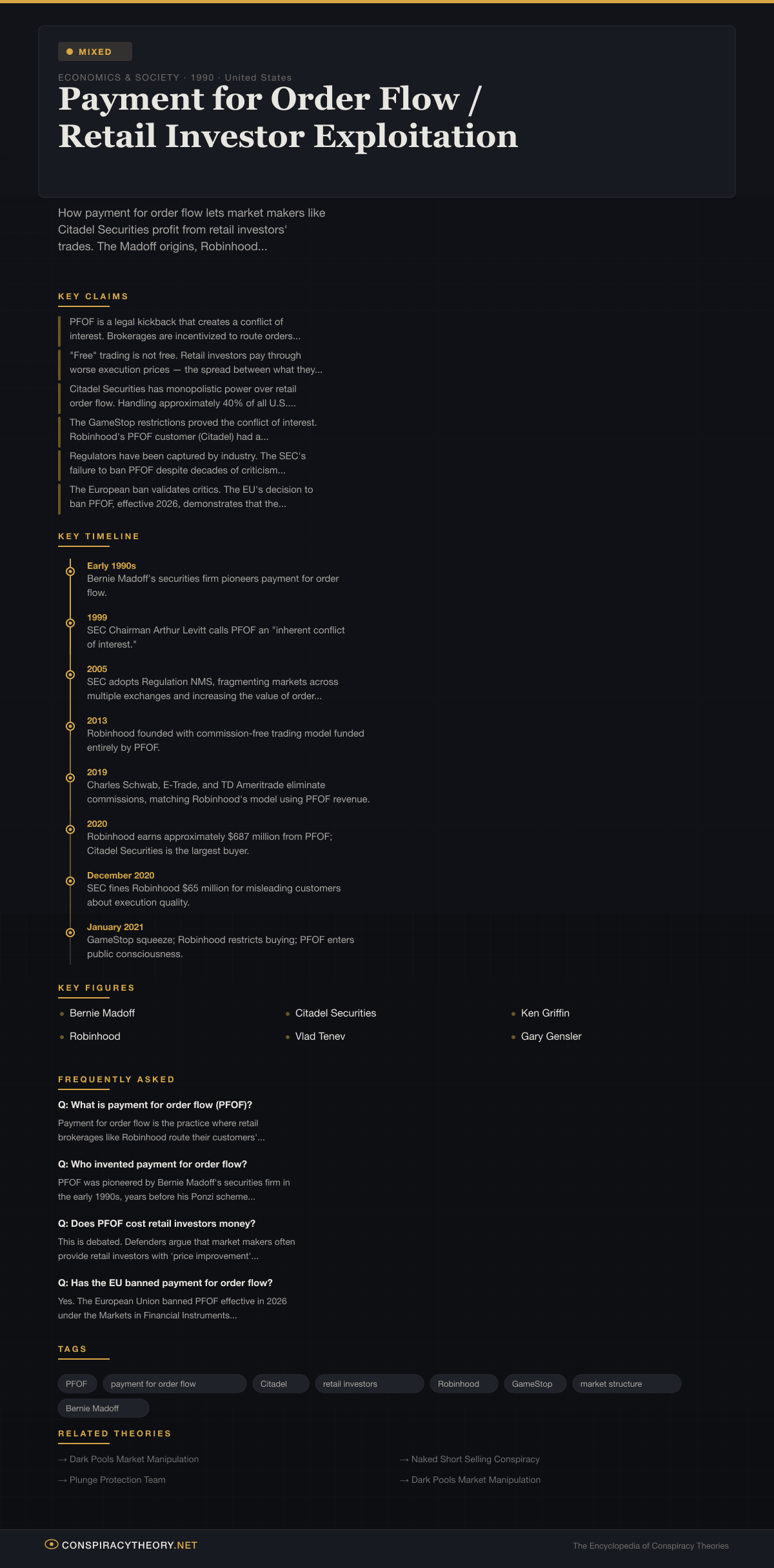
Payment for Order Flow / Retail Investor Exploitation
Overview
The man who invented the business model that makes your free stock trades possible was Bernie Madoff. Yes, that Bernie Madoff — the architect of the largest Ponzi scheme in history, the man who defrauded investors of $65 billion, who died in federal prison in 2021. Before all that, in the early 1990s, Madoff’s legitimate market-making firm pioneered a practice called payment for order flow, in which he paid retail brokerages a small fee for the right to execute their customers’ stock orders. It was, at the time, considered borderline scandalous — SEC Chairman Arthur Levitt called it an “inherent conflict of interest” in 1999.
Twenty-five years later, PFOF is the foundation of a multi-billion-dollar business model. Robinhood, the brokerage app that brought commission-free trading to 23 million accounts, earned 80% of its revenue from PFOF in its early years. Citadel Securities, the market maker that processes roughly 40% of all U.S. retail equity orders, pays hundreds of millions annually for the privilege. The practice has simultaneously democratized stock trading — removing the commissions that once priced out small investors — and created a system in which the brokerage’s customer is not the retail investor but the market maker who pays for the order flow.
Whether this constitutes exploitation depends on which experts you ask. The system’s defenders point to price improvement data showing that retail investors often get better prices through PFOF than they would on public exchanges. Its critics point to a structural conflict of interest so obvious that the European Union has banned the practice entirely. The GameStop episode of January 2021 turned this arcane question of market microstructure into a populist cause, and the debate has not settled since.
Origins & History
Madoff’s Innovation
To understand PFOF, you need to understand what came before it. Throughout most of the twentieth century, buying and selling stocks cost money. Retail investors paid commissions to their brokers — typically $50 to $200 per trade at full-service brokerages, and $10 to $30 even at discount brokerages like E-Trade and Charles Schwab. These commissions were the price of admission to the stock market, and they effectively meant that frequent trading was impractical for anyone who wasn’t wealthy.
Bernie Madoff saw an opportunity. His firm, Bernard L. Madoff Investment Securities, was a large and legitimate market-making operation (the Ponzi scheme operated through a separate, secret unit). In the early 1990s, Madoff began offering to pay discount brokerages a small fee — about a penny per share — to route their customers’ orders to his firm for execution. The brokerages could pocket the payment, pass it along to customers as reduced commissions, or both.
The economics were straightforward. When a retail investor submits an order to buy, say, 100 shares of a stock trading at $50, the market maker buys those shares at $50.00 and sells them to the investor at $50.01, capturing a one-cent-per-share spread. On 100 shares, the market maker earns $1. The market maker pays the brokerage half a cent per share ($0.50 for this order) and keeps the rest. Multiply by millions of orders per day, and the fractions of pennies become billions.
The SEC investigated the practice multiple times. Chairman Arthur Levitt publicly criticized it. But PFOF was never banned because its defenders made a compelling argument: retail investors were getting better execution through market makers than they would on the crowded, slower public exchanges. The small spread that market makers captured was, the argument went, less than the costs retail investors would face on the NYSE or NASDAQ. Whether this was actually true depended on how you measured “better.”
The Robinhood Revolution
PFOF remained a moderately controversial but stable feature of market structure until Robinhood took it to its logical extreme. Founded in 2013 by Stanford graduates Vlad Tenev and Baiju Bhatt, Robinhood launched with a radical value proposition: completely free stock trades. No commissions. No account minimums. A sleek mobile app designed to make trading feel like a game.
The secret was PFOF. Robinhood earned essentially all of its revenue by selling its customers’ order flow to market makers, with Citadel Securities as the largest buyer. In 2020, Robinhood earned approximately $687 million from PFOF. In the first quarter of 2021 — the GameStop quarter — it earned $331 million from PFOF alone.
The model was wildly successful. By 2021, Robinhood had 23 million funded accounts, with a median user age of 31. The app had brought an entire generation of young investors into the stock market. It had also, critics argued, turned stock trading into a dopamine-optimized mobile game, complete with confetti animations when users executed trades and a user interface designed to encourage frequent trading.
In December 2020, the SEC fined Robinhood $65 million for “misleading customers about revenue sources and failing to satisfy its duty of best execution.” The SEC found that between 2015 and 2018, Robinhood had told customers their orders were executed at the best available price when they were not, and that the inferior execution prices had cost customers approximately $34 million more than they would have paid at competing brokerages — even after accounting for the commission savings.
Robinhood paid the fine. It did not change its business model.
GameStop: The System Under Stress
The January 2021 GameStop saga brought PFOF from trade publication obscurity to front-page outrage. The full story is documented in our article on dark pools and HFT, but the PFOF angle deserves separate treatment.
When retail traders on r/WallStreetBets began driving GameStop’s stock price upward, the volume of orders flowing through Robinhood exploded. On January 27 and 28, Robinhood processed orders for GameStop at volumes dozens of times above normal. Each of those orders generated PFOF revenue for Robinhood and trading opportunities for Citadel Securities.
Then, on January 28, Robinhood restricted buying of GameStop and several other volatile stocks. Customers could sell but not buy. The stock price collapsed. Citadel had, the day before, invested $2.75 billion in Melvin Capital, a hedge fund that was being destroyed by its short position in GameStop.
The optics were devastating. The brokerage that sold its customers’ orders to Citadel had restricted buying of a stock in which Citadel had a massive financial interest (through its Melvin Capital investment). Robinhood said the restriction was due to a $3 billion collateral demand from the DTCC. The SEC’s subsequent investigation supported this explanation. But for millions of retail investors, the sequence of events — Citadel pays Robinhood, Citadel invests in short seller, Robinhood restricts buying — was the proof they needed that the system was rigged.
Key Claims
-
PFOF is a legal kickback that creates a conflict of interest. Brokerages are incentivized to route orders to whichever market maker pays them the most, not to whichever venue provides the best execution for the customer.
-
“Free” trading is not free. Retail investors pay through worse execution prices — the spread between what they pay and what they would pay on a transparent exchange is the hidden cost of commission-free trading.
-
Citadel Securities has monopolistic power over retail order flow. Handling approximately 40% of all U.S. retail equity volume gives Citadel Securities an informational advantage and structural power that is incompatible with fair markets.
-
The GameStop restrictions proved the conflict of interest. Robinhood’s PFOF customer (Citadel) had a financial interest in GameStop’s price falling, and Robinhood restricted the activity (buying) that was making it rise.
-
Regulators have been captured by industry. The SEC’s failure to ban PFOF despite decades of criticism reflects the revolving door between the financial industry and its regulators.
-
The European ban validates critics. The EU’s decision to ban PFOF, effective 2026, demonstrates that the practice fails any honest cost-benefit analysis.
Evidence & Analysis
The Price Improvement Debate
The central factual dispute in the PFOF debate is whether retail investors receive better or worse prices through the system. The answer depends on what you compare to.
Market makers argue they provide “price improvement” — executing orders at better prices than the National Best Bid and Offer (NBBO) available on public exchanges. Citadel Securities reports that it provided $3.8 billion in price improvement to retail investors in 2022. This sounds impressive, but the NBBO is a floor, not a ceiling. Critics argue that if orders were routed to competitive exchanges rather than internalized by a single market maker, the competition would produce even better prices.
SEC Chair Gary Gensler made this argument explicitly in 2022 when proposing market structure reforms. Gensler noted that roughly 90% of retail marketable orders are routed to a small number of wholesalers rather than to exchanges where they would interact with other orders. “Retail investors aren’t getting the full benefit of competition,” Gensler said. His proposed rule would have required that most retail orders be sent to competitive auctions before being internalized by market makers.
The financial industry lobbied aggressively against the proposal. As of 2026, it has not been implemented.
The Information Asymmetry
Perhaps the most sophisticated argument against PFOF is not about the price of any individual trade but about the aggregate information advantage that order flow provides to market makers. When Citadel Securities sees 40% of all retail equity orders, it has an extraordinarily detailed real-time picture of retail investor behavior — which stocks they are buying, which they are selling, and in what volumes.
This information is valuable beyond the spread captured on individual orders. It provides signals about market sentiment, momentum, and likely short-term price movements. Whether Citadel Securities uses this information for its own proprietary trading (as opposed to its market-making operations) is a question that critics have raised and the company has denied.
The structural concern is simple: in a system where one entity sees a substantial fraction of all retail order flow before those orders affect the public market price, that entity has an information advantage that is, by definition, unavailable to the retail investors whose orders created it. Whether that advantage is used in ways that harm retail investors is a separate question — but the advantage itself is inherent in the architecture.
The Madoff Irony
It is worth dwelling on the fact that the business model underpinning modern commission-free trading was invented by the most notorious financial criminal of the twenty-first century. This does not mean PFOF is a fraud — it means that even Madoff’s legitimate business innovations were designed to benefit the intermediary at the expense of the end customer.
Madoff understood something fundamental: in financial markets, the most profitable position is the one between the buyer and the seller. Payment for order flow formalized that position, giving the intermediary a guaranteed right to stand in the middle of every transaction. That Madoff was simultaneously running a $65 billion Ponzi scheme through the same firm is not evidence that PFOF is criminal, but it is a reminder that financial innovation often serves the innovator more than the customer.
Cultural Impact
The PFOF debate has fundamentally changed how a generation of investors understands financial markets. Before GameStop, most retail investors had never heard of payment for order flow. After GameStop, “PFOF” became a rallying cry on financial Reddit and Twitter (now X), a shorthand for the structural unfairness that retail investors believed they had discovered.
The phrase “if the product is free, you are the product” — originally coined about social media companies and their advertising model — was applied with devastating effectiveness to Robinhood’s business model. The parallel was apt: just as Facebook sells users’ attention to advertisers, Robinhood sells users’ trading activity to market makers. In both cases, the user interface is optimized to maximize the commodity being sold (engagement/order flow), and the user is simultaneously the customer and the product.
The cultural impact extends beyond stock trading. The PFOF debate has contributed to a broader skepticism about financial intermediaries that has fueled interest in cryptocurrency, decentralized finance, and direct-to-exchange trading platforms. Whether these alternatives actually solve the problems of traditional market structure or simply create new intermediaries with even less transparency is an ongoing question.
The Congressional hearings following GameStop — featuring the spectacle of Robinhood CEO Vlad Tenev and Citadel CEO Ken Griffin testifying before the same committee — introduced millions of Americans to concepts like market microstructure, order routing, and execution quality. The quality of the congressional questioning was uneven, but the mere fact that payment for order flow was being discussed on C-SPAN represented a significant victory for financial transparency advocates.
Timeline
- Early 1990s — Bernie Madoff’s securities firm pioneers payment for order flow.
- 1999 — SEC Chairman Arthur Levitt calls PFOF an “inherent conflict of interest.”
- 2005 — SEC adopts Regulation NMS, fragmenting markets across multiple exchanges and increasing the value of order routing decisions.
- 2013 — Robinhood founded with commission-free trading model funded entirely by PFOF.
- 2019 — Charles Schwab, E-Trade, and TD Ameritrade eliminate commissions, matching Robinhood’s model using PFOF revenue.
- 2020 — Robinhood earns approximately $687 million from PFOF; Citadel Securities is the largest buyer.
- December 2020 — SEC fines Robinhood $65 million for misleading customers about execution quality.
- January 2021 — GameStop squeeze; Robinhood restricts buying; PFOF enters public consciousness.
- February 2021 — Congressional hearings examine Robinhood’s PFOF relationships and the GameStop trading restrictions.
- October 2021 — SEC staff report on GameStop finds no direct collusion but notes structural concerns with PFOF.
- 2022 — SEC Chair Gary Gensler proposes sweeping market structure reforms, including competitive auctions for retail orders.
- 2023 — Citadel Securities reports $3.8 billion in price improvement provided to retail investors.
- 2024 — EU finalizes ban on payment for order flow, effective 2026.
- 2025 — Proposed SEC market structure reforms remain under debate; financial industry lobbying continues.
- 2026 — EU PFOF ban takes effect; pressure mounts on SEC to act.
Sources & Further Reading
- Lewis, Michael. Flash Boys: A Wall Street Revolt. W.W. Norton, 2014
- U.S. Securities and Exchange Commission. “Staff Report on Equity and Options Market Structure Conditions in Early 2021.” October 2021
- U.S. Securities and Exchange Commission. “Order Regarding Robinhood Financial, LLC.” Administrative Proceeding, December 2020
- Gensler, Gary. “Prepared Remarks at Piper Sandler Global Exchange Conference.” SEC, 2022
- Comerton-Forde, Carole, and Katya Malinova. “Regulating Dark Trading: Order Flow Segmentation and Market Quality.” Journal of Financial Economics, 2018
- European Securities and Markets Authority. “MiFIR Review: Ban on Payment for Order Flow.” Technical Advice, 2023
- U.S. House Financial Services Committee. “Game Stopped? Who Wins and Loses When Short Sellers, Social Media, and Retail Investors Collide.” February 2021
- Battalio, Robert, et al. “Can Brokers Have It All? On the Relation between Make-Take Fees and Limit Order Execution Quality.” Journal of Finance, 2016
Related Theories
- Dark Pools / HFT Rigging — the broader ecosystem of hidden trading venues and speed-based advantages
- Naked Short Selling — the related theory about phantom shares used to suppress stock prices
- Plunge Protection Team — allegations of government intervention in stock markets
- Gold Price Suppression — similar claims about institutional manipulation of commodity prices
Frequently Asked Questions
What is payment for order flow (PFOF)?
Who invented payment for order flow?
Does PFOF cost retail investors money?
Has the EU banned payment for order flow?
Infographic
Share this visual summary. Right-click to save.