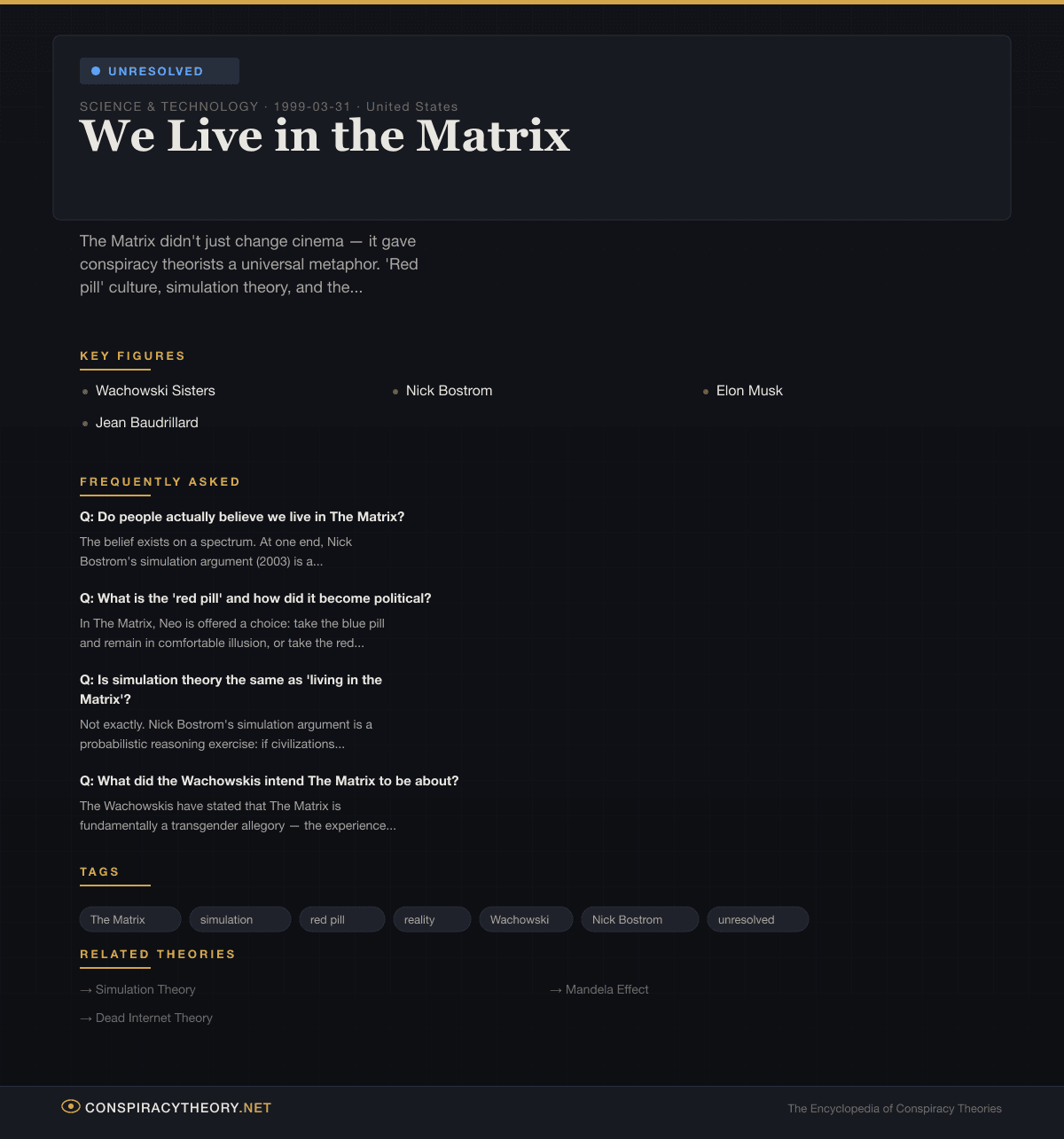
We Live in the Matrix

Overview
On March 31, 1999, a movie came out in which a hacker played by Keanu Reeves discovers that the entire world is a computer simulation run by machines that harvest humans for energy. He takes a red pill, learns kung fu via instant download, dodges bullets in slow motion, and eventually defeats the system through a combination of martial arts and believing in himself.
The Matrix was a box-office smash, a visual effects revolution, and a genuinely interesting piece of pop philosophy. It was also, inadvertently, the most consequential conspiracy theory film ever made — not because it described a real conspiracy, but because it provided a generation of conspiracy theorists with their master metaphor.
Before The Matrix, conspiracy theorists had to explain their worldview from scratch. After The Matrix, they could just say: “It’s like the Matrix.” Everything is fake. The world you see is an illusion. The people in charge are maintaining the illusion to control you. Wake up. Take the red pill. See reality.
The metaphor proved so powerful that it detached entirely from the film and became a freestanding element of internet culture. “Red-pilled” became a verb. “The Matrix” became shorthand for any system of perceived deception. And a movie made by two transgender women about the experience of living in a reality that doesn’t match your true identity became, bizarrely, a foundational text for far-right conspiracy culture.
The Film and Its Sources
What the Wachowskis Built
The Matrix was never just a sci-fi action movie. It was a blender full of philosophy, religion, and critical theory — processed into a form that could be consumed by anyone willing to buy a movie ticket.
Plato’s Cave: The central premise — that perceived reality is a shadow of true reality, and that most people prefer the comfortable shadow — comes directly from Plato’s allegory of the cave in The Republic. Plato described prisoners chained in a cave, watching shadows on a wall and believing them to be reality. The Matrix is Plato’s cave with better special effects.
Baudrillard’s Simulacra: The film explicitly references Jean Baudrillard’s Simulacra and Simulation — Neo hides contraband inside a hollowed-out copy of the book. Baudrillard argued that modern society had replaced reality with representations of reality (simulacra) to such an extent that the distinction between real and simulated had collapsed. We live in “hyperreality” — a world of copies without originals.
Baudrillard himself was not impressed by the film. He argued that the Wachowskis misunderstood his work — that the problem wasn’t a hidden “real” world behind the simulation (as the film suggests) but that there is no “real” world to return to. The simulation is all there is.
Gnostic Theology: The film’s structure mirrors Gnostic Christianity, which held that the material world was created by a malevolent or ignorant deity (the Demiurge) and that true spiritual reality lay beyond it. Neo is the Gnostic savior who awakens humanity from the false material prison. “The One” is the Gnostic pneumatic — the spiritual being who can see through the illusion.
Cyberpunk Fiction: William Gibson’s Neuromancer (1984), Philip K. Dick’s reality-questioning novels, and the entire cyberpunk genre provided the aesthetic and narrative framework.
The Transgender Reading
Both Lilly and Lana Wachowski have confirmed that The Matrix is, at its core, a transgender allegory. The experience of living in a world that insists on an identity that doesn’t match your inner reality — and the liberation of breaking free from that imposed identity — maps precisely onto the trans experience.
The character Switch was originally written to present as male in the Matrix and female in the real world — a concept the studio rejected. The red pill itself has been connected to the red color of Premarin, an estrogen medication commonly prescribed to transgender women in the 1990s.
This makes the film’s subsequent adoption by anti-trans political movements particularly ironic.
The Red Pill Goes Political
From Film Metaphor to Internet Culture
The transition of “the red pill” from film metaphor to political identity happened gradually through the 2000s and accelerated in the 2010s.
Men’s rights and pickup artist communities were among the first to adopt the language. “Taking the red pill” meant recognizing that gender relations were rigged against men — that feminism was the Matrix, and seeing through it was the path to power and sexual success. The subreddit r/TheRedPill, founded in 2012, became a hub for this worldview.
Political conspiracy communities adopted the metaphor for their own purposes. “Red-pilling” someone meant exposing them to conspiracy theories about government, media, or finance. QAnon followers described their journey into Q beliefs as “going down the rabbit hole” — another Matrix reference.
Far-right movements embraced the language with enthusiasm. “Red pill” became synonymous with far-right political awakening — seeing through liberal media, rejecting progressive social values, recognizing the “true” power structures. The metaphor was flexible enough to accommodate everything from mild conservatism to white nationalism.
The common thread: the belief that mainstream reality is a manufactured illusion, that most people are too comfortable or too stupid to see through it, and that a small minority of awakened individuals has access to the truth. This structure flatters the believer and makes disagreement evidence of the other person’s ignorance.
The Irony Problem
The appropriation of The Matrix by right-wing movements created a persistent irony that the Wachowskis have publicly addressed. A film about liberation from imposed identity, created by transgender women, became the foundational metaphor for political movements that frequently oppose transgender rights.
In 2020, Lilly Wachowski responded to Elon Musk and Ivanka Trump tweeting “Take the red pill” by tweeting: “Fuck both of you.” The creators of the metaphor and its most prominent users could not be further apart ideologically.
Simulation Theory: The Serious Version
Nick Bostrom’s Argument
In 2003, Oxford philosopher Nick Bostrom published “Are You Living in a Computer Simulation?” — a paper that gave the “we live in the Matrix” intuition a rigorous philosophical framework.
Bostrom’s argument is a trilemma. At least one of the following must be true:
- Civilizations almost always go extinct before developing the technology to run realistic simulations of conscious beings
- Civilizations that develop such technology almost always choose not to run such simulations
- We are almost certainly living in a simulation
The logic: if civilizations can and do run ancestor simulations, they would run millions or billions of them. In that case, the number of simulated conscious beings would vastly outnumber “real” beings. Statistically, any given conscious being (including you) would almost certainly be simulated.
Bostrom was careful to note that his argument doesn’t prove we’re in a simulation — it proves that one of his three propositions must be true. But the third option got all the attention.
The Tech Billionaire Endorsement
Elon Musk became the most prominent advocate of simulation theory when he stated in 2016 that “the odds that we’re in base reality is one in billions.” Neil deGrasse Tyson put the probability at 50-50. Various physicists have speculated about whether the “pixelation” of reality at the quantum level might be evidence of a computational substrate.
This mainstream attention blurred the line between Bostrom’s careful philosophical argument and the conspiracy theory version. Bostrom’s argument doesn’t require a conspiracy — it’s a statistical inference. The conspiracy version adds intentionality and malice: someone designed the simulation to control us, and the people in power know the truth and are keeping it from us.
The Matrix as Conspiracy Operating System
The Universal Metaphor
The Matrix’s lasting impact on conspiracy culture isn’t any specific claim — it’s the provision of a universal operating system for conspiracy thinking. The structure works for virtually any conspiracy theory:
- The illusion: Whatever mainstream consensus the theorist rejects (vaccines work, the Earth is round, elections are fair)
- The machines/agents: The forces maintaining the illusion (government, media, Big Pharma, the Deep State)
- The red pill: The specific piece of information or experience that “awakened” the theorist
- The awakened few: The community of believers who see through the illusion
- The sleeping masses: Everyone else, still trapped in the Matrix
This framework is seductive because it’s self-reinforcing. If you believe reality is a manufactured illusion, then anyone who disagrees with you is just proving how effective the illusion is. Evidence against your theory is evidence of how deep the conspiracy goes. You can’t lose.
Glitches in the Matrix
The concept of “glitches in the Matrix” — moments where the simulation supposedly reveals itself through anomalies — has become a thriving genre of internet content. Videos of coincidental events, optical illusions, deja vu, and unusual occurrences are interpreted as evidence that reality is simulated and occasionally malfunctions.
The Mandela Effect — the phenomenon of large groups of people sharing false memories (like remembering Nelson Mandela dying in prison in the 1980s) — has been incorporated into Matrix theory as evidence of “timeline edits” or simulation patches.
The Philosophical Problem
Simulation theory — in both its philosophical and conspiratorial forms — has a fundamental problem: it’s unfalsifiable. If we live in a sufficiently advanced simulation, the simulation would be capable of hiding all evidence of its own existence. Any test we could devise, any anomaly we could detect, could be explained as part of the simulation’s design.
An unfalsifiable hypothesis isn’t necessarily wrong. It’s just not science. It occupies the same epistemological space as Last Thursdayism (the universe was created last Thursday with all memories and evidence pre-installed) or solipsism (only your mind exists). These ideas can’t be disproven, but they also can’t be usefully engaged with.
The Matrix metaphor’s power doesn’t come from its truth value. It comes from its emotional and narrative appeal — the idea that you’re special, that you can see what others can’t, that reality is more interesting than it appears. That appeal is real even if the underlying claim is unverifiable.
Timeline
| Date | Event |
|---|---|
| 380 BCE | Plato writes the Allegory of the Cave |
| 1981 | Jean Baudrillard publishes Simulacra and Simulation |
| 1984 | William Gibson’s Neuromancer defines cyberpunk |
| March 31, 1999 | The Matrix released in theaters |
| 2003 | Nick Bostrom publishes simulation argument paper |
| 2003 | The Matrix Reloaded and The Matrix Revolutions released |
| 2012 | r/TheRedPill subreddit founded; “red pill” enters political lexicon |
| 2016 | Elon Musk: “The odds we’re in base reality is one in billions” |
| 2020 | Wachowskis publicly reject far-right appropriation of “red pill” |
| 2021 | The Matrix Resurrections released; film directly addresses appropriation |
Sources & Further Reading
- Bostrom, Nick. “Are You Living in a Computer Simulation?” Philosophical Quarterly, 2003.
- Baudrillard, Jean. Simulacra and Simulation. University of Michigan Press, 1994.
- Irwin, William, ed. The Matrix and Philosophy. Open Court, 2002.
- Chalmers, David J. Reality+: Virtual Worlds and the Problems of Philosophy. W.W. Norton, 2022.
- Nagle, Angela. Kill All Normies: Online Culture Wars from 4chan and Tumblr to Trump and the Alt-Right. Zero Books, 2017.
Related Theories
- Simulation Theory — The philosophical argument for simulated reality
- Mandela Effect — Mass false memories as “glitches in the Matrix”
- Dead Internet Theory — The theory that most online content is generated by bots

Frequently Asked Questions
Do people actually believe we live in The Matrix?
What is the 'red pill' and how did it become political?
Is simulation theory the same as 'living in the Matrix'?
What did the Wachowskis intend The Matrix to be about?
Infographic
Share this visual summary. Right-click to save.