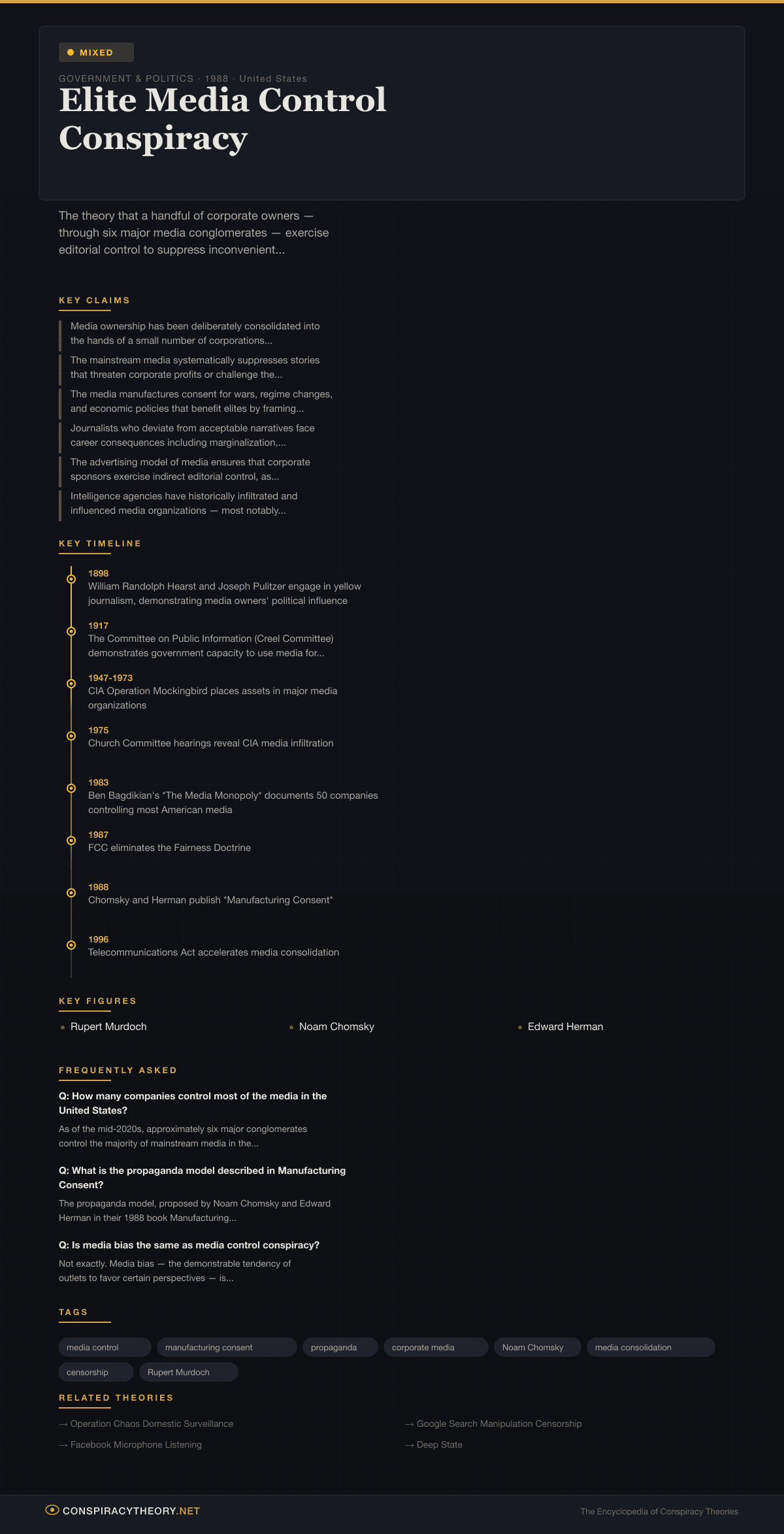
Elite Media Control Conspiracy
Overview
The elite media control theory holds that a small number of wealthy individuals and corporations exercise disproportionate control over the information that reaches the public through news media, entertainment, and increasingly digital platforms. Rather than serving as a free press that holds power accountable, the theory argues, mainstream media functions as a propaganda apparatus that manufactures public consent for policies favoring economic and political elites while marginalizing dissenting perspectives.
This theory exists on a spectrum. At one end, it draws on well-documented facts about media consolidation, corporate ownership, and structural bias — arguments advanced by respected academics like Noam Chomsky and Edward Herman. At the other end, it merges with more conspiratorial claims about secret cabals of media moguls coordinating to manipulate world events. The theory has gained traction across the political spectrum, with both left-wing critics focusing on corporate influence and right-wing critics alleging liberal media bias and collusion with government agencies.
The theory is classified as mixed because some of its core claims are well-supported by evidence — media ownership is highly concentrated, corporate interests do influence editorial decisions, and institutional incentives systematically shape coverage in measurable ways. However, the more extreme versions, which posit a unified, centrally coordinated conspiracy to control public thought, are not supported by evidence and underestimate the genuine diversity and internal conflicts within the media landscape.
Origins & History
Concerns about concentrated media power are as old as mass media itself. In the United States, debates over newspaper monopolies date to the early twentieth century, when press barons like William Randolph Hearst and Joseph Pulitzer wielded enormous political influence through their newspaper chains. The concept of “yellow journalism” — sensationalized reporting designed to drive circulation and advance the owner’s political agenda — emerged during this period.
The modern theory took shape in the 1980s against the backdrop of rapid media consolidation. The deregulation policies of the Reagan administration, particularly the elimination of the Fairness Doctrine in 1987, removed requirements that broadcast media present balanced coverage of controversial issues. That same decade saw a wave of corporate mergers that dramatically reduced the number of independent media companies.
The intellectual foundation of the theory was laid by Noam Chomsky and Edward Herman in their 1988 book Manufacturing Consent: The Political Economy of the Mass Media. Drawing on extensive case studies, Chomsky and Herman proposed the “propaganda model” of media, which identified five structural “filters” that systematically shape news coverage: concentrated corporate ownership, dependence on advertising revenue, reliance on government and corporate sources, organized “flak” campaigns against critical reporting, and ideological framing. Crucially, Chomsky and Herman argued this system operated through institutional incentives rather than explicit coordination — reporters and editors did not need to be told what to write because the system naturally selected for those who produced acceptable content.
The Telecommunications Act of 1996, signed by President Bill Clinton, further accelerated media consolidation by removing barriers to cross-ownership. Between 1996 and 2005, the number of major media companies shrank dramatically through a series of mega-mergers. By the early 2000s, media critic Ben Bagdikian documented that just five conglomerates controlled most of the American media landscape.
The digital era introduced new dimensions to the theory. The rise of Google, Facebook, and other tech platforms created new gatekeepers whose algorithms determine what billions of people see and read. Revelations about algorithmic bias, content moderation policies, and the platforms’ relationships with government agencies have added new evidence for those who see centralized control of information as a defining feature of modern power.
Key Claims
- Media ownership has been deliberately consolidated into the hands of a small number of corporations and individuals who share common class interests and coordinate coverage to protect those interests
- The mainstream media systematically suppresses stories that threaten corporate profits or challenge the political establishment, including coverage of labor movements, corporate crime, wealth inequality, and anti-war perspectives
- The media manufactures consent for wars, regime changes, and economic policies that benefit elites by framing them as necessary, inevitable, or morally justified
- Journalists who deviate from acceptable narratives face career consequences including marginalization, demotion, or termination, creating a chilling effect that produces self-censorship
- The advertising model of media ensures that corporate sponsors exercise indirect editorial control, as outlets avoid coverage that might offend major advertisers
- Intelligence agencies have historically infiltrated and influenced media organizations — most notably through Operation Mockingbird during the Cold War — and this relationship continues in less visible forms
- Tech platforms have become the new gatekeepers, using algorithms and content moderation to amplify approved narratives and suppress dissent
Evidence
Documented media consolidation: The concentration of media ownership is an established fact, not a conspiracy theory. In 1983, media critic Ben Bagdikian identified 50 companies controlling the majority of American media; by 2004, his updated research showed this had shrunk to five. Academic studies by organizations including the Pew Research Center, Columbia Journalism Review, and the FCC itself have documented this trend in detail.
Advertising influence on editorial content: There are numerous documented cases of advertisers influencing editorial decisions. The tobacco industry’s long-standing advertising relationships with magazines correlated with reduced health reporting. Pharmaceutical advertising has been linked to less critical drug coverage. Automotive advertising revenue has been connected to reduced reporting on car safety issues.
Government-media relationships: The CIA’s Operation Mockingbird, which placed agents and assets within major media organizations during the Cold War, was confirmed by the Church Committee hearings in 1975. More recently, documents released through FOIA requests have revealed ongoing government efforts to shape media coverage, including Pentagon-sponsored “military analysts” appearing on television news during the Iraq War without disclosing their government ties.
Case studies in suppressed coverage: Chomsky and Herman’s original work documented specific cases where coverage was shaped by propaganda model filters, including the differential coverage of “worthy” versus “unworthy” victims in Central American conflicts. More recent examples include the media’s largely uncritical amplification of claims about Iraqi weapons of mass destruction before the 2003 invasion, and the delayed mainstream coverage of NSA mass surveillance programs that Edward Snowden eventually revealed.
Counter-evidence: Media organizations frequently publish stories critical of corporate interests and government policy. Investigative journalism outlets like ProPublica, The Intercept, and The Guardian regularly produce adversarial coverage. The existence of significant ideological diversity among outlets — from Fox News to MSNBC to independent media — suggests that complete, coordinated control is not in effect. Internal conflicts within media organizations, including public disagreements between journalists and management, further complicate the picture of unified control.
Debunking / Verification
Verified: Media ownership is highly concentrated. Corporate interests influence editorial decisions. Advertising creates incentive structures that shape coverage. Government agencies have historically infiltrated and influenced media organizations. Structural bias in coverage of war, economics, and politics is measurable and well-documented.
Debunked: The claim of a single, unified conspiracy coordinating all media coverage is not supported by evidence. Media organizations frequently compete with each other, break stories that embarrass other outlets’ parent companies, and produce coverage that angers powerful interests. The internet and independent media have created alternative channels that bypass traditional gatekeepers, undermining the claim of total control.
Unresolved: The degree to which media consolidation constitutes a deliberate strategy versus market dynamics remains debated. Whether algorithmic curation by tech platforms represents a new form of media control comparable to traditional editorial control is an open question with significant implications for democratic governance.
Cultural Impact
The media control theory has profoundly shaped public discourse across the political spectrum. On the left, Chomsky’s propaganda model became foundational for media criticism and the development of independent media outlets like Democracy Now!, The Intercept, and various podcast networks. On the right, the concept of “liberal media bias” became a central political narrative, helping drive the creation of Fox News, conservative talk radio, and right-wing digital media.
The theory has contributed to a broader crisis of trust in media institutions. Gallup polling has documented a dramatic decline in American public confidence in the mass media, from 72% in 1976 to approximately 32% by the mid-2020s. While this decline has multiple causes, the media control narrative has been a significant contributing factor.
The phrase “mainstream media” or “MSM” has become a term of derision used by critics across the political spectrum. Former President Donald Trump’s characterization of news outlets as “fake news” and “the enemy of the people” drew on decades of accumulated skepticism about media credibility, even as it served to discredit legitimate investigative journalism.
The rise of social media and citizen journalism has been both a response to and a complication of the media control theory. While these platforms have democratized information sharing, they have also enabled the spread of misinformation and created new forms of algorithmic gatekeeping that may be even less transparent than traditional editorial control.
Timeline
- 1898 — William Randolph Hearst and Joseph Pulitzer engage in yellow journalism, demonstrating media owners’ political influence
- 1917 — The Committee on Public Information (Creel Committee) demonstrates government capacity to use media for propaganda during World War I
- 1947-1973 — CIA Operation Mockingbird places assets in major media organizations
- 1975 — Church Committee hearings reveal CIA media infiltration
- 1983 — Ben Bagdikian’s The Media Monopoly documents 50 companies controlling most American media
- 1987 — FCC eliminates the Fairness Doctrine
- 1988 — Chomsky and Herman publish Manufacturing Consent
- 1996 — Telecommunications Act accelerates media consolidation
- 2003 — Media largely fails to critically examine WMD claims before Iraq invasion
- 2004 — Bagdikian’s updated research shows five companies control majority of media
- 2013 — Edward Snowden reveals NSA mass surveillance, highlighting media’s failure to report earlier indications
- 2016 — “Fake news” becomes a dominant political concept during the US presidential election
- 2018 — Sinclair Broadcast Group’s coordinated must-run segments draw attention to local media consolidation
- 2021 — Facebook whistleblower Frances Haugen reveals internal documents about algorithmic amplification of divisive content
Sources & Further Reading
- Chomsky, Noam, and Edward S. Herman. Manufacturing Consent: The Political Economy of the Mass Media. Pantheon Books, 1988
- Bagdikian, Ben H. The New Media Monopoly. Beacon Press, 2004
- McChesney, Robert W. Rich Media, Poor Democracy. University of Illinois Press, 1999
- Zuboff, Shoshana. The Age of Surveillance Capitalism. PublicAffairs, 2019
- Bernays, Edward. Propaganda. Ig Publishing, 1928 (reprint 2004)
- Altheide, David L., and Robert P. Snow. Media Logic. SAGE Publications, 1979
- Documentary: Manufacturing Consent: Noam Chomsky and the Media. Directed by Mark Achbar and Peter Wintonick, 1992

Watch: Documentaries & Videos
Related documentaries available on YouTube.
Manufacturing Consent: Noam Chomsky and the Media
Psywar: The Real Battlefield is the Mind
The War You Don't See
HyperNormalisation
Frequently Asked Questions
How many companies control most of the media in the United States?
What is the propaganda model described in Manufacturing Consent?
Is media bias the same as media control conspiracy?

Infographic
Share this visual summary. Right-click to save.