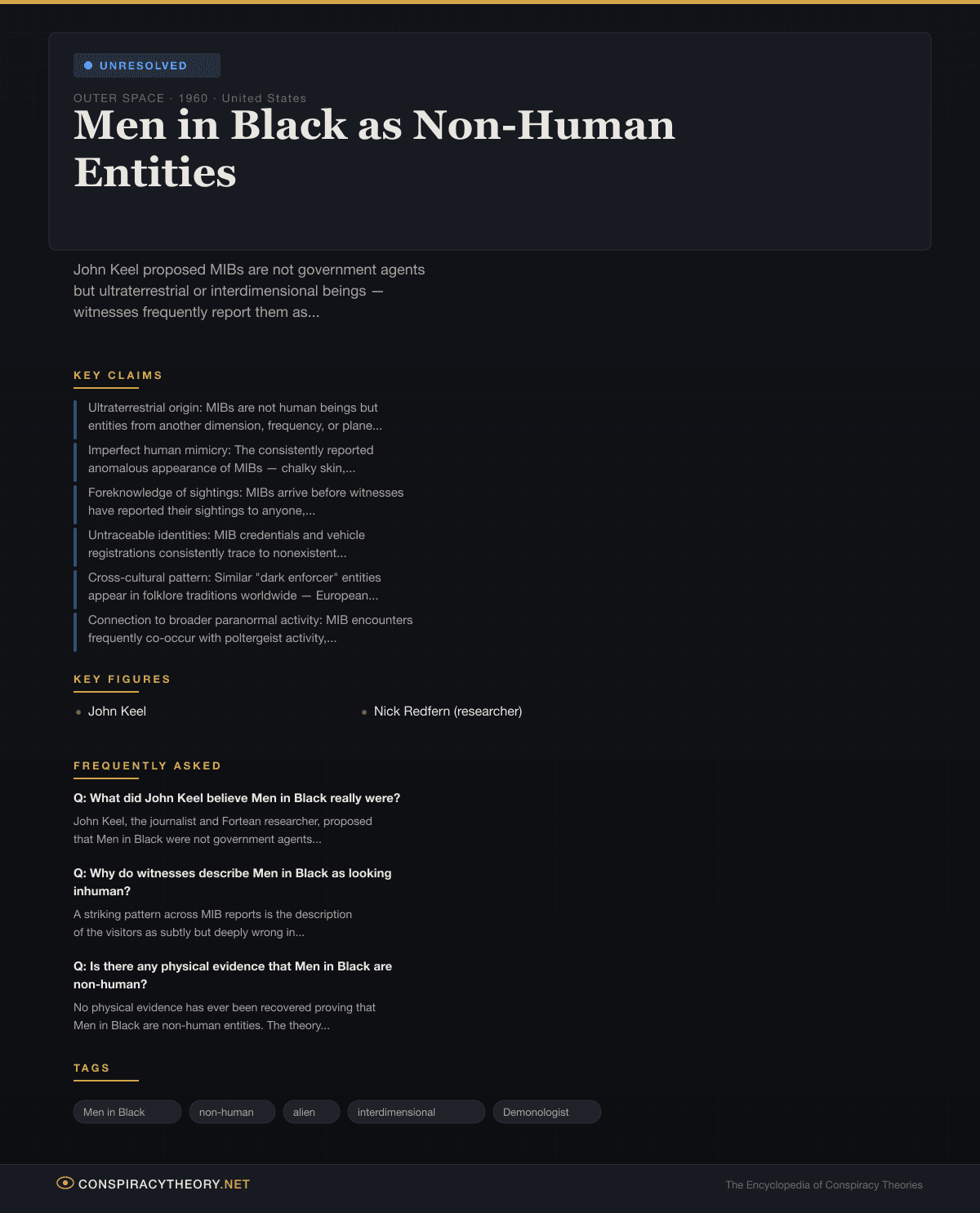
Men in Black as Non-Human Entities

Overview
The standard explanation for Men in Black is straightforward enough: they are government agents — possibly CIA, possibly Air Force intelligence, possibly some unnamed agency — who visit UFO witnesses to intimidate them into silence. It is a tidy narrative that fits comfortably within the familiar framework of government conspiracy and institutional cover-up. The witnesses saw something classified, and the men in dark suits showed up to make sure they kept quiet about it.
But for researchers who spent decades collecting MIB encounter reports, that explanation never quite fit. The visitors were too strange. Their behavior was too bizarre. Their appearance was too wrong. And their knowledge of events — showing up before witnesses had told anyone about their sightings — suggested capabilities that no government agency, however secretive, could plausibly possess.
Beginning in the 1960s, journalist and Fortean researcher John Keel proposed a radically different interpretation: Men in Black were not human at all. They were something else entirely — entities from another dimension, another frequency of existence, another layer of reality that intersects with ours in ways we do not understand. This theory, which Keel called the “ultraterrestrial hypothesis,” reframed MIBs not as agents of a bureaucracy but as manifestations of a non-human intelligence that has been interacting with humanity throughout recorded history, wearing whatever disguise the culture of the era would find most plausible.
Origins & History
The Limits of the Government Agent Theory
The government-agent explanation for Men in Black was the first and most intuitive theory: witnesses see UFOs, shadowy federal operatives show up to keep them quiet. It made sense in the context of Cold War America, where the Air Force was actively investigating UFO reports through Projects Sign, Grudge, and Blue Book, and the CIA was monitoring public interest in unidentified objects through its Robertson Panel of 1953. Some MIB encounters may indeed have involved real government agents conducting real intimidation — the Air Force did interview UFO witnesses, and some of those interviews were reportedly conducted in a manner designed to discourage further discussion.
But by the mid-1960s, researchers who had accumulated large files of MIB reports began noticing details that strained the government-agent hypothesis past its capacity. The visitors sometimes appeared within minutes of a sighting that the witness had not yet reported to anyone. They drove cars that, when traced through license plate registrations, belonged to nonexistent owners, deceased individuals, or had never been issued. They displayed ignorance of basic human customs — how to sit in a chair, how to eat food, how to carry on a casual conversation. And their physical appearance, in report after report, was described as subtly but deeply wrong: waxy or grayish skin, eyes that appeared to lack normal reflexes, movements that were mechanical rather than fluid, voices that sounded rehearsed or artificial.
John Keel’s Ultraterrestrial Hypothesis
John Keel was an unlikely candidate to upend UFO orthodoxy. A journalist by trade who had written for Playboy, Saga, and other magazines, he had spent years investigating anomalous phenomena across the United States. In 1966, he arrived in Point Pleasant, West Virginia, to look into reports of a winged creature that would become known as the Mothman. What he found went far beyond a single cryptid sighting. Witnesses in the area described not only the Mothman but also UFO sightings, poltergeist activity, mysterious phone calls with metallic or synthesized voices, and — critically — visits from Men in Black.
The MIB encounters Keel documented in Point Pleasant and throughout the Ohio Valley shared features with the standard template: dark suits, black cars, warnings to stop talking about what they had seen. But they also included details that defied the government-agent framework. In one case, a witness reported being visited by a man in a dark suit who arrived in a car so new it appeared to still have factory film on the interior surfaces — yet the car was a model several years out of production. The visitor asked strange questions about the witness’s television set, as if he had never seen one before. In another case, a MIB was observed attempting to drink Jell-O, apparently unfamiliar with its semi-solid consistency.
Keel synthesized these observations into what he called the “ultraterrestrial hypothesis.” In UFOs: Operation Trojan Horse (1970) and The Mothman Prophecies (1975), he argued that MIBs, UFOs, and various paranormal phenomena were all manifestations of a non-human intelligence that had been interacting with humanity throughout recorded history. This intelligence, Keel proposed, was not extraterrestrial in the conventional sense — not visitors from another planet arriving in mechanical spacecraft — but something indigenous to our reality yet operating from a dimension or frequency beyond normal human perception. The MIBs were not agents sent by a bureaucracy. They were something else wearing the costume of an agent, using the visual language of authority that would be most effective in mid-twentieth-century America.
Keel drew parallels to earlier historical phenomena. The fairy encounters described in European folklore — beings who appeared from nowhere, behaved according to their own incomprehensible logic, and often enforced taboos on speaking about the experience — bore structural similarities to MIB encounters. The “dark stranger” who appeared at witch trials in early modern Europe, dressed in black and enforcing compliance through intimidation, echoed the MIB pattern. Keel argued that the phenomenon adapted its appearance to the expectations of the culture it was visiting. In the medieval period, it wore the costume of the demonic. In the Age of Enlightenment, it might appear as a mysterious gentleman. In the twentieth century, it wore a dark suit and drove a black car.
Nick Redfern and the Demonic Connection
Researcher Nick Redfern expanded on this line of thinking in subsequent decades, compiling additional cases and noting that MIB descriptions bore similarities to accounts of demonic or djinn-like entities in religious and folklore traditions across cultures. In his 2011 book The Real Men in Black, Redfern catalogued encounters spanning decades and noted recurring elements: the pale or olive skin, the black clothing, the enforcement of silence, the aura of menace combined with an almost comedic inability to function normally.
Redfern drew attention to the cross-cultural dimension. Islamic accounts of djinn — beings created from smokeless fire who inhabit a dimension parallel to the human world — include descriptions of entities who can take human form but imperfectly, who enforce hidden rules, and who interact with humans at moments of spiritual or anomalous significance. Asian folklore traditions include similar figures: entities in dark clothing who appear at boundaries between the normal and the strange, acting as enforcers or guardians of forbidden knowledge.
This cross-cultural pattern is significant for proponents of the non-human theory because it predates modern UFO culture. If MIBs were simply a cultural artifact — a product of Cold War anxiety projected onto ambiguous encounters — one would expect them to appear only in post-1947 American accounts. The existence of structurally similar figures in pre-modern, non-Western traditions suggests either a genuine phenomenon or a very deep-rooted archetype in the human psyche.
Timothy Green Beckley and Physical Anomalies
The non-human MIB theory gained further detail through the work of researchers like Timothy Green Beckley, who collected dozens of reports in which witnesses described MIBs who appeared unable to perform basic human functions. In his 1990 book The UFO Silencers, Beckley compiled cases in which MIBs walked with a strange, shuffling gait, as though their legs did not bend normally at the joints. Others appeared to have difficulty breathing, making shallow, irregular inhalations. Some wore makeup that appeared designed to simulate normal skin tone over an underlying complexion that was gray or greenish. Lips were described as overly red, as though painted on. Hair was sometimes identified as a wig.
These details — the makeup, the wigs, the mechanical movement — paint a picture of entities attempting to pass as human with incomplete understanding of how humans actually look and behave. Whether this represents genuine non-human entities, mentally ill individuals, elaborate hoaxers, or the creative embellishment of witnesses influenced by existing MIB lore is the central question the theory cannot definitively answer.
Key Claims
- Ultraterrestrial origin: MIBs are not human beings but entities from another dimension, frequency, or plane of existence that interact with our reality
- Imperfect human mimicry: The consistently reported anomalous appearance of MIBs — chalky skin, mechanical movement, missing social skills — indicates non-human entities attempting to pass as human
- Foreknowledge of sightings: MIBs arrive before witnesses have reported their sightings to anyone, suggesting surveillance capabilities beyond any human technology or an ability to perceive events across time
- Untraceable identities: MIB credentials and vehicle registrations consistently trace to nonexistent entities, deceased individuals, or government agencies that deny involvement
- Cross-cultural pattern: Similar “dark enforcer” entities appear in folklore traditions worldwide — European Black Man legends, Islamic djinn accounts, Japanese tengu stories, fairy lore — suggesting a phenomenon older than modern UFO culture
- Connection to broader paranormal activity: MIB encounters frequently co-occur with poltergeist activity, cryptid sightings, electronic disturbances, and prophetic dreams, suggesting a common non-human source
- Physical anomalies of the visitors: Reports describe MIBs who do not appear to breathe normally, whose skin has an artificial or waxy texture, who move with a mechanical quality inconsistent with biological life, and who wear apparent cosmetic disguises
- Historical continuity: The phenomenon adapts its appearance to the cultural expectations of each era — appearing as demons in the medieval period, as gentlemen in the Enlightenment, and as government agents in the twentieth century
Evidence
The evidence for the non-human MIB theory is entirely anecdotal, consisting of witness testimony collected by researchers over seven decades. No physical evidence — no photograph, no biological sample, no artifact — has ever been presented. This is a significant limitation that skeptics rightly emphasize. The theory belongs to the category of paranormal claims that resist empirical verification by their nature.
The Testimonial Pattern
What the testimonial record does provide is a pattern — one that proponents argue is too consistent, too widespread, and too detailed to be explained by cultural contamination alone. Keel documented cases throughout the late 1960s and 1970s in which MIB encounters included details difficult to reconcile with the government-agent hypothesis. In Point Pleasant, a witness reported being visited within an hour of a sighting that she had not yet told anyone about. The visitor drove a car that appeared brand-new but was a model several years out of production. He asked questions about the witness’s television set as though he had never seen one.
Albert Bender, whose 1962 book Flying Saucers and the Three Men is often cited as the foundational MIB text, described visitors who materialized in his room rather than arriving by any conventional means. Bender’s account includes sensory details — a sulfurous smell, a feeling of intense cold, a sense of paralyzing fear — that match accounts of demonic encounters in religious literature. Whether this represents genuine phenomenological overlap or unconscious borrowing from religious narratives is debatable.
The researcher Dr. Herbert Hopkins reported a 1976 encounter in Maine that became one of the most detailed MIB accounts on record. Hopkins, a physician who had been investigating a UFO case, received a phone call from a man claiming to represent a local UFO organization. The caller arrived at Hopkins’ home within minutes — impossibly fast, Hopkins believed, given the distance. The visitor was completely bald, with no eyebrows or eyelashes, wore dark clothing, and had what appeared to be lipstick painted on his lips. He spoke in a monotone and made a coin vanish from Hopkins’ palm (Hopkins could not explain how). The visitor then warned Hopkins to destroy his UFO research files and left. When Hopkins looked outside, the visitor was gone — no car, no footprints in the snow.
Skeptical Explanations
Skeptics offer several explanations for the pattern. The power of suggestion, reinforced by decades of MIB media portrayals (beginning with Gray Barker’s 1956 They Knew Too Much About Flying Saucers), could lead witnesses to interpret ambiguous encounters through the MIB template. Sleep paralysis and hypnagogic states can produce vivid experiences of menacing visitors. The human tendency toward pattern recognition — pareidolia applied to social encounters — can weave unrelated anomalies into a coherent but illusory narrative. And some encounters may involve real, if eccentric, humans — private investigators, UFO hoaxers, or mentally ill individuals — misidentified as something more sinister.
The cultural contamination argument is strengthened by the chronological development of MIB reports. Early accounts (1950s-1960s) tend to be simpler and more varied; later accounts increasingly conform to a standardized template that may reflect the influence of published MIB literature rather than independent observation. However, proponents counter that the most anomalous details — the inability to eat, the skin texture, the mechanical movement — appear in early accounts as well, before a standardized MIB template existed in popular culture.
Keel’s research methodology was journalistic rather than scientific — he conducted interviews, cross-referenced accounts, and looked for patterns, but he did not employ controlled observation or produce reproducible results. The same applies to subsequent researchers like Redfern and Beckley. Their work is valuable as a compendium of reported experiences but does not constitute evidence in the scientific sense.
Key Figures
- John Keel (1930–2009): Journalist and Fortean researcher who developed the ultraterrestrial hypothesis. Author of The Mothman Prophecies and UFOs: Operation Trojan Horse. Investigated the Point Pleasant, West Virginia, phenomena of 1966-67.
- Nick Redfern (b. 1964): British author and researcher who expanded on Keel’s non-human MIB theory, compiling additional cases and exploring connections to demonology and folklore traditions.
- Gray Barker (1925–1984): Author of They Knew Too Much About Flying Saucers (1956), the book that introduced Men in Black to popular culture and established many of the standard narrative elements.
- Albert Bender (1921–2016): UFO researcher whose 1953 encounter and subsequent 1962 book Flying Saucers and the Three Men is considered the foundational MIB account. Described materializing entities rather than conventional visitors.
- Timothy Green Beckley (1947–2021): Publisher and researcher who compiled extensive collections of MIB encounter reports, focusing on physical anomalies and behavioral patterns.
- Jacques Vallee (b. 1939): French-American computer scientist and UFO researcher whose “interdimensional hypothesis” parallels Keel’s ultraterrestrial framework.
- Dr. Herbert Hopkins (1921–1998): Physician who reported one of the most detailed MIB encounters in 1976, including the visitor’s apparent lack of eyebrows and eyelashes.
Timeline
- 1947: Kenneth Arnold UFO sighting inaugurates the modern UFO era; earliest Men in Black reports begin appearing in the following years
- 1953: Albert Bender reports being visited by three dark-suited entities who warn him to stop UFO research; he shuts down his International Flying Saucer Bureau
- 1956: Gray Barker publishes They Knew Too Much About Flying Saucers, introducing MIBs to popular culture
- 1962: Albert Bender publishes Flying Saucers and the Three Men, describing MIBs as materializing entities rather than conventional visitors
- 1966–1967: John Keel investigates Mothman sightings and associated MIB encounters in Point Pleasant, West Virginia
- 1970: Keel publishes UFOs: Operation Trojan Horse, formally proposing the ultraterrestrial hypothesis
- 1975: Keel publishes The Mothman Prophecies, documenting MIB encounters alongside other paranormal phenomena
- 1976: Dr. Herbert Hopkins reports his detailed MIB encounter in Maine
- 1979: Jacques Vallee publishes Messengers of Deception, exploring the interdimensional hypothesis
- 1990: Timothy Green Beckley publishes The UFO Silencers, compiling decades of MIB encounter reports
- 1997: The Men in Black film franchise launches, popularizing a comedic government-agent version of MIBs that largely displaces the darker, stranger original tradition
- 2011: Nick Redfern publishes The Real Men in Black, expanding the non-human theory with new cases and cross-cultural analysis
- 2017–present: Pentagon UFO programs (AATIP, AARO) revive mainstream interest in anomalous encounters, though official investigations do not address MIB phenomena
Cultural Impact
The non-human interpretation of Men in Black has had a profound influence on how the broader paranormal community understands anomalous encounters. Keel’s ultraterrestrial hypothesis challenged the dominant “nuts-and-bolts” extraterrestrial framework of 1960s UFO research, which assumed that UFOs were physical spacecraft from other planets piloted by biological beings. By proposing that MIBs, UFOs, and paranormal phenomena were interconnected manifestations of a non-human intelligence, Keel opened the door to a more holistic — and more unsettling — model of the phenomenon.
This framework influenced subsequent researchers and thinkers, including Jacques Vallee, whose “interdimensional hypothesis” parallels Keel’s work in significant respects. Vallee argued that UFO phenomena shared characteristics with fairy folklore, religious apparitions, and other historical anomalies — suggesting a control system operating across human history rather than recent extraterrestrial visitation. The Pentagon’s Advanced Aerospace Threat Identification Program (AATIP), which reportedly investigated phenomena beyond conventional UFO sightings, including alleged poltergeist activity at Skinwalker Ranch in Utah, reflected an institutional openness to the broader paranormal framework that Keel helped establish.
In popular culture, the creepy, inhuman version of Men in Black has been largely overshadowed by the comedic depiction in the Men in Black film franchise (1997, 2002, 2012, 2019), where the MIBs are human agents using alien technology to police extraterrestrial activity on Earth. The films were enormously successful — the franchise has grossed over $1.6 billion worldwide — but they represent a fundamentally different tradition from the one Keel described. Tommy Lee Jones and Will Smith’s MIBs are competent, funny, and very human. Keel’s MIBs were none of those things.
However, the original unsettling archetype persists in horror fiction, creepypasta, the SCP Foundation community, and the growing genre of paranormal podcasts and YouTube channels. The image of an almost-but-not-quite-human figure in a black suit asking strange questions continues to resonate as one of the most genuinely disturbing motifs in anomalous encounter literature. It taps into what psychologists call the “uncanny valley” — the revulsion triggered by something that is close to human but detectably not — a concept that may explain both the theory’s psychological power and some of its evidential basis.
The non-human MIB theory remains outside the boundaries of scientific investigation. It persists because it provides an internally consistent framework for the most extreme reported encounters — those that defy the government-agent explanation — and because the absence of evidence is not, by itself, evidence of absence. Whether MIBs are ultraterrestrials, misidentified humans, products of altered states of consciousness, or something else entirely, the phenomenon continues to generate reports, research, and unease.
Sources & Further Reading
- Keel, John A. UFOs: Operation Trojan Horse. G.P. Putnam’s Sons, 1970.
- Keel, John A. The Mothman Prophecies. Saturday Review Press, 1975.
- Redfern, Nick. The Real Men in Black: Evidence, Famous Cases, and True Stories. New Page Books, 2011.
- Beckley, Timothy Green. The UFO Silencers: Mystery of the Men in Black. Inner Light Publications, 1990.
- Barker, Gray. They Knew Too Much About Flying Saucers. University Books, 1956.
- Bender, Albert K. Flying Saucers and the Three Men. Saucerian Books, 1962.
- Vallee, Jacques. Messengers of Deception: UFO Contacts and Cults. And/Or Press, 1979.
- Vallee, Jacques. Passport to Magonia: From Folklore to Flying Saucers. Henry Regnery, 1969.
- Clark, Jerome. The UFO Encyclopedia. Omnigraphics, 1998.
Related Theories
- Men in Black — UFO Witness Silencing Agents — the conventional government-agent interpretation of MIB encounters
- Skinwalker Ranch — a location where multiple paranormal phenomena converge, consistent with Keel’s ultraterrestrial framework
- UFO Cover-Up History — the broader history of government secrecy regarding unidentified aerial phenomena
Frequently Asked Questions
What did John Keel believe Men in Black really were?
Why do witnesses describe Men in Black as looking inhuman?
Is there any physical evidence that Men in Black are non-human?
Infographic
Share this visual summary. Right-click to save.