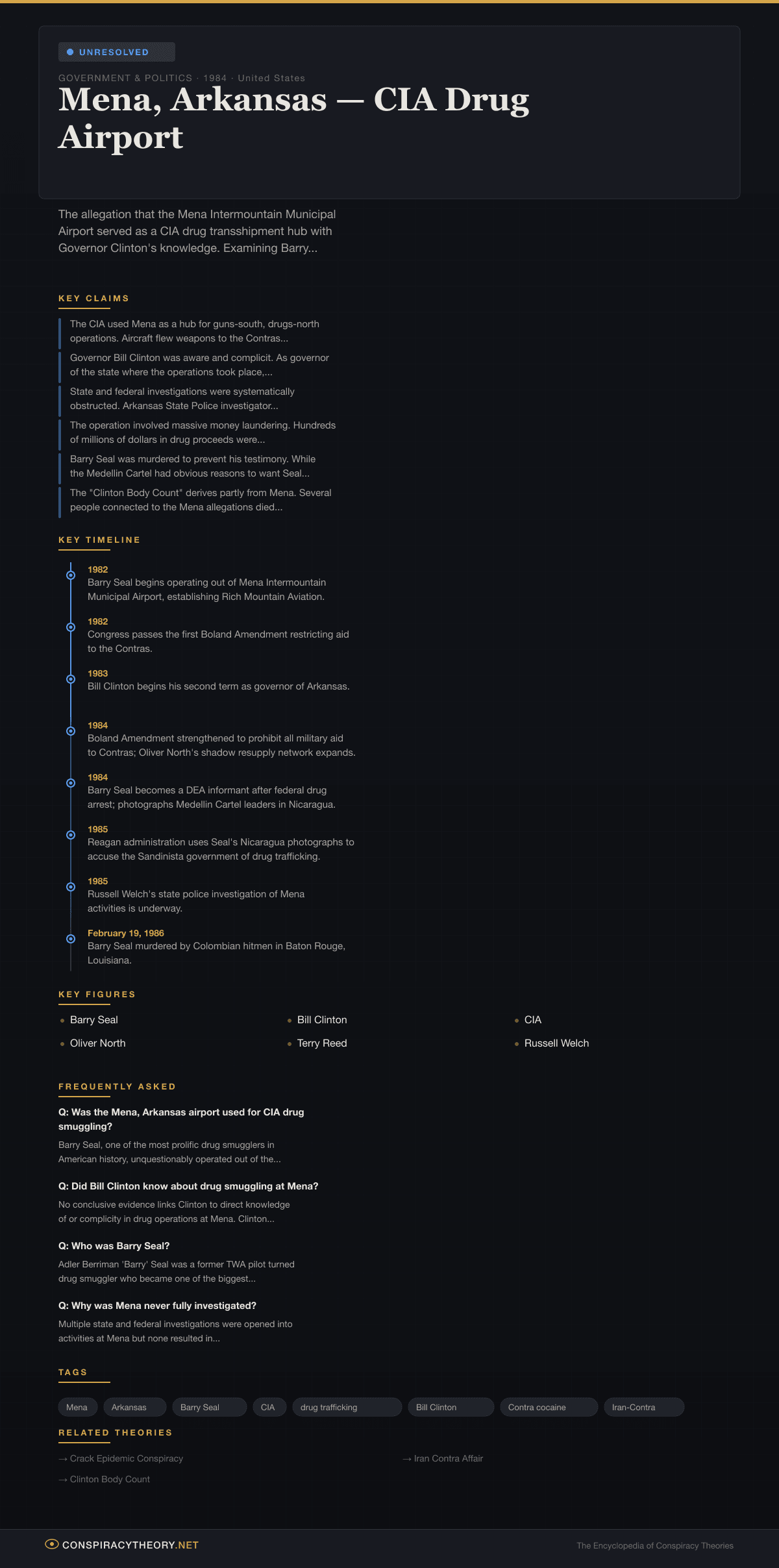
Mena, Arkansas — CIA Drug Airport
Overview
In the rolling Ouachita Mountains of western Arkansas, population 5,600 and falling, sits the small city of Mena. Its intermountain municipal airport, built during World War II as a military training facility, should have been one of the least interesting pieces of aviation infrastructure in the United States. Instead, it became the locus of one of the most persistent and politically explosive conspiracy theories of the late twentieth century — a theory that connects the CIA, Colombian cocaine, the Nicaraguan Contras, and a future President of the United States in a narrative that is either a devastating indictment of American governance or a masterwork of partisan fever-dreaming, depending on whom you ask.
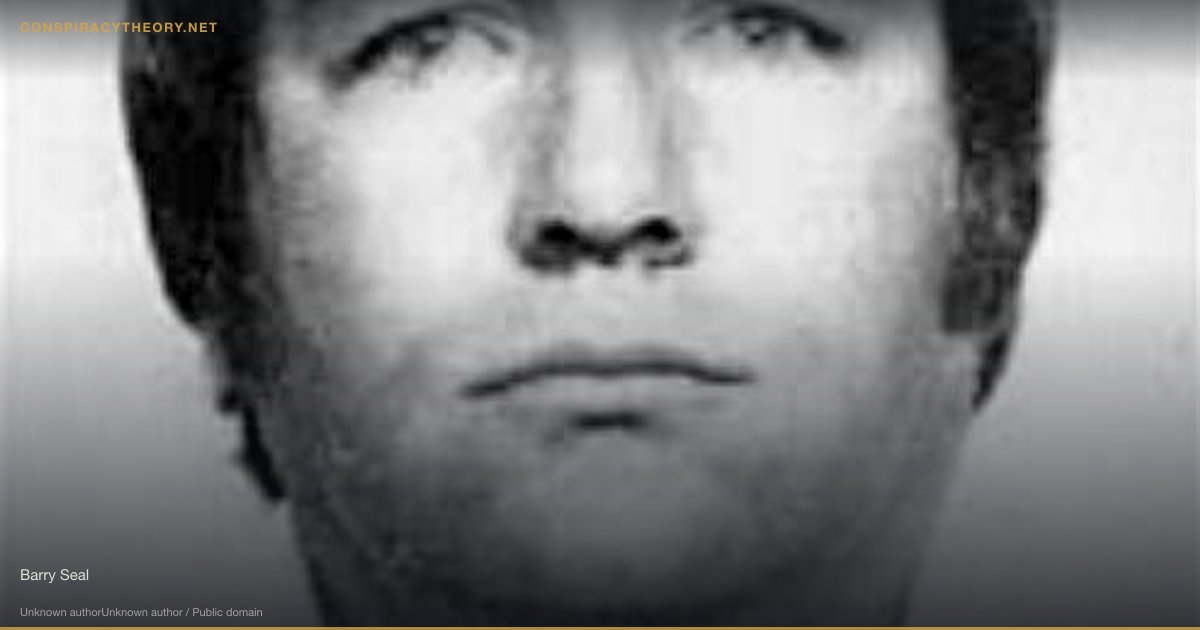
The facts that are not in dispute are damning enough. In the early-to-mid 1980s, a man named Barry Seal — a former TWA pilot who had become one of the most prolific drug smugglers in history — operated out of the Mena airport, flying modified military transport planes on routes that connected Colombia, Central America, and the American heartland. Seal was simultaneously a major cocaine importer, a DEA informant, and a participant in the CIA-backed Contra resupply network that would become the Iran-Contra affair. His planes carried guns south to the Contras and, according to multiple witnesses and investigators, carried cocaine north on the return trips.
What remains contested — and what elevates this from a story about one charismatic criminal to a political conspiracy theory — is who knew what, who looked the other way, and whether the governor of Arkansas was among those who chose not to see.
Origins & History
Barry Seal: The Most Interesting Drug Smuggler in American History
Barry Seal’s life reads like a rejected screenplay for being too implausible. Born in Baton Rouge, Louisiana, in 1939, he earned his pilot’s license at 16, joined the Civil Air Patrol as a teenager (where he allegedly crossed paths with a young Lee Harvey Oswald, though this claim is disputed), and was flying for TWA by his early twenties. He was fired from TWA in 1974 after being caught trying to smuggle plastic explosives to anti-Castro Cubans in Mexico.
By the late 1970s, Seal had found his true calling: smuggling cocaine. He was extraordinarily good at it. Flying modified Fairchild C-123 military transports — planes large enough to carry tons of cargo — Seal ran cocaine from Colombia through Central America to landing strips across the Gulf Coast. Estimates of the cocaine he moved range from several thousand to 36,000 kilograms over his career, worth billions of dollars at street prices. He earned, by some accounts, $25 million to $50 million personally.
Seal chose the Mena airport as his primary operational base around 1982. The airport offered a long runway capable of handling large aircraft, minimal federal presence, and geographic isolation. He established a business called Rich Mountain Aviation, which ostensibly serviced and modified aircraft but which, investigators later alleged, was a front for laundering money and maintaining his smuggling fleet.
The Contra Connection
What made Seal’s operation at Mena something more than an exceptionally successful drug smuggling enterprise was its intersection with the Reagan administration’s covert war in Central America. The Contras — right-wing guerrillas fighting the leftist Sandinista government in Nicaragua — were a consuming obsession for the Reagan White House. When Congress passed the Boland Amendment in 1982 (and strengthened it in 1984), explicitly banning U.S. military aid to the Contras, the administration sought alternative channels.
Oliver North, a National Security Council aide, became the architect of a shadow resupply network. Planes flew weapons and supplies south from the United States to Contra bases in Honduras and Costa Rica. According to multiple sources — including pilots, ground crew, and investigators — some of these same planes returned north loaded with cocaine.
Seal’s aircraft were part of this network. The specific C-123K that Seal used for some of his smuggling runs — tail number N4410F, known as “The Fat Lady” — was later shot down over Nicaragua in October 1986 carrying CIA operative Eugene Hasenfus and a cargo of weapons for the Contras. That shootdown, and Hasenfus’s capture, helped blow open the Iran-Contra scandal.
Seal became a DEA informant in 1984, after being arrested on federal drug charges. The DEA used him in an elaborate sting operation against the Medellin Cartel. Seal flew to Nicaragua, where he photographed Pablo Escobar’s associate Federico Vaughan and Nicaraguan military personnel loading 750 kilos of cocaine onto his plane. The photographs were gold for the Reagan administration, which used them to claim the Sandinista government was involved in drug trafficking — a propaganda victory that conveniently supported the case for Contra aid.
The Murder of Barry Seal
On February 19, 1986, Barry Seal was shot dead in the parking lot of the Salvation Army halfway house in Baton Rouge where he was serving a sentence of community service — a remarkably lenient arrangement for a man who had smuggled thousands of kilos of cocaine. He was hit by a barrage of bullets from MAC-10 machine pistols. Three Colombian hitmen, linked to the Medellin Cartel, were convicted of the murder.
Seal’s death eliminated the single most important witness to whatever happened at Mena. He had been scheduled to testify in multiple proceedings. His knowledge of the intersection between CIA operations, Contra resupply, and drug trafficking died with him.
In his car at the time of his murder, investigators found the direct phone number of Vice President George H.W. Bush. The significance of this detail is debated. Seal had photographed the Medellin Cartel operations at the request of the DEA, and his intelligence had been briefed to senior administration officials — a phone number could have been given to him through official channels. Or it could have indicated a more direct relationship.
Key Claims
-
The CIA used Mena as a hub for guns-south, drugs-north operations. Aircraft flew weapons to the Contras and returned with cocaine, with the CIA providing operational cover, including protection from law enforcement.
-
Governor Bill Clinton was aware and complicit. As governor of the state where the operations took place, Clinton allegedly knew about the drug trafficking and blocked state-level investigations in exchange for political support from the intelligence community or direct financial benefit.
-
State and federal investigations were systematically obstructed. Arkansas State Police investigator Russell Welch and IRS investigator Bill Duncan both documented cases that were blocked, redirected, or shut down by superiors, allegedly at the direction of parties interested in protecting the Mena operations.
-
The operation involved massive money laundering. Hundreds of millions of dollars in drug proceeds were allegedly laundered through Arkansas financial institutions, with some of the money flowing into political campaigns.
-
Barry Seal was murdered to prevent his testimony. While the Medellin Cartel had obvious reasons to want Seal dead, the theory suggests that American interests — CIA, political figures — also benefited from his permanent silence.
-
The “Clinton Body Count” derives partly from Mena. Several people connected to the Mena allegations died under suspicious circumstances, feeding into the broader Clinton Body Count conspiracy theory.
Evidence & Analysis
What Is Documented
Several facts about Mena are established beyond reasonable dispute:
Barry Seal operated a major drug smuggling enterprise out of the Mena airport from approximately 1982 to 1985. He used the airport for aircraft maintenance, modification, and as a base for smuggling flights. This is confirmed by federal court records, DEA files, and Seal’s own testimony.
Seal was a DEA informant who simultaneously worked with elements of the U.S. intelligence community. His involvement in the Contra resupply network is documented in Iran-Contra investigation records.
Arkansas State Police investigator Russell Welch did investigate suspicious activities at Mena for years and did encounter significant obstacles. Welch has spoken publicly about his investigations, and his account has been corroborated by other law enforcement officials. Notably, in 1991, Welch fell ill with what he believed was anthrax poisoning — he was diagnosed with military-grade anthrax and survived only because his doctor recognized the symptoms quickly.
IRS criminal investigator Bill Duncan did resign from the IRS in protest, claiming his investigation into money laundering connected to Mena was blocked by his superiors. Duncan testified before Congress about the obstruction he encountered.
The Clinton Question
The most politically charged aspect of the Mena theory — Clinton’s alleged complicity — rests on the weakest evidence. The primary source for direct Clinton involvement is Terry Reed, a former Air Force intelligence officer who published Compromised: Clinton, Bush, and the CIA in 1994. Reed claimed to have witnessed a meeting in which Clinton discussed the Mena operations with CIA operatives. His account has been challenged on factual grounds, and some of his specific claims have been contradicted by documentary evidence.
Clinton, when asked about Mena, has generally responded that the operations were federal matters beyond the purview of the governor’s office. This is partially true — drug smuggling and CIA operations are federal jurisdiction. However, the state police investigator was an Arkansas employee, and the question of whether state-level obstruction occurred at the direction of the governor’s office remains unanswered.
The political context is important. The Mena theory gained its widest circulation during Clinton’s presidential campaigns and presidency, promoted primarily by conservative media outlets and political opponents. This does not make it false, but it means the theory was amplified in an environment where partisan motivation was strong and editorial standards were sometimes secondary to political utility.
The Investigative Failures
Perhaps the most troubling aspect of the Mena story is the number of investigations that were opened and then went nowhere. A partial list:
The Arkansas State Police investigation, led by Russell Welch, which accumulated extensive documentation but never led to prosecution. Welch has attributed this to interference from above.
The IRS criminal investigation, led by Bill Duncan, which documented suspicious financial transactions linked to the Mena operations but was blocked before it could proceed to prosecution.
A Polk County, Arkansas, grand jury investigation in the early 1990s, which heard testimony but did not return indictments.
Special prosecutor Charles Black, appointed by the governor (then-Governor Jim Guy Tucker, Clinton’s successor) to investigate Mena, who reportedly told journalist Ambrose Evans-Pritchard that his investigation was obstructed and underfunded.
Congressional investigations by both the House and Senate, which touched on Mena in the context of Iran-Contra but never conducted a dedicated investigation of the airport’s drug operations.
The pattern — investigations opened, evidence gathered, prosecutions never brought — is consistent with either a cover-up or with a situation where the evidence was insufficient for criminal charges despite being deeply suspicious. The CIA’s involvement in the Contra resupply network — confirmed by the Iran-Contra investigation — creates a plausible mechanism for obstruction: classified operations intersecting with criminal ones, with the intelligence community exerting pressure to protect sources and methods.
Cultural Impact
The Mena story has had an outsized influence on American political culture, particularly on the right. It became a foundational narrative for anti-Clinton conspiracy theories in the 1990s, feeding into the broader Clinton Body Count theory and contributing to the atmosphere of suspicion that surrounded the Clinton presidency.
The Barry Seal story, stripped of its most contested political elements, has been told in multiple formats. Tom Cruise starred as Seal in American Made (2017), a Doug Liman film that depicted Seal’s drug smuggling and CIA connections with a breezy, darkly comic tone. The film notably downplayed the Mena connection and the Clinton angle entirely, focusing instead on the guns-for-drugs loop as a systemic critique of Cold War policy.
The Mena theory also played a significant role in the development of what would become the modern conservative alternative media ecosystem. The story was championed by publications like the American Spectator and by journalists like Ambrose Evans-Pritchard of the Daily Telegraph, who wrote extensively about Mena during his tenure as Washington correspondent. The mainstream American press largely ignored the story, which critics attributed to liberal bias and defenders attributed to insufficient evidence. This dynamic — alternative media breaking stories that mainstream media would not touch — prefigured the media landscape that would later produce phenomena like the Deep State narrative and QAnon.
Reporter Gary Webb’s 1996 San Jose Mercury News series “Dark Alliance,” which alleged CIA complicity in crack cocaine distribution in Los Angeles, was a thematic cousin of the Mena story. Webb focused on the California end of the Contra cocaine pipeline; the Mena theory focused on the Arkansas hub. Both stories alleged that the U.S. government tolerated or facilitated drug trafficking to fund covert operations, and both remain controversial.
Timeline
- 1982 — Barry Seal begins operating out of Mena Intermountain Municipal Airport, establishing Rich Mountain Aviation.
- 1982 — Congress passes the first Boland Amendment restricting aid to the Contras.
- 1983 — Bill Clinton begins his second term as governor of Arkansas.
- 1984 — Boland Amendment strengthened to prohibit all military aid to Contras; Oliver North’s shadow resupply network expands.
- 1984 — Barry Seal becomes a DEA informant after federal drug arrest; photographs Medellin Cartel leaders in Nicaragua.
- 1985 — Reagan administration uses Seal’s Nicaragua photographs to accuse the Sandinista government of drug trafficking.
- 1985 — Russell Welch’s state police investigation of Mena activities is underway.
- February 19, 1986 — Barry Seal murdered by Colombian hitmen in Baton Rouge, Louisiana.
- October 1986 — C-123K “The Fat Lady” shot down over Nicaragua carrying CIA operative Eugene Hasenfus; Iran-Contra scandal begins to unravel.
- 1987 — Congressional Iran-Contra hearings; Oliver North testifies.
- 1991 — Russell Welch falls ill with suspected military-grade anthrax poisoning.
- 1992 — Bill Clinton elected president; Mena allegations intensify.
- 1994 — Terry Reed publishes Compromised: Clinton, Bush, and the CIA.
- 1995 — IRS investigator Bill Duncan resigns in protest over obstructed Mena investigations.
- 1996 — Gary Webb publishes “Dark Alliance” in the San Jose Mercury News.
- 2004 — Gary Webb dies by suicide; ruled two gunshot wounds to the head.
- 2017 — American Made, starring Tom Cruise as Barry Seal, released.
Sources & Further Reading
- Reed, Terry, and John Cummings. Compromised: Clinton, Bush, and the CIA. SPI Books, 1994
- Evans-Pritchard, Ambrose. The Secret Life of Bill Clinton: The Unreported Stories. Regnery Publishing, 1997
- Hopsicker, Daniel. Barry & ‘the Boys’: The CIA, the Mob, and America’s Secret History. MadCow Press, 2001
- Webb, Gary. Dark Alliance: The CIA, the Contras, and the Crack Cocaine Explosion. Seven Stories Press, 1998
- Walsh, Lawrence E. Iran-Contra: The Final Report. Times Books, 1994
- Cockburn, Alexander, and Jeffrey St. Clair. Whiteout: The CIA, Drugs, and the Press. Verso, 1998
- U.S. Senate Committee on Foreign Relations. “Drugs, Law Enforcement, and Foreign Policy.” (Kerry Committee Report), 1989
- Seal, Deborah. Interviews and public statements regarding Barry Seal’s activities
Related Theories
- CIA Drug Trafficking — the broader theory of CIA involvement in the global drug trade
- Iran-Contra Affair — the confirmed scandal involving illegal arms sales and Contra funding
- Clinton Body Count — the list of suspicious deaths connected to the Clintons, partly rooted in Mena allegations
- Gary Webb & Dark Alliance — the journalist who exposed CIA-Contra cocaine connections and died under disputed circumstances
Frequently Asked Questions
Was the Mena, Arkansas airport used for CIA drug smuggling?
Did Bill Clinton know about drug smuggling at Mena?
Who was Barry Seal?
Why was Mena never fully investigated?
Infographic
Share this visual summary. Right-click to save.