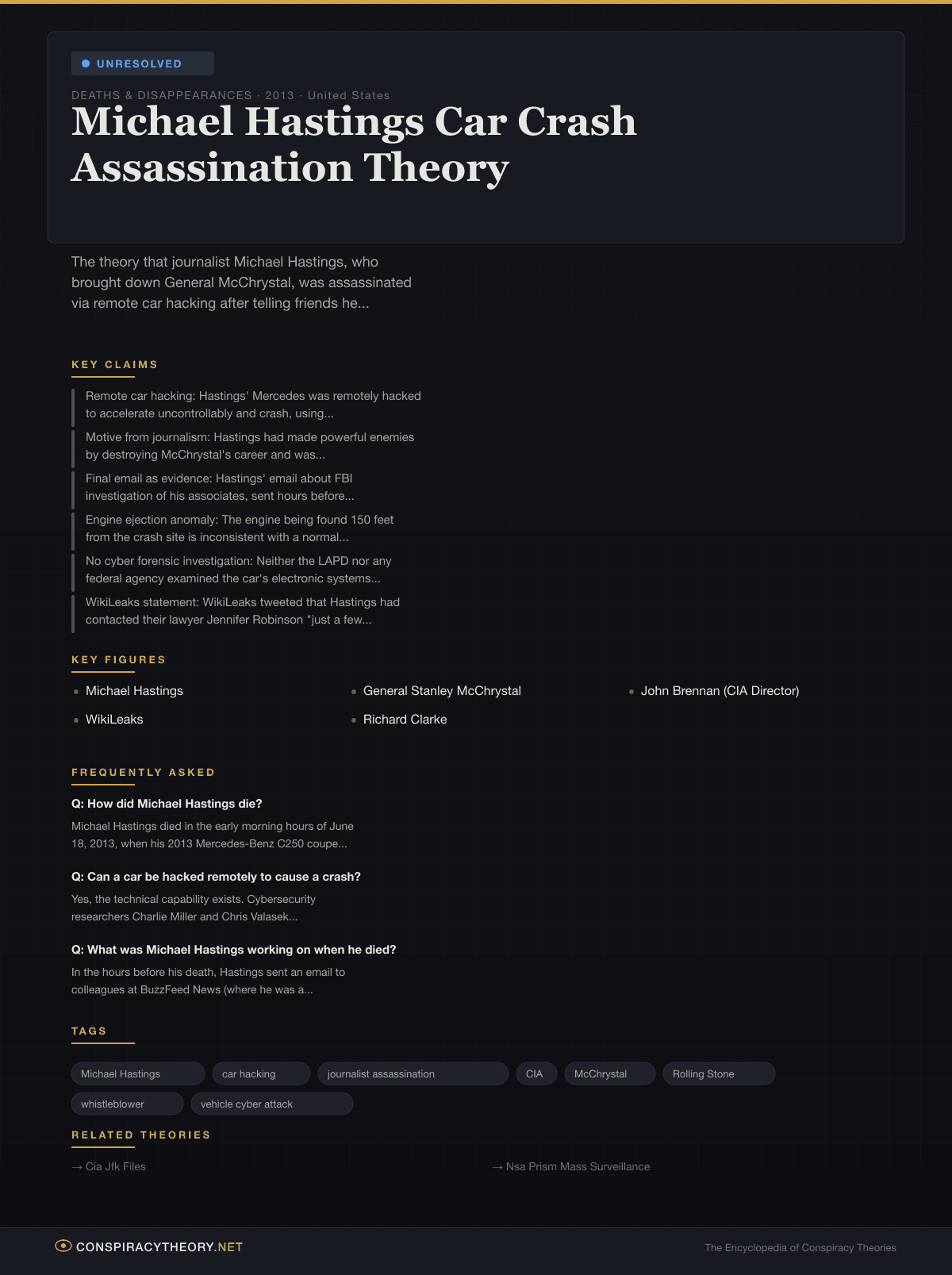
Michael Hastings Car Crash Assassination Theory
Overview
At 4:25 AM on June 18, 2013, a Mercedes-Benz C250 coupe driven by 33-year-old investigative journalist Michael Hastings was traveling at extreme speed down Highland Avenue in the Hancock Park neighborhood of Los Angeles when it struck a palm tree and exploded in a fireball visible from blocks away. The engine was ejected from the vehicle and found 50 yards south of the crash site. Hastings was killed instantly.
The official ruling was accidental death. But for those who knew Michael Hastings and what he was working on, the word “accident” landed with a thud. This was the reporter who had brought down a four-star general. And in the hours before he died, he had told friends he was being investigated by the FBI and was working on the biggest story of his career.
Origins & History
Michael Hastings was not an ordinary journalist, and his death was never going to be treated as ordinary by the people who followed his work.
In June 2010, Hastings had published a profile of General Stanley McChrystal in Rolling Stone magazine titled “The Runaway General.” The piece, which captured McChrystal and his senior staff making dismissive and insubordinate comments about Vice President Joe Biden, National Security Advisor James Jones, and the Obama administration’s Afghanistan policy, triggered a political earthquake. McChrystal was summoned to Washington and resigned. A reporter in his early thirties had ended the career of the commander of all U.S. and NATO forces in Afghanistan with a single article. The military and intelligence establishment took notice — and, Hastings’ supporters would later argue, they took it personally.
After Rolling Stone, Hastings joined BuzzFeed News as a staff reporter and continued pursuing stories about the military, intelligence agencies, and the expanding surveillance state. In 2012, he published The Operators, a book expanding on his McChrystal reporting. In early 2013, he wrote a critical profile of CIA Director John Brennan and had been investigating the agency’s drone program and its domestic surveillance activities — subjects that put him in direct conflict with the most powerful and least accountable institutions in the U.S. government.
On June 17, 2013, at approximately 12:30 PM, Hastings sent an email to several colleagues with the subject line “FBI Investigation, re: NSA.” The email stated: “the Feds are interviewing my ‘close friends and associates.’” He described himself as being “onto a big story” and said he needed to “go off the radar for a bit.” He asked a lawyer at BuzzFeed for legal counsel. This email, which was later published by multiple news outlets, would become the central document in the conspiracy theory surrounding his death.
Less than sixteen hours later, Hastings was dead.
The crash itself raised immediate questions. Witnesses reported seeing the Mercedes traveling at an estimated 100 mph or more on a residential street at 4:25 AM. The impact with the palm tree was so violent that the engine was ejected from the chassis and found approximately 150 feet from the crash site. The car burned so intensely that the body was severely charred, and forensic identification required dental records. Neighbors who heard the crash described an explosion-like sound.
The Los Angeles Police Department investigated and ruled the death accidental. The LA County Coroner determined the cause of death as massive blunt force trauma consistent with a high-speed collision, with the fire as a contributing factor. Toxicology found traces of THC (marijuana) and amphetamine — the latter consistent with Adderall, which Hastings was known to use. The LAPD stated it found no evidence of foul play.
The conspiracy theory coalesced around several strands. Former U.S. National Coordinator for Security, Infrastructure Protection, and Counter-terrorism Richard Clarke — not a conspiracy theorist but a career government official — told Huffington Post that the crash was “consistent with a car cyber attack” and that it was known in intelligence circles that the capability to remotely hack modern vehicles existed. Clarke stopped short of saying Hastings was murdered but stated that the possibility could not be dismissed without a proper cyber forensic investigation of the car’s electronic control systems — an investigation that was never conducted.
The timing of Hastings’ death relative to the Edward Snowden revelations added a layer of context. Snowden’s first NSA disclosures were published by The Guardian on June 5, 2013 — thirteen days before Hastings’ death. Hastings’ final email referenced an FBI investigation connected to NSA surveillance. The convergence of these timelines suggested to theorists that Hastings may have been pursuing a story related to NSA domestic spying that threatened powerful interests.
Key Claims
- Remote car hacking: Hastings’ Mercedes was remotely hacked to accelerate uncontrollably and crash, using techniques that were technically feasible and that Richard Clarke confirmed intelligence agencies possessed
- Motive from journalism: Hastings had made powerful enemies by destroying McChrystal’s career and was actively investigating the CIA and FBI at the time of his death
- Final email as evidence: Hastings’ email about FBI investigation of his associates, sent hours before his death, indicates he knew he was being targeted
- Engine ejection anomaly: The engine being found 150 feet from the crash site is inconsistent with a normal car accident and suggests an explosion or additional force
- No cyber forensic investigation: Neither the LAPD nor any federal agency examined the car’s electronic systems for evidence of remote manipulation, despite the publicly known capability
- WikiLeaks statement: WikiLeaks tweeted that Hastings had contacted their lawyer Jennifer Robinson “just a few hours before he died,” indicating he was preparing to share sensitive material
- Cremation without family consent: Hastings’ body was cremated before his family in Vermont had given their consent, destroying potential forensic evidence
- Pattern of journalist targeting: Hastings’ death fits a pattern in which journalists investigating intelligence agencies face harassment, surveillance, and in some theories, elimination
Evidence
The evidence in this case is genuinely ambiguous, which is why the theory persists among people who are not typically drawn to conspiracy thinking.
On the side of the official account: the toxicology results are consistent with impaired driving. Amphetamines can cause reckless behavior, paranoia, and poor judgment, particularly in someone who was under extreme stress — and multiple friends described Hastings as erratic and anxious in his final weeks. The crash dynamics, while dramatic, are consistent with a high-speed single-vehicle accident. The engine ejection, while unusual, has been documented in other high-speed Mercedes crashes due to the engine’s mounting design. The LAPD found no physical evidence of tampering.
On the side of the conspiracy theory: the technical capability for remote car hacking is not hypothetical. In July 2013 — one month after Hastings’ death — security researchers Charlie Miller and Chris Valasek demonstrated that they could remotely control a vehicle’s acceleration, braking, and steering through its electronic systems. In 2015, they demonstrated a fully remote hack of a Jeep Cherokee via its Uconnect entertainment system, leading to a 1.4-million-vehicle recall. The CIA’s own capability to hack vehicle control systems was later confirmed in the 2017 WikiLeaks “Vault 7” release, which documented a CIA program investigating “vehicle systems” for potential “undetectable assassinations.”
Richard Clarke’s statement lends the theory unusual credibility. Clarke served three presidents as the nation’s top counterterrorism official. He was not speculating from the fringes; he was speaking from direct knowledge of intelligence capabilities.
The critical evidentiary gap is the absence of a cyber forensic examination of the vehicle. The LAPD treated the crash as a conventional accident and did not examine the car’s electronic control units, CAN bus data, or cellular/WiFi connection logs. By the time the conspiracy theory gained traction, the vehicle had been impounded and the relevant electronic evidence may have been destroyed or degraded. This gap means the car-hacking hypothesis can be neither confirmed nor ruled out.
Cultural Impact
The Michael Hastings case occupies a distinctive position in the landscape of conspiracy theories because it is taken seriously by people who reject most other conspiracies. Clarke’s statement, the documented car-hacking capability, the Vault 7 revelations, and Hastings’ own documented conflict with powerful institutions give the theory a foundation that purely speculative theories lack.
The case has become a reference point in discussions about press freedom and the risks faced by journalists who investigate intelligence agencies. It is cited alongside the deaths of investigative journalists Gary Webb (who exposed CIA-Contra cocaine trafficking and died of a ruled-suicide in 2004) and Danny Casolaro (who was investigating intelligence-related corruption and was found dead in a hotel bathtub in 1991).
The car-hacking angle has had a lasting impact on cybersecurity discourse. Miller and Valasek have cited the Hastings case as a motivating factor in their vehicle security research. The automotive industry’s response — including the development of intrusion detection systems for vehicle networks — was accelerated in part by public concern generated by the Hastings theory.
For investigative journalism more broadly, the Hastings case serves as a chilling reminder that the intersection of national security reporting and personal safety is not abstract. Whether Hastings was murdered or died in a tragic accident, the documented facts — his final email, his WikiLeaks contact, his CIA and FBI investigations — paint a picture of a journalist who was operating in genuinely dangerous territory.
Sources & Further Reading
- Hastings, Michael. “The Runaway General.” Rolling Stone, June 22, 2010.
- Hastings, Michael. The Operators: The Wild and Terrifying Inside Story of America’s War in Afghanistan. Blue Rider Press, 2012.
- Clarke, Richard. Interview with Huffington Post, June 24, 2013.
- Miller, Charlie, and Chris Valasek. “Remote Exploitation of an Unaltered Passenger Vehicle.” Black Hat USA, 2015.
- WikiLeaks. “Vault 7: CIA Hacking Tools Revealed.” March 7, 2017. (Includes “Vehicle Systems” references)
- Los Angeles Police Department. Michael Hastings traffic collision report, 2013.
- Kenner, Robert. “Why Was the Reporter Michael Hastings Driving So Fast?” Los Angeles Times, August 22, 2013.
- Greenwald, Glenn. “The War on Whistleblowers and Journalists.” The Intercept, various articles.
Frequently Asked Questions
How did Michael Hastings die?
Can a car be hacked remotely to cause a crash?
What was Michael Hastings working on when he died?

Infographic
Share this visual summary. Right-click to save.