Michael Jackson Was Murdered
Overview
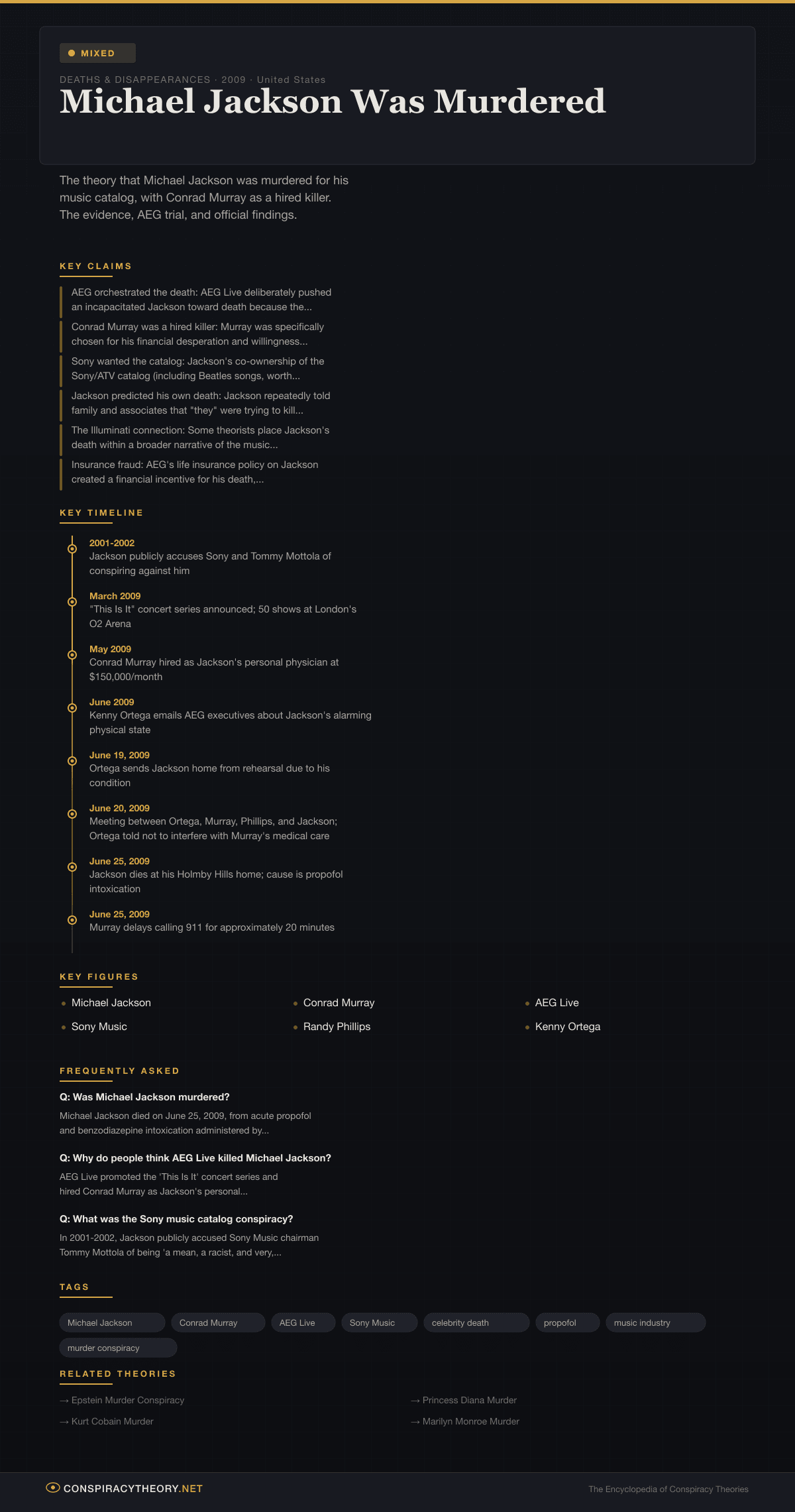
Michael Jackson, the self-proclaimed “King of Pop” and one of the best-selling music artists in history, died on June 25, 2009, at the age of 50 at his rented Holmby Hills mansion in Los Angeles. The cause of death was acute propofol and benzodiazepine intoxication — a powerful surgical anesthetic administered by his personal physician, Dr. Conrad Murray, as a sleep aid. Murray was convicted of involuntary manslaughter in 2011 and served approximately two years in prison.
While Murray’s criminal negligence in Jackson’s death is established legal fact, conspiracy theories extend far beyond one doctor’s recklessness. The most persistent claims allege that Jackson was deliberately killed — either by concert promoter AEG Live, which stood to profit from the massive “This Is It” tour and had insured Jackson’s life, or by Sony Music, which sought full control of the enormously valuable Sony/ATV music catalog that Jackson co-owned. These theories are bolstered by Jackson’s own public statements accusing powerful figures of plotting against him, internal AEG emails showing awareness of his deteriorating health, and the fact that Sony ultimately did acquire the catalog after his death.
The theory is classified as mixed. Conrad Murray’s criminal negligence is a confirmed fact, and the institutional pressures surrounding Jackson’s final months are well-documented. However, the leap from negligence to deliberate murder conspiracy has not been supported by the evidence presented in either the criminal trial or the subsequent civil litigation.
Origins & History
Jackson’s Decline and the “This Is It” Tour
In 2009, Jackson announced a series of 50 comeback concerts at London’s O2 Arena, promoted by AEG Live under CEO Randy Phillips. The “This Is It” residency was meant to resolve Jackson’s severe financial problems — despite earning hundreds of millions during his career, he carried an estimated $400-500 million in debt.
Behind the scenes, Jackson was in fragile physical and mental health. He had been dependent on various prescription medications for years, particularly after suffering severe burns during a Pepsi commercial filming in 1984 and enduring the stress of the 2005 child molestation trial (in which he was acquitted). Rehearsal director Kenny Ortega sent urgent emails to AEG executives in June 2009 describing Jackson as visibly unwell, comparing him to someone who “ichael is not in good shape,” and recommending he be examined by medical professionals independent of Conrad Murray.
Conrad Murray and Propofol
Dr. Conrad Murray was a cardiologist with a struggling practice who was hired in May 2009 to serve as Jackson’s personal physician at a salary of $150,000 per month, paid by AEG Live. Murray administered propofol — a hospital-grade anesthetic intended for use only in monitored surgical settings — to Jackson on a nightly basis to treat his severe insomnia.
On the morning of June 25, 2009, Murray administered a series of benzodiazepines followed by propofol via IV drip, then left the room. When he returned, Jackson was not breathing. Murray’s delayed and inadequate response — including failing to call 911 for approximately 20 minutes — contributed to Jackson’s death. The coroner ruled the death a homicide (in the medical-legal sense of a death caused by another person’s actions, not necessarily implying intent).
The Criminal Trial
Murray’s 2011 trial established his gross negligence: administering propofol without proper monitoring equipment, failing to maintain adequate medical records, delaying the emergency call, and attempting to conceal evidence by having an assistant remove propofol vials from the scene. He was convicted of involuntary manslaughter — not murder — and sentenced to four years, serving approximately two years.
The AEG Wrongful Death Lawsuit
In 2013, Jackson’s mother Katherine and his three children sued AEG Live for wrongful death, alleging the company negligently hired, retained, and supervised Conrad Murray. The trial revealed extensive internal communications:
- AEG executive Paul Gongaware emailed about Murray: “We want to remind him that it is AEG, not MJ, who is paying his salary”
- Kenny Ortega’s emails describing Jackson’s alarming physical state were forwarded among executives
- AEG had taken out a $17.5 million insurance policy on Jackson’s life for the tour
After a five-month trial, the jury found AEG not liable, concluding that Murray was a competent physician at the time of hiring and that AEG could not have foreseen his negligent use of propofol. The verdict disappointed conspiracy theorists but the trial’s revelations about AEG’s internal culture fueled ongoing suspicion.
Key Claims
- AEG orchestrated the death: AEG Live deliberately pushed an incapacitated Jackson toward death because the company would profit more from his death (through insurance payouts and posthumous licensing) than from cancelled concerts
- Conrad Murray was a hired killer: Murray was specifically chosen for his financial desperation and willingness to administer dangerous drugs, making him a perfect instrument for a plausible-deniability murder
- Sony wanted the catalog: Jackson’s co-ownership of the Sony/ATV catalog (including Beatles songs, worth billions) made him a target for Sony, which could negotiate more favorable terms with his estate than with Jackson himself
- Jackson predicted his own death: Jackson repeatedly told family and associates that “they” were trying to kill him, that he would be murdered like Elvis, and that people wanted his music catalog badly enough to kill for it
- The Illuminati connection: Some theorists place Jackson’s death within a broader narrative of the music industry “Illuminati” eliminating artists who resist industry control
- Insurance fraud: AEG’s life insurance policy on Jackson created a financial incentive for his death, particularly if the tour was going to be cancelled due to his deteriorating health
Evidence & Analysis
Jackson’s Own Warnings
The most emotionally compelling element of the conspiracy theory is Jackson’s documented statements predicting his own death. In phone calls, conversations with family members, and statements to associates, Jackson expressed fear that people were plotting to kill him. His brother Jermaine Jackson wrote that Michael told him: “I’m better off dead. I’m done.” His sister La Toya Jackson publicly stated after his death that Michael had been murdered and that he had named the people who would kill him.
However, Jackson had a documented history of paranoia that predated the specific “This Is It” circumstances, and his statements about being targeted were general rather than identifying specific murder plots.
The Financial Motive Question
The financial dimensions are complex. AEG had invested approximately $30 million in the tour and held a $17.5 million life insurance policy. If the tour were cancelled due to Jackson’s inability to perform, AEG would have faced massive losses. If Jackson died, the insurance would partially offset the investment. However, a successful tour would have been far more profitable — the 50 shows were projected to gross over $100 million.
For Sony, the calculus was different. Jackson’s half of the Sony/ATV catalog was estimated to be worth $1-2 billion. While Jackson was alive, he resisted selling his share despite his debts. After his death, his estate was managed by executors who ultimately sold the share to Sony in 2016 for $750 million — a price many considered below market value.
What the Evidence Actually Shows
The available evidence — from the criminal trial, the AEG civil trial, and investigative journalism — paints a picture not of deliberate murder but of institutional negligence driven by financial pressure. AEG executives were aware Jackson was deteriorating but were financially incentivized to keep the show going. They hired a financially desperate doctor who would prioritize the client’s wishes (and his own income) over medical ethics. No evidence presented in either trial suggested anyone at AEG or Sony intended for Jackson to die.
The Involuntary Manslaughter vs. Murder Distinction
Murray was charged with involuntary manslaughter, not murder. Prosecutors had the opportunity to pursue more serious charges and chose not to, indicating they did not believe the evidence supported intentional killing. This prosecutorial judgment is significant — if evidence of a broader conspiracy existed, the high-profile nature of the case virtually guaranteed it would have been pursued.
Cultural Impact
The Posthumous Empire
Jackson’s death transformed him from a financially struggling, scandal-plagued figure into the highest-earning dead celebrity in history. His estate earned over $2 billion in the decade following his death through music sales, the Cirque du Soleil show, the “This Is It” documentary film, and licensing deals. This extraordinary posthumous profitability is cited by conspiracy theorists as evidence of the financial motive for murder.
Music Industry Conspiracy Culture
Jackson’s death, combined with his public accusations against Sony and the music industry, became a cornerstone of the broader “music industry Illuminati” conspiracy narrative. It connected to similar theories about the deaths of Prince (2016), Aaliyah (2001), and other artists, creating a framework in which the music industry is viewed as a predatory institution willing to eliminate artists for profit.
The Doctor-Celebrity Relationship
The case prompted widespread examination of the ethics of physicians who serve wealthy, powerful patients. Murray’s willingness to administer propofol as a sleep aid — something no competent physician would do outside a hospital setting — highlighted the dangers of concierge medicine where doctors become financially dependent on single patients.
Timeline
- 2001-2002 — Jackson publicly accuses Sony and Tommy Mottola of conspiring against him
- March 2009 — “This Is It” concert series announced; 50 shows at London’s O2 Arena
- May 2009 — Conrad Murray hired as Jackson’s personal physician at $150,000/month
- June 2009 — Kenny Ortega emails AEG executives about Jackson’s alarming physical state
- June 19, 2009 — Ortega sends Jackson home from rehearsal due to his condition
- June 20, 2009 — Meeting between Ortega, Murray, Phillips, and Jackson; Ortega told not to interfere with Murray’s medical care
- June 25, 2009 — Jackson dies at his Holmby Hills home; cause is propofol intoxication
- June 25, 2009 — Murray delays calling 911 for approximately 20 minutes
- August 2009 — Death ruled a homicide by Los Angeles County Coroner
- February 2010 — Murray charged with involuntary manslaughter
- November 2011 — Murray convicted; sentenced to four years
- 2013 — Jackson family files wrongful death suit against AEG Live
- October 2013 — Jury finds AEG not liable in wrongful death case
- October 2013 — Murray released after serving approximately two years
- 2016 — Sony acquires Jackson estate’s share of Sony/ATV catalog for $750 million
- 2023 — Jackson biopic announced; controversy over portrayal of his final years
Sources & Further Reading
- Sullivan, Randall. Untouchable: The Strange Life and Tragic Death of Michael Jackson. Grove Press, 2012.
- Hughes, Geraldine. Redemption: The Truth Behind the Michael Jackson Child Molestation Allegation. Branch & Vine, 2004.
- Halperin, Ian. Unmasked: The Final Years of Michael Jackson. Transit Publishing, 2009.
- Jackson, La Toya. Starting Over. Gallery Books, 2011.
- People v. Conrad Murray. Superior Court of California, Los Angeles County. Case No. SA073164. 2011.
- Katherine Jackson et al. v. AEG Live. Los Angeles Superior Court. Case No. BC445597. 2013.
- Vogel, Joseph. Man in the Music: The Creative Life and Work of Michael Jackson. Sterling, 2011.

Frequently Asked Questions
Was Michael Jackson murdered?
Why do people think AEG Live killed Michael Jackson?
What was the Sony music catalog conspiracy?
Infographic
Share this visual summary. Right-click to save.