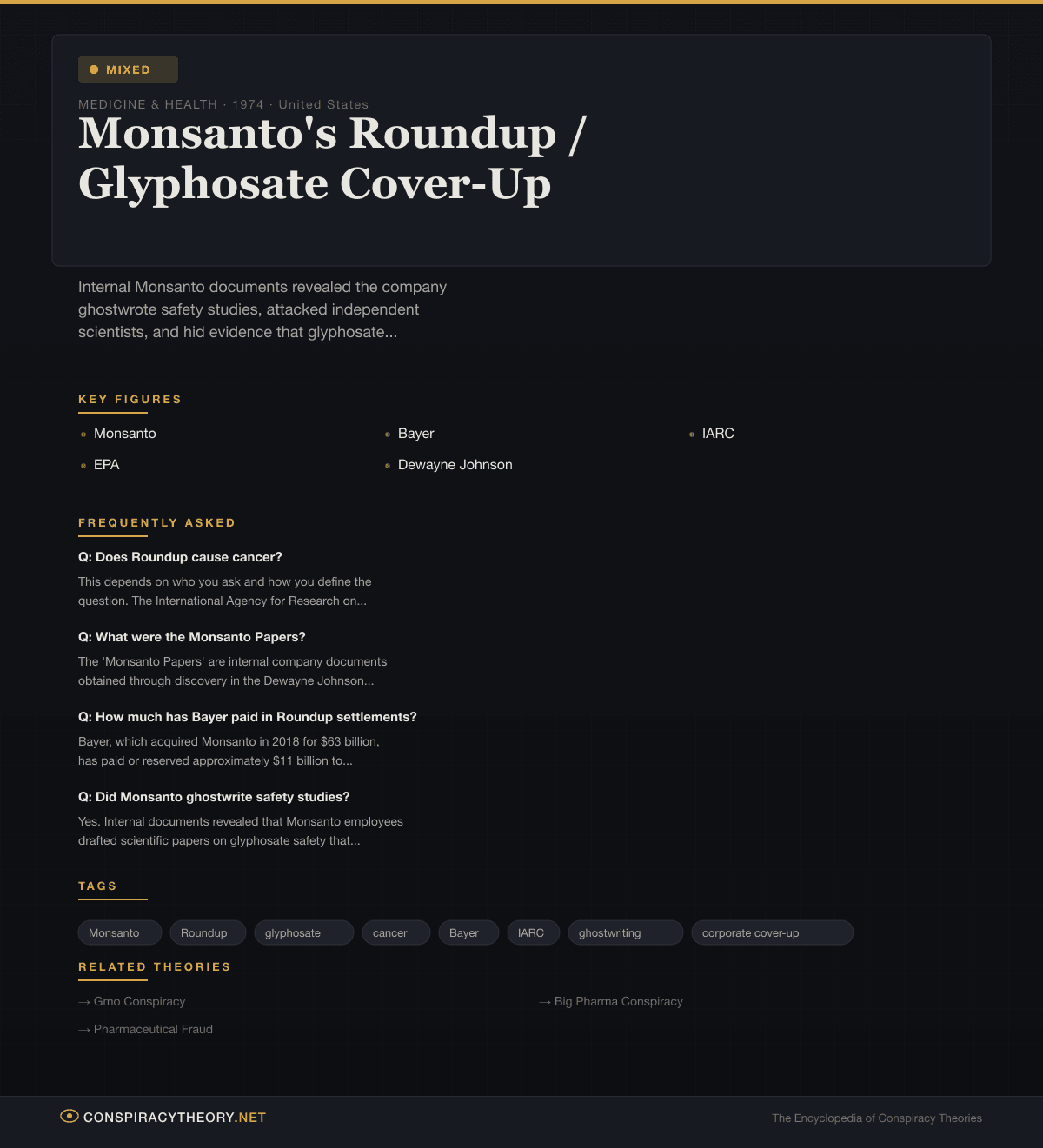
Monsanto's Roundup / Glyphosate Cover-Up
Overview
Roundup is the most widely used herbicide in human history. Since its introduction by Monsanto in 1974, glyphosate — Roundup’s active ingredient — has been sprayed on farms, lawns, parks, and playgrounds across the world. By 2014, farmers were applying an estimated 826 million kilograms of the stuff annually. It’s in the food you eat, the water you drink, and — according to biomonitoring studies — already in your body.
The question of whether it’s killing you has generated one of the most contentious scientific and legal battles of the 21st century.
On one side: the International Agency for Research on Cancer, which in 2015 classified glyphosate as “probably carcinogenic to humans,” based on evidence linking it to non-Hodgkin lymphoma. On the other side: the U.S. EPA, the European Food Safety Authority, and most national regulatory agencies, which have concluded that glyphosate, used as directed, is unlikely to cause cancer.
Between them: the Monsanto Papers — a trove of internal company documents, pried loose by litigation, revealing that Monsanto ghostwrote safety studies, orchestrated campaigns to destroy the careers of independent scientists, and maintained a cheerful public face while its internal communications told a more complicated story.
Bayer, the German pharmaceutical giant that acquired Monsanto in 2018 for $63 billion, has since paid approximately $11 billion to settle cancer lawsuits. It continues to insist that glyphosate is safe. The settlements, the company maintains, are not an admission of guilt — just a business decision.
More than 100,000 people who believe Roundup gave them cancer might describe the business decision differently.
The Product
Roundup’s Rise
Glyphosate was first synthesized in 1950 by Swiss chemist Henri Martin, but its herbicidal properties weren’t discovered until 1970 by Monsanto chemist John Franz. The company commercialized it as Roundup in 1974, and the product was an immediate success. Glyphosate kills plants by inhibiting an enzyme called EPSP synthase, which is essential for plant growth but doesn’t exist in animals. This mechanism suggested — and Monsanto aggressively marketed the idea — that glyphosate was essentially harmless to humans.
The product became truly dominant after Monsanto introduced “Roundup Ready” genetically modified crops in 1996. These crops were engineered to resist glyphosate, allowing farmers to spray Roundup directly on their fields without killing the crop plants. The system was extraordinarily convenient — and it made both Roundup and Roundup Ready seeds more or less mandatory for farmers who adopted the technology.
By the 2010s, glyphosate was everywhere. It was the most widely used agricultural chemical in the world. It was sprayed on residential lawns and municipal parks. It was applied as a pre-harvest desiccant on wheat and oats — meaning traces were present in bread, cereal, and other grain products. Studies detected glyphosate in urine samples from the general population, in breast milk, in honey, and in drinking water.
If glyphosate caused cancer, the implications were staggering. If it didn’t, the fear campaign against it was one of the most damaging scientific misunderstandings of the modern era.
The IARC Classification
March 2015
In March 2015, the International Agency for Research on Cancer — a specialized agency of the World Health Organization, based in Lyon, France — classified glyphosate as “probably carcinogenic to humans” (Group 2A). The classification was based on a review of published scientific literature, including epidemiological studies of agricultural workers, animal studies showing tumor development, and mechanistic evidence of genotoxicity (DNA damage).
The IARC finding focused primarily on non-Hodgkin lymphoma (NHL), a cancer of the immune system. Several epidemiological studies had found elevated NHL rates among agricultural workers with high glyphosate exposure, though the results were not uniform across studies.
The classification landed like a bomb. Monsanto’s stock price dropped. Lawsuits began almost immediately. And a war over the science that would consume billions of dollars was officially underway.
The Methodological Dispute
The disagreement between IARC and regulatory agencies like the EPA is partly substantive and partly methodological:
IARC assesses hazard — whether a substance can cause cancer under any conditions. This is a binary question: does the evidence suggest carcinogenicity, yes or no? IARC does not consider typical exposure levels. By this standard, many common substances are classified as carcinogenic, including alcohol, processed meat, and wood dust.
Regulatory agencies assess risk — whether a substance is likely to cause cancer at the exposure levels people actually experience. This is a different question: not “can it cause cancer?” but “does it cause cancer at the doses humans encounter?”
This distinction matters. Sunlight is a hazard (it can cause skin cancer). But a brief walk outside is not a significant risk. The question is whether glyphosate at real-world exposure levels poses meaningful cancer risk — and on that question, the major regulatory agencies have generally said no.
Critics of the regulatory agencies, however, point out that those agencies have been influenced by Monsanto’s own research — research that the Monsanto Papers revealed was not always as independent as it appeared.
The Monsanto Papers
What the Documents Showed
The most damaging revelations came not from scientists but from lawyers. Beginning with the Dewayne Johnson lawsuit in 2018, plaintiff attorneys obtained tens of thousands of internal Monsanto documents through the discovery process. These documents — collectively known as the “Monsanto Papers” — painted a picture of a company that was far more uncertain about glyphosate’s safety than it had ever publicly acknowledged.
Ghostwriting: Internal emails showed Monsanto scientists drafting sections of published scientific papers that were then attributed to outside academics. In one email, a Monsanto toxicologist wrote about a planned paper: “We would be keeping the cost down by us doing the writing and they would just edit & sign their names so to speak.” The academics who served as nominal authors lent their institutional credibility to what was essentially industry-produced research.
Attacking IARC: Documents revealed a coordinated campaign to discredit IARC after the 2015 classification. Monsanto orchestrated letters from scientists criticizing IARC’s methodology, planted negative stories in the media, and lobbied to cut IARC’s funding. The company’s internal communications used military language — “war room,” “attack plan” — to describe its response to the classification.
Regulatory capture: Emails showed unusually close relationships between Monsanto officials and EPA regulators. In one exchange, an EPA official appeared to promise to quash a review of glyphosate by another federal agency, telling a Monsanto executive: “If I can kill this I should get a medal.”
Internal uncertainty: Some internal communications suggested that Monsanto’s own scientists were less confident about glyphosate’s safety than the company’s public statements indicated. A 2003 internal email from a Monsanto scientist stated: “You cannot say that Roundup is not a carcinogen… we have not done the necessary testing on the formulation to make that statement.”
What the Documents Didn’t Show
It’s important to note what the Monsanto Papers did not reveal: a smoking gun — a definitive internal study showing that glyphosate causes cancer, hidden from regulators. The documents showed that Monsanto manipulated the scientific literature, attacked independent researchers, and maintained closer relationships with regulators than it should have. They showed a company willing to cut corners on scientific integrity to protect a $4 billion annual product line.
But they did not prove that glyphosate causes cancer. They proved that Monsanto behaved badly in arguing that it doesn’t.
The Lawsuits
Dewayne Johnson
The case that broke the story open was filed by Dewayne “Lee” Johnson, a 46-year-old school groundskeeper in Benicia, California, who developed non-Hodgkin lymphoma after years of applying Roundup to school properties. Johnson’s case was fast-tracked because he was terminally ill.
On August 10, 2018, a San Francisco jury awarded Johnson $289 million in damages — including $250 million in punitive damages — finding that Monsanto had acted with “malice” and that Roundup was a “substantial factor” in causing Johnson’s cancer. The award was later reduced to $78.5 million on appeal, but the verdict was upheld.
Two subsequent trials also resulted in verdicts against Monsanto:
- Edwin Hardeman (March 2019): $80 million (reduced to $25 million on appeal)
- Alva and Alberta Pilliod (May 2019): $2 billion (reduced to $87 million on appeal)
The pattern of jury verdicts — three out of three trials finding against Monsanto — prompted Bayer to pursue a mass settlement.
The $11 Billion Settlement
In June 2020, Bayer announced it would pay approximately $10.9 billion to settle most of the pending Roundup lawsuits — approximately 100,000 claims. The settlement was one of the largest product liability settlements in corporate history.
Bayer explicitly stated that the settlement was not an admission that Roundup causes cancer. The company continues to sell Roundup with glyphosate (though it announced in 2021 that it would replace glyphosate in residential products sold in the U.S. by 2023 — a decision it characterized as a business choice, not a safety concession).
The $11 billion payout, combined with the $63 billion acquisition price of Monsanto, has made the Roundup litigation one of the most expensive corporate miscalculations in history. Bayer’s market capitalization has dropped by more than 50% since the acquisition.
The Scientific Debate
The Epidemiological Evidence
The strongest epidemiological evidence comes from the Agricultural Health Study (AHS), a long-running U.S. study of pesticide applicators. Initial analyses of the AHS found no overall association between glyphosate and non-Hodgkin lymphoma — a finding Monsanto cited extensively. However, a 2019 meta-analysis by researchers at the University of Washington, combining the AHS data with other studies, found a 41% increased risk of NHL among individuals with high glyphosate exposure.
The interpretation depends on which studies you weigh and how you handle confounding variables. Agricultural workers are exposed to many chemicals. Isolating glyphosate’s contribution is genuinely difficult.
The Regulatory Picture
As of 2026, the global regulatory landscape remains divided:
- EPA (U.S.): “Not likely to be carcinogenic to humans” (2020 review, though currently under additional scrutiny)
- EFSA (EU): “Unlikely to pose a carcinogenic hazard” (2015, reaffirmed 2023)
- IARC (WHO): “Probably carcinogenic to humans” (2015, unchanged)
- Health Canada: “Not likely to cause cancer”
- Germany’s BfR: “Not carcinogenic”
The near-unanimous position of regulatory agencies against IARC is either a reflection of the scientific consensus or a demonstration of Monsanto’s success in influencing the regulatory process — or, most likely, some combination of both.
What’s Confirmed, What’s Not
Confirmed: Monsanto ghostwrote scientific papers, orchestrated attacks on independent scientists, maintained inappropriately close relationships with regulators, and was more uncertain about glyphosate’s safety internally than it acknowledged publicly. These are not conspiracy theories — they are documented facts established through legal discovery.
Not confirmed: That glyphosate causes cancer at real-world exposure levels. The scientific evidence is genuinely mixed. IARC’s classification is based on legitimate evidence. The regulatory agencies’ contrary conclusions are also based on evidence, though their credibility has been damaged by the revelations about Monsanto’s influence campaigns.
The lesson: Sometimes the conspiracy is not about the final answer but about the process. Even if glyphosate turns out to be safe, Monsanto’s behavior — ghostwriting studies, attacking scientists, manipulating regulators — corrupted the very process by which safety should be determined. The cover-up doesn’t prove the crime, but it makes it impossible to trust the acquittal.
Timeline
| Date | Event |
|---|---|
| 1974 | Monsanto introduces Roundup with glyphosate |
| 1996 | Monsanto launches Roundup Ready GM crops |
| 2000s | Glyphosate becomes most widely used herbicide globally |
| March 2015 | IARC classifies glyphosate as “probably carcinogenic” |
| 2015-2017 | Monsanto Papers begin emerging through litigation discovery |
| Aug 2018 | Dewayne Johnson jury verdict: $289 million (reduced to $78.5M) |
| June 2018 | Bayer completes $63 billion acquisition of Monsanto |
| March 2019 | Hardeman verdict: $80 million |
| May 2019 | Pilliod verdict: $2 billion (reduced to $87M) |
| June 2020 | Bayer announces ~$11 billion settlement |
| 2021 | Bayer announces glyphosate removal from U.S. residential products |
| 2023 | EU renews glyphosate approval for 10 years |
Sources & Further Reading
- International Agency for Research on Cancer. IARC Monographs Volume 112: Glyphosate. WHO, 2015.
- U.S. EPA. Glyphosate: Interim Registration Review Decision. 2020.
- Gillam, Carey. Whitewash: The Story of a Weed Killer, Cancer, and the Corruption of Science. Island Press, 2017.
- Zhang, Luoping, et al. “Exposure to Glyphosate-Based Herbicides and Risk for Non-Hodgkin Lymphoma: A Meta-Analysis and Supporting Evidence.” Mutation Research, 2019.
- McHenry, Leemon B. “The Monsanto Papers: Poisoning the Scientific Well.” International Journal of Risk & Safety in Medicine, 2018.
- Baum Hedlund Law. Monsanto Papers document archive (publicly available court filings).
Related Theories
- GMO Conspiracy — Broader anti-GMO movement, intertwined with Roundup concerns
- Big Pharma Conspiracy — Corporate suppression of health information
- Pharmaceutical Fraud — Similar patterns of corporate deception

Frequently Asked Questions
Does Roundup cause cancer?
What were the Monsanto Papers?
How much has Bayer paid in Roundup settlements?
Did Monsanto ghostwrite safety studies?

Infographic
Share this visual summary. Right-click to save.