The Montauk Project
Overview
The Montauk Project is the claim that between the late 1960s and early 1980s, the United States government conducted a series of classified experiments at Montauk Air Force Station (also known as Camp Hero) on the eastern tip of Long Island, New York. According to proponents, these experiments involved psychic warfare, mind control, time travel, teleportation, and the opening of interdimensional portals. The narrative presents the Montauk Project as a direct continuation of the Philadelphia Experiment of 1943, alleging that technology originally developed to render a Navy destroyer invisible was refined over subsequent decades into far more exotic capabilities.
The story originates almost entirely from a series of books written by Preston B. Nichols and Peter Moon, beginning with The Montauk Project: Experiments in Time (1992). Nichols claimed to be a former participant in the experiments who had recovered suppressed memories of his involvement. The books introduced a cast of alleged participants — including Al Bielek, Duncan Cameron, and Stewart Swerdlow — each of whom elaborated on the narrative with their own accounts of psychic chairs, temporal vortexes, and encounters with extraterrestrial beings.
The Montauk Project is classified as debunked. No government documents, military records, scientific evidence, or credible independent testimony support any of its claims. Montauk Air Force Station was a conventional Cold War SAGE (Semi-Automatic Ground Environment) radar facility that operated from 1954 to 1981. Its history is well documented in Air Force records and has been independently verified by military historians. The base was decommissioned, transferred to the State of New York, and is now part of Camp Hero State Park, open to the public. Despite its lack of evidentiary support, the Montauk Project has had an outsized cultural impact, most notably as a primary inspiration for the Netflix series Stranger Things.
Origins & History
Montauk Air Force Station: The Real History
Before examining the conspiracy claims, it is useful to understand what actually took place at Montauk Air Force Station. The facility was constructed in 1942 as Camp Hero, a United States Army coastal defense installation during World War II. Its location on the easternmost point of Long Island made it strategically valuable for monitoring the Atlantic approaches to New York. The base was equipped with large-caliber coastal artillery batteries, including a 16-inch gun emplacement that remains on the site today.
After World War II, the base transitioned to Cold War air defense operations. In 1954, it became Montauk Air Force Station, part of the SAGE radar network — a continental air defense system designed to detect Soviet bomber attacks. The facility’s most prominent feature was a massive AN/FPS-35 radar antenna, an 80-foot-tall structure that became a local landmark. The base operated as a conventional radar station until 1981, when it was decommissioned as part of broader Air Force base closures. The property was declared surplus federal land and eventually transferred to the State of New York in 2002, becoming Camp Hero State Park.
Nothing in the base’s documented military history suggests any activities beyond standard air defense radar operations and earlier coastal defense functions.
Preston Nichols and the Birth of the Narrative
The Montauk Project conspiracy theory did not emerge during the base’s operational years. No reports of unusual experiments, mysterious phenomena, or government secrecy emanated from the Montauk community during the 1970s or 1980s. The narrative was constructed retroactively, beginning in the late 1980s, by Preston B. Nichols, a Long Island resident who claimed to be an electrical engineer with experience in defense contracting.
Nichols stated that he had worked at the Montauk base as part of a secret project but that his memories of the experience had been erased through mind control techniques. He claimed that in the mid-1980s, these suppressed memories began to resurface, revealing his participation in experiments involving psychic amplification, time manipulation, and interdimensional travel. He connected with Peter Moon (born Vincent Barbarick), a writer and publisher with an interest in occult and fringe topics, and the two began collaborating on what would become the Montauk book series.
The Montauk Book Series
The primary texts establishing the Montauk Project mythology are:
- The Montauk Project: Experiments in Time (1992) — The foundational text, co-authored by Nichols and Moon, introducing the core claims of mind control experiments, time travel, and the connection to the Philadelphia Experiment.
- Montauk Revisited: Adventures in Synchronicity (1994) — Expanded the narrative to include connections to Aleister Crowley, Jack Parsons, and occult traditions.
- Pyramids of Montauk: Explorations in Consciousness (1995) — Incorporated ancient Egypt, sacred geometry, and extraterrestrial civilizations into the mythology.
- The Music of Time (2001) and subsequent volumes continued to elaborate the narrative in increasingly esoteric directions.
The books were published by Sky Books, a small press operated by Moon himself. They were not reviewed by mainstream publishers, academic journals, or scientific publications. The series sold modestly but developed a dedicated following within conspiracy and New Age communities.
Al Bielek and the Philadelphia Experiment Connection
A critical element of the Montauk narrative is its claimed link to the Philadelphia Experiment. This connection was largely established by Alfred Bielek, who in the late 1980s began claiming that he was actually Edward Cameron, a sailor who had served aboard the USS Eldridge during the alleged 1943 invisibility experiment. Bielek stated that during the Philadelphia Experiment, he and his brother Duncan Cameron were thrown through a time portal and arrived at Montauk Air Force Station in 1983, where secret experiments were underway.
According to Bielek, the government subsequently sent him back in time, erased his memories, and gave him a new identity as Alfred Bielek. He claimed to have recovered these memories decades later. Bielek’s account provided the narrative bridge between the Philadelphia Experiment legend and the Montauk mythology, creating a unified conspiracy timeline spanning from 1943 to the 1980s.
Bielek’s claims have been thoroughly investigated and debunked. His real name was indeed Alfred Bielek — not a government-assigned alias. Navy records contain no one named Edward Cameron serving on the USS Eldridge. His biographical claims, including educational credentials and employment history, have not been verified. Bielek died in 2011, having maintained his claims throughout his life.
Key Claims
The Montauk Project mythology encompasses a wide range of extraordinary claims, which can be grouped into several categories:
-
Psychic amplification and mind control: The experiments allegedly centered on a device called the “Montauk Chair,” which could amplify human psychic abilities to extraordinary levels. Subjects seated in the chair could supposedly project thoughts into the minds of others, create physical objects from mental imagery, and manipulate the perceptions of people at great distances. Nichols claimed this technology was derived from furniture recovered from a crashed alien spacecraft.
-
Time travel: The most dramatic claim is that the Montauk experiments achieved functional time travel. Using the psychic chair in conjunction with advanced transmitter technology supposedly housed in the SAGE radar building, researchers allegedly opened stable time portals — referred to as “time tunnels” — through which individuals could physically travel to other points in time. Proponents claim that subjects were sent to various historical periods and that the technology was used to alter past events.
-
Interdimensional portals: Beyond time travel, the experiments allegedly opened doorways to parallel dimensions and alternate realities. Nichols described incidents in which creatures from other dimensions entered our reality through these portals, necessitating emergency shutdowns of the equipment.
-
The “Montauk Boys”: One of the more disturbing claims is that the project recruited or abducted young boys, typically runaways or children from troubled backgrounds, to serve as psychic test subjects. These children were allegedly subjected to extreme psychological and physical conditioning to enhance their psychic abilities. Proponents claim that thousands of children were processed through the program, with many suffering permanent psychological damage or dying during experiments.
-
Connection to the Philadelphia Experiment: As described above, the project is presented as a direct outgrowth of the 1943 Philadelphia Experiment, with the same core technology — electromagnetic field manipulation — being developed over forty years from invisibility experiments into time travel and mind control capabilities.
-
Continuation through “Project Phoenix”: Some proponents claim that when the Montauk experiments were shut down in 1983 following an incident in which a creature from another dimension materialized and damaged the facility, the research continued under different code names at other locations, possibly including underground installations.
Evidence & Debunking
No Documentary Evidence Exists
The most fundamental problem with the Montauk Project claims is the complete absence of documentary evidence. No government documents, military records, budget allocations, personnel files, scientific reports, or internal communications referencing the alleged experiments have ever been produced. Unlike genuinely secret government programs such as MKUltra — which were eventually exposed through Freedom of Information Act requests, congressional investigations, and the accidental discovery of surviving records — the Montauk Project has left no paper trail whatsoever.
Montauk Air Force Station’s actual records are available through standard military archives and confirm its role as a SAGE radar facility. There is no gap in the documentation that would suggest a parallel classified program of the scope described by Nichols and Bielek.
The Source Material Is Unreliable
The entire Montauk narrative rests on the testimony of a small group of individuals — primarily Nichols, Moon, Bielek, Cameron, and Swerdlow — whose claims cannot be independently verified. None of them has produced credentials, employment records, security clearances, or any other documentation supporting their alleged involvement in the project. Their accounts were published through a self-owned publishing house without editorial review or fact-checking.
Preston Nichols claimed to hold degrees in electrical engineering and parapsychology, but these credentials have not been independently verified at the institutions he named. His descriptions of the technology allegedly used in the experiments contain numerous errors and inconsistencies that suggest a superficial understanding of the physics involved. For instance, his descriptions of how the SAGE radar transmitter was modified to achieve time travel involve technical claims that are physically meaningless — the power levels, frequencies, and mechanisms he describes bear no relationship to any known or theoretical physics.
The Physics Are Impossible
The core technological claims of the Montauk Project — psychic amplification through electromagnetic radiation, the creation of stable time portals, and the opening of interdimensional gateways — are not supported by any branch of established physics. Time travel to the past, while a subject of legitimate theoretical speculation in the context of general relativity (e.g., closed timelike curves, wormholes), would require conditions of matter and energy that are far beyond anything achievable with radar equipment or any other existing technology. The claim that a 1960s-era radar installation could be converted into a time machine has no basis in physics.
Community Testimony Contradicts the Claims
Residents of the Montauk area who lived near the base during its operational years have not reported unusual phenomena consistent with the book claims. No accounts of mysterious disappearances, unexplained phenomena, or military activity beyond normal base operations were reported in local media or community records during the period when the alleged experiments were supposedly taking place. The first anyone heard of secret experiments at the base was when Nichols began speaking publicly in the late 1980s and published his book in 1992 — more than a decade after the base was decommissioned.
The Base Is Publicly Accessible
Since its transfer to New York State and conversion to Camp Hero State Park, the former Montauk Air Force Station has been open to the public. Visitors can walk the grounds, examine the remaining military structures — including the iconic radar tower — and explore bunkers and buildings. No evidence of the exotic equipment, underground facilities, or advanced technology described in the Montauk books has been found. The buildings contain the remnants of standard military radar and communications equipment consistent with the facility’s documented purpose.
Recovered Memory Claims Are Problematic
A central feature of the Montauk narrative is the claim that participants’ memories were erased and later recovered. This narrative device is inherently unfalsifiable — it allows proponents to explain both the absence of evidence (memories were erased) and the emergence of claims decades later (memories were recovered). The concept of “recovered memories” has been extensively studied by cognitive psychologists and is widely regarded as unreliable. Research has demonstrated that detailed false memories can be created through suggestion, and the recovered memory movement of the 1980s and 1990s produced numerous cases of individuals sincerely believing in events that never occurred.
Cultural Impact
Stranger Things
The Montauk Project’s most significant cultural legacy is its role as a primary inspiration for the Netflix series Stranger Things, created by the Duffer Brothers and first released in 2016. The show was originally titled Montauk during development and was initially set on Long Island before the setting was relocated to the fictional town of Hawkins, Indiana.
The series draws extensively from the Montauk mythology. Its central premise — a secret Department of Energy laboratory conducting experiments on children with psychic abilities, resulting in the accidental opening of a portal to an alternate dimension called “the Upside Down” — closely mirrors the Montauk Project claims about psychic chairs, child subjects, and interdimensional gateways. The character of Eleven, a girl with telekinetic powers who was raised in a government laboratory, reflects the “Montauk Boys” narrative. Matt and Ross Duffer have acknowledged the Montauk Project, along with MKUltra and the works of Stephen King and Steven Spielberg, as foundational influences on the series.
The success of Stranger Things — which became one of Netflix’s most-watched programs and a global cultural phenomenon — brought the Montauk Project to an audience of millions who had never encountered the original conspiracy literature. This led to a significant increase in public interest in the Montauk claims, a surge of tourism to Camp Hero State Park, and renewed sales of the Nichols and Moon book series.
Books and Documentary Media
Beyond the original book series, the Montauk Project has been the subject of numerous documentaries, podcasts, and YouTube investigations. These range from credulous treatments that present the claims as plausible to skeptical examinations that deconstruct the narrative. The story has been featured in documentary series such as Dark Matters: Twisted But True and has been discussed extensively on conspiracy-focused podcasts and video channels.
Integration into Broader Conspiracy Narratives
The Montauk Project has been incorporated into larger conspiracy frameworks connecting it to MKUltra (the CIA’s real mind control research program), Operation Paperclip (the recruitment of German scientists after World War II), and various claims about secret government time travel and teleportation programs. In some versions of the narrative, Montauk is presented as one node in a network of underground bases engaged in exotic research, connected to other alleged sites such as the Dulce base in New Mexico and facilities beneath the Denver International Airport.
The theory also holds a notable position in the subset of conspiracy culture that blends government secrecy claims with New Age and occult themes. The later volumes in the Nichols and Moon series incorporated elements of sacred geometry, ancient Egyptian mysticism, and the writings of Aleister Crowley, situating the Montauk experiments within a broader metaphysical framework that appealed to audiences beyond the traditional conspiracy community.
Tourism and Local Economy
Camp Hero State Park has become a destination for conspiracy enthusiasts, history buffs, and Stranger Things fans. The massive AN/FPS-35 radar antenna — the physical structure most closely associated with the Montauk Project legend — remains standing and has been designated a historic landmark. Guided tours of the former military installation attract visitors who come to see the setting of the alleged experiments. The Montauk area has embraced this tourism to some degree, with local businesses referencing the mythology. The influx of visitors increased notably after the premiere of Stranger Things.
Timeline
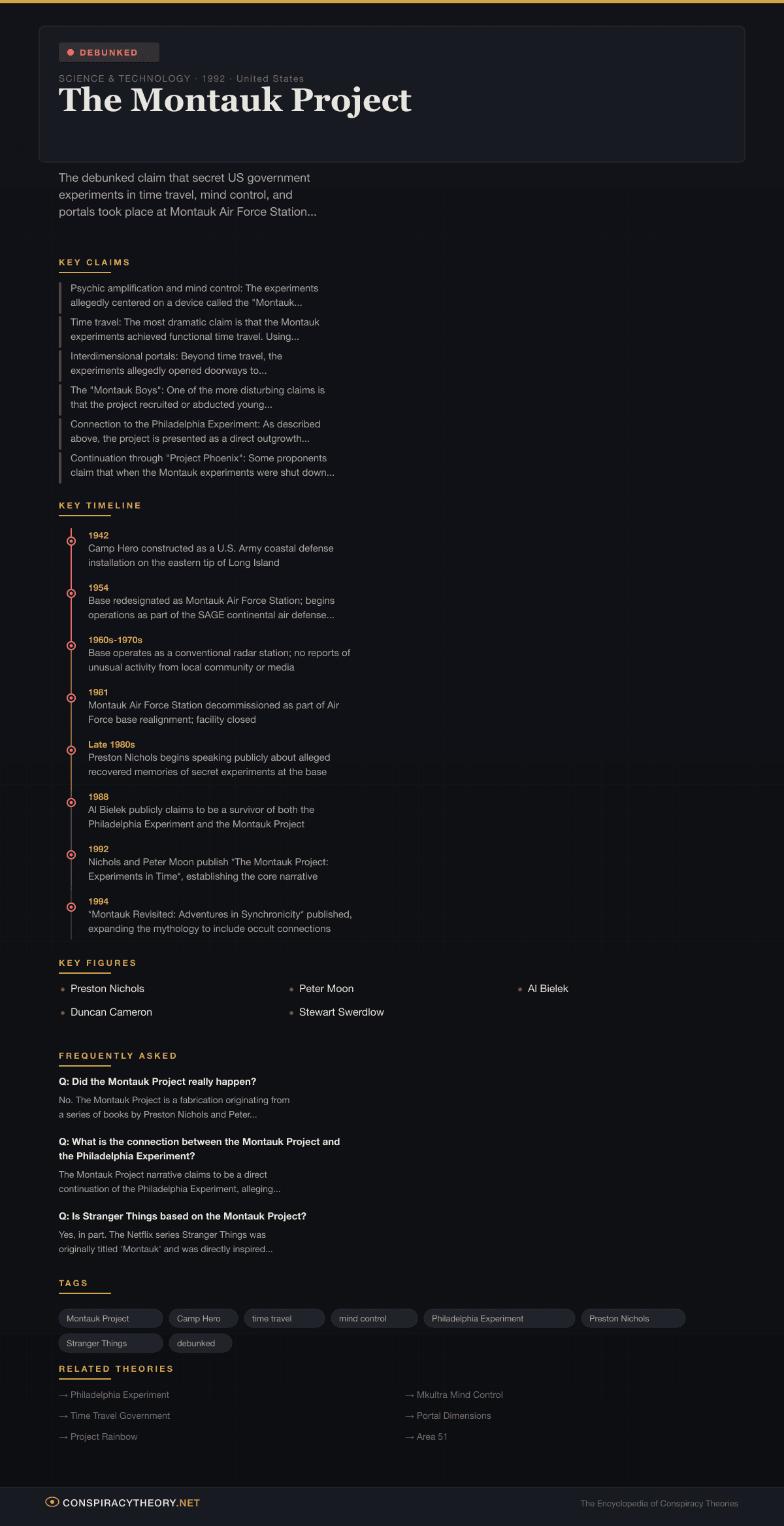
- 1942 — Camp Hero constructed as a U.S. Army coastal defense installation on the eastern tip of Long Island
- 1954 — Base redesignated as Montauk Air Force Station; begins operations as part of the SAGE continental air defense radar network
- 1960s-1970s — Base operates as a conventional radar station; no reports of unusual activity from local community or media
- 1981 — Montauk Air Force Station decommissioned as part of Air Force base realignment; facility closed
- Late 1980s — Preston Nichols begins speaking publicly about alleged recovered memories of secret experiments at the base
- 1988 — Al Bielek publicly claims to be a survivor of both the Philadelphia Experiment and the Montauk Project
- 1992 — Nichols and Peter Moon publish The Montauk Project: Experiments in Time, establishing the core narrative
- 1994 — Montauk Revisited: Adventures in Synchronicity published, expanding the mythology to include occult connections
- 1995 — Pyramids of Montauk: Explorations in Consciousness published, incorporating ancient civilizations and extraterrestrial themes
- 2002 — Former Montauk Air Force Station officially transferred to the State of New York; becomes Camp Hero State Park, open to the public
- 2011 — Al Bielek dies, having maintained his claims about the Philadelphia Experiment and Montauk Project throughout his life
- 2016 — Stranger Things premieres on Netflix, drawing heavily from Montauk Project mythology and dramatically increasing public awareness of the claims
- 2016-present — Renewed interest in the Montauk narrative leads to increased book sales, documentaries, podcasts, and tourism to Camp Hero State Park
Sources & Further Reading
- Nichols, Preston B., and Peter Moon. The Montauk Project: Experiments in Time. Sky Books, 1992.
- Nichols, Preston B., and Peter Moon. Montauk Revisited: Adventures in Synchronicity. Sky Books, 1994.
- Weinstein, Joseph P. “The Montauk Air Force Station Historical Overview.” U.S. Air Force Historical Research Agency.
- Redfern, Nick. Top Secret Alien Abduction Files. Visible Ink Press, 2018.
- Berlitz, Charles, and William Moore. The Philadelphia Experiment: Project Invisibility. Fawcett, 1979.
- Vallée, Jacques. “Anatomy of a Hoax: The Philadelphia Experiment Fifty Years Later.” Journal of Scientific Exploration, 1994.
- U.S. Air Force. Montauk Air Force Station operational records and decommissioning documentation, National Archives.
- Loftus, Elizabeth F. “The Reality of Repressed Memories.” American Psychologist, 48(5), 518-537, 1993.
- Camp Hero State Park historical documentation, New York State Office of Parks, Recreation and Historic Preservation.
- Duffer Brothers (Matt Duffer and Ross Duffer). Interviews regarding Stranger Things development and influences, 2016-2022.
Frequently Asked Questions
Did the Montauk Project really happen?
What is the connection between the Montauk Project and the Philadelphia Experiment?
Is Stranger Things based on the Montauk Project?

Infographic
Share this visual summary. Right-click to save.