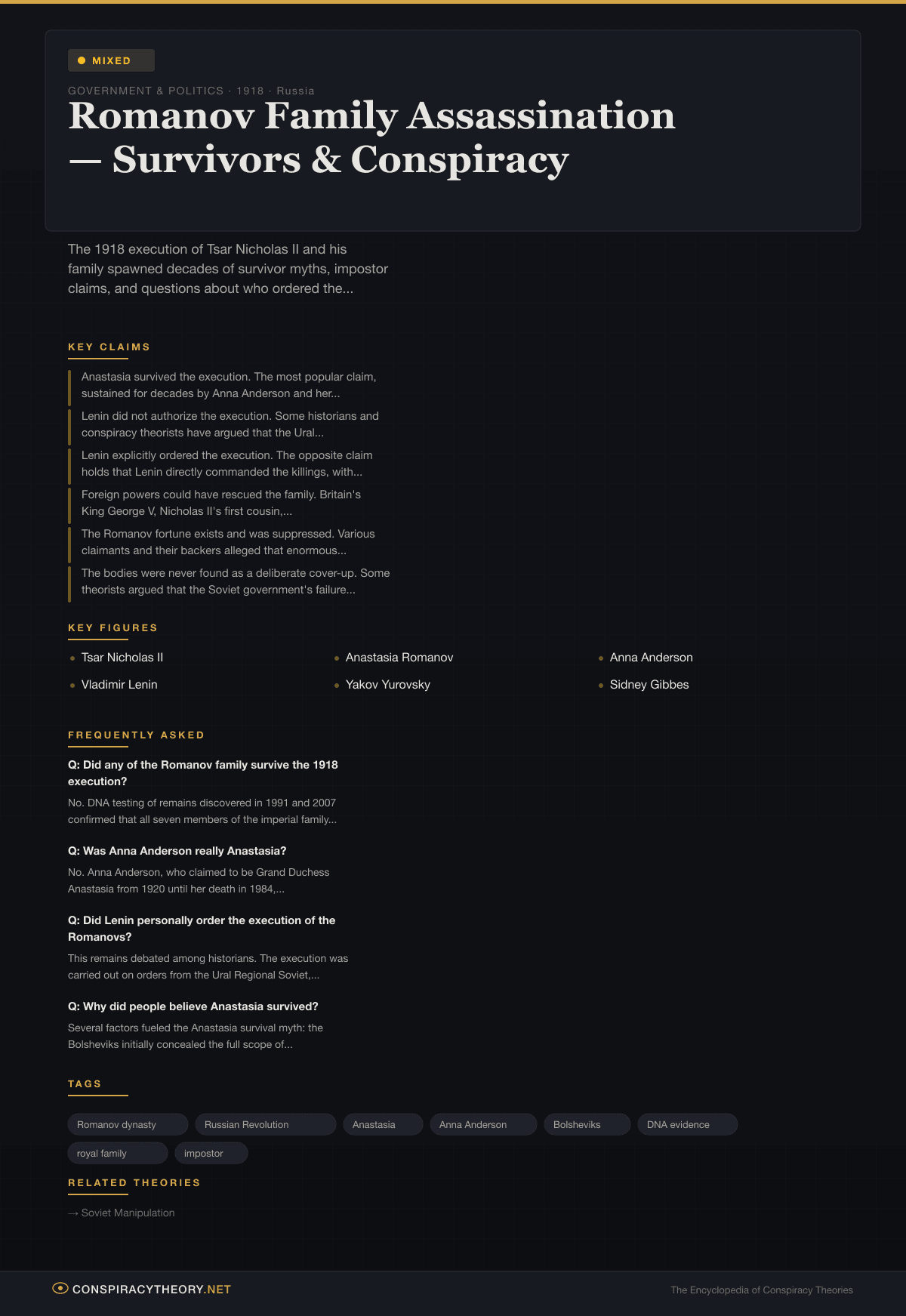
Romanov Family Assassination — Survivors & Conspiracy
Overview
On the night of July 17, 1918, in the basement of a merchant’s house in Yekaterinburg, Russia, a Bolshevik firing squad executed Tsar Nicholas II, his wife Tsarina Alexandra, their five children, and four loyal retainers. It was one of the most significant political assassinations of the twentieth century — the violent end of a 300-year dynasty that had ruled the largest country on Earth.
But the killing was only the beginning of the mystery. The Bolsheviks tried to destroy the bodies, botched the cover-up, and then lied about what happened for decades. They announced the Tsar’s death but said the family had been “moved to a safe place.” The bodies vanished into unmarked forest graves. And into that gap between fact and official silence rushed a century of conspiracy theories: that one or more of the children had survived the slaughter, that vast Romanov fortunes sat unclaimed in European banks, and that the order to kill came — or did not come — from Lenin himself.
The most famous of these myths centered on Grand Duchess Anastasia, the Tsar’s youngest daughter, whose alleged survival spawned dozens of impostors, a landmark German legal case, an Academy Award-winning film, and a Broadway musical. The Anastasia legend was definitively debunked by DNA evidence in the 1990s. But the broader questions about the execution — who authorized it, whether it could have been prevented, and what it tells us about revolutionary violence — remain subjects of genuine historical debate. The theory’s status is classified as mixed: the survivor claims are debunked, but aspects of the political conspiracy surrounding the killings remain legitimately unresolved.
Origins & History
The Fall of the Romanovs
Nicholas II abdicated the Russian throne on March 15, 1917, in the chaos of the February Revolution, ending the Romanov dynasty’s rule that had begun in 1613. He and his family were placed under house arrest, first at the Alexander Palace in Tsarskoye Selo, then moved to Tobolsk in Siberia. After the Bolsheviks seized power in the October Revolution of 1917, the family’s situation deteriorated sharply. In April 1918, the Romanovs were transferred to Yekaterinburg and imprisoned in the Ipatiev House, ominously renamed the “House of Special Purpose.”
The Tsar’s captors were the Ural Regional Soviet, hardline Bolsheviks who viewed the imperial family as a dangerous rallying point for the White Army forces then advancing on Yekaterinburg. As the civil war front drew closer through June and July 1918, the question of what to do with the Romanovs became urgent.
The Execution
In the early hours of July 17, 1918, Yakov Yurovsky, the commandant of the Ipatiev House, woke the family and told them they needed to move to the basement for their safety. Nicholas, Alexandra, their five children — Olga (22), Tatiana (21), Maria (19), Anastasia (17), and the hemophiliac Alexei (13) — along with the family physician Dr. Eugene Botkin, the valet Alexei Trupp, the cook Ivan Kharitonov, and the maid Anna Demidova descended to a half-basement room.
Yurovsky then read a brief statement announcing the sentence of death. The killing that followed was chaotic and gruesome. The initial volley failed to kill several of the children, reportedly because they had sewn diamonds and precious stones into their corsets as a means of smuggling wealth, which acted as crude body armor. The executioners resorted to bayonets and point-blank gunshots to finish the killing. The entire episode lasted approximately twenty minutes.
The Cover-Up
What followed was a two-day ordeal of body disposal that the Bolsheviks handled with a combination of brutality and incompetence. The bodies were initially taken to the abandoned Four Brothers mine shaft outside Yekaterinburg. When the mine proved too shallow, Yurovsky ordered the bodies moved. They were stripped, doused in sulfuric acid to prevent identification, and buried in two separate locations along a muddy forest road called Koptyaki Road. Nine bodies went into one pit; two — Alexei and one of his sisters — were buried separately nearby and partially burned.
The Bolshevik government announced only the Tsar’s execution, claiming that “Nicholas Romanov’s wife and son have been sent to a secure place.” This deliberate lie, maintained for years, became the seedbed for every survivor conspiracy theory that followed.
The Anastasia Legend
The most enduring myth began in February 1920, when a young woman was pulled from the Landwehr Canal in Berlin after an apparent suicide attempt. She refused to identify herself and was committed to a mental institution. Over the following months, she began claiming to be Grand Duchess Anastasia, the youngest daughter of Nicholas II, who had somehow survived the execution.
This woman eventually became known as Anna Anderson, and her claim consumed European courts and Romanov relatives for more than six decades. Her supporters pointed to physical resemblances, her knowledge of court life, and her stubborn persistence. Her detractors noted inconsistencies in her story, her inability to speak Russian fluently, and the testimony of Romanov family members who met her and declared she was not Anastasia.
Anderson was not the only claimant. Over the decades, at least ten women claimed to be Anastasia, and others presented themselves as Alexei, Maria, or Tatiana. A total of more than thirty individuals came forward claiming to be surviving Romanovs. The phenomenon reflected both the romance of the doomed dynasty and the very practical lure of the supposed Romanov fortune — rumored to be worth billions — allegedly deposited in the Bank of England and other European institutions.
Key Claims
- Anastasia survived the execution. The most popular claim, sustained for decades by Anna Anderson and her supporters, held that the youngest grand duchess was merely wounded and spirited away by a sympathetic guard. Variations existed for other children, particularly Alexei and Maria.
- Lenin did not authorize the execution. Some historians and conspiracy theorists have argued that the Ural Soviet acted independently, executing the family without Moscow’s explicit approval, and that Lenin was presented with a fait accompli. The implication is that the killings were a local atrocity, not central Bolshevik policy.
- Lenin explicitly ordered the execution. The opposite claim holds that Lenin directly commanded the killings, with the Ural Soviet serving as a convenient cover for central Bolshevik responsibility. Proponents cite coded telegrams and the political logic of eliminating all potential claimants to the throne.
- Foreign powers could have rescued the family. Britain’s King George V, Nicholas II’s first cousin, initially agreed to grant the family asylum but withdrew the offer under political pressure. Conspiracy theorists argue that a rescue was entirely feasible and that George V bears moral responsibility for the family’s fate.
- The Romanov fortune exists and was suppressed. Various claimants and their backers alleged that enormous Romanov deposits in Western banks were being withheld, and that acknowledging a survivor would unlock these funds. In reality, investigations have found that most Romanov assets within Russia were seized by the Bolsheviks, and foreign deposits were far smaller than legend suggested.
- The bodies were never found as a deliberate cover-up. Some theorists argued that the Soviet government’s failure to disclose the burial location was not mere secrecy but an active concealment of evidence that the execution did not happen as described — or did not happen at all.
Evidence
The Discovery of the Remains
The first major breakthrough came in 1979, when amateur archaeologist Alexander Avdonin and filmmaker Geli Ryabov located the main burial pit near Yekaterinburg using Yurovsky’s own notes, which had been preserved in Soviet archives. Fearing repercussions from the Soviet government, they reburied the remains and did not reveal the discovery until 1989, when glasnost made it politically safe.
The grave was officially exhumed in 1991, yielding nine skeletons. Forensic analysis, including groundbreaking DNA testing conducted by Peter Gill at the UK Forensic Science Service, confirmed the identities of Nicholas II, Alexandra, and three of their daughters. The Tsarina’s identity was further confirmed through mitochondrial DNA comparison with her living grand-nephew, Prince Philip, Duke of Edinburgh.
Critically, two bodies were missing from the main grave: those of Alexei and one daughter, which kept the survivor myths technically alive for another sixteen years.
The Second Grave
In 2007, amateur archaeologists discovered a second burial site approximately 70 meters from the first, containing charred bone fragments and teeth. DNA analysis conducted by multiple independent laboratories — including the U.S. Armed Forces DNA Identification Laboratory — confirmed these were the remains of Alexei and one of his sisters (most likely Maria, though some analyses suggested Anastasia). This discovery closed the evidentiary gap that had sustained survivor theories for nearly a century.
The Anna Anderson DNA Test
The definitive debunking of the Anastasia myth came in 1994, when mitochondrial DNA extracted from a tissue sample taken during one of Anna Anderson’s surgeries (she had died in 1984) was compared to the Romanov remains and to living relatives. The results were unambiguous: Anderson’s DNA did not match the Romanov family. It did, however, match Karl Maucher, a living relative of Franziska Schanzkowska, a Polish factory worker who had disappeared from a Berlin boarding house shortly before the mysterious woman appeared in the Landwehr Canal.
The Lenin Question
The question of who authorized the execution remains genuinely contested among historians. Key evidence includes:
- Yurovsky’s own account, written for Soviet archives, which describes receiving the execution order from the Ural Regional Soviet
- A telegram from the Ural Soviet to Moscow on July 17 that appears to report the execution as an accomplished fact
- Leon Trotsky’s diary entry, written years later, claiming that Lenin told him the decision was “necessary” and was taken in Moscow
- Historian Richard Pipes’s argument, based on circumstantial evidence, that Lenin ordered the killing through intermediaries while maintaining deniability
- Counter-arguments by other scholars that the local Soviets were genuinely acting under their own authority, motivated by the advancing Czech Legion and White Army forces
No single document has been found in which Lenin explicitly orders the execution, though several indirect pieces of evidence point to his involvement.
Debunking / Verification
The conspiracy theories surrounding the Romanov execution fall into two distinct categories with different evidentiary statuses.
Debunked claims:
- All survivor claims have been conclusively disproven by DNA evidence. No member of the imperial family survived the July 17, 1918 execution.
- Anna Anderson was Franziska Schanzkowska, not Anastasia. This is established scientific fact, confirmed by multiple independent DNA laboratories.
- The enormous hidden Romanov fortune does not exist in the form alleged by claimants. While some Romanov assets did exist abroad, they were far smaller than legend suggested and were largely claimed by verified relatives.
Legitimately unresolved:
- The precise chain of command for the execution order — whether it originated with Lenin and the central government or was a local Ural Soviet decision — remains debated among serious historians.
- Whether the British government could have and should have rescued the family is a matter of historical judgment rather than conspiracy, but the circumstances of King George V’s withdrawal of his asylum offer continue to generate scholarly discussion.
Cultural Impact
Few conspiracy theories have had the cultural reach of the Anastasia myth. The story of a lost princess surviving a massacre and wandering the world in disguise had an almost fairy-tale quality that transcended politics and history.
The 1956 film Anastasia, starring Ingrid Bergman, won the Academy Award for Best Actress and cemented the survivor legend in Western popular culture. The 1997 animated film Anastasia by 20th Century Fox (not a Disney production, as is commonly misbelieved) further popularized the myth for a new generation, grossing $140 million worldwide. A Broadway musical adaptation followed in 2017.
Anna Anderson’s story alone generated at least a dozen books, multiple documentaries, and the longest-running identity trial in German legal history (1938-1970), which ultimately ruled that Anderson had failed to prove her claim — but notably did not rule that she was definitively not Anastasia, a legal nuance that kept the mystery alive in the public mind.
The Romanov execution also became a potent symbol in Cold War propaganda. In the West, it served as evidence of Bolshevik barbarism and the inherent brutality of communism. In the Soviet Union, the killings were either justified as a revolutionary necessity or quietly ignored. The Russian Orthodox Church canonized the Romanov family as passion-bearers in 2000, adding a religious dimension to their legacy.
The discovery and identification of the remains in the 1990s and 2000s became a landmark moment in the history of forensic science, demonstrating the power of DNA analysis to resolve historical mysteries and providing a template for the identification of mass grave victims in conflicts from Bosnia to Argentina.
Timeline
| Date | Event |
|---|---|
| March 15, 1917 | Tsar Nicholas II abdicates the Russian throne |
| August 1917 | Romanov family transferred to Tobolsk, Siberia |
| April 1918 | Family moved to the Ipatiev House in Yekaterinburg |
| July 17, 1918 | Nicholas II, his family, and four retainers executed by Bolshevik firing squad |
| July 17-19, 1918 | Bodies buried in two separate pits along Koptyaki Road |
| July 20, 1918 | Bolshevik government announces execution of the Tsar; claims family moved to safety |
| February 1920 | Unknown woman (later “Anna Anderson”) pulled from Berlin canal; begins claiming to be Anastasia |
| 1922 | Anderson’s claim gains first public attention; Romanov relatives divided |
| 1938-1970 | Anna Anderson’s identity trial in German courts |
| 1956 | Film Anastasia starring Ingrid Bergman released |
| 1970 | German court rules Anderson failed to prove her identity as Anastasia |
| 1979 | Avdonin and Ryabov locate main Romanov burial pit using Yurovsky’s notes |
| 1984 | Anna Anderson dies in Charlottesville, Virginia |
| 1989 | Discovery of burial site made public during glasnost |
| 1991 | Official exhumation yields nine skeletons; DNA testing begins |
| 1994 | DNA testing confirms Anna Anderson was Franziska Schanzkowska, not Anastasia |
| 1998 | Identified Romanov remains interred at Peter and Paul Cathedral, St. Petersburg |
| 2000 | Russian Orthodox Church canonizes the Romanov family |
| 2007 | Second burial site discovered with remains of Alexei and one sister |
| 2008-2009 | DNA analysis confirms identities of all family members; all survivor myths debunked |
Sources & Further Reading
- Massie, Robert K. The Romanovs: The Final Chapter. Random House, 1995
- Rappaport, Helen. The Last Days of the Romanovs: Tragedy at Yekaterinburg. St. Martin’s Press, 2009
- King, Greg, and Penny Wilson. The Fate of the Romanovs. Wiley, 2003
- Pipes, Richard. The Russian Revolution. Knopf, 1990
- Gill, Peter, et al. “Identification of the Remains of the Romanov Family by DNA Analysis.” Nature Genetics 6, no. 2 (1994): 130-135
- Coble, Michael D., et al. “Mystery Solved: The Identification of the Two Missing Romanov Children Using DNA Analysis.” PLoS ONE 4, no. 3 (2009)
- Kurth, Peter. Anastasia: The Riddle of Anna Anderson. Little, Brown, 1983
- Lovell, James Blair. Anastasia: The Lost Princess. Regnery, 1991
- Radzinsky, Edvard. The Last Tsar: The Life and Death of Nicholas II. Doubleday, 1992
- Klier, John, and Helen Mingay. The Quest for Anastasia. Smith Gryphon, 1995
Related Theories
- Soviet Manipulation — Broader theories about Soviet-era disinformation and state deception, of which the Romanov cover-up is an early example
Frequently Asked Questions
Did any of the Romanov family survive the 1918 execution?
Was Anna Anderson really Anastasia?
Did Lenin personally order the execution of the Romanovs?
Why did people believe Anastasia survived?

Infographic
Share this visual summary. Right-click to save.