NAFTA Superhighway — North American Union Conspiracy
Overview
In the mid-2000s, a theory swept through conservative media, libertarian forums, and talk radio like a brushfire: a secret superhighway, ten lanes wide and stretching from the port of Lazaro Cardenas in Mexico to Winnipeg, Canada, was under construction. Along this corridor would run not just trucks but also rail lines, petroleum pipelines, fiber-optic cables, and — in some tellings — a parallel government infrastructure designed to bypass American sovereignty altogether. The highway was merely the physical backbone of a far larger plot: the merger of the United States, Canada, and Mexico into a “North American Union,” complete with a shared currency called the “Amero,” modeled on the European Union and the euro.
The theory was vivid, specific, and almost entirely wrong.
There was no NAFTA Superhighway. There was no secret plan to create a North American Union. The Amero existed only as an academic thought experiment. And yet the conspiracy gained enough traction to be discussed on CNN’s primetime programming, referenced in presidential debates, and investigated by multiple fact-checking organizations. Its rise and fall offer a useful case study in how real policy developments can be distorted into conspiratorial narratives — and how media amplification can transform a fringe theory into something that briefly feels mainstream.
This theory is classified as debunked because its core claims — the existence of a secret superhighway project and a government plan to merge three sovereign nations — were never supported by evidence and have been conclusively contradicted by the actual policies, legislation, and infrastructure projects they purported to describe.
Origins & History
The Real Ingredients (2001-2005)
Like many conspiracy theories, the NAFTA Superhighway narrative was not fabricated from nothing. It was assembled from real but separate developments, each of which was misrepresented and then stitched together into a grand unified plot.
The Trans-Texas Corridor (TTC): In 2002, Texas Governor Rick Perry proposed the Trans-Texas Corridor, an ambitious state transportation project that would have created a network of toll roads, rail lines, and utility corridors across Texas. The TTC was controversial from the start — landowners objected to the massive right-of-way requirements, fiscal conservatives questioned the toll financing model, and immigration hawks worried that improved highways would facilitate trade from Mexico. The TTC was a real project, but it was a Texas state initiative, not a federal one, and it bore no resemblance to the continental superhighway described by conspiracy theorists.
The Security and Prosperity Partnership (SPP): In March 2005, President George W. Bush, Canadian Prime Minister Paul Martin, and Mexican President Vicente Fox launched the Security and Prosperity Partnership of North America, a trilateral forum for cooperation on trade, security, and regulatory harmonization. The SPP had no binding authority, produced no treaties, and created no supranational institutions. It was, by all accounts, a bureaucratic talking shop. But its very existence — three leaders standing together announcing closer cooperation — provided visual and rhetorical ammunition for conspiracy theorists.
Robert Pastor’s Academic Proposals: Robert Pastor, a political scientist at American University and former National Security Council staffer under Jimmy Carter, published Toward a North American Community in 2001. The book proposed closer integration among the three nations, including a customs union, a North American development fund, and — in some discussions — a possible shared currency. Pastor’s proposals were academic and received little political traction, but conspiracy theorists treated them as a leaked blueprint for the North American Union.
Jerome Corsi and the Crystallization of the Theory (2006-2007)
The person most responsible for assembling these disparate elements into a coherent conspiracy narrative was Jerome Corsi, a conservative author best known for co-writing Unfit for Command, the 2004 book attacking John Kerry’s Vietnam War record. Corsi began writing about the “NAFTA Superhighway” and the North American Union in articles for WorldNetDaily in 2006 and published The Late Great USA: The Coming Merger with Mexico and Canada in 2007.
Corsi’s argument was straightforward: powerful elites in government, business, and academia were secretly working to merge the three North American nations into a single political and economic entity, following the model of the European Union. The NAFTA Superhighway was the physical infrastructure for this merger; the SPP was the political mechanism; the Amero was the financial instrument. American sovereignty, the Constitution, and the dollar were all under imminent threat.
Corsi was an effective polemicist, and his framing resonated with several overlapping anxieties of the mid-2000s: opposition to illegal immigration, resentment of NAFTA’s effects on American manufacturing, distrust of the Bush administration, and a broader New World Order paranoia that had been percolating through right-wing discourse since the early 1990s.
Lou Dobbs and Mainstream Amplification (2006-2007)
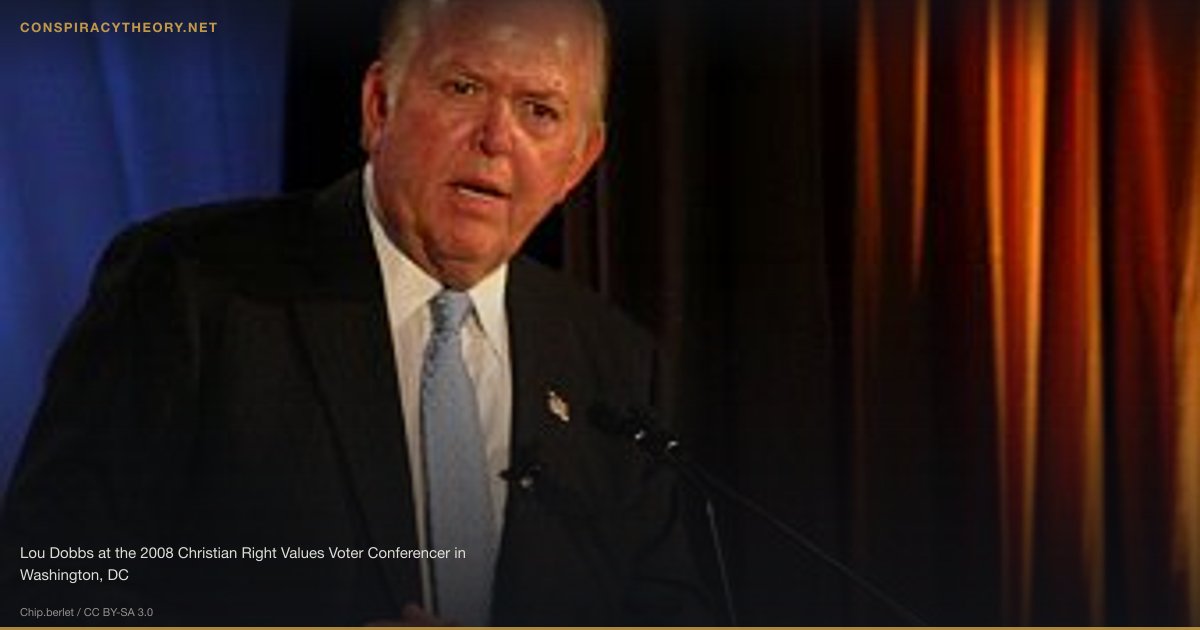
The theory might have remained in the orbit of WorldNetDaily and late-night talk radio if not for Lou Dobbs, the CNN anchor whose nightly program Lou Dobbs Tonight had pivoted hard toward immigration and trade populism. Dobbs featured the NAFTA Superhighway theory multiple times on his show, treating it as credible investigative reporting rather than fringe conspiracy.
In one memorable segment, a CNN correspondent stood in front of a map showing the alleged superhighway route while Dobbs intoned about threats to American sovereignty. The network’s imprimatur — and Dobbs’s considerable audience — elevated the theory to a level of visibility that its evidence could not justify.
The 2008 Presidential Campaign
The conspiracy entered the 2008 presidential race when Representative Ron Paul, running for the Republican nomination, referenced the North American Union as a threat during debates and campaign events. Paul’s libertarian base was already primed to receive the theory, and his candidacy gave it additional legitimacy. Other Republican candidates were asked about the theory at debates, with some offering carefully hedged responses that avoided either endorsing or fully dismissing it.
Key Claims
-
A secret superhighway is under construction: A massive transportation corridor, far wider and more extensive than any existing highway, is being built from Mexico through the United States to Canada, bypassing normal legislative and environmental review processes.
-
The North American Union is being created: The governments of the U.S., Canada, and Mexico are secretly planning to merge into a single political entity, modeled on the European Union, with shared institutions, laws, and governance.
-
The Amero will replace the dollar: A new shared currency, the Amero, will replace the U.S. dollar, the Canadian dollar, and the Mexican peso, eliminating national monetary sovereignty.
-
The SPP is the mechanism: The Security and Prosperity Partnership is not an informal forum but the institutional framework for creating the North American Union, operating without congressional authorization or public scrutiny.
-
American sovereignty is being eliminated: The entire project is designed to dissolve the United States as a sovereign nation-state, subordinating its Constitution and laws to a supranational North American authority.
Evidence
What Was Real
The Trans-Texas Corridor was a genuine infrastructure project proposed by the Texas governor’s office. It generated real controversy, particularly among landowners whose property would have been affected by eminent domain. The project was eventually scaled back significantly and formally cancelled in 2011.
The Security and Prosperity Partnership was a real trilateral initiative that operated from 2005 to 2009, when it was quietly shelved by the Obama administration. It produced a series of reports and working group recommendations on trade facilitation, product safety, and emergency management, none of which proposed or implied political union.
Robert Pastor really did propose closer North American integration in his academic work, including the possibility of a shared currency. But his proposals were explicitly modeled on European integration, which itself took decades of voluntary, democratic decision-making — not the secret government conspiracy described by Corsi and others.
What Was Not Real
No federal legislation, executive order, or international agreement ever proposed the construction of a “NAFTA Superhighway” as described by the conspiracy theory. The Federal Highway Administration explicitly stated that no such project existed.
No government of any of the three nations ever proposed the creation of a North American Union or a shared currency. The SPP’s own charter explicitly stated that it was not intended to lead to political integration.
The Amero was never the subject of any government proposal, negotiation, or planning document. Physical coins labeled “Amero” that circulated online were novelty items created by a private individual named Daniel Carr, who produced fantasy currency designs as a hobby.
The Debunking
In 2007, the non-partisan Congressional Research Service published a report examining the NAFTA Superhighway claims and concluded that the theory was based on “a mischaracterization of the Trans-Texas Corridor” and other real developments. PolitiFact, FactCheck.org, and the New York Times all investigated and debunked the theory. The Federal Highway Administration published a FAQ specifically addressing and denying the existence of the alleged superhighway.
Cultural Impact
The NAFTA Superhighway conspiracy is significant less for what it claimed than for what it revealed about the media landscape and political culture of the mid-2000s. It demonstrated how a mainstream cable news anchor could amplify a fringe conspiracy theory to millions of viewers with little accountability. It illustrated the mechanism by which real but boring policy developments (a Texas toll road, a trilateral talking shop) could be repackaged as evidence of existential threats to national sovereignty.
The theory also represented an early convergence of conspiracy thinking with right-wing populism that would become much more prominent in subsequent years. The anxieties that powered the NAFTA Superhighway theory — fear of globalization, hostility toward immigration, distrust of international institutions, and suspicion that elected officials were secretly serving interests other than their constituents — would resurface with far greater force in the Tea Party movement, the 2016 presidential campaign, and the broader populist-nationalist turn in American politics.
The theory’s rapid deflation after 2008 is equally instructive. Once the SPP was shelved, the Trans-Texas Corridor was cancelled, and the 2008 financial crisis redirected public anxiety toward Wall Street rather than imaginary superhighways, the conspiracy lost its energy almost overnight. It remains a historical artifact of a specific moment in American politics rather than an ongoing concern.
In Popular Culture
The NAFTA Superhighway conspiracy did not generate significant film or television portrayals, largely because its window of cultural relevance was relatively brief (roughly 2006-2009). However, it was extensively covered in political documentaries about conspiracy theories and the rise of right-wing populism. Alex Jones featured the theory prominently on his InfoWars program. The theory appeared in several conspiracy-themed documentary films of the era, including the Zeitgeist series. Jerome Corsi’s The Late Great USA was a bestseller in conservative book markets. Lou Dobbs’s coverage was later cited as an example of irresponsible journalism in media criticism studies.
Timeline
| Date | Event |
|---|---|
| January 1, 1994 | NAFTA enters into force |
| 2001 | Robert Pastor publishes Toward a North American Community |
| 2002 | Texas Governor Rick Perry proposes the Trans-Texas Corridor |
| March 2005 | Bush, Martin, and Fox launch the Security and Prosperity Partnership |
| 2006 | Jerome Corsi begins writing about the NAFTA Superhighway for WorldNetDaily |
| 2006-2007 | Lou Dobbs features the theory on CNN’s Lou Dobbs Tonight |
| July 2007 | Jerome Corsi publishes The Late Great USA |
| 2007 | Congressional Research Service publishes report debunking the theory |
| 2007-2008 | Ron Paul references the North American Union during presidential campaign |
| 2009 | Obama administration shelves the Security and Prosperity Partnership |
| 2011 | Trans-Texas Corridor formally cancelled |
Sources & Further Reading
- Corsi, Jerome R. The Late Great USA: The Coming Merger with Mexico and Canada. WND Books, 2007.
- Pastor, Robert A. Toward a North American Community: Lessons from the Old World for the New. Institute for International Economics, 2001.
- Congressional Research Service. “North American Free Trade Agreement (NAFTA) Implementation: The Future of Commercial Trucking Across the Mexican Border.” Report RL31738, 2007.
- Stokes, Bruce. “The North American Superhighway: A New Trade Route?” National Journal, 2007.
- PolitiFact. “Claim that NAFTA Superhighway is Under Construction.” Rated False, 2007.
- FactCheck.org. “The NAFTA Superhighway.” November 2007.
- Federal Highway Administration. “NAFTA Superhighway FAQ.” fhwa.dot.gov, 2007.
- Barkun, Michael. A Culture of Conspiracy: Apocalyptic Visions in Contemporary America. University of California Press, 2013.
Related Theories
- New World Order — The broader conspiracy theory about global governance that the North American Union was said to advance
- Agenda 21 — Another conspiracy theory about international agreements threatening American sovereignty
- Deep State — The theory of a permanent government apparatus operating beyond democratic control

Frequently Asked Questions
Was the NAFTA Superhighway a real project?
What was the Amero?
Why did people believe in the NAFTA Superhighway conspiracy?
Who promoted the NAFTA Superhighway theory?
Infographic
Share this visual summary. Right-click to save.
