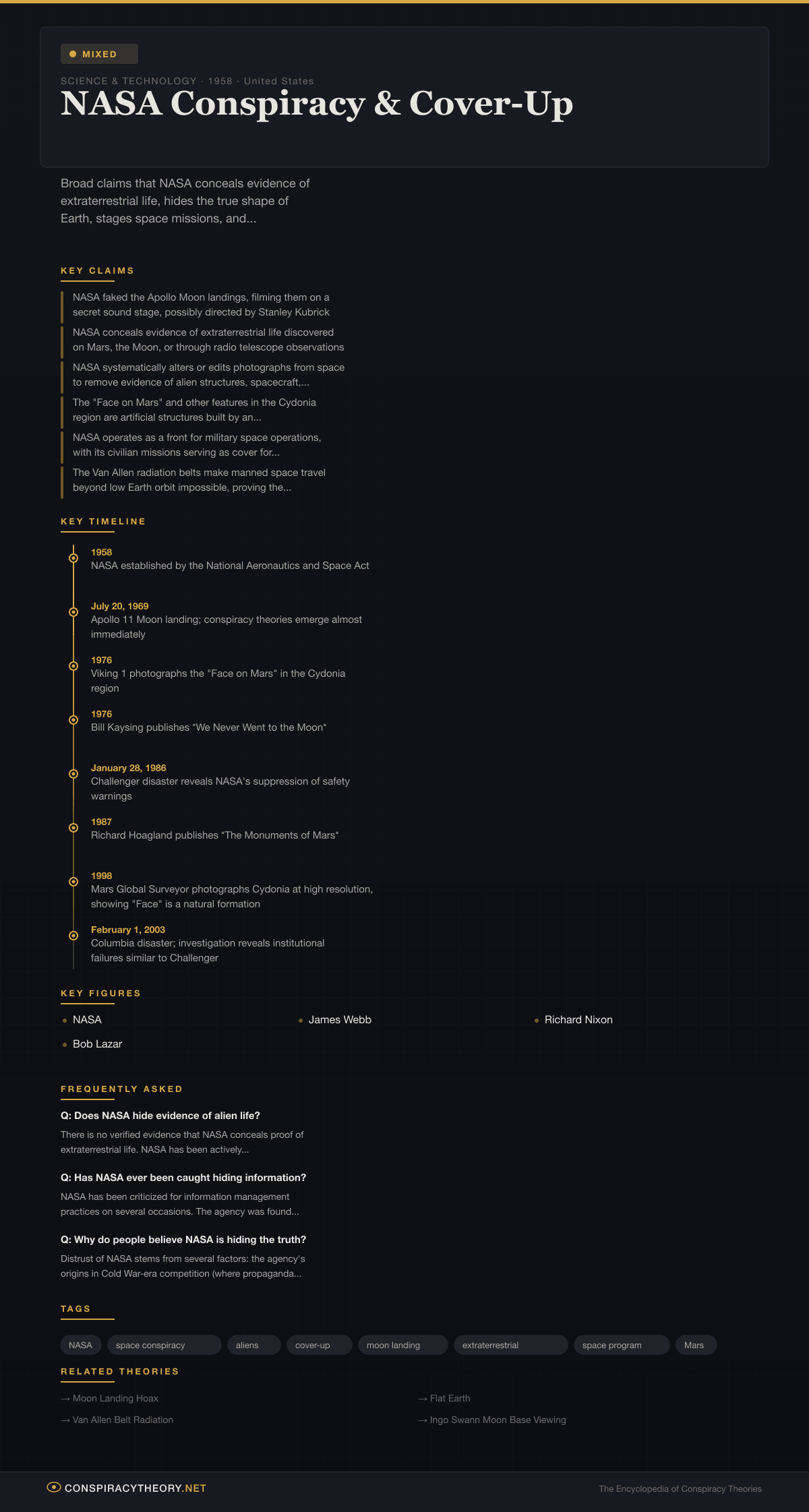
NASA Conspiracy & Cover-Up
Overview
Since its establishment in 1958, the National Aeronautics and Space Administration (NASA) has been the subject of a remarkably diverse array of conspiracy theories. These theories range from the well-known claim that the Apollo Moon landings were faked, to allegations that NASA conceals evidence of extraterrestrial life, to assertions that the agency participates in hiding the true shape of the Earth. Collectively, NASA conspiracy theories represent one of the most persistent and multifaceted domains of conspiratorial thinking.
The theories are united by a common premise: that NASA, as the primary civilian space agency of the world’s most powerful nation, serves as a gatekeeper controlling what the public is allowed to know about space, other worlds, and the fundamental nature of reality. In this view, NASA’s publicly available imagery, data, and mission reports represent a carefully curated version of space that conceals discoveries too disruptive or threatening for public knowledge.
The NASA conspiracy complex is classified as mixed because it encompasses an enormous range of claims with very different evidentiary standings. Some NASA-related conspiracy claims are conclusively debunked (the Moon landings were faked, the Earth is flat), while others touch on legitimate questions about government transparency (the relationship between NASA and the military-intelligence complex, the handling of UAP data). The documented reality that NASA has, on occasion, managed information for political or institutional reasons provides a factual foothold for theories that extend far beyond what the evidence supports.
Origins & History
NASA was established on July 29, 1958, born out of the Cold War space race with the Soviet Union. From its inception, the agency existed at the intersection of scientific discovery, military technology, national security, and public relations — a combination that created fertile ground for conspiracy theories.
The earliest NASA conspiracies focused on the space race itself. When the Soviet Union launched Sputnik in 1957 and put Yuri Gagarin into orbit in 1961, some Americans questioned whether these achievements were genuine or Soviet propaganda. Conversely, when NASA began achieving its own milestones, Soviet commentators and some Western skeptics raised questions about the authenticity of American space accomplishments.
The Moon landing conspiracy theory emerged almost immediately after Apollo 11. On July 20, 1969, when Neil Armstrong and Buzz Aldrin became the first humans to walk on the Moon, surveys suggested a small but notable percentage of Americans doubted the achievement was real. Bill Kaysing, a former technical writer at Rocketdyne (a NASA contractor), published We Never Went to the Moon: America’s Thirty Billion Dollar Swindle in 1976, which became the foundational text of the Moon landing hoax theory.
Throughout the 1970s and 1980s, NASA conspiracies expanded to encompass alleged cover-ups of anomalous objects in space photographs. The so-called “Face on Mars,” a geological formation in the Cydonia region photographed by Viking 1 in 1976, became the centerpiece of claims that NASA was hiding evidence of an ancient Martian civilization. Richard Hoagland, a former NASA consultant, became the most prominent advocate of this theory through his 1987 book The Monuments of Mars and his subsequent work promoting claims of artificial structures on the Moon and Mars.
The Challenger disaster of January 28, 1986, in which seven crew members died, added a new dimension to NASA conspiracies. The Rogers Commission investigation revealed that NASA management had overridden engineers’ safety concerns about O-ring performance in cold weather — a documented case of institutional failure and information suppression that, while not a conspiracy in the traditional sense, reinforced the narrative that NASA conceals inconvenient truths.
In the twenty-first century, NASA conspiracies have proliferated with the rise of social media and the broader Flat Earth movement. The agency’s role as the primary source of Earth imagery from space makes it a central target for Flat Earthers, who must argue that NASA systematically fabricates or manipulates all space photography. Meanwhile, the US government’s acknowledgment of Unidentified Aerial Phenomena (UAPs) beginning in 2017 has reopened questions about what NASA and other agencies know about unexplained aerospace observations.
Key Claims
NASA conspiracy theories encompass a wide range of claims, including:
- NASA faked the Apollo Moon landings, filming them on a secret sound stage, possibly directed by Stanley Kubrick
- NASA conceals evidence of extraterrestrial life discovered on Mars, the Moon, or through radio telescope observations
- NASA systematically alters or edits photographs from space to remove evidence of alien structures, spacecraft, or other anomalies
- The “Face on Mars” and other features in the Cydonia region are artificial structures built by an ancient Martian civilization, and NASA deliberately photographed them at angles designed to obscure their artificial nature
- NASA operates as a front for military space operations, with its civilian missions serving as cover for classified activities
- The Van Allen radiation belts make manned space travel beyond low Earth orbit impossible, proving the Apollo missions were faked
- NASA’s budget is used for classified projects unrelated to its stated mission of scientific exploration
- The International Space Station (ISS) is filmed underwater or in zero-gravity aircraft rather than in actual orbit
- NASA participates in concealing the flat shape of the Earth by fabricating curved-Earth imagery using CGI and fish-eye lenses
- Mars rover images are actually filmed on Devon Island in northern Canada or other terrestrial locations
Evidence
Evidence cited by conspiracy theorists:
Photography claims: Theorists point to perceived anomalies in Apollo mission photographs — missing stars in lunar sky photos, seemingly inconsistent shadows, the waving of the American flag in a vacuum, and identical backgrounds in photos supposedly taken at different locations. Each of these has been thoroughly explained by photographic experts (stars are invisible due to exposure settings for the bright lunar surface, shadow anomalies are caused by wide-angle lenses and uneven terrain, the flag had a horizontal rod to extend it, and backgrounds appear similar because the mountains are very distant).
Technical arguments: The Van Allen radiation belt argument claims that radiation levels in the belts would be lethal to astronauts. In reality, the Apollo trajectories were designed to minimize exposure by passing through the thinnest parts of the belts, and the total radiation dose received was well within survivable limits — comparable to a few chest X-rays.
Anomalous objects: NASA photographs occasionally contain artifacts that conspiracy theorists interpret as alien structures, spacecraft, or evidence of cover-ups. In virtually every documented case, these have been explained as photographic artifacts (lens flare, compression artifacts, pixel errors), natural geological features, or spacecraft components.
Evidence against the conspiracy:
Third-party verification: The Moon landings have been independently verified by multiple countries and organizations, including the Soviet Union (which had every motivation to expose a hoax). Lunar laser ranging experiments, which bounce laser beams off retroreflectors left on the Moon by Apollo astronauts, continue to operate and have been used by observatories worldwide. Multiple space agencies (ESA, JAXA, ISRO, China’s CNSA) have photographed Apollo landing sites, showing equipment and even astronaut footprints.
Scale of deception: The Apollo program employed approximately 400,000 people across thousands of contractors and subcontractors. The notion that a conspiracy of this scale could be maintained for over fifty years without a single credible whistleblower defies plausibility.
Documented information management: NASA’s actual documented instances of information management — the Challenger O-ring issue, political pressure on climate scientists, occasional over-classification of data — are far more mundane than the sweeping conspiracies alleged by theorists. Paradoxically, these documented failures demonstrate that NASA leaks regularly happen, making a multi-decade cover-up less rather than more plausible.
Debunking / Verification
Debunked: The Moon landing hoax theory is conclusively debunked by overwhelming physical evidence, third-party verification, and the testimony of hundreds of thousands of program participants. The Flat Earth variant of NASA conspiracies is debunked by fundamental physics and directly observable phenomena. The “Face on Mars” was shown to be a natural geological formation by high-resolution Mars Global Surveyor photographs in 1998 and subsequent imagery.
Verified (partially): NASA has documented instances of managing information for institutional or political reasons. The agency does maintain classified programs and has historical connections to the intelligence community. The relationship between NASA and the Department of Defense is closer than public perception suggests.
Unresolved: The broader question of what government agencies know about UAPs remains genuinely open, following the Pentagon’s acknowledgment of unexplained phenomena and congressional hearings on the topic. NASA established a UAP study team in 2022 and appointed a Director of UAP Research in 2023, signaling that the agency takes the question seriously.
Cultural Impact
NASA conspiracy theories have become embedded in global popular culture. The Moon landing hoax theory, in particular, has transcended its origins to become a cultural reference point — the archetypal conspiracy theory invoked in discussions about truth, evidence, and institutional trust.
Films like Capricorn One (1977), which depicted a faked Mars mission, helped popularize the idea that space missions could be staged. The found-footage film Apollo 18 (2011) and numerous television series have explored NASA conspiracy themes. The documentary A Funny Thing Happened on the Way to the Moon (2001) presented the hoax theory to a broad audience.
The cultural impact extends beyond entertainment. NASA conspiracy theories have been studied extensively by psychologists and social scientists as models for understanding conspiratorial thinking, motivated reasoning, and the psychology of distrust. Researchers have found that belief in NASA conspiracies correlates strongly with broader conspiratorial worldviews and lower trust in scientific institutions.
NASA itself has been forced to devote resources to addressing conspiracy claims, from publishing detailed rebuttals to Moon landing hoax claims to releasing higher-resolution imagery of Mars features to counter artificial-structure theories. The agency’s public engagement strategy has increasingly incorporated conspiracy awareness, reflecting the theories’ influence on public perception.
Timeline
- 1958 — NASA established by the National Aeronautics and Space Act
- July 20, 1969 — Apollo 11 Moon landing; conspiracy theories emerge almost immediately
- 1976 — Viking 1 photographs the “Face on Mars” in the Cydonia region
- 1976 — Bill Kaysing publishes We Never Went to the Moon
- January 28, 1986 — Challenger disaster reveals NASA’s suppression of safety warnings
- 1987 — Richard Hoagland publishes The Monuments of Mars
- 1998 — Mars Global Surveyor photographs Cydonia at high resolution, showing “Face” is a natural formation
- February 1, 2003 — Columbia disaster; investigation reveals institutional failures similar to Challenger
- 2014-2015 — Flat Earth movement revival brings renewed focus on NASA as alleged fabricator of globe imagery
- December 2017 — Pentagon acknowledges Advanced Aerospace Threat Identification Program (AATIP), reopening questions about government knowledge of anomalous phenomena
- April 2020 — Pentagon officially releases three UAP videos, acknowledging they show unexplained objects
- June 2022 — NASA announces UAP independent study team
- September 2023 — NASA appoints Mark McInerney as Director of UAP Research
- 2024 — Congressional hearings on UAPs continue to raise questions about government transparency
Sources & Further Reading
- Kaysing, Bill. We Never Went to the Moon: America’s Thirty Billion Dollar Swindle. Desert Publications, 1976
- Plait, Philip. Bad Astronomy: Misconceptions and Misuses Revealed. John Wiley & Sons, 2002
- Hoagland, Richard C. The Monuments of Mars: A City on the Edge of Forever. North Atlantic Books, 1987
- Launius, Roger D. “Denying the Apollo Moon Landings.” Proceedings of the 48th AIAA Aerospace Sciences Meeting, 2010
- Rogers Commission. Report of the Presidential Commission on the Space Shuttle Challenger Accident. 1986
- National Research Council. NASA’s Scientific Data Buy Program. National Academies Press, 2017
- NASA Office of Inspector General. Various audit reports on information management practices. oig.nasa.gov

Frequently Asked Questions
Does NASA hide evidence of alien life?
Has NASA ever been caught hiding information?
Why do people believe NASA is hiding the truth?

Infographic
Share this visual summary. Right-click to save.