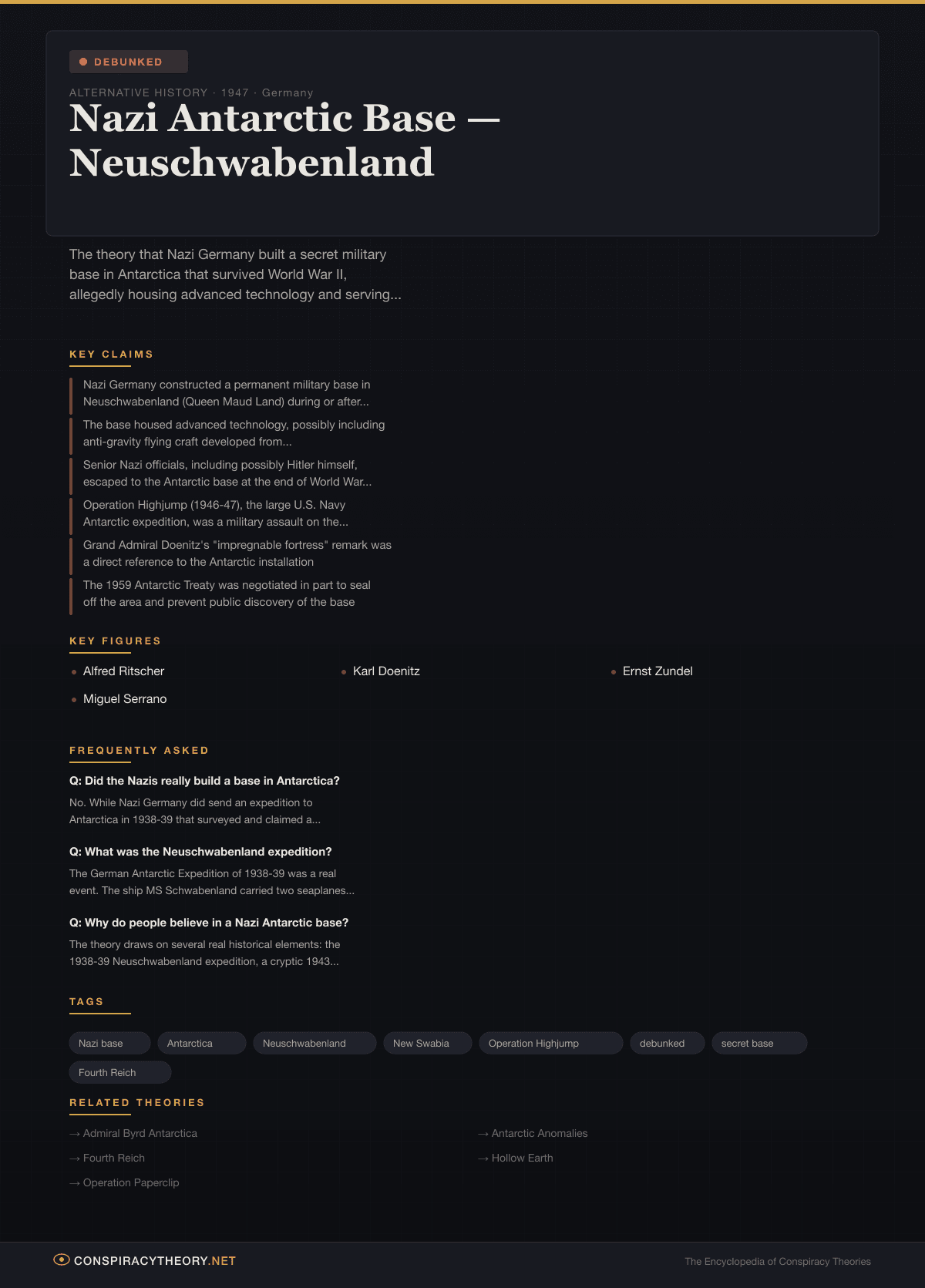
Nazi Antarctic Base — Neuschwabenland

Overview
The theory that Nazi Germany built a secret military base in Antarctica that survived World War II, allegedly housing advanced technology and serving as a refuge for fleeing Nazi officials.
Origins & History
The Nazi Antarctic base theory is rooted in a genuine historical event that has been inflated beyond all recognition. In late 1938, the German Antarctic Expedition departed Hamburg aboard the MS Schwabenland, a converted freighter equipped with catapult-launched Dornier Wal seaplanes. Under the command of Captain Alfred Ritscher, the expedition reached the coast of Queen Maud Land in January 1939 and spent approximately three weeks conducting aerial photographic surveys. The aircraft covered roughly 350,000 square kilometers, photographing terrain and dropping metal claim markers — small swastika-embossed darts — onto the ice below. Germany claimed the surveyed territory as Neuschwabenland (New Swabia), challenging Norway’s existing claim to the same region.
The expedition’s purposes were prosaic: territorial assertion in the race for Antarctic claims, identification of potential whaling grounds (whale oil was strategically important for margarine and nitroglycerin production), and general scientific survey. The Schwabenland departed in February 1939 without leaving any permanent installations, personnel, or infrastructure on the continent.
The conspiracy narrative emerged in the post-war period. A remark attributed to Grand Admiral Karl Doenitz from 1943 — “The German submarine fleet is proud of having built for the Fuehrer, in another part of the world, a Shangri-La on land, an impregnable fortress” — has been widely quoted in conspiracy literature, though its precise provenance and context are disputed by historians.
At the war’s end, several German U-boats were unaccounted for. Two submarines, U-530 and U-977, surrendered in Argentina months after Germany’s capitulation, fueling speculation about what missions they might have been conducting. Neither boat’s logs or crew testimony indicated any Antarctic destination, but the delayed surrenders provided a narrative hook.
The theory was given its fullest early expression by Ernst Zundel, a German-Canadian publisher and Holocaust denier, who in 1974 published a book under the pseudonym Christof Friedrich titled UFOs: Nazi Secret Weapon? Zundel conflated the Antarctic base legend with flying saucer lore, claiming that the Nazis had developed anti-gravity aircraft and were operating them from a polar fortress. Chilean diplomat and Nazi mystic Miguel Serrano later incorporated the Antarctic base into an elaborate esoteric framework involving Aryan polar mythology and Jungian archetypes.
By the 1990s and 2000s, the theory had migrated from neo-Nazi fringe publishing to mainstream conspiracy culture via internet forums, where it merged with hollow Earth theories, Admiral Byrd myths, and the broader “hidden history” genre.
Key Claims
- Nazi Germany constructed a permanent military base in Neuschwabenland (Queen Maud Land) during or after the 1938-39 expedition
- The base housed advanced technology, possibly including anti-gravity flying craft developed from suppressed physics
- Senior Nazi officials, including possibly Hitler himself, escaped to the Antarctic base at the end of World War II via U-boat
- Operation Highjump (1946-47), the large U.S. Navy Antarctic expedition, was a military assault on the Nazi base that was repelled by superior German technology
- Grand Admiral Doenitz’s “impregnable fortress” remark was a direct reference to the Antarctic installation
- The 1959 Antarctic Treaty was negotiated in part to seal off the area and prevent public discovery of the base
- The unaccounted-for U-boats at war’s end (particularly U-530 and U-977) were ferrying personnel and materiel to Antarctica
- The base may still be operational, maintained by descendants of the original occupants or by an allied advanced civilization
Evidence
There is no credible evidence supporting the existence of a Nazi Antarctic base. The evidence against it is logistical, documentary, and archaeological.
The logistical impossibility is the most straightforward refutation. Colin Summerhayes of the Scott Polar Research Institute at Cambridge University published a comprehensive analysis in Polar Record (2007) examining whether 1940s technology could have supported a permanent Antarctic base. His conclusion was unequivocal: the construction materials, heating fuel, food supplies, and personnel required to maintain even a small installation through Antarctic winters — where temperatures drop below -50°C and months of total darkness prevail — could not have been transported and sustained without a continuous, detectable supply chain. No evidence of any such supply chain exists in German naval records, decoded Enigma intercepts, or Allied intelligence files (Summerhayes, “Hitler’s Antarctic Base: The Myth and the Reality,” Polar Record 43.224, 2007).
The Schwabenland expedition’s own records document a brief aerial survey, not a construction project. The expedition carried no building materials, heavy equipment, or base-construction personnel. The aircraft dropped claim markers from altitude; no landing parties established ground installations. The expedition’s scientific reports, published in Germany, describe cartographic and meteorological work.
German naval records — including those captured by the Allies after the war and extensively studied by historians — contain no references to an Antarctic base, supply missions to Antarctica, or any continuation of the Neuschwabenland project during the war. The Enigma decrypts held at Bletchley Park and subsequently declassified provide an extraordinarily detailed picture of German naval operations; an Antarctic base program would have left traces in these communications.
U-530 and U-977, the submarines that surrendered late in Argentina, have been thoroughly investigated. Their crews were interrogated by Argentine, American, and British intelligence. Their logs were examined. Neither vessel had been to Antarctica. U-977’s commander, Heinz Schaffer, published a memoir (U-977, 1952) documenting the boat’s movements in detail.
Cultural Impact
The Nazi Antarctic base theory occupies a peculiar and uncomfortable position in conspiracy culture. It originated in neo-Nazi circles as an extension of the myth of German technological superiority — the idea that the Reich’s defeat was merely political and that its true achievements survived in a hidden polar sanctuary. This provenance means the theory carries ideological baggage that later, more mainstream conspiracy consumers may not recognize.
As the theory migrated from far-right publishing into general conspiracy culture through the internet, it shed much of its explicit political content and became primarily an adventure narrative — a lost-world story with Nazis as characters rather than ideological protagonists. The image of a hidden Antarctic base with flying saucers and advanced technology is irresistible to a certain kind of speculative imagination, and it has been adopted by conspiracy communities with no connection to Nazi ideology.
The theory has generated a substantial body of fiction, from the satirical Finnish-German film Iron Sky (2012), which depicts Nazis launching an invasion of Earth from a lunar base, to numerous novels, video games, and tabletop roleplaying scenarios. The Wolfenstein franchise, one of the best-selling video game series in history, draws extensively on imagery of surviving Nazi technological programs.
Historians of the Antarctic, however, note that the theory’s popularity has the unfortunate effect of overshadowing the actual history of polar exploration and the genuine geopolitical competition for Antarctic territory that characterized the mid-twentieth century.
Sources & Further Reading
- Summerhayes, Colin P. “Hitler’s Antarctic Base: The Myth and the Reality.” Polar Record 43.224 (2007): 1-21.
- Barkun, Michael. A Culture of Conspiracy: Apocalyptic Visions in Contemporary America. University of California Press, 2003.
- Mills, William James. Exploring Polar Frontiers: A Historical Encyclopedia. ABC-CLIO, 2003.
- Schaffer, Heinz. U-977: Sixty-Six Days Under Water. William Kimber, 1952.
- Goodrick-Clarke, Nicholas. Black Sun: Aryan Cults, Esoteric Nazism, and the Politics of Identity. New York University Press, 2002.
- Murphy, David Thomas. German Exploration of the Polar World: A History, 1870-1940. University of Nebraska Press, 2002.
- Rose, Lisle A. Explorer: The Life of Richard E. Byrd. University of Missouri Press, 2008.
Frequently Asked Questions
Did the Nazis really build a base in Antarctica?
What was the Neuschwabenland expedition?
Why do people believe in a Nazi Antarctic base?

Infographic
Share this visual summary. Right-click to save.