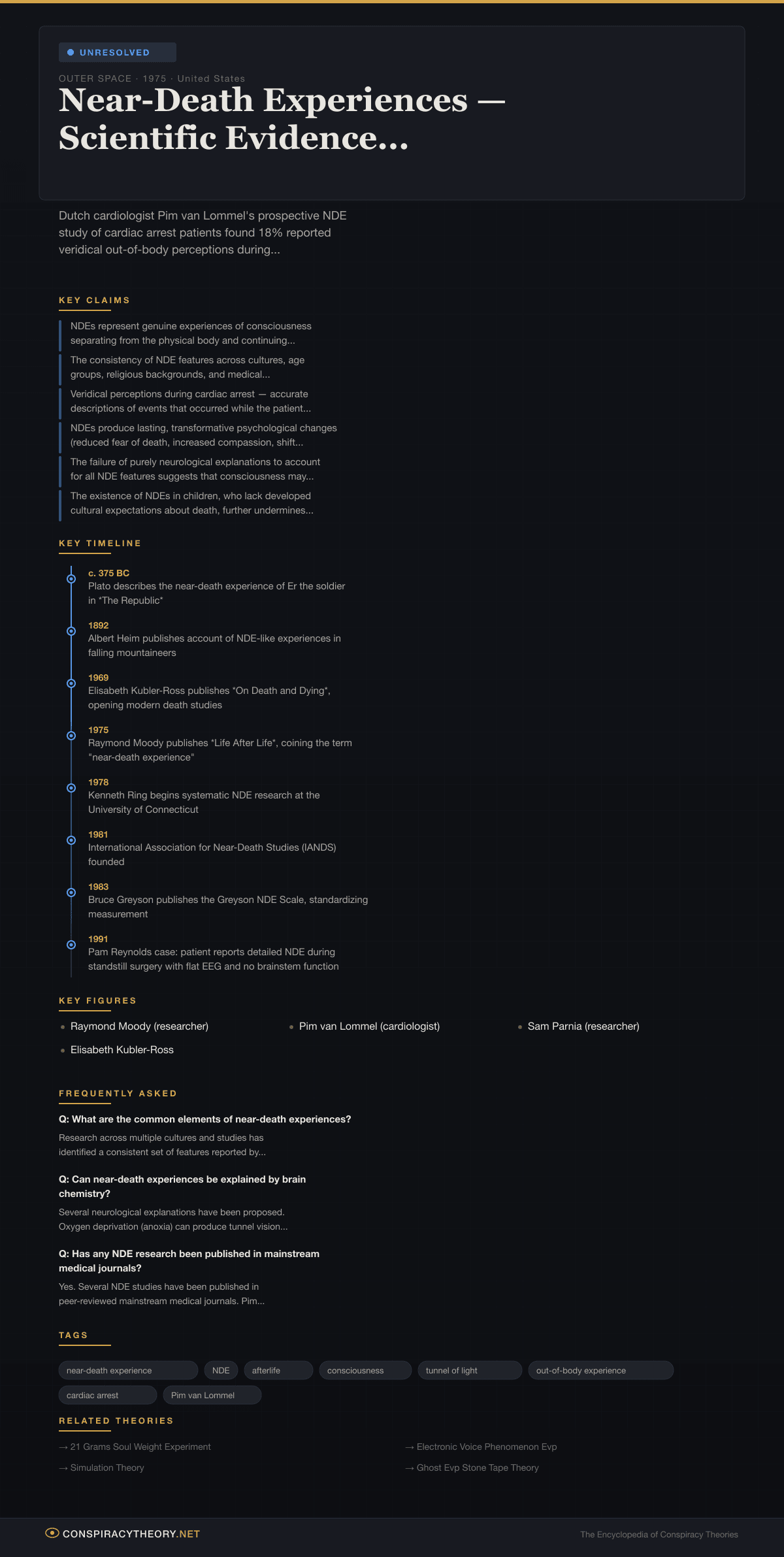
Near-Death Experiences — Scientific Evidence for Afterlife
Overview
Near-death experiences (NDEs) — the vivid, structured experiences reported by some individuals who come close to death or are briefly clinically dead — represent one of the most intriguing and contentious intersections of science, consciousness research, and questions about the nature of human existence. For those who interpret NDEs as evidence of consciousness surviving physical death, these experiences constitute the strongest empirical argument for an afterlife. For skeptics, they are fascinating but ultimately explicable products of a dying brain.
The phenomenon gained widespread public and scientific attention with the publication of Raymond Moody’s Life After Life in 1975, which catalogued consistent features reported across hundreds of NDE accounts: the out-of-body experience, the tunnel, the light, the life review, and the encounter with deceased loved ones or spiritual beings. In the decades since, prospective medical studies — including Pim van Lommel’s landmark study published in The Lancet (2001) and Sam Parnia’s AWARE study — have attempted to bring scientific rigor to the investigation of these experiences.
The topic is classified as unresolved because the evidence is genuinely ambiguous. NDEs are real subjective experiences with documented psychological and physiological consequences. Their cross-cultural consistency is remarkable. Some reported veridical perceptions during cardiac arrest — cases where patients accurately described events occurring while they had no measurable brain activity — are difficult to explain by conventional neuroscience. However, no study has yet produced the definitive, controlled evidence that would settle the question, and plausible neurological explanations exist for most NDE features.
Origins & History
Reports of transcendent experiences at the threshold of death appear throughout human history and across virtually all cultures. Ancient Egyptian, Greek, Tibetan, Hindu, and Christian texts all contain accounts recognizable as near-death experiences. Plato’s Republic includes the story of Er, a soldier who died in battle and returned to life with an account of the afterlife. The medieval text The Vision of Drythelm describes a seventh-century monk’s experience of death and return with remarkable parallels to modern NDE accounts.
Modern scientific interest in NDEs began in the nineteenth century with the work of Swiss geologist Albert Heim, who collected accounts from mountaineers who had survived falls. Heim, himself a fall survivor, published a paper in 1892 documenting a consistent pattern of experiences: time dilation, life review, profound calm, and heightened sensory awareness.
The field’s modern era began with Elisabeth Kubler-Ross, the Swiss-American psychiatrist whose work on death and dying in the 1960s and 1970s brought attention to the experiences of the terminally ill. Kubler-Ross began collecting accounts of deathbed experiences and NDEs, eventually incorporating them into her broader work on the psychology of dying.
Raymond Moody’s Life After Life (1975) transformed NDE research from an academic niche into a cultural phenomenon. Moody, a philosopher and psychiatrist, coined the term “near-death experience” and identified the common elements that would define subsequent research: the out-of-body experience, the tunnel, the being of light, the life review, the deceased relatives, the boundary, and the return. His book sold millions of copies and established NDEs as a subject of both popular and scientific interest.
The International Association for Near-Death Studies (IANDS), founded in 1981, provided an institutional home for researchers and experiencers. Bruce Greyson, a psychiatrist at the University of Virginia, developed the Greyson NDE Scale, a standardized tool for measuring and classifying near-death experiences that enabled systematic research.
The most significant scientific milestones have been prospective hospital studies that monitored cardiac arrest patients and interviewed survivors:
Van Lommel’s Lancet study (2001): Dutch cardiologist Pim van Lommel conducted a prospective study of 344 cardiac arrest patients across ten Dutch hospitals. Of the 62 patients who survived and could be interviewed, 18% reported NDEs with typical features. Van Lommel reported that NDE occurrence did not correlate with the duration of cardiac arrest, medication, or depth of unconsciousness — challenging the hypothesis that NDEs are simply produced by oxygen deprivation.
Parnia’s AWARE study (2014): Anesthesiologist Sam Parnia led the AWARE (AWAreness during REsuscitation) study, a four-year prospective investigation across fifteen hospitals in the US, UK, and Austria. The study placed hidden images on high shelves in resuscitation rooms — images that could only be seen from above — to test whether out-of-body perceptions were veridical. Of 2,060 cardiac arrest patients, 330 survived and 140 were interviewed. Nine reported NDEs, but only two cardiac arrests occurred in rooms with the hidden images, and neither patient reported an out-of-body experience. One patient did provide a detailed, verified account of events during his cardiac arrest lasting three minutes, during which he should have had no conscious awareness.
Key Claims
Proponents of NDEs as afterlife evidence make several claims:
- NDEs represent genuine experiences of consciousness separating from the physical body and continuing to function after clinical death
- The consistency of NDE features across cultures, age groups, religious backgrounds, and medical conditions suggests an objective experience rather than a culturally constructed hallucination
- Veridical perceptions during cardiac arrest — accurate descriptions of events that occurred while the patient had no measurable brain activity — cannot be explained by conventional neuroscience
- NDEs produce lasting, transformative psychological changes (reduced fear of death, increased compassion, shift in values) that distinguish them from ordinary hallucinations or dreams
- The failure of purely neurological explanations to account for all NDE features suggests that consciousness may not be entirely produced by the brain
- The existence of NDEs in children, who lack developed cultural expectations about death, further undermines the cultural construction hypothesis
- NDEs are consistent with certain interpretations of quantum mechanics that propose consciousness as fundamental rather than emergent
Evidence
Cross-cultural consistency: Studies of NDEs across diverse cultures — including Western, Eastern, African, and Indigenous populations — have documented a core set of features that appear with remarkable consistency. While cultural coloring affects specific details (Christians may see Jesus, Hindus may see Yamraj), the structural elements — out-of-body experience, tunnel or passage, light, being of love, life review, boundary, return — appear across cultural boundaries. This consistency is documented in research by Allan Kellehear, Karlis Osis, and others.
Prospective medical studies: The Van Lommel (2001) and Parnia (2014, 2023) studies represent the gold standard in NDE research because they prospectively enrolled cardiac arrest patients and conducted standardized interviews. These studies confirm that a significant minority of cardiac arrest survivors report NDEs and that some features of their reports correspond to verifiable events.
Veridical perception cases: The most compelling evidence for NDE proponents consists of cases where patients accurately described events occurring while they were clinically dead. The most famous is the “dentures man” case from Van Lommel’s study, in which a patient accurately described the nurse who removed his dentures during resuscitation — a period when the patient was deeply comatose. Maria’s shoe case, in which a patient at Harborview Medical Center described a tennis shoe on a third-floor window ledge that was later confirmed, is another frequently cited example.
Neurological explanations: Skeptics offer several plausible mechanisms:
Oxygen deprivation (anoxia/hypoxia): Reduced oxygen to the brain can produce tunnel vision, bright lights, and euphoria. Fighter pilots experiencing G-force-induced loss of consciousness report tunnel vision and dreamlike states.
Endorphin release: The massive release of endogenous opioids during trauma could account for feelings of peace and pain reduction.
REM intrusion: Researcher Kevin Nelson has proposed that NDEs result from the intrusion of REM sleep mechanisms into waking consciousness during physiological crisis.
DMT hypothesis: Rick Strassman proposed that endogenous DMT release during extreme stress produces NDE-like experiences, though evidence for sufficient DMT production in the human brain is limited.
Temporal lobe stimulation: Neurosurgeon Wilder Penfield’s work demonstrated that electrical stimulation of the temporal lobe can produce out-of-body sensations and memory flashbacks, suggesting a neural basis for some NDE features.
Debunking / Verification
Verified: NDEs are real subjective experiences that occur in a significant minority of cardiac arrest survivors. They produce lasting psychological changes. Their core features are consistent across cultures. Some reported perceptions have been verified against independent evidence. The experiences are not correlated with prior expectations, religious belief, or medication — factors that might predict hallucinatory content.
Debunked (partially): Simple oxygen deprivation does not fully explain NDEs, as Van Lommel’s study found no correlation between NDE occurrence and duration of cardiac arrest. However, the claim that NDEs occur during periods of absolutely zero brain activity has not been definitively established — the exact timing of subjective experiences relative to brain states is extremely difficult to determine with current technology.
Unresolved: The fundamental question — whether NDEs represent evidence of consciousness surviving physical death or are exotic but ultimately explicable products of brain physiology — remains genuinely open. No controlled study has produced the definitive evidence (such as a patient accurately identifying a hidden image visible only from above during an out-of-body experience) that would settle the matter. The Parnia AWARE II study (2023) produced suggestive but inconclusive results, and research continues.
Cultural Impact
Near-death experiences have profoundly influenced contemporary culture, spirituality, and attitudes toward death. Popular NDE accounts, including Betty Eadie’s Embraced by the Light (1992), Eben Alexander’s Proof of Heaven (2012), and Colton Burpo’s Heaven Is for Real (2010), have become international bestsellers, introducing millions to the phenomenon.
NDEs have influenced medical practice, particularly in palliative care and hospice settings, where awareness of NDEs helps clinicians support patients and families through the dying process. Many hospitals and healthcare systems now include NDE awareness in their training programs.
The phenomenon has sparked interdisciplinary dialogue between neuroscience, philosophy of mind, and religious studies. The “hard problem of consciousness” — the question of how subjective experience arises from physical matter — remains one of the deepest unsolved problems in science, and NDEs are frequently invoked in debates about its resolution.
NDEs have also become a significant feature of popular entertainment, from films like Flatliners (1990, 2017) and Enter the Void (2009) to television series and numerous documentaries. The cultural fascination with NDEs reflects both a widespread desire for reassurance about death and genuine intellectual engagement with the nature of consciousness.
Timeline
- c. 375 BC — Plato describes the near-death experience of Er the soldier in The Republic
- 1892 — Albert Heim publishes account of NDE-like experiences in falling mountaineers
- 1969 — Elisabeth Kubler-Ross publishes On Death and Dying, opening modern death studies
- 1975 — Raymond Moody publishes Life After Life, coining the term “near-death experience”
- 1978 — Kenneth Ring begins systematic NDE research at the University of Connecticut
- 1981 — International Association for Near-Death Studies (IANDS) founded
- 1983 — Bruce Greyson publishes the Greyson NDE Scale, standardizing measurement
- 1991 — Pam Reynolds case: patient reports detailed NDE during standstill surgery with flat EEG and no brainstem function
- 2001 — Pim van Lommel’s prospective study published in The Lancet
- 2008 — Sam Parnia launches the AWARE study across fifteen hospitals
- 2012 — Eben Alexander’s Proof of Heaven becomes a bestseller, reigniting public debate
- 2014 — AWARE study results published in Resuscitation
- 2023 — AWARE II study results presented; suggestive but inconclusive findings about consciousness during cardiac arrest
- Ongoing — Research continues at the University of Virginia Division of Perceptual Studies, NYU Langone, and other institutions
Sources & Further Reading
- Moody, Raymond A. Life After Life. Mockingbird Books, 1975
- Van Lommel, Pim. Consciousness Beyond Life: The Science of the Near-Death Experience. HarperOne, 2010
- Parnia, Sam. Erasing Death: The Science That Is Rewriting the Boundaries Between Life and Death. HarperOne, 2013
- Greyson, Bruce. After: A Doctor Explores What Near-Death Experiences Reveal About Life and Beyond. St. Martin’s Essentials, 2021
- Van Lommel, Pim, et al. “Near-Death Experience in Survivors of Cardiac Arrest: A Prospective Study in the Netherlands.” The Lancet 358 (2001): 2039-2045
- Parnia, Sam, et al. “AWARE — AWAreness during REsuscitation — A Prospective Study.” Resuscitation 85 (2014): 1799-1805
- Blackmore, Susan. Dying to Live: Near-Death Experiences. Prometheus Books, 1993
Frequently Asked Questions
What are the common elements of near-death experiences?
Can near-death experiences be explained by brain chemistry?
Has any NDE research been published in mainstream medical journals?
Infographic
Share this visual summary. Right-click to save.