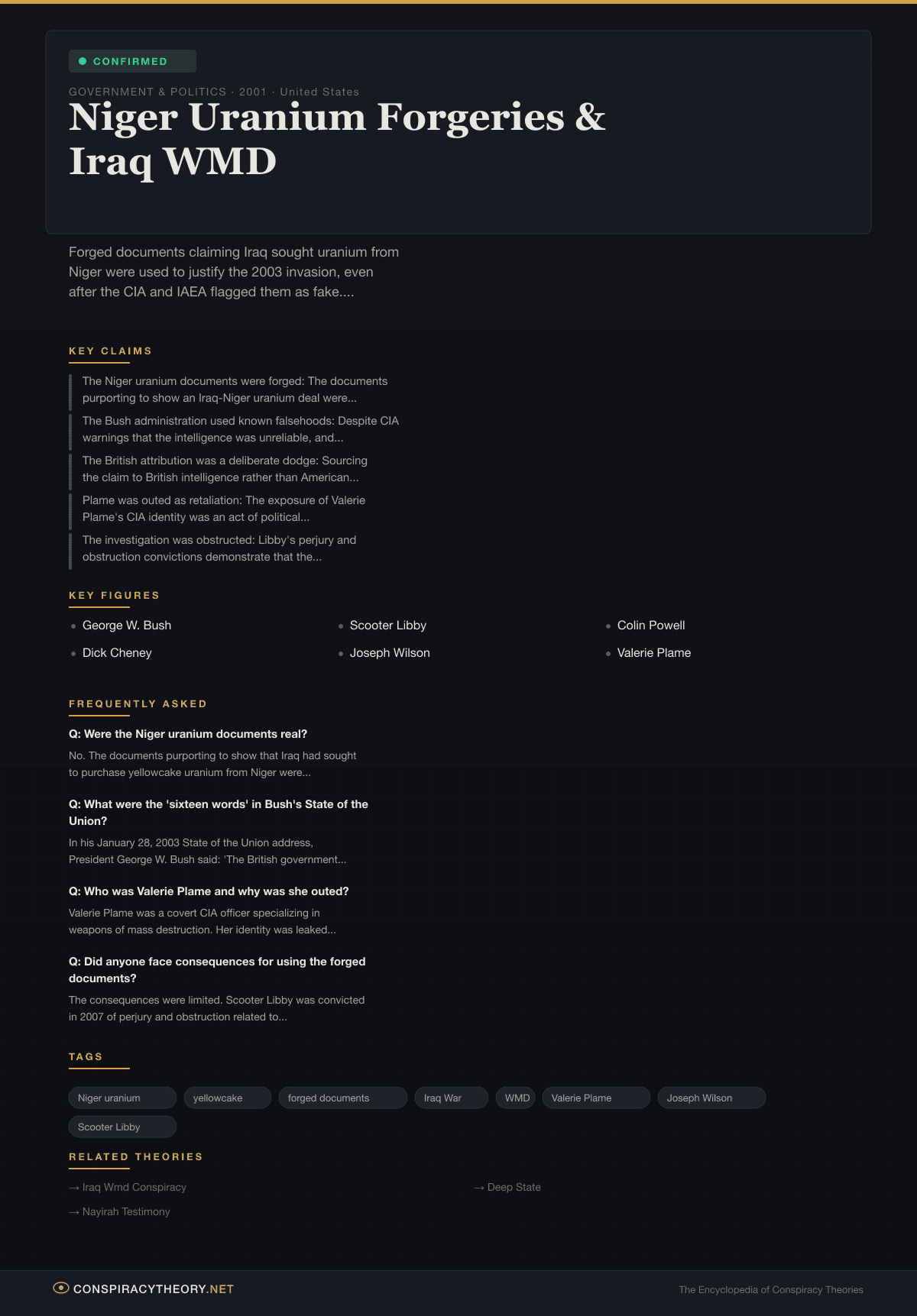
Niger Uranium Forgeries & Iraq WMD
Overview
On the evening of January 28, 2003, President George W. Bush stood before a joint session of Congress to deliver his State of the Union address. Among the many claims he made about the threat posed by Saddam Hussein’s regime, sixteen words would become the most consequential — and the most dishonest: “The British government has learned that Saddam Hussein recently sought significant quantities of uranium from Africa.”
The claim was based on forged documents. The CIA knew the documents were unreliable. The International Atomic Energy Agency would determine, within weeks, that the forgeries were so crude they could be debunked with a Google search. A former U.S. ambassador had traveled to Niger on the CIA’s behalf and reported back that the uranium story was almost certainly false. The White House had been warned, repeatedly, not to use the claim. They used it anyway.
What followed was not merely the invasion of Iraq — that decision had been made on many other grounds as well — but a sequence of events that included the criminal exposure of a covert CIA officer, a special prosecutor investigation, a felony conviction in the Vice President’s office, and a case study in how intelligence can be manipulated, cherry-picked, and outright fabricated to serve a predetermined policy conclusion. The Niger uranium affair is one of the most thoroughly documented cases of a government using known falsehoods to justify military action in modern American history.
This theory is classified as confirmed — the documents were forged, the intelligence was known to be unreliable before it was used, and the subsequent cover-up and retaliation against whistleblowers are matters of public record established through congressional investigations, a special prosecutor’s inquiry, and court proceedings.
Origins & History
The Forgeries Appear (Late 2001-2002)
The Niger uranium documents appear to have entered the intelligence pipeline in late 2001 or early 2002, though their exact origin remains one of the case’s persistent mysteries. The most credible reconstruction traces them to Rocco Martino, an Italian former intelligence asset, who obtained or fabricated documents purporting to show a contract between Niger and Iraq for the sale of 500 tons of yellowcake uranium (a processed form of uranium ore).
Martino provided the documents to Italian military intelligence (SISMI), which passed them to British intelligence (MI6) and eventually to the CIA. The British also claimed to have independent intelligence supporting the Niger uranium story, though they have never disclosed this evidence.
The documents themselves were remarkably shoddy forgeries. They bore the letterhead of the Niger government but were formatted incorrectly. One letter was signed by Allele Habibou as Niger’s foreign minister — but Habibou had left office in 1989, more than a decade before the supposed transaction. Other documents contained dates, reference numbers, and official titles that did not correspond to any real Niger government records.
Joseph Wilson’s Mission to Niger (February 2002)
In February 2002, the CIA dispatched former Ambassador Joseph Wilson to Niger to investigate the uranium claims. Wilson had extensive experience in Africa, having served as Ambassador to Gabon and as acting ambassador in Baghdad during the First Gulf War. His wife, Valerie Plame, was a covert CIA officer specializing in WMD intelligence, and she had suggested Wilson for the trip — a fact that would later be weaponized against both of them.
Wilson spent eight days in Niger, meeting with current and former government officials and mining industry executives. He concluded that it was highly unlikely Iraq had purchased or sought uranium from Niger. Niger’s uranium mining was controlled by a French-led consortium (COGEMA), with production, transport, and export tightly monitored by the IAEA and the French government. A clandestine sale of 500 tons of yellowcake would have been virtually impossible to conceal.
Wilson reported his findings to the CIA in a verbal debriefing upon his return. He later said he was told his report was circulated to the Vice President’s office, which had originally requested the intelligence be investigated — though the exact distribution of his report became a matter of dispute.
The October 2002 Cincinnati Speech
Despite Wilson’s findings and the CIA’s own doubts about the Niger intelligence, the uranium claim continued to circulate within the administration. In October 2002, as the White House prepared a major speech on Iraq for the president to deliver in Cincinnati, the speech draft included a reference to the Niger uranium. CIA Director George Tenet personally intervened to have the claim removed. He sent two memoranda to the White House and called Deputy National Security Adviser Stephen Hadley to insist the claim was too unreliable to include in a presidential speech.
The claim was removed from the Cincinnati speech. But it would be back.
The Sixteen Words (January 28, 2003)
Three months later, the Niger uranium claim appeared in the State of the Union address, this time attributed to British intelligence rather than American: “The British government has learned that Saddam Hussein recently sought significant quantities of uranium from Africa.”
The attribution to British intelligence was a deliberate strategy to sidestep the CIA’s objections. Since the CIA had warned against the claim, the White House sourced it to the British, who had not withdrawn their assessment. This bureaucratic maneuver allowed the claim to reach the American public through the most prominent presidential speech of the year, lending it an authority that the underlying intelligence did not justify.
The IAEA Debunks the Documents (March 2003)
In March 2003, the IAEA received copies of the Niger uranium documents from the United States and determined almost immediately that they were forgeries. IAEA Director General Mohamed ElBaradei announced the finding on March 7, 2003, less than two weeks before the invasion of Iraq began on March 20. ElBaradei’s team reported that the forgeries had been identifiable within hours, using publicly available information to confirm that names, dates, and official formats did not match real Niger government records.
The IAEA’s debunking received relatively little attention in the United States, where media coverage was dominated by war preparations. The invasion proceeded as planned.
Wilson Goes Public (July 6, 2003)
After months of watching the Niger uranium claim used to justify a war he believed was based on false pretenses, Joseph Wilson published an op-ed in the New York Times on July 6, 2003, titled “What I Didn’t Find in Africa.” Wilson described his CIA-commissioned trip to Niger and his conclusion that the uranium claims were unfounded. He wrote: “Based on my experience with the administration in the months leading up to the war, I have little choice but to conclude that some of the intelligence related to Iraq’s nuclear weapons program was twisted to exaggerate the Iraqi threat.”
The op-ed detonated in Washington. Wilson was explicitly challenging the honesty of a sitting president’s State of the Union address on a matter of war and peace.
The Plame Leak (July 14, 2003)
Eight days after Wilson’s op-ed, conservative columnist Robert Novak published a column identifying Valerie Plame as a CIA operative and noting that she had suggested her husband for the Niger trip. The column, headlined “Mission to Niger,” was widely interpreted as retaliation — an attempt to discredit Wilson by suggesting that his trip was a nepotistic junket rather than a legitimate intelligence-gathering mission.
The leak of a covert CIA officer’s identity was potentially a federal crime under the Intelligence Identities Protection Act. The Justice Department appointed Patrick Fitzgerald as special counsel to investigate.
The Libby Trial and Conviction (2005-2007)
Fitzgerald’s investigation determined that the primary source for the Plame leak was Richard Armitage, the Deputy Secretary of State, who had mentioned Plame’s identity to Novak in what Armitage said was a casual conversation. However, Fitzgerald also found that Vice Presidential Chief of Staff I. Lewis “Scooter” Libby had discussed Plame’s identity with multiple journalists and had subsequently lied to investigators about his actions.
Libby was indicted in October 2005 on charges of perjury, making false statements to the FBI, and obstruction of justice. He was convicted on four of five counts in March 2007 and sentenced to 30 months in prison and a $250,000 fine. President Bush commuted Libby’s prison sentence on the day it was to begin, calling it “excessive.” In April 2018, President Trump granted Libby a full pardon.
Key Claims
-
The Niger uranium documents were forged: The documents purporting to show an Iraq-Niger uranium deal were crude fabrications, and this was known or discoverable before they were used.
-
The Bush administration used known falsehoods: Despite CIA warnings that the intelligence was unreliable, and despite Wilson’s report from Niger, the administration included the uranium claim in the State of the Union to build the case for war.
-
The British attribution was a deliberate dodge: Sourcing the claim to British intelligence rather than American was a bureaucratic maneuver to avoid the CIA’s objections while still getting the claim into a presidential address.
-
Plame was outed as retaliation: The exposure of Valerie Plame’s CIA identity was an act of political revenge against her husband for challenging the administration’s case for war.
-
The investigation was obstructed: Libby’s perjury and obstruction convictions demonstrate that the Vice President’s office attempted to impede the investigation into the leak.
Evidence
The evidentiary record in this case is exceptionally strong because it was developed through multiple formal investigative processes:
The Senate Select Committee on Intelligence published a detailed report in July 2004 examining the pre-war intelligence on Iraq, including the Niger uranium claims. The report documented the CIA’s warnings to the White House and the agency’s assessment that the Niger intelligence was unreliable.
The Robb-Silberman Commission (Commission on the Intelligence Capabilities of the United States Regarding Weapons of Mass Destruction) published its report in March 2005, concluding that the intelligence community’s pre-war assessments about Iraq’s WMD programs were fundamentally wrong.
Patrick Fitzgerald’s special counsel investigation produced extensive court filings and trial testimony establishing the timeline of the Plame leak and the roles of various administration officials.
The IAEA’s determination that the Niger documents were forgeries was published in formal reports to the UN Security Council.
George Tenet’s memoir, At the Center of the Storm (2007), acknowledged the CIA’s failures but also documented his efforts to prevent the Niger claim from appearing in presidential speeches.
Cultural Impact
The Niger uranium affair became one of the defining scandals of the George W. Bush presidency and contributed significantly to the erosion of public trust in government intelligence claims and the conduct of the Iraq War. The phrase “sixteen words” entered the political lexicon as shorthand for the manipulation of intelligence to serve policy ends.
The Plame affair specifically highlighted the vulnerability of intelligence officers to political retaliation and raised fundamental questions about the relationship between the intelligence community and the political leadership it serves. Plame’s case became a cause celebre in both intelligence and media circles, generating debate about press freedom, source protection, and the responsibilities of journalists who receive classified information.
More broadly, the Niger uranium case became Exhibit A in the argument that the Iraq War was launched on false pretenses. While the broader case for war rested on multiple intelligence claims — most of which proved to be wrong — the Niger uranium story was unique in that it was based on documents that were known to be forged before they were used.
In Popular Culture
The case generated significant media and cultural attention. The 2010 film Fair Game, directed by Doug Liman, starred Naomi Watts as Valerie Plame and Sean Penn as Joseph Wilson, dramatizing the Niger investigation, the State of the Union speech, and the subsequent retaliation. Plame published her memoir, Fair Game: My Life as a Spy, My Betrayal by the White House, in 2007. Wilson published The Politics of Truth: Inside the Lies That Led to War and Betrayed My Wife’s CIA Identity in 2004. The case features prominently in numerous Iraq War documentaries, including No End in Sight (2007) and The Unknown Known (2013).
Timeline
| Date | Event |
|---|---|
| Late 2001-early 2002 | Niger uranium forgeries enter the intelligence pipeline, reportedly via Italian intelligence |
| February 2002 | CIA sends Joseph Wilson to Niger to investigate uranium claims |
| March 2002 | Wilson reports to CIA that Niger uranium deal is highly unlikely |
| October 2002 | CIA Director Tenet intervenes to remove Niger claim from Bush’s Cincinnati speech |
| January 28, 2003 | Bush includes “sixteen words” about Niger uranium in State of the Union address |
| March 7, 2003 | IAEA announces Niger documents are forgeries |
| March 20, 2003 | U.S. invades Iraq |
| July 6, 2003 | Wilson publishes “What I Didn’t Find in Africa” op-ed in the New York Times |
| July 14, 2003 | Robert Novak publishes column identifying Valerie Plame as CIA officer |
| July 2003 | White House acknowledges the “sixteen words” should not have been in the State of the Union |
| December 2003 | Patrick Fitzgerald appointed special counsel |
| October 2005 | Scooter Libby indicted on perjury and obstruction charges |
| March 2007 | Libby convicted on four of five counts |
| June 2007 | Libby sentenced to 30 months in prison; Bush commutes the sentence |
| April 2018 | President Trump grants Libby a full pardon |
Sources & Further Reading
- Wilson, Joseph. The Politics of Truth: Inside the Lies That Led to War and Betrayed My Wife’s CIA Identity. Carroll & Graf, 2004.
- Plame Wilson, Valerie. Fair Game: My Life as a Spy, My Betrayal by the White House. Simon & Schuster, 2007.
- Tenet, George. At the Center of the Storm: My Years at the CIA. HarperCollins, 2007.
- Senate Select Committee on Intelligence. “Report on the U.S. Intelligence Community’s Prewar Intelligence Assessments on Iraq.” July 2004.
- Commission on the Intelligence Capabilities of the United States Regarding Weapons of Mass Destruction (Robb-Silberman Commission). Report to the President, March 2005.
- Isikoff, Michael, and David Corn. Hubris: The Inside Story of Spin, Scandal, and the Selling of the Iraq War. Crown, 2006.
- Liman, Doug, director. Fair Game. Summit Entertainment, 2010.
- Bamford, James. A Pretext for War: 9/11, Iraq, and the Abuse of America’s Intelligence Agencies. Doubleday, 2004.
Related Theories
- Iraq WMD Conspiracy — The broader theory about the manipulation of intelligence to justify the Iraq invasion
- Deep State — Claims of unaccountable government apparatus operating beyond democratic control
- Nayirah Testimony — Another confirmed case of fabricated evidence used to build support for military action against Iraq

Frequently Asked Questions
Were the Niger uranium documents real?
What were the 'sixteen words' in Bush's State of the Union?
Who was Valerie Plame and why was she outed?
Did anyone face consequences for using the forged documents?
Infographic
Share this visual summary. Right-click to save.