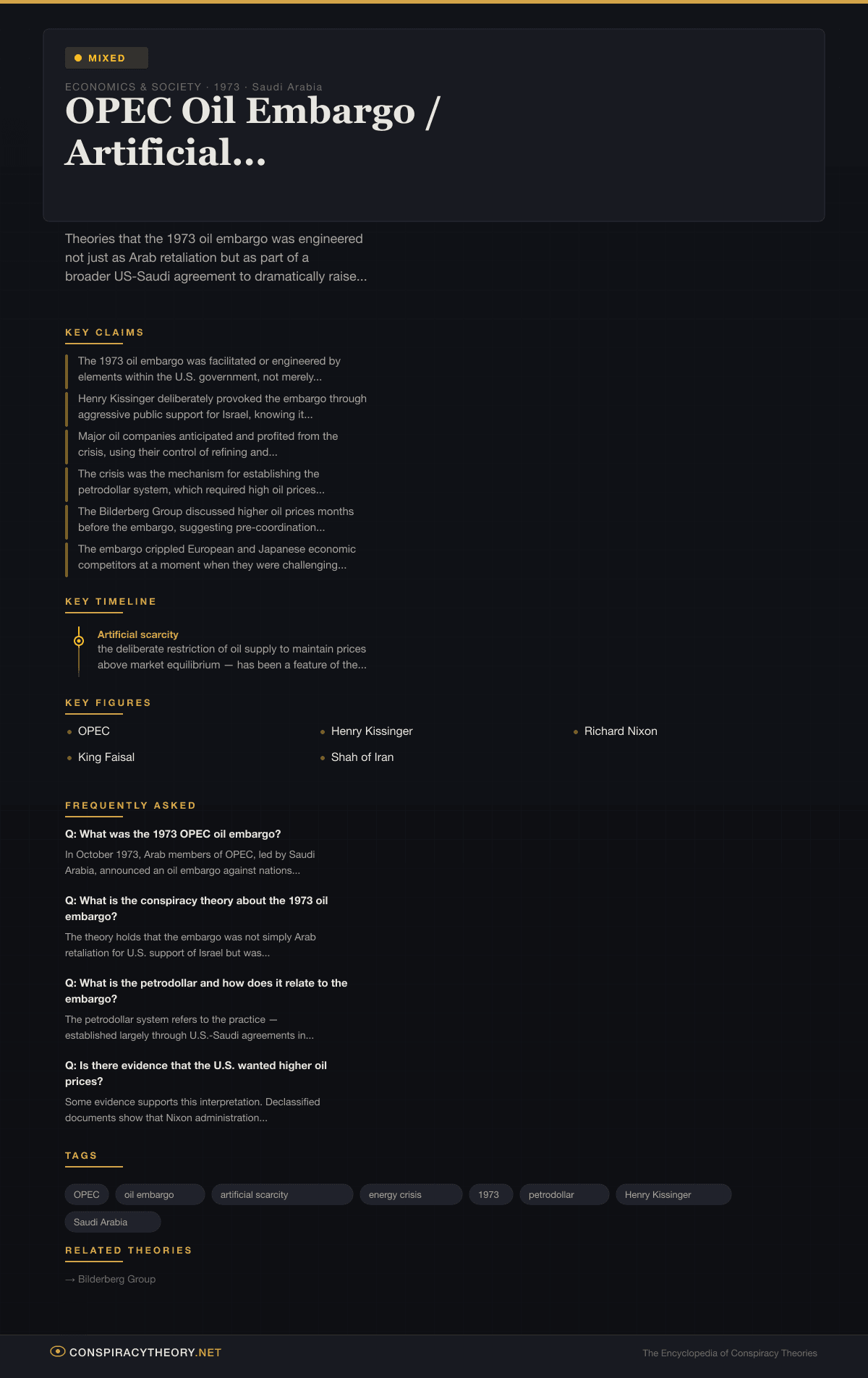
OPEC Oil Embargo / Artificial Scarcity Conspiracy
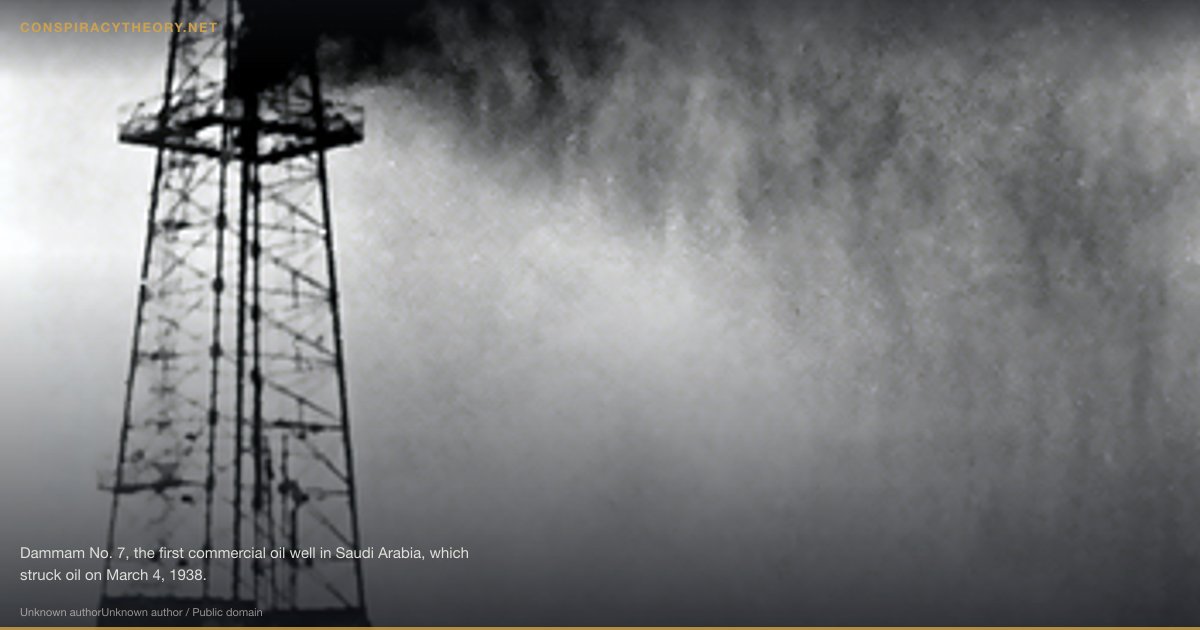
Overview
The official history of the 1973 oil crisis is straightforward enough: on October 6, 1973, Egypt and Syria launched a surprise attack on Israel — the Yom Kippur War. The United States airlifted emergency military supplies to Israel. In retaliation, Arab members of OPEC announced an oil embargo against the U.S. and other Israeli allies. Oil prices quadrupled. Americans lined up for hours at gas stations. The postwar economic order shuddered. And the modern era of energy geopolitics was born.
That is the textbook version, and it is not wrong. But it may not be complete.
A persistent alternative interpretation argues that the embargo was not a spontaneous act of geopolitical retaliation but something more calculated — a crisis that powerful actors on multiple sides either facilitated, encouraged, or deliberately failed to prevent because skyrocketing oil prices served their interests. In this reading, the 1973 crisis was the mechanism through which the global economy was restructured around the petrodollar, American debt was financed by Saudi oil revenues, major oil companies saw their profits multiply, and European and Japanese economic competitors were hobbled at a moment when they were threatening American industrial dominance.
This is not a theory that requires shadowy cabals meeting in smoke-filled rooms (though the Bilderberg Group, which met in May 1973, allegedly discussed oil pricing). It requires only the recognition that in geopolitics, the question “who benefits?” often reveals more than the question “who caused it?” — and that in the case of the 1973 oil crisis, the beneficiaries included some of the same people who claimed to be its victims.
Origins & History
The Pre-Embargo Landscape
To understand the conspiracy theory, you need to understand the oil market in 1972. Three features are critical:
Oil was cheap. Adjusted for inflation, oil in early 1973 cost roughly what it had cost in 1950. OPEC had been founded in 1960 specifically to resist downward pressure on prices from the major oil companies (the “Seven Sisters”), but for its first decade, the cartel had limited success. Western consumers treated cheap gas as a birthright.
The dollar was in trouble. In August 1971, Nixon had unilaterally ended the dollar’s convertibility to gold — the “Nixon Shock” — effectively destroying the Bretton Woods monetary system. The dollar was floating, declining in value, and losing its structural role in the international economy. The U.S. needed a new mechanism to support dollar demand. Oil — a commodity every nation needed and that was traded internationally — was the obvious candidate.
American oil production had peaked. In 1970, U.S. domestic oil production hit its all-time high and began declining — exactly as geologist M. King Hubbert had predicted in 1956. For the first time, the United States was becoming dependent on imported oil, primarily from the Middle East. This vulnerability was new, and the U.S. government knew it.
The Yom Kippur War and the Embargo
On October 6, 1973, Egyptian and Syrian forces attacked Israel. The timing — on the Jewish holy day of Yom Kippur — achieved tactical surprise. Israel was pushed back on two fronts before rallying.
The U.S. response was massive. Operation Nickel Grass airlifted over 22,000 tons of military equipment to Israel between October 14 and November 14, 1973. It was the largest American airlift operation since the Berlin Airlift.
On October 17, 1973, Arab OPEC members responded by announcing a 5% monthly production cut and a complete embargo against the United States and the Netherlands. On October 20, Saudi Arabia specifically embargoed the U.S. after Nixon requested $2.2 billion in emergency military aid to Israel. Oil prices began their dramatic ascent.
The Conspiracy Interpretation
Here is where the alternative narrative diverges from the textbook:
Kissinger’s alleged role: James Akins, who served as U.S. Ambassador to Saudi Arabia from 1973-75, later stated publicly that he believed Henry Kissinger had deliberately provoked the Arab embargo. Akins argued that Kissinger’s aggressive public support for Israel was calibrated to trigger an oil response — not because Kissinger cared about Israel per se, but because a price shock would serve broader U.S. strategic interests. Akins was recalled from his ambassadorship in 1975 under circumstances he attributed to retaliation for his views.
The oil companies’ windfall: The major oil companies — Exxon, Mobil, Texaco, Chevron, Gulf, BP, Shell — saw their profits explode during the crisis. Exxon’s 1973 profits were up 59% over 1972. Texaco’s rose 45%. These companies were not passive victims of the embargo; they controlled the refining and distribution infrastructure and had advance warning of supply disruptions. Senate investigations in 1974 raised questions about whether the companies had manipulated supply chains to exacerbate shortages.
The petrodollar system: In 1974, Treasury Secretary William Simon traveled to Saudi Arabia to negotiate what would become the petrodollar arrangement. Under the deal, Saudi Arabia agreed to price all oil exports in U.S. dollars and to invest surplus oil revenues in U.S. Treasury securities. In return, the U.S. guaranteed Saudi security. This agreement — which would not have been meaningful at $3/barrel oil but was enormously significant at $12/barrel — became the foundation of dollar hegemony for the next half-century. The conspiracy interpretation argues that this outcome was not a fortunate accident but the actual purpose of the crisis.
The Bilderberg connection: The Bilderberg Group met in Saltsjobaden, Sweden, in May 1973 — five months before the embargo. According to leaked participant notes (whose authenticity is disputed), attendees discussed the geopolitical implications of a dramatic oil price increase. Some researchers have interpreted this as evidence of pre-planning, though the discussion could equally reflect routine scenario analysis by international elites.
Key Claims
- The 1973 oil embargo was facilitated or engineered by elements within the U.S. government, not merely suffered as a consequence of Middle East policy
- Henry Kissinger deliberately provoked the embargo through aggressive public support for Israel, knowing it would trigger an Arab oil response that served broader U.S. interests
- Major oil companies anticipated and profited from the crisis, using their control of refining and distribution to exacerbate shortages and maximize revenue
- The crisis was the mechanism for establishing the petrodollar system, which required high oil prices to generate sufficient Saudi revenue to finance U.S. debt through Treasury purchases
- The Bilderberg Group discussed higher oil prices months before the embargo, suggesting pre-coordination among Western elites and oil producers
- The embargo crippled European and Japanese economic competitors at a moment when they were challenging U.S. industrial dominance, serving American interests disguised as an American hardship
- Artificial scarcity — the deliberate restriction of oil supply to maintain prices above market equilibrium — has been a feature of the oil industry ever since
Evidence
Supporting the Conspiracy Interpretation
James Akins’ testimony: Akins, a career diplomat who was the State Department’s top energy expert before becoming ambassador to Saudi Arabia, is the most credible insider to allege deliberate U.S. provocation. His claims are not based on documents but on his direct participation in policy discussions. His recall from Riyadh in 1975 — which he attributed to Kissinger’s displeasure — lends circumstantial credibility to his account.
Oil company profits: The profit explosion during the crisis is a matter of public record. Senate investigations documented that major oil companies had advance knowledge of supply disruptions and made strategic decisions that maximized their revenue during the shortage. Whether this constitutes conspiracy or normal business behavior is a matter of interpretation.
Declassified documents on petrodollar recycling: U.S. Treasury and State Department documents from the period show that officials quickly recognized the strategic value of high oil prices for dollar hegemony. The speed with which the Simon-Saudi agreement was reached suggests that the conceptual groundwork had been laid before the crisis.
OPEC’s own internal dynamics: Some OPEC historians have noted that King Faisal of Saudi Arabia was reluctant to impose the embargo and only did so under intense domestic and pan-Arab pressure. If the embargo was not in Saudi Arabia’s natural interests — and Saudi Arabia was already developing a close relationship with the United States — then the question of who actually drove the crisis becomes more complex.
Against the Conspiracy Interpretation
Occam’s Razor: The simplest explanation — that the embargo was a genuine reaction to U.S. military support for Israel, driven by Arab nationalist sentiment and inter-Arab political dynamics — explains the events without requiring secret coordination. Yom Kippur was a real war with real casualties. Arab anger was real.
Kissinger’s record suggests reaction, not planning: Declassified records of the Nixon administration’s response to the embargo show genuine alarm. If Kissinger planned the crisis, he was an extraordinarily convincing actor — and the administration’s scrambling response, including the humiliating lowering of highway speed limits to 55 mph, seems inconsistent with a controlled operation.
Multiple parties had to cooperate: For the conspiracy to work as described, it would require secret coordination between U.S. officials, Saudi royals, OPEC ministers, and major oil companies — each with different and often competing interests. The logistics of such coordination, while not impossible, strain plausibility.
Oil companies also faced risks: While major oil companies profited from high prices, the embargo also triggered the rise of OPEC as a geopolitical force, the development of non-OPEC production (North Sea, Alaska), and the first serious push for energy conservation — all developments that threatened long-term oil company interests.
Debunking / Verification
This theory is classified as mixed because:
Confirmed elements: Oil companies profited enormously. The petrodollar system was established as a direct consequence of the price increase. U.S. officials quickly recognized and exploited the strategic advantages of higher oil prices. Advance discussions about oil price scenarios occurred in elite forums.
Debunked elements: The strongest versions of the theory — that the embargo was entirely scripted, that Kissinger personally orchestrated it as a covert operation, that the Bilderberg Group pre-planned the crisis — lack the documentary evidence that would be required to support such extraordinary claims.
Unresolved elements: Whether U.S. officials passively allowed or actively encouraged the conditions that made the embargo possible; whether advance knowledge was acted upon for private profit; whether the speed of the petrodollar arrangement indicates pre-planning.
The truth likely lies in the murky territory between conspiracy and coincidence that characterizes much of geopolitics: powerful actors recognizing and exploiting a crisis without necessarily having engineered it from scratch.
Cultural Impact
The 1973 oil crisis permanently reshaped American culture and politics. The gas lines, the rationing, the 55 mph speed limit — these became iconic symbols of national vulnerability. The crisis ended the postwar assumption that cheap energy was a permanent condition and launched the modern environmental and energy independence movements.
The conspiracy interpretation has influenced several streams of political thought:
Petrodollar warfare theory: The idea that U.S. foreign policy is fundamentally driven by the need to maintain dollar-denominated oil pricing has been applied to subsequent events, including the Iraq War, the Libya intervention, and U.S. opposition to petroyuan proposals.
Resource nationalism: The theory reinforced the belief in producer nations that Western powers manipulate commodity markets for geopolitical advantage, fueling resource nationalism from Venezuela to Russia.
Anti-corporate populism: The documented oil company profits during the crisis became foundational evidence for the argument that major corporations benefit from — and therefore have incentives to create — supply disruptions and crises.
The 1973 crisis also spawned a permanent genre of energy conspiracy theorizing, encompassing claims about suppressed alternative energy technologies, artificial scarcity, and the deliberate maintenance of fossil fuel dependence.
Timeline
| Date | Event |
|---|---|
| August 1971 | Nixon ends dollar-gold convertibility; Bretton Woods system collapses |
| 1970 | U.S. domestic oil production peaks |
| May 1973 | Bilderberg Group meets in Sweden; oil pricing allegedly discussed |
| October 6, 1973 | Yom Kippur War begins; Egypt and Syria attack Israel |
| October 14, 1973 | U.S. begins Operation Nickel Grass — massive arms airlift to Israel |
| October 17, 1973 | Arab OPEC members announce 5% monthly production cuts and embargo |
| October 20, 1973 | Saudi Arabia embargoes U.S. after Nixon requests $2.2 billion Israel aid |
| November 1973 | Oil prices reach $12/barrel, up from $3 before the crisis |
| January 1974 | Nixon signs Emergency Highway Energy Conservation Act (55 mph speed limit) |
| March 1974 | Arab oil embargo officially ends |
| 1974 | Treasury Secretary William Simon negotiates petrodollar arrangement with Saudi Arabia |
| 1974 | Senate investigations into oil company profits and supply manipulation begin |
| 1975 | Ambassador James Akins recalled from Saudi Arabia |
| 1979 | Second oil crisis reinforces patterns established in 1973 |
Sources & Further Reading
- Yergin, Daniel. The Prize: The Epic Quest for Oil, Money & Power. Free Press, 1991.
- Engdahl, F. William. A Century of War: Anglo-American Oil Politics and the New World Order. Pluto Press, 2004.
- Akins, James. Various interviews and public statements on the 1973 crisis.
- Bronson, Rachel. Thicker Than Oil: America’s Uneasy Partnership with Saudi Arabia. Oxford University Press, 2006.
- Spiro, David. The Hidden Hand of American Hegemony: Petrodollar Recycling and International Markets. Cornell University Press, 1999.
- U.S. Senate Permanent Subcommittee on Investigations. “Investigation of the Petroleum Industry.” 1974.
- Painter, David. “Oil and the American Century.” Journal of American History 99, no. 1 (2012): 24-39.
Related Theories
- Petrodollar Warfare — The theory that U.S. military interventions are driven by defense of dollar-denominated oil pricing
- Bilderberg Group — The secretive elite forum allegedly connected to pre-embargo oil price discussions
- Peak Oil Suppression — Theories about deliberate manipulation of energy supply and pricing
Frequently Asked Questions
What was the 1973 OPEC oil embargo?
What is the conspiracy theory about the 1973 oil embargo?
What is the petrodollar and how does it relate to the embargo?
Is there evidence that the U.S. wanted higher oil prices?
Infographic
Share this visual summary. Right-click to save.