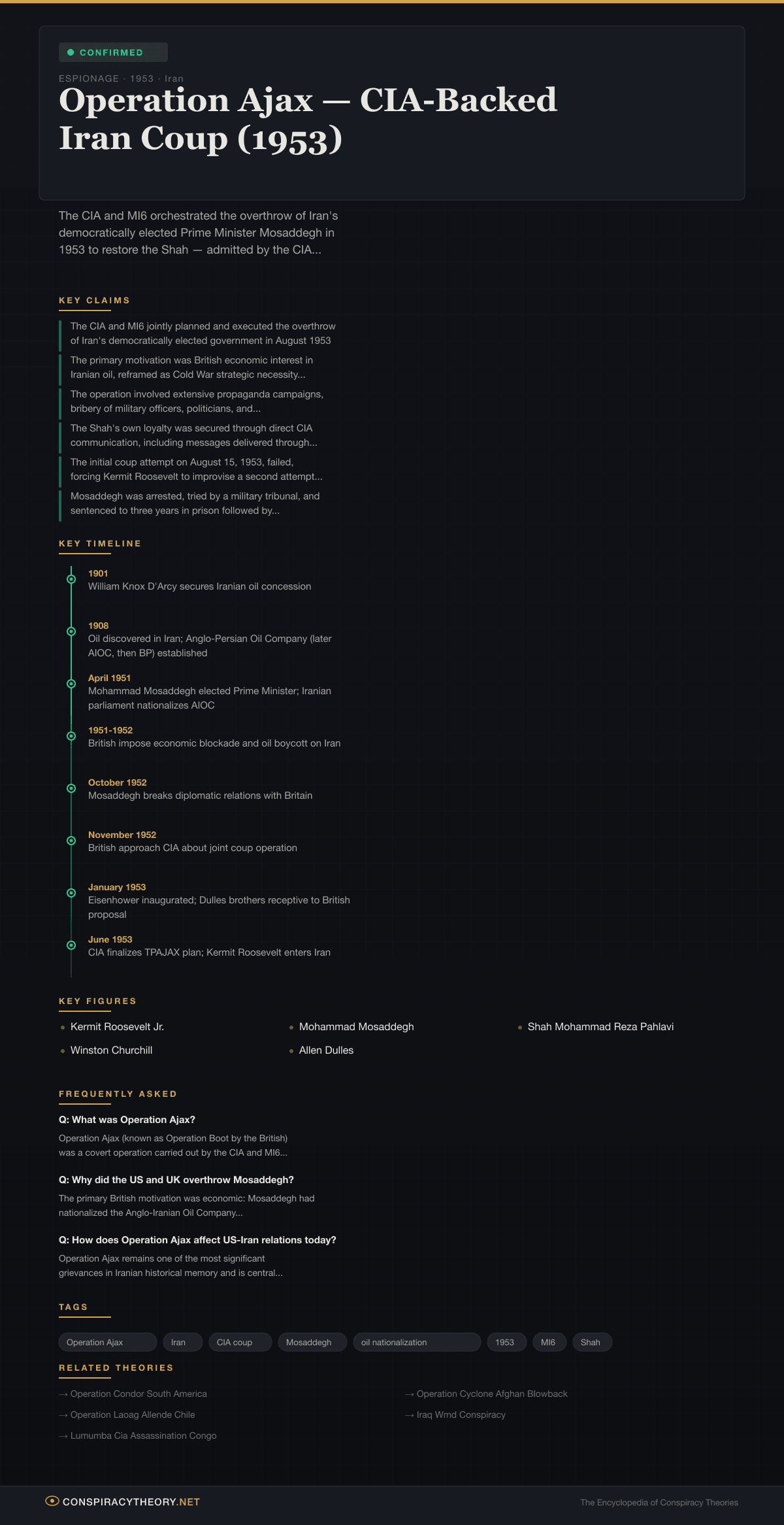
Operation Ajax — CIA-Backed Iran Coup (1953)
Overview
Operation Ajax stands as one of the most consequential and well-documented covert operations in modern history. In August 1953, the Central Intelligence Agency and Britain’s Secret Intelligence Service (MI6) orchestrated the overthrow of Iran’s democratically elected Prime Minister Mohammad Mosaddegh, replacing him with the authoritarian rule of Shah Mohammad Reza Pahlavi. The coup was motivated primarily by Mosaddegh’s nationalization of Iran’s oil industry, which threatened British petroleum interests, and was justified to the American public under Cold War rhetoric about preventing communist expansion.
For decades, the US and British governments denied involvement in the coup, and those who claimed foreign interference were dismissed as conspiracy theorists or anti-Western propagandists. The truth emerged gradually through investigative journalism, academic research, and eventually the declassification of government documents. In 2013, the CIA publicly acknowledged its role for the first time through the release of previously classified internal histories. Additional documents released in 2017 provided further detail about the operation’s planning and execution.
Operation Ajax is classified as confirmed — it is a documented historical fact, acknowledged by the governments that carried it out. Its significance extends far beyond the events of August 1953. The coup destroyed Iran’s experiment with democratic governance, installed an authoritarian regime whose repression would fuel the 1979 Islamic Revolution, and set in motion a chain of events that continues to shape Middle Eastern geopolitics, US-Iran relations, and global perceptions of American foreign policy.
Origins & History
The roots of Operation Ajax lie in Iran’s oil. In 1901, British entrepreneur William Knox D’Arcy had secured a concession from the Iranian government granting near-exclusive rights to Iranian petroleum. This concession eventually became the Anglo-Iranian Oil Company (AIOC) — now known as BP — which controlled Iran’s enormous oil wealth while paying the Iranian government a small fraction of the revenue. By the late 1940s, Iranian resentment of this arrangement had become a potent political force.
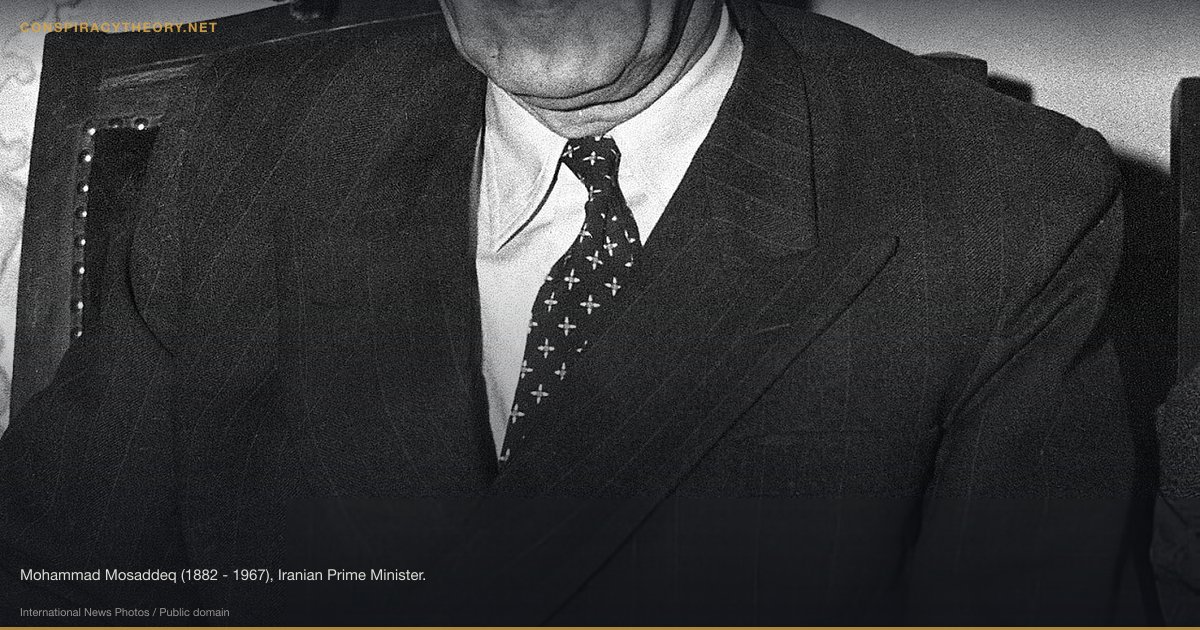
Mohammad Mosaddegh, a Swiss-educated lawyer and landowner, emerged as the champion of oil nationalization. Elected to Iran’s parliament (Majlis) and appointed Prime Minister in April 1951, Mosaddegh moved swiftly to nationalize the AIOC, declaring Iran’s sovereign right to control its own natural resources. The nationalization was wildly popular in Iran, making Mosaddegh one of the most beloved political figures in the country’s history.
The British government, led by Winston Churchill, responded with fury. Britain imposed a devastating economic blockade on Iran, organized a global boycott of Iranian oil, froze Iranian assets, and threatened military intervention. When the International Court of Justice ruled it had no jurisdiction over the dispute, and the UN Security Council declined to act, Britain turned to covert action.
The British intelligence service MI6 developed a plan for Mosaddegh’s overthrow, code-named Operation Boot. However, the British had been expelled from Iran after Mosaddegh closed their embassy, leaving them unable to execute the operation alone. They approached the Truman administration for support, but President Truman, sympathetic to Iranian nationalism and wary of colonial adventures, declined.
The election of Dwight D. Eisenhower in January 1953 changed the calculation. Eisenhower’s Secretary of State, John Foster Dulles, and CIA Director Allen Dulles (John Foster’s brother) were receptive to the British pitch, particularly when it was reframed in Cold War terms. The argument that a weakened Mosaddegh government might fall to the Tudeh Party (Iran’s communist party) and bring Iran into the Soviet sphere proved persuasive, despite limited evidence that this was a realistic scenario.
The CIA designated the operation TPAJAX — shortened in common usage to Operation Ajax. Kermit Roosevelt Jr., the grandson of President Theodore Roosevelt and a veteran CIA officer, was appointed to lead the operation from inside Iran.
Key Claims
As a confirmed operation, the claims are established facts:
- The CIA and MI6 jointly planned and executed the overthrow of Iran’s democratically elected government in August 1953
- The primary motivation was British economic interest in Iranian oil, reframed as Cold War strategic necessity to secure American participation
- The operation involved extensive propaganda campaigns, bribery of military officers, politicians, and religious leaders, organization of street mobs, and coordination with pro-Shah military elements
- The Shah’s own loyalty was secured through direct CIA communication, including messages delivered through his twin sister, Princess Ashraf
- The initial coup attempt on August 15, 1953, failed, forcing Kermit Roosevelt to improvise a second attempt on August 19, which succeeded
- Mosaddegh was arrested, tried by a military tribunal, and sentenced to three years in prison followed by house arrest until his death in 1967
- The restored Shah implemented increasingly authoritarian rule, backed by SAVAK (the CIA-trained secret police), leading to the conditions that produced the 1979 Islamic Revolution
Evidence
The evidence for Operation Ajax is comprehensive and comes from multiple independent sources:
Declassified documents: The CIA’s internal history of the operation, written by Donald Wilber in 1954, was leaked to The New York Times in 2000 and officially declassified in 2014. Additional documents released through the State Department’s Foreign Relations of the United States (FRUS) series in 2017 provided extensive detail about the operation’s planning, including the decision-making process within the Eisenhower administration.
CIA acknowledgment: In August 2013, the CIA publicly acknowledged its role in the coup for the first time, releasing documents through the National Security Archive at George Washington University. The agency’s statement confirmed its central role in organizing and executing the overthrow.
British government records: British government documents, including Cabinet minutes and Foreign Office correspondence, have confirmed MI6’s role in planning the operation and persuading the Americans to participate. These records detail the economic motivations behind the British push for regime change.
Participant accounts: Kermit Roosevelt published his account of the operation in Countercoup: The Struggle for the Control of Iran (1979). While self-serving in some respects, his account provides firsthand detail about the operation’s execution that has been largely corroborated by declassified documents.
Academic research: Historians including Ervand Abrahamian, Mark Gasiorowski, and Malcolm Byrne have conducted extensive archival research that has filled in details not covered by official declassifications. Abrahamian’s The Coup: 1953, the CIA, and the Roots of Modern U.S.-Iranian Relations (2013) provides perhaps the most comprehensive account.
Debunking / Verification
Confirmed in every significant detail: The CIA and MI6 organized and executed the coup. The primary motivation was oil. The operation involved propaganda, bribery, and organized violence. Mosaddegh was overthrown and the Shah was restored to power. The consequences included decades of authoritarian rule and ultimately the Islamic Revolution.
Debated: Some historians debate the relative weight of British economic interests versus genuine American Cold War concerns in motivating US participation. Others debate whether the coup would have succeeded without CIA involvement — whether internal Iranian opposition to Mosaddegh was sufficient to produce regime change independently. The extent of Soviet intent to exploit the situation remains uncertain.
Legacy acknowledged: In 2000, Secretary of State Madeleine Albright acknowledged the US role in the coup, stating: “The Eisenhower administration believed its actions were justified for strategic reasons. But the coup was clearly a setback for Iran’s political development. And it is easy to see now why many Iranians continue to resent this intervention by America in their internal affairs.”
Cultural Impact
Operation Ajax has had an enormous and lasting impact on international relations, regional politics, and public understanding of covert action.
In Iran, the 1953 coup is a defining event in national consciousness. It is a central element of the Iranian government’s narrative about Western imperialism and a key justification for the Islamic Republic’s anti-American posture. The coup is taught in Iranian schools, commemorated in public discourse, and remains a living grievance that shapes political attitudes toward the United States.
In the United States and globally, Operation Ajax has become a case study in the unintended consequences of covert regime change. It is frequently cited alongside operations in Guatemala (1954), Chile (1973), and other countries as evidence of a pattern of American intervention that destabilized democratic governments for economic and strategic purposes.
The operation fundamentally shaped the trajectory of the Middle East. The Shah’s increasingly autocratic rule, his reliance on the SAVAK secret police, his modernization programs that alienated both traditional and leftist constituencies, and his close alignment with the United States all contributed to the revolutionary conditions that produced the 1979 Islamic Revolution, the hostage crisis, and the emergence of the Islamic Republic as a major regional power hostile to American interests.
The case is also frequently cited in debates about intelligence accountability, congressional oversight of covert operations, and the relationship between democratic governance and foreign policy. The fact that the operation was conducted without public knowledge or congressional authorization helped fuel the reforms of the 1970s, including the creation of permanent congressional intelligence oversight committees.
Timeline
- 1901 — William Knox D’Arcy secures Iranian oil concession
- 1908 — Oil discovered in Iran; Anglo-Persian Oil Company (later AIOC, then BP) established
- April 1951 — Mohammad Mosaddegh elected Prime Minister; Iranian parliament nationalizes AIOC
- 1951-1952 — British impose economic blockade and oil boycott on Iran
- October 1952 — Mosaddegh breaks diplomatic relations with Britain
- November 1952 — British approach CIA about joint coup operation
- January 1953 — Eisenhower inaugurated; Dulles brothers receptive to British proposal
- June 1953 — CIA finalizes TPAJAX plan; Kermit Roosevelt enters Iran
- August 15, 1953 — First coup attempt fails; Shah flees to Baghdad, then Rome
- August 19, 1953 — Second coup attempt succeeds; pro-Shah military and organized mobs seize control; Mosaddegh arrested
- August 22, 1953 — Shah returns to Tehran
- 1953-1979 — Shah rules with increasingly authoritarian methods, backed by SAVAK
- 1967 — Mosaddegh dies under house arrest
- 1979 — Islamic Revolution overthrows the Shah; Iran hostage crisis begins
- 2000 — CIA internal history leaked to the New York Times
- 2000 — Secretary Albright acknowledges US role
- 2013 — CIA publicly acknowledges its role in the coup
- 2017 — State Department releases additional declassified documents through FRUS series
Sources & Further Reading
- Abrahamian, Ervand. The Coup: 1953, the CIA, and the Roots of Modern U.S.-Iranian Relations. The New Press, 2013
- Kinzer, Stephen. All the Shah’s Men: An American Coup and the Roots of Middle East Terror. John Wiley & Sons, 2003
- Gasiorowski, Mark J., and Malcolm Byrne, eds. Mohammad Mosaddeq and the 1953 Coup in Iran. Syracuse University Press, 2004
- Roosevelt, Kermit. Countercoup: The Struggle for the Control of Iran. McGraw-Hill, 1979
- Wilber, Donald N. “Overthrow of Premier Mossadeq of Iran.” CIA Clandestine Service History, 1954 (declassified 2014)
- National Security Archive. “The CIA Confirms Role in 1953 Iran Coup.” George Washington University, 2013
- De Bellaigue, Christopher. Patriot of Persia: Muhammad Mossadegh and a Tragic Anglo-American Coup. Harper, 2012
Frequently Asked Questions
What was Operation Ajax?
Why did the US and UK overthrow Mosaddegh?
How does Operation Ajax affect US-Iran relations today?
Infographic
Share this visual summary. Right-click to save.