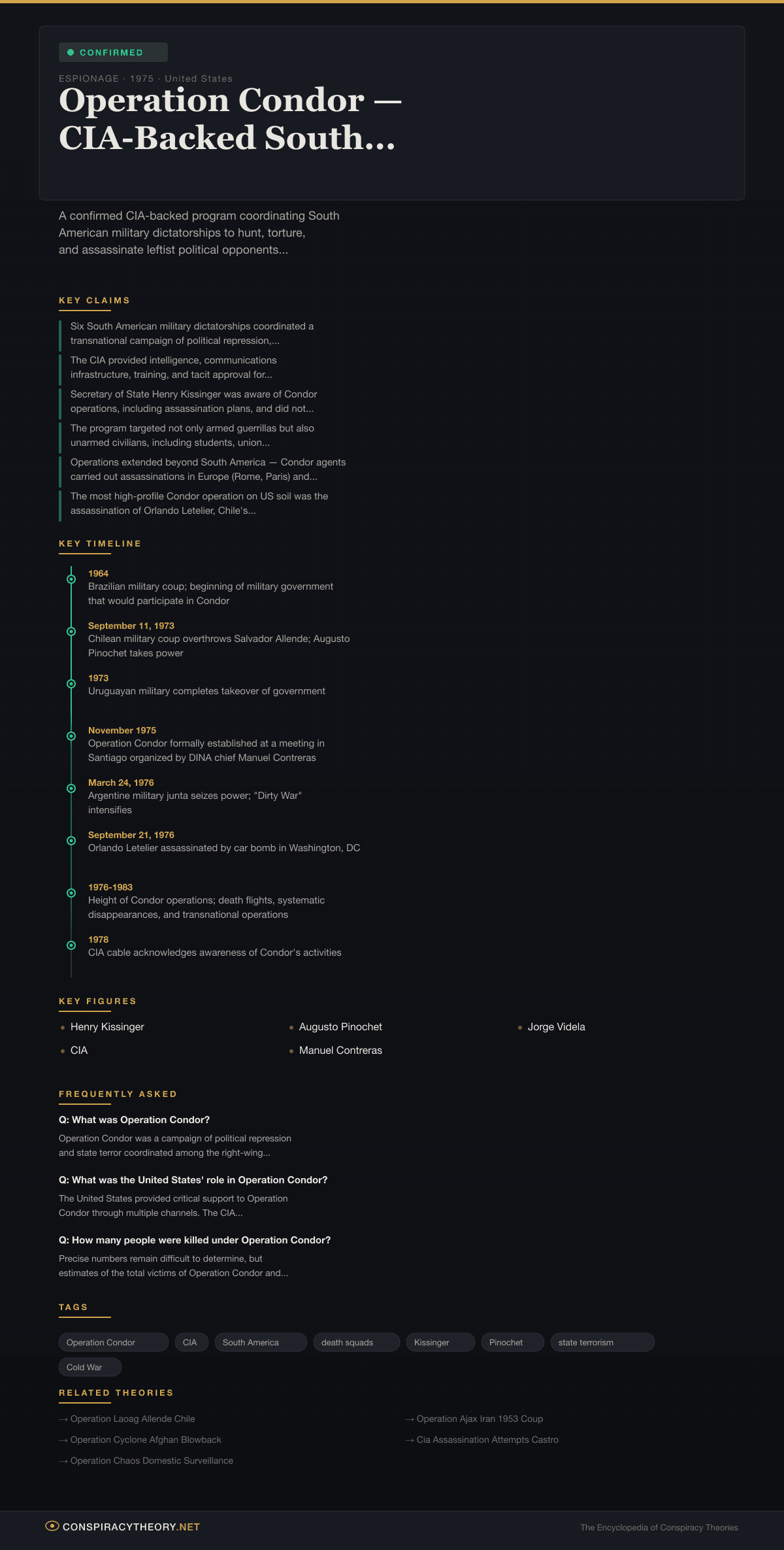
Operation Condor — CIA-Backed South American Death Squads
Overview
Operation Condor was a covert campaign of state-sponsored terror coordinating the intelligence services of six South American military dictatorships — Argentina, Bolivia, Brazil, Chile, Paraguay, and Uruguay — to track, kidnap, torture, and assassinate political opponents across national borders. Formally established in November 1975 and active through the early 1980s, the operation represented an unprecedented transnational system of political repression that claimed an estimated 60,000 or more lives, disappeared tens of thousands more, and imprisoned hundreds of thousands.
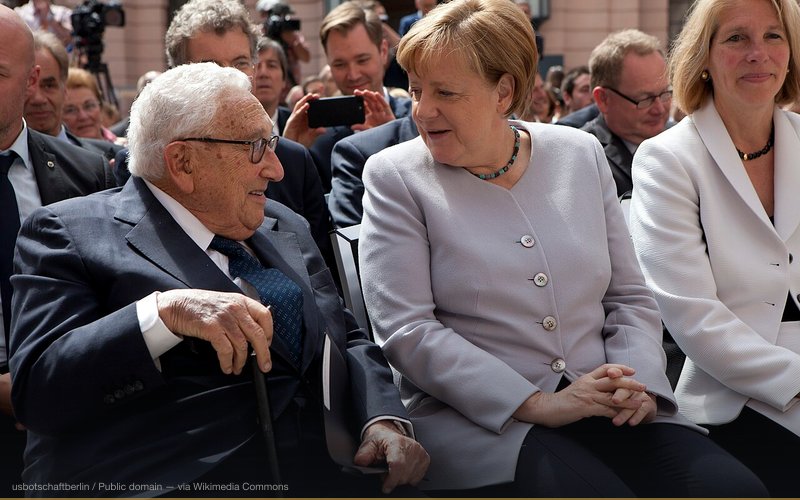
The operation is confirmed in every significant detail. Declassified US government documents, the discovery of the “Archive of Terror” in Paraguay in 1992, the testimony of participants and survivors, and the verdicts of courts in multiple countries have established the program’s existence, its methods, and the involvement of the United States. The CIA provided intelligence, communications infrastructure, training, and tacit approval. Secretary of State Henry Kissinger was aware of the program and, according to declassified documents, took no action to prevent it — and in some cases actively encouraged the participating regimes.
Operation Condor is significant not only for its immediate human toll but as a case study in how Cold War ideology was used to justify the systematic violation of human rights on a continental scale. It demonstrates the capacity of ostensibly democratic governments to support and enable authoritarian repression abroad when such repression serves perceived strategic interests.
Origins & History
Operation Condor’s origins lie in the Cold War struggle for influence in Latin America. Following the Cuban Revolution of 1959, the United States became increasingly concerned about the spread of leftist movements across the hemisphere. The Kennedy administration launched the Alliance for Progress, combining economic development with military and police training aimed at countering communist influence. Simultaneously, the US military established the School of the Americas (later renamed the Western Hemisphere Institute for Security Cooperation) at Fort Benning, Georgia, where it trained thousands of Latin American military officers in counterinsurgency techniques.
By the early 1970s, a wave of right-wing military coups had installed authoritarian regimes across South America. Brazil’s military had seized power in 1964. Bolivia experienced a right-wing coup in 1971. Chile’s Salvador Allende was overthrown in 1973 and replaced by General Augusto Pinochet. Uruguay’s civilian government fell to a military-backed coup in 1973. Argentina would fall to a military junta in 1976.
These regimes faced a common challenge: leftist opposition movements that could flee across borders to organize in exile. A Chilean dissident who escaped to Argentina, an Argentine guerrilla who sought refuge in Brazil, or a Uruguayan union leader who fled to Paraguay could continue opposing the regime from relative safety. This cross-border mobility frustrated the ambitions of national security services accustomed to operating within their own territories.
The formal establishment of Operation Condor occurred at a meeting in Santiago, Chile, in November 1975. The meeting was organized by Colonel Manuel Contreras, the head of Chile’s Direccion de Inteligencia Nacional (DINA), Pinochet’s feared secret police. Representatives of Argentina, Bolivia, Brazil, Chile, Paraguay, and Uruguay agreed to a system of cooperation that would enable their intelligence services to operate across borders — sharing intelligence, coordinating surveillance, and carrying out joint operations including kidnapping and assassination.
The CIA played a crucial supporting role. Declassified documents reveal that the agency provided communications equipment, including the Condortel telex network that enabled participating services to coordinate operations securely. CIA officers maintained relationships with intelligence chiefs in all participating countries. The US military continued its training programs through the School of the Americas, where curricula included interrogation techniques, psychological operations, and methods of handling “subversive” populations.
Key Claims
As a confirmed program, the following are established facts:
- Six South American military dictatorships coordinated a transnational campaign of political repression, including surveillance, kidnapping, torture, and assassination across borders
- The CIA provided intelligence, communications infrastructure, training, and tacit approval for the program
- Secretary of State Henry Kissinger was aware of Condor operations, including assassination plans, and did not act to prevent them
- The program targeted not only armed guerrillas but also unarmed civilians, including students, union leaders, journalists, priests, lawyers, and family members of suspected dissidents
- Operations extended beyond South America — Condor agents carried out assassinations in Europe (Rome, Paris) and in the United States (Washington, DC)
- The most high-profile Condor operation on US soil was the assassination of Orlando Letelier, Chile’s former ambassador, by a car bomb on Embassy Row in Washington, DC, on September 21, 1976
- Systematic practices included forced disappearance, torture, “death flights” (in which prisoners were drugged and thrown from aircraft into the ocean), theft of detainees’ children (given to military families), and the use of secret detention centers
- An estimated 60,000+ people were killed, 30,000 disappeared, and 400,000 imprisoned under Condor and associated regime repression
Evidence
The Archive of Terror: In December 1992, Paraguayan judge Jose Agustin Fernandez and human rights activist Martin Almada discovered the so-called “Archive of Terror” — nearly four tons of documents from Paraguay’s secret police stored in a police station in Lambare, a suburb of Asuncion. The archive contained detailed records of Operation Condor, including lists of prisoners, records of interrogations, correspondence between the participating intelligence services, and documentation of the international coordination of repression. This single discovery provided documentary proof of the program’s existence and methods.
Declassified US documents: Through FOIA requests and deliberate declassification initiatives (including the Clinton-era Chile Declassification Project), thousands of pages of US government documents have been released. These include CIA cables, State Department correspondence, NSC memoranda, and embassy reports that document US awareness of and involvement in Condor operations. A 1978 CIA cable identified Condor as a “cooperative effort by the intelligence/security services of several South American countries to combat terrorism and subversion” and noted that “the activities of Condor are of interest to the United States.”
The Letelier assassination: The September 21, 1976 car bombing in Washington, DC, that killed former Chilean ambassador Orlando Letelier and his American colleague Ronni Moffitt was traced to DINA agents operating under Condor. The investigation, conducted by the FBI, led to the conviction of DINA operative Michael Townley and Cuban exile anti-Castro militants. The case provided direct evidence of Condor’s operational reach extending to the US capital.
Court proceedings: Courts in Argentina, Chile, Italy, and France have prosecuted Condor participants. In May 2016, an Argentine court convicted fifteen former military and intelligence officers for their roles in Operation Condor, formally establishing the program’s criminal nature in judicial proceedings. In Italy, courts convicted South American officials in absentia for the disappearance and murder of Italian citizens under Condor.
Survivor testimony: Thousands of survivors have provided testimony through truth commissions, court proceedings, and human rights organizations. Argentina’s National Commission on the Disappearance of Persons (CONADEP, 1984), Chile’s Rettig Commission (1991) and Valech Commission (2004), and similar bodies in other countries have compiled extensive records of testimony documenting Condor’s practices.
Debunking / Verification
Confirmed in every significant detail: The existence of Operation Condor, its transnational coordination, its methods (including forced disappearance, torture, and assassination), and the involvement of the United States are all established facts supported by multiple independent evidence sources: the Archive of Terror, declassified US documents, court proceedings, and survivor testimony.
Debated: The precise extent of US responsibility remains contested. Some historians argue that the US was the primary organizer and driving force behind Condor, while others characterize the US role as supportive but not directive — that the South American regimes would have coordinated repression regardless of US involvement. The degree of Kissinger’s personal knowledge and approval of specific operations remains a matter of interpretation of declassified documents, as does the question of whether the US could have prevented the program’s worst excesses had it chosen to do so.
Ongoing accountability: Legal proceedings continue in multiple countries. The question of whether Henry Kissinger should face prosecution for his role in Condor and related operations has been raised by human rights organizations and legal scholars, though no prosecution has been initiated.
Cultural Impact
Operation Condor has had profound and lasting effects on South American societies, politics, and culture. The trauma of the disappearances, torture, and state terror continues to shape political discourse, artistic expression, and social movements across the continent.
In Argentina, the Mothers of the Plaza de Mayo — mothers and grandmothers of the disappeared who marched weekly in Buenos Aires’s central plaza demanding information about their children — became one of the world’s most recognized human rights movements. The Grandmothers of the Plaza de Mayo have dedicated decades to identifying children stolen from detained parents and given to military families, using DNA testing to reunite families separated by state terror.
The cultural impact extends to literature, film, and music. Works including the films The Official Story (1985, Argentina), Machuca (2004, Chile), and No (2012, Chile), novels by authors like Isabel Allende and Roberto Bolano, and musical traditions of protest and memory have processed the trauma of the Condor era.
Operation Condor has also shaped global human rights law and practice. The prosecution of former Condor participants has established legal precedents for holding state officials accountable for systematic human rights violations. The concept of “universal jurisdiction” — the principle that certain crimes against humanity can be prosecuted by any nation regardless of where they occurred — has been strengthened by Condor-related cases, including the landmark arrest of Pinochet in London in 1998 on a Spanish extradition request.
Timeline
- 1964 — Brazilian military coup; beginning of military government that would participate in Condor
- September 11, 1973 — Chilean military coup overthrows Salvador Allende; Augusto Pinochet takes power
- 1973 — Uruguayan military completes takeover of government
- November 1975 — Operation Condor formally established at a meeting in Santiago organized by DINA chief Manuel Contreras
- March 24, 1976 — Argentine military junta seizes power; “Dirty War” intensifies
- September 21, 1976 — Orlando Letelier assassinated by car bomb in Washington, DC
- 1976-1983 — Height of Condor operations; death flights, systematic disappearances, and transnational operations
- 1978 — CIA cable acknowledges awareness of Condor’s activities
- 1983 — Argentine military junta falls; transition to democracy begins
- 1984 — CONADEP report Nunca Mas (“Never Again”) documents Argentine disappearances
- 1985 — Trial of the Juntas in Argentina; military commanders convicted
- 1988 — Chilean plebiscite rejects Pinochet’s continuation in power
- 1991 — Chile’s Rettig Commission documents over 3,000 killed or disappeared
- 1992 — Archive of Terror discovered in Paraguay
- October 1998 — Pinochet arrested in London on Spanish extradition warrant
- 1999-2000 — Clinton-era Chile Declassification Project releases thousands of documents
- May 2016 — Argentine court convicts fifteen former officials for Operation Condor crimes
- 2023 — Legal proceedings and identification of the disappeared continue
Sources & Further Reading
- McSherry, J. Patrice. Predatory States: Operation Condor and Covert War in Latin America. Rowman & Littlefield, 2005
- Dinges, John. The Condor Years: How Pinochet and His Allies Brought Terrorism to Three Continents. The New Press, 2004
- Kornbluh, Peter. The Pinochet File: A Declassified Dossier on Atrocity and Accountability. The New Press, 2003
- National Security Archive. “Operation Condor: Cable Suggests US Role.” George Washington University
- CONADEP. Nunca Mas: Report of the Argentine National Commission on the Disappeared. 1984
- Grandin, Greg. The Last Colonial Massacre: Latin America in the Cold War. University of Chicago Press, 2004
- Documentary: The Condor Trials. Various television broadcasts documenting the legal proceedings
- Hitchens, Christopher. The Trial of Henry Kissinger. Verso, 2001
Frequently Asked Questions
What was Operation Condor?
What was the United States' role in Operation Condor?
How many people were killed under Operation Condor?
Infographic
Share this visual summary. Right-click to save.