Operation Highjump — Secret Nazi Battle
Overview
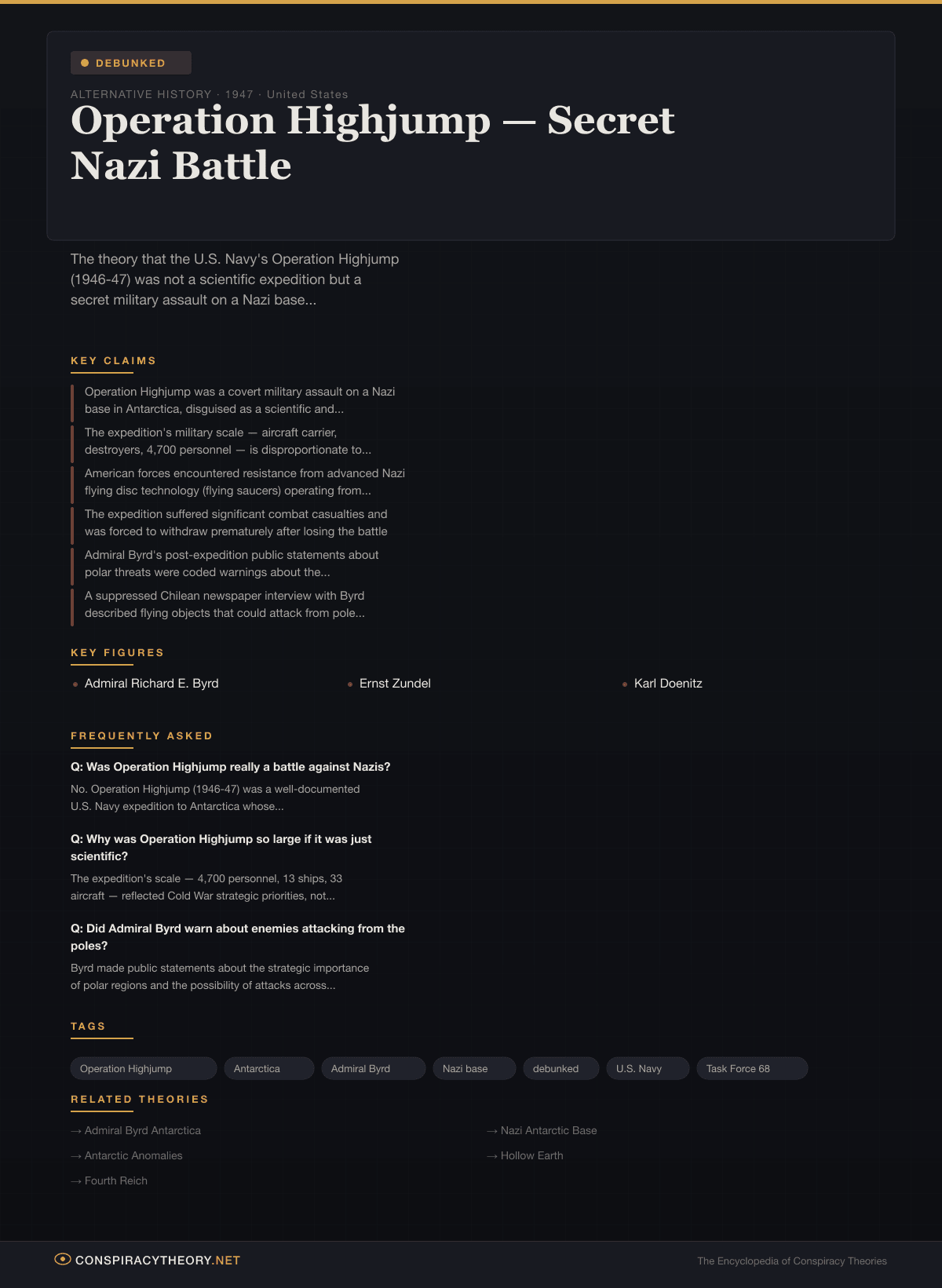
The theory that the U.S. Navy’s Operation Highjump (1946-47) was not a scientific expedition but a secret military assault on a Nazi base in Antarctica, allegedly repelled by advanced German technology.
Origins & History
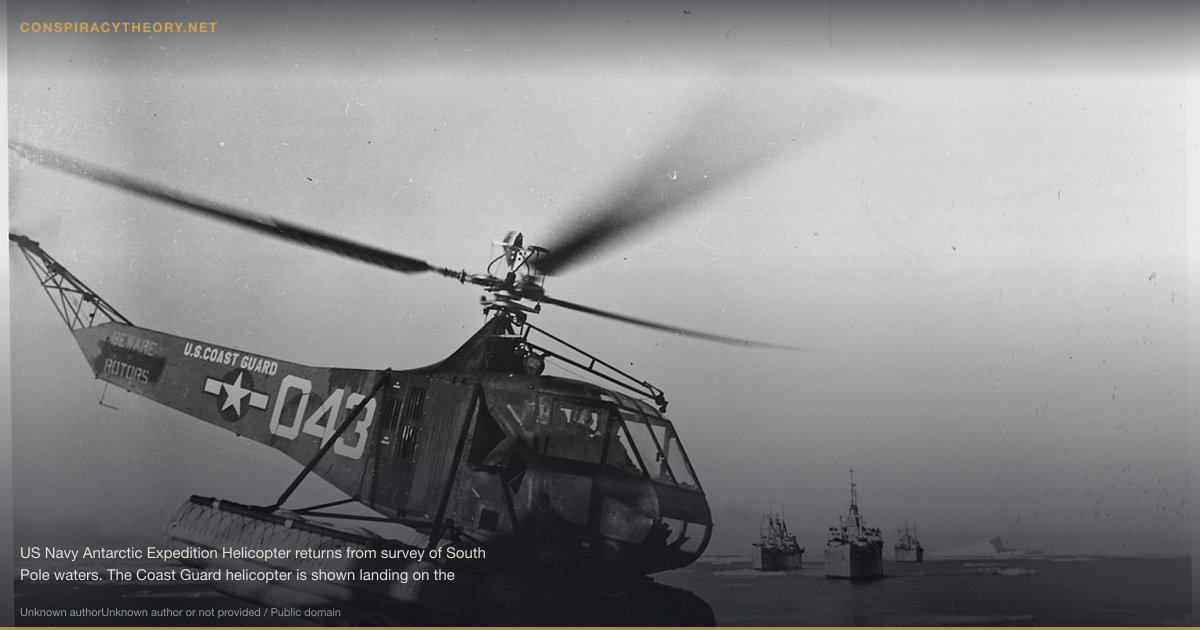
Operation Highjump, officially designated United States Navy Antarctic Developments Program and classified as Task Force 68, launched from Norfolk, Virginia in December 1946 under the overall command of Rear Admiral Richard H. Cruzen, with Rear Admiral Richard E. Byrd serving as officer in charge of the project. The expedition was unprecedented in scale: 4,700 men, 13 ships (including the aircraft carrier USS Philippine Sea), and 33 aircraft. Its stated objectives were to establish the Antarctic research base Little America IV, test military equipment and personnel in polar conditions, train for potential Cold War operations in extreme environments, and extend American sovereignty claims.
The expedition operated for approximately eight weeks, from late December 1946 to late February 1947. Its primary accomplishment was an extensive aerial photographic survey: aircraft flew mapping missions over approximately 60,000 square miles of Antarctic coastline and interior, producing roughly 70,000 photographs. The operation ended ahead of schedule when approaching Antarctic winter made flight operations dangerous. A PBM Mariner flying boat designated George 1 crashed on December 30, 1946, killing three of its nine crew members — the expedition’s only fatalities.
The conspiracy narrative emerged gradually. In the immediate postwar years, there was no public claim that Highjump had encountered enemy forces. The reinterpretation began in the 1960s and 1970s, primarily in neo-Nazi and esoteric literature. Ernst Zundel’s 1974 book UFOs: Nazi Secret Weapon? (published under the pseudonym Christof Friedrich) was among the first to explicitly claim that Operation Highjump was a military assault on a surviving Nazi base in Queen Maud Land, and that the expedition’s early termination reflected a defeat inflicted by advanced German flying disc technology.
The narrative was elaborated by subsequent authors who added details from various sources: a supposed Chilean newspaper interview with Byrd (whose authenticity has never been verified from Chilean press archives) in which he allegedly warned of “flying objects” that could traverse pole to pole at incredible speeds; the misinterpretation of Byrd’s legitimate Cold War public statements about polar strategic vulnerability; and the gradual merging of the Antarctic base legend with hollow Earth theory and UFO lore.
By the internet era, the story had crystallized into a dramatic combat narrative: American forces attacked the Nazi base, were met with flying saucers and advanced weapons, suffered significant casualties, and retreated. This version bears no resemblance to any documented account from expedition participants, Navy records, or contemporary press coverage.
Key Claims
- Operation Highjump was a covert military assault on a Nazi base in Antarctica, disguised as a scientific and training expedition
- The expedition’s military scale — aircraft carrier, destroyers, 4,700 personnel — is disproportionate to any scientific purpose and reveals its true combat mission
- American forces encountered resistance from advanced Nazi flying disc technology (flying saucers) operating from the base
- The expedition suffered significant combat casualties and was forced to withdraw prematurely after losing the battle
- Admiral Byrd’s post-expedition public statements about polar threats were coded warnings about the Nazi adversary, not Cold War rhetoric about the Soviets
- A suppressed Chilean newspaper interview with Byrd described flying objects that could attack from pole to pole at high speed
- The expedition’s early termination was caused by military defeat, not weather or logistical difficulties
- The failure of Highjump to destroy the Nazi base led directly to the Antarctic Treaty of 1959, which sealed the continent from public scrutiny
Evidence
The evidence against the Operation Highjump battle narrative is comprehensive and comes from multiple independent documentary sources.
The expedition’s official records are held at the National Archives and Records Administration (Record Group 313) and are available to researchers. They document an aerial survey and training operation. Daily reports, flight logs, photographic indexes, meteorological records, and personnel reports describe routine operations, equipment testing, and the cartographic work that was the expedition’s primary output. There are no combat reports, no descriptions of enemy encounters, no battle damage assessments, and no casualties attributed to hostile action. The only fatalities — the three crew members of the George 1 aircraft — died in an operational flying accident, not combat.
The crew of 4,700 men returned to the United States and dispersed into civilian and military life. In over seven decades since the expedition, no participant has ever come forward — publicly, in memoir, or in deathbed confession — to describe combat with Nazi forces or encounters with flying saucers. Given the number of personnel involved, the absence of a single corroborating witness account is dispositive.
The scale of the expedition, which conspiracy theorists cite as evidence of military intent, has a straightforward explanation. Cold War military planning in 1946-47 included extensive polar operations training. The Navy was testing its ability to project force into extreme environments, anticipating that Arctic routes might figure in a conflict with the Soviet Union. Admiral Chester Nimitz, Chief of Naval Operations, authorized the expedition’s scope for training and sovereignty purposes — objectives documented in his directives.
The supposed Chilean newspaper interview with Byrd has never been located in Chilean press archives by researchers who have searched for it. The quotes attributed to Byrd in this alleged interview — about flying objects crossing from pole to pole — appear only in conspiracy literature and cannot be verified against any primary source. Historian Lisle Rose, who wrote the most comprehensive biography of Byrd (Explorer, 2008), found no evidence of such an interview in Byrd’s papers or in Chilean newspaper records (Rose, Explorer, University of Missouri Press).
Colin Summerhayes of the Scott Polar Research Institute at Cambridge addressed the broader Antarctic base narrative in his 2007 paper in Polar Record, concluding that the logistical requirements for a permanent Antarctic base were impossible for 1940s Germany to meet, and that Operation Highjump’s records are entirely consistent with its stated purpose.
Cultural Impact
The Operation Highjump battle narrative has become one of the most visually compelling stories in conspiracy culture, combining military adventure, secret Nazi technology, and Antarctic mystery into a narrative that functions as a kind of alternative history pulp fiction. It has been retold in countless YouTube videos, blog posts, and online documentaries, many of which present the claims with dramatic recreations and ominous narration that make them emotionally persuasive regardless of their factual basis.
The theory has contributed to a broader cultural phenomenon of retroactive military reinterpretation, in which routine military operations are reimagined as secret campaigns against hidden adversaries. This pattern recurs across conspiracy culture, from claims about tunnel warfare beneath American cities to alleged battles with aliens at Dulce, New Mexico.
The Highjump narrative has also served as source material for popular entertainment. Video games, novels, and films have drawn on the imagery of American forces encountering Nazi technology in polar settings. While these fictions do not claim to be factual, they reinforce the narrative’s cultural presence and ensure that searches for the historical Operation Highjump return a mix of legitimate history and conspiracy content.
For historians of Antarctic exploration, the conspiracy theory represents an ongoing challenge: the genuine achievements of Operation Highjump — its cartographic contributions, its logistical innovations, and its role in establishing America’s sustained Antarctic presence — are increasingly obscured by the fictional overlay.
Sources & Further Reading
- U.S. Navy. Operation Highjump records. National Archives and Records Administration, Record Group 313.
- Rose, Lisle A. Explorer: The Life of Richard E. Byrd. University of Missouri Press, 2008.
- Summerhayes, Colin P. “Hitler’s Antarctic Base: The Myth and the Reality.” Polar Record 43.224 (2007): 1-21.
- Mills, William James. Exploring Polar Frontiers: A Historical Encyclopedia. ABC-CLIO, 2003.
- Byrd Polar and Climate Research Center. Richard E. Byrd Papers. Ohio State University Archives.
- Barkun, Michael. A Culture of Conspiracy: Apocalyptic Visions in Contemporary America. University of California Press, 2003.
- Goodrick-Clarke, Nicholas. Black Sun: Aryan Cults, Esoteric Nazism, and the Politics of Identity. New York University Press, 2002.
Frequently Asked Questions
Was Operation Highjump really a battle against Nazis?
Why was Operation Highjump so large if it was just scientific?
Did Admiral Byrd warn about enemies attacking from the poles?

Infographic
Share this visual summary. Right-click to save.