Operation Mockingbird — CIA Media Control
Overview
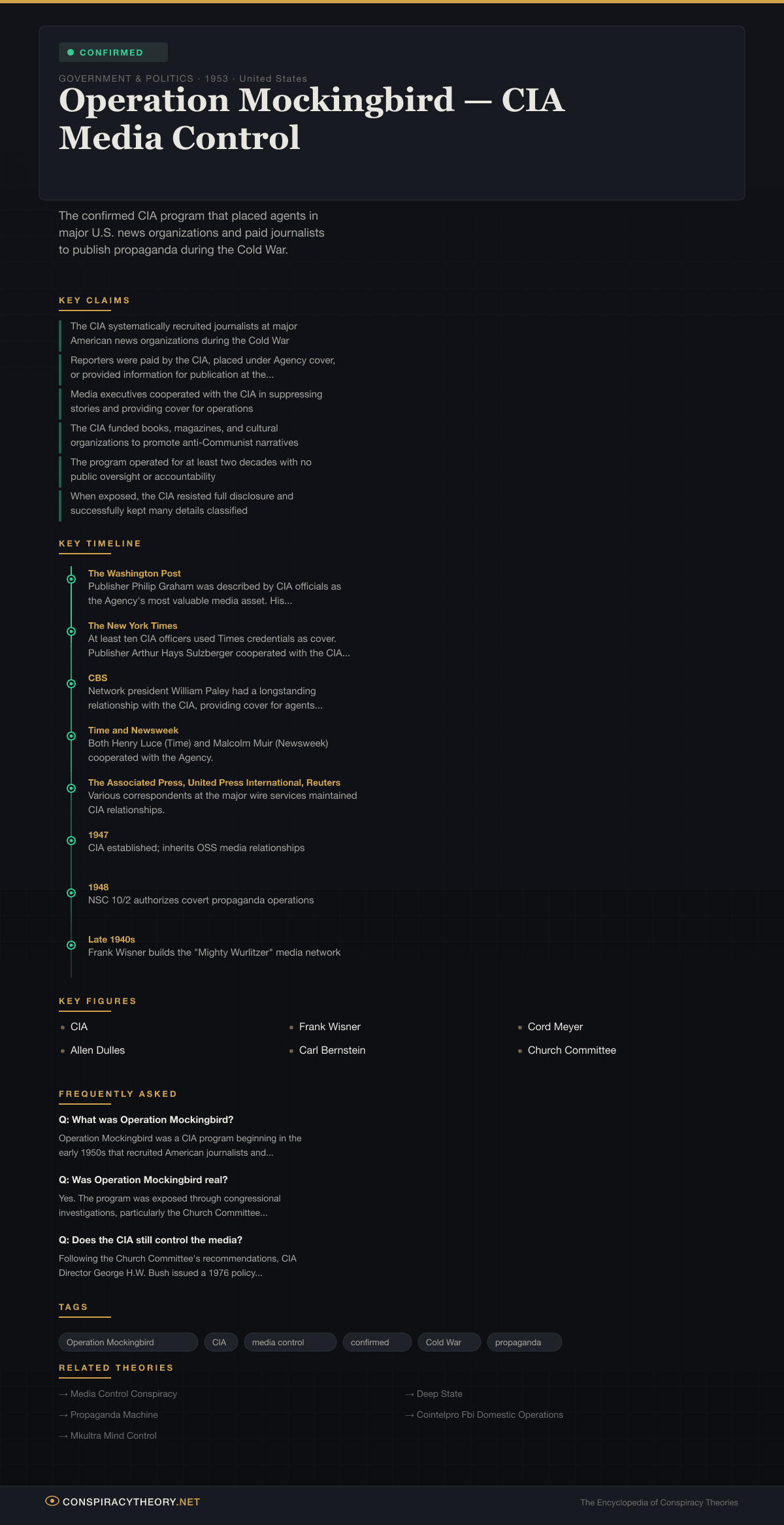
Operation Mockingbird was a large-scale program of the United States Central Intelligence Agency (CIA) that began in the early 1950s to recruit and influence American journalists and media organizations for propaganda purposes during the Cold War. The operation, primarily organized by CIA officers Frank Wisner, Cord Meyer, and Allen Dulles, cultivated relationships with reporters, editors, and publishers at major American news outlets, used these relationships to plant stories favorable to CIA objectives, suppressed stories that might embarrass the Agency or its allies, and subsidized domestic and foreign media organizations.
The program was exposed through multiple channels in the mid-1970s: the Church Committee congressional investigation (1975-1976), investigative reporting by Carl Bernstein in Rolling Stone (1977), and subsequent Freedom of Information Act releases. The evidence confirmed that the CIA had maintained relationships with at least 50 American journalists or media executives, including figures at The Washington Post, The New York Times, CBS, Time, Newsweek, and the Associated Press.
Operation Mockingbird is classified as confirmed — it is a documented historical program, not a conspiracy theory. However, it occupies a significant position in conspiracy discourse because it provides verified evidence that the U.S. government secretly manipulated domestic media, a claim that is central to many modern conspiracy theories about media control.
Origins & History
The Office of Policy Coordination (1948-1952)
The roots of media manipulation at the CIA predate the agency itself. When the CIA was established in 1947, it inherited intelligence relationships with journalists that had been cultivated by the Office of Strategic Services (OSS) during World War II. In 1948, the National Security Council issued directive NSC 10/2, which authorized the CIA to conduct covert operations including “propaganda” and “preventive direct action.”
Frank Wisner, who led the CIA’s Office of Policy Coordination (OPC) — the covert action wing — began systematically building relationships with American journalists in the late 1940s. Wisner referred to his media network as his “Mighty Wurlitzer,” comparing it to the famous theater organ and its ability to produce any desired sound. By the early 1950s, the OPC had been merged into the CIA’s Directorate of Plans, and the media influence program was well established.
The Dulles Era (1953-1961)
Under CIA Director Allen Dulles (1953-1961), the media program expanded significantly. Dulles, who had personal friendships with many media executives, oversaw a period in which:
- CIA officers were placed under journalistic cover at American news outlets, both domestically and abroad
- Reporters were paid directly by the CIA to publish stories reflecting Agency positions
- Media owners and editors cooperated with the CIA in killing or altering stories that might compromise operations
- The CIA subsidized books, magazines, and cultural organizations — including the Congress for Cultural Freedom, which funded publications across Europe and Latin America
- Foreign correspondents were debriefed after trips abroad, and some actively gathered intelligence for the Agency
The program was coordinated primarily by Cord Meyer, who headed the CIA’s International Organizations Division, and later by other senior officers. The relationships ranged from witting cooperation (journalists who knowingly worked for the CIA) to unwitting manipulation (journalists who published planted stories without knowing their source was the Agency).
Known Media Assets
According to Carl Bernstein’s 1977 investigation, CIA documents, and Church Committee testimony, the following outlets had some form of relationship with the CIA:
- The Washington Post — Publisher Philip Graham was described by CIA officials as the Agency’s most valuable media asset. His successor, Katharine Graham, acknowledged in her autobiography that some Post employees had maintained CIA connections.
- The New York Times — At least ten CIA officers used Times credentials as cover. Publisher Arthur Hays Sulzberger cooperated with the CIA in providing journalistic cover and in suppressing certain stories.
- CBS — Network president William Paley had a longstanding relationship with the CIA, providing cover for agents and allowing CIA officers to review raw news footage.
- Time and Newsweek — Both Henry Luce (Time) and Malcolm Muir (Newsweek) cooperated with the Agency.
- The Associated Press, United Press International, Reuters — Various correspondents at the major wire services maintained CIA relationships.
Exposure (1975-1977)
The program was revealed through several overlapping investigations:
The Church Committee (1975-1976): The Senate Select Committee to Study Governmental Operations with Respect to Intelligence Activities, chaired by Senator Frank Church (D-Idaho), investigated CIA abuses including domestic surveillance, assassination plots, and media manipulation. The committee found that the CIA had “maintained covert relationships with about 50 United States journalists or employees of United States media organizations.”
The committee’s findings were partially redacted at the CIA’s request, and many details about specific journalists and outlets were withheld from the public report. The full scope of the media program has never been completely declassified.
Carl Bernstein’s Investigation (1977): The Watergate journalist published “The CIA and the Media” in Rolling Stone, based on interviews with CIA officials and review of internal documents. Bernstein identified over 400 American journalists who had “secretly carried out assignments for the Central Intelligence Agency” over the previous 25 years. He documented that the CIA’s media relationships were far more extensive than the Church Committee’s report had indicated.
Key Claims
As a confirmed operation, the following are documented facts rather than contested claims:
- The CIA systematically recruited journalists at major American news organizations during the Cold War
- Reporters were paid by the CIA, placed under Agency cover, or provided information for publication at the CIA’s direction
- Media executives cooperated with the CIA in suppressing stories and providing cover for operations
- The CIA funded books, magazines, and cultural organizations to promote anti-Communist narratives
- The program operated for at least two decades with no public oversight or accountability
- When exposed, the CIA resisted full disclosure and successfully kept many details classified
The Ongoing Debate
The confirmed historical program raises unresolved questions that inform contemporary media conspiracy theories:
-
Post-1976 relationships: CIA Director George H.W. Bush issued a policy in 1976 stating the CIA would not enter into paid or contractual relationships with accredited U.S. journalists. However, the policy explicitly permitted voluntary, unpaid cooperation. Whether intelligence agencies continue to maintain informal relationships with journalists remains an open question.
-
Scope: Bernstein’s reporting suggested the program was far more extensive than the Church Committee disclosed. Many documents remain classified, and the full scope of the operation may never be known.
-
Foreign media: The CIA’s influence on foreign media was even more extensive and is less controversial, as influencing foreign opinion was considered a legitimate intelligence function. The CIA funded Radio Free Europe, the Congress for Cultural Freedom, and numerous foreign publications.
Evidence
Primary Sources
- Church Committee reports (Senate Reports 94-755, 1975-1976)
- CIA FOIA releases related to media relationships
- Congressional testimony of former CIA Directors William Colby, Richard Helms, and George H.W. Bush
- Bernstein, Carl. “The CIA and the Media.” Rolling Stone, October 20, 1977
Secondary Documentation
- Internal CIA memoranda discussing journalist assets (partially declassified)
- Graham, Katharine. Personal History (1997) — acknowledges Washington Post-CIA connections
- Accounts from journalists who were recruited or approached by the CIA
- Records of CIA-funded publications and cultural organizations
Cultural Impact
Operation Mockingbird has had an outsized impact on public trust in media and government institutions. It provides verified evidence for the claim that the U.S. government has secretly manipulated the press — a claim that, without Mockingbird’s documentation, would be easily dismissed as paranoia.
The operation is routinely cited in contemporary media criticism from both the political left and right. Left-wing critics invoke it when discussing corporate media’s relationship with the national security establishment. Right-wing critics cite it when alleging liberal media bias or coordination between journalists and Democratic administrations. Both invocations typically extrapolate far beyond what the historical evidence supports, but the confirmed existence of the program makes categorical denials of any government-media coordination untenable.
The term “Mockingbird media” has become shorthand in conspiracy circles for the claim that mainstream media outlets continue to operate as government propaganda vehicles. While this modern usage vastly overstates and misrepresents the historical program, Mockingbird’s confirmed existence gives the accusation a factual kernel that more speculative media conspiracy theories lack.
The program’s exposure also contributed to the broader post-Watergate collapse of trust in American institutions during the 1970s, alongside revelations about COINTELPRO, MKUltra, illegal domestic surveillance, and CIA assassination plots.
Timeline
- 1947 — CIA established; inherits OSS media relationships
- 1948 — NSC 10/2 authorizes covert propaganda operations
- Late 1940s — Frank Wisner builds the “Mighty Wurlitzer” media network
- 1953 — Allen Dulles becomes CIA Director; media program expands significantly
- 1950s-1960s — CIA funds Congress for Cultural Freedom, Radio Free Europe, and numerous publications
- 1967 — Ramparts magazine exposes CIA funding of the National Student Association
- 1973 — CIA Director William Colby begins limited disclosure of “family jewels” (internal report of CIA abuses)
- 1975-1976 — Church Committee investigates and confirms CIA-media relationships
- 1976 — CIA Director George H.W. Bush issues policy limiting journalist recruitment
- October 1977 — Carl Bernstein publishes “The CIA and the Media” in Rolling Stone
- 1996 — CIA Inspector General report acknowledges past media relationships
Sources & Further Reading
- Bernstein, Carl. “The CIA and the Media.” Rolling Stone, October 20, 1977
- Senate Select Committee to Study Governmental Operations with Respect to Intelligence Activities. Final Report. U.S. Senate, 1976
- Wilford, Hugh. The Mighty Wurlitzer: How the CIA Played America. Harvard University Press, 2008
- Saunders, Frances Stonor. The Cultural Cold War: The CIA and the World of Arts and Letters. The New Press, 1999
- Weiner, Tim. Legacy of Ashes: The History of the CIA. Doubleday, 2007
- Graham, Katharine. Personal History. Alfred A. Knopf, 1997
- Moran, Christopher R. “Ian Fleming and the CIA.” Journal of Cold War Studies 17, no. 1 (2015): 149-180
Frequently Asked Questions
What was Operation Mockingbird?
Was Operation Mockingbird real?
Does the CIA still control the media?
Infographic
Share this visual summary. Right-click to save.