P2 Lodge — Italy's Masonic Shadow Government
Overview
Propaganda Due, commonly known as P2, was a clandestine Masonic lodge operating in Italy from the 1960s through the early 1980s under the leadership of Licio Gelli. Unlike the many alleged secret societies that populate conspiracy literature, P2’s existence and activities have been thoroughly documented through criminal investigations, parliamentary inquiries, and judicial proceedings. The lodge functioned as a shadow government that infiltrated virtually every institution of the Italian state.
When Italian magistrates raided Gelli’s villa in Arezzo in March 1981 during an investigation into the financial activities of banker Michele Sindona, they discovered a membership list containing 962 names. The list read like a directory of the Italian power structure: cabinet ministers, parliamentarians, generals, admirals, intelligence chiefs, senior judges, police commanders, media executives, and captains of industry. The revelation triggered a political earthquake that brought down the Italian government and led to years of parliamentary and criminal investigations.
P2 stands as one of the most clearly confirmed conspiracies of the twentieth century, demonstrating that a covert network operating within a Western democracy’s institutions could exercise enormous power while remaining hidden from public view for decades.
Origins & History
The Propaganda Lodge was originally founded in 1877 as a legitimate Masonic body under the Grand Orient of Italy, intended for members whose public association with Freemasonry would be politically sensitive. It fell dormant and was revived in 1966, when Licio Gelli was appointed as its organizing secretary and later as its Venerable Master.
Gelli was a complex and contradictory figure. Born in 1919 in Pistoia, he had served as a volunteer in Francisco Franco’s forces during the Spanish Civil War and later as a liaison officer to the German SS during World War II. After the war, he established connections with both U.S. intelligence and right-wing Italian political circles, eventually building a network of influence that reached across Italy and into Latin America.
Under Gelli’s leadership, P2 transformed from a Masonic lodge into a clandestine political organization. Gelli recruited members by offering them access to a powerful network, promising to advance their careers and facilitate business dealings. Membership was organized on a cell-like basis, with most members knowing only Gelli and a few others, preventing any individual from understanding the full scope of the organization.
The Grand Orient of Italy expelled P2 in 1976 after growing concerned about Gelli’s activities, but the lodge continued to operate independently. By the late 1970s, P2 had members in every branch of the Italian government, military, and intelligence services. Its reach extended internationally, with documented connections to Argentine military dictator Jorge Videla, Uruguayan intelligence, and figures in the United States.
Key Claims
- P2 functioned as a shadow government within Italy, capable of influencing government policy, judicial proceedings, military decisions, and media coverage
- Gelli maintained a “Plan for Democratic Rebirth” (Piano di Rinascita Democratica) that outlined steps for consolidating right-wing control over Italian institutions, including reforms to concentrate media ownership and weaken labor unions
- The lodge was connected to some of Italy’s most notorious political violence, including the 1980 Bologna railway station bombing that killed 85 people
- P2 was intertwined with both the Vatican Bank and Banco Ambrosiano in massive financial fraud
- The CIA and NATO intelligence structures maintained awareness of P2 and may have used it as an asset during the Cold War
- Roberto Calvi’s death by hanging under Blackfriars Bridge in London was murder rather than suicide, carried out because he threatened to reveal P2’s financial networks
- P2 was connected to Operation Gladio, NATO’s clandestine “stay-behind” network intended to resist potential Soviet occupation
Evidence
The evidence confirming P2’s existence and activities is extensive and comes from multiple authoritative sources.
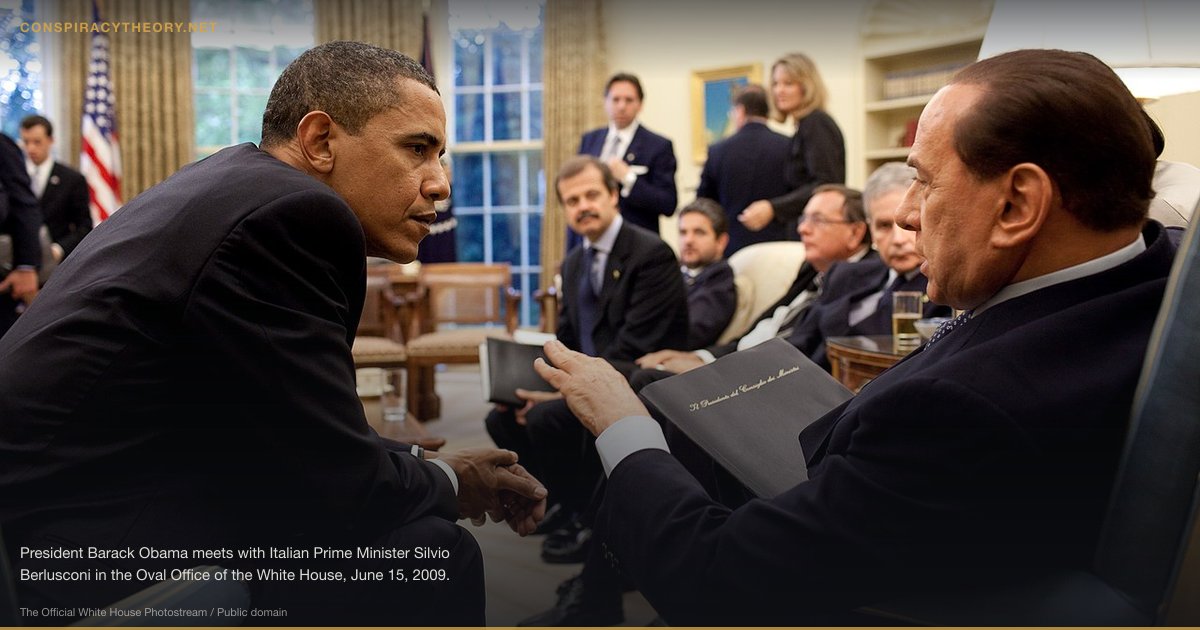
The Membership List: The 962-name list discovered in Gelli’s villa was authenticated and published by the Italian government. Members confirmed included: Silvio Berlusconi (future Prime Minister, membership number 1816); General Giuseppe Santovito (head of SISMI, military intelligence); Admiral Giovanni Torrisi (Chief of the Defence Staff); Colonel Antonio Viezzer (head of SIFAR counterintelligence); 44 members of parliament; 3 sitting cabinet ministers; multiple judges and prosecutors; and the heads of all three Italian intelligence agencies.
Parliamentary Commission: The Italian Parliament established a formal commission of inquiry in 1981, chaired by Tina Anselmi. After three years of investigation, the Anselmi Commission concluded that P2 was “a secret criminal association” that had operated “within and against the State.” The commission’s final report, published in 1984, ran to thousands of pages and documented P2’s infiltration of state institutions.
The Plan for Democratic Rebirth: Among the documents seized from Gelli’s villa was a detailed political program calling for control of political parties, the judiciary, the media, and trade unions. The plan bore striking similarities to political developments in Italy during subsequent decades, particularly media concentration under Berlusconi.
Financial Evidence: The collapse of Banco Ambrosiano in 1982 with $1.2 billion in liabilities exposed a web of financial fraud connecting P2, the Vatican Bank (Istituto per le Opere di Religione), and offshore shell companies. Roberto Calvi, Banco Ambrosiano’s chairman and P2 member, was found dead in London while fleeing prosecution.
Criminal Convictions: Licio Gelli was convicted multiple times in Italian courts, including for his role in the collapse of Banco Ambrosiano. Several P2 members were convicted in connection with various crimes, including financial fraud and obstruction of justice. In 1994, former P2 member Gelli was convicted of obstruction of the investigation into the 1980 Bologna station bombing.
Debunking / Verification
This conspiracy is classified as confirmed. The Italian government formally acknowledged P2’s existence and activities through:
- Parliamentary investigation (Anselmi Commission, 1981-1984)
- Criminal prosecutions of Gelli and multiple members
- Legislative action: Italian Law 17 of January 25, 1982 banned secret associations
- P2 was formally suppressed by act of Parliament
- The membership list was authenticated and made public
Some claims associated with P2 remain debated, particularly the full extent of its connection to political violence in Italy during the “Years of Lead” (Anni di piombo). While individual P2 members have been linked to various acts of terrorism, the question of whether the lodge as an organization directed or merely facilitated such violence remains the subject of historical debate.
Cultural Impact
The P2 affair had a profound and lasting impact on Italian politics and culture. It confirmed suspicions held by many Italians that their democratic institutions had been compromised by unaccountable networks of power. The term “P2” entered the Italian political lexicon as shorthand for secret, antidemocratic manipulation.
The scandal contributed to the broader delegitimization of Italy’s post-war political establishment that culminated in the “Tangentopoli” corruption scandals of the early 1990s and the collapse of the First Republic’s party system. The irony that P2 member Berlusconi subsequently became Italy’s longest-serving post-war Prime Minister was not lost on Italian commentators.
Internationally, P2 became a reference point for discussions of deep state activity, institutional corruption, and the limits of democratic accountability. It has been cited by conspiracy theorists as proof that secret societies genuinely control governments, though the actual lesson of P2 may be more nuanced: the lodge’s exposure demonstrated that democratic institutions, while vulnerable to infiltration, are also capable of investigating and dismantling such networks when the political will exists.
P2 inspired numerous books, films, and television programs. Roberto Calvi’s death beneath Blackfriars Bridge — a name that evoked the black-robed friars associated with historical conspiracy — became one of the most iconic images of twentieth-century political intrigue.
Timeline
- 1877 — Propaganda Lodge originally established under the Grand Orient of Italy
- 1966 — Lodge revived with Licio Gelli as organizing secretary
- 1971 — Gelli becomes Venerable Master of P2
- 1976 — Grand Orient of Italy expels P2; lodge continues operating independently
- 1978 — Silvio Berlusconi joins P2 as member number 1816
- 1978 — Michele Sindona’s Franklin National Bank collapses in the largest U.S. bank failure to date
- 1980 — Bologna railway station bombing kills 85 people; P2 members later linked to the attack
- March 1981 — Police raid Gelli’s villa in Arezzo; discovery of the 962-name membership list
- May 1981 — Italian government publishes the P2 membership list; government of Prime Minister Arnaldo Forlani collapses
- 1981 — Italian Parliament establishes Anselmi Commission to investigate P2
- June 1982 — Roberto Calvi found hanging under Blackfriars Bridge, London
- July 1982 — Banco Ambrosiano collapses with $1.2 billion in liabilities
- 1982 — Italian Parliament passes Law 17 banning secret associations
- 1984 — Anselmi Commission publishes final report declaring P2 a criminal conspiracy
- 1986 — Michele Sindona dies in prison from cyanide poisoning, ruled suicide
- 1994 — Gelli convicted of obstruction in Bologna bombing investigation
- 1998 — Gelli convicted and sentenced for Banco Ambrosiano fraud
- 2015 — Licio Gelli dies at age 96
Sources & Further Reading
- Willan, Philip. The Last Supper: The Mafia, the Masons, and the Killing of Roberto Calvi. Robinson, 2007.
- Tosches, Nick. Power on Earth: Michele Sindona’s Explosive Story. Arbor House, 1986.
- Commissione parlamentare d’inchiesta sulla Loggia massonica P2 (Anselmi Commission). Final Report, 1984.
- Cornwell, Rupert. God’s Banker: The Life and Death of Roberto Calvi. Victor Gollancz, 1984.
- Ferrara, Gianluca. P2: La Controstoria. Castelvecchi, 2014.
- BBC News. “Italy’s P2 Masonic Lodge.” Special Report series.
Frequently Asked Questions
Was the P2 Lodge a real conspiracy?
Who was the most famous member of the P2 Lodge?
What was the P2 Lodge's connection to the Vatican?

Infographic
Share this visual summary. Right-click to save.
