Parkland School Shooting Conspiracy Theories
Overview
On Valentine’s Day 2018, a nineteen-year-old former student named Nikolas Cruz walked into Marjory Stoneman Douglas High School in Parkland, Florida, with an AR-15 semi-automatic rifle and killed seventeen people — fourteen students and three staff members. Within hours, before the blood had been cleaned from the hallways, the conspiracy theories began. By the next morning, they were trending.
The Parkland conspiracy theories followed a template that had been refined after the 2012 Sandy Hook massacre: the shooting was a “false flag” operation staged by the government to generate support for gun control legislation, and the articulate, media-savvy students who emerged as advocates for policy change were not genuine survivors but “crisis actors” — trained performers hired to play the roles of grieving teenagers. The theory was not new, but its application to Parkland marked a significant escalation. Unlike Sandy Hook, where the victims were six- and seven-year-old children who never spoke publicly, the Parkland survivors were teenagers who took to television cameras and social media with a fluency that both energized the gun control movement and, paradoxically, fueled the conspiracy theories targeting them.
The Parkland false flag narrative was debunked in real time by journalists, fact-checkers, and the survivors themselves. It was contradicted by extensive physical evidence, surveillance footage, criminal proceedings, and the testimony of hundreds of witnesses. Nikolas Cruz was arrested, confessed, stood trial, and was convicted. None of this stopped the theories from spreading, because the theories were never really about evidence. They were about the political stakes of gun violence in America.
Origins & History
The False Flag Template
To understand the Parkland conspiracy theories, it is necessary to understand the template from which they were drawn. The modern mass shooting false flag narrative was largely established in the aftermath of the December 14, 2012, Sandy Hook Elementary School shooting in Newtown, Connecticut, in which twenty children and six staff members were killed. Conspiracy theorist Alex Jones, through his Infowars media platform, became the most prominent voice claiming Sandy Hook was staged, calling it “a giant hoax” and “completely fake with actors.”
The Sandy Hook conspiracy theories established several key narrative elements that would be recycled for nearly every subsequent mass shooting: the attack was a “false flag” designed to create political momentum for gun confiscation; the victims were either fictional or secretly relocated; the grieving families were professional actors; any inconsistencies in initial news coverage proved government orchestration; and any survivor or family member who advocated for policy change was thereby revealed as a political operative rather than a genuine victim.
By the time of the Parkland shooting in 2018, this template had been applied to the 2016 Pulse nightclub shooting in Orlando, the 2017 Las Vegas massacre, the 2017 Sutherland Springs church shooting in Texas, and numerous other events. Each iteration refined and amplified the playbook, and each new application made the next one easier.
The Shooting and Immediate Aftermath
The shooting at Marjory Stoneman Douglas High School began at approximately 2:21 PM on February 14, 2018. Cruz entered Building 12, pulled the fire alarm to draw students into the hallways, and opened fire. The attack lasted approximately six minutes. Cruz then dropped his weapon, blended in with fleeing students, and left the school. He was arrested about an hour later at a nearby residence.
What happened next was unprecedented in the history of American mass shootings. Within hours, surviving students began posting raw, emotionally devastating accounts on social media. Senior David Hogg, who had conducted video interviews with fellow students while hiding during the shooting, uploaded footage that was viewed millions of times. Junior Cameron Kasky created the Never Again MSD social media accounts that night. Senior Emma Gonzalez gave a speech at a gun control rally three days later that went viral, her raw emotion and shaved head making her an instantly recognizable figure.
The students’ rapid mobilization was not accidental. Marjory Stoneman Douglas was a well-funded public school in an affluent suburb, and many of the students who became public spokespeople had backgrounds in the school’s debate team, drama program, and television production classes. They were, in short, exactly the kind of articulate, media-literate young people one might expect to emerge from that environment. To conspiracy theorists, however, this competence was not a product of education but proof of professional training — evidence that these could not possibly be real teenagers.
The Crisis Actor Accusations
The crisis actor accusations began circulating on social media within hours of the shooting, but they reached a mass audience on February 20, 2018, when a video claiming David Hogg was a “crisis actor” briefly became the number-one trending video on YouTube. The video, which spliced together clips of Hogg speaking about an unrelated incident in California months earlier with his Parkland interviews to suggest he was a traveling professional actor, was viewed hundreds of thousands of times before YouTube removed it.
The accusation was quickly debunked. Hogg’s enrollment at Marjory Stoneman Douglas was confirmed by school records, yearbook photos from multiple years, and statements from administrators, teachers, and fellow students. The California video showed Hogg as a bystander to an argument on a beach during a family vacation — entirely consistent with the social media behavior of a normal teenager, not evidence of professional crisis acting.
Nevertheless, the crisis actor narrative spread rapidly. Gateway Pundit, a right-wing blog, published articles amplifying the claims. Conspiracy-oriented YouTube channels produced dozens of videos. Benjamin Kelly, a legislative aide to Florida State Representative Shawn Harrison, emailed a reporter at the Tampa Bay Times claiming Hogg and Gonzalez were “actors that travel to shooting scenes.” Harrison fired Kelly the following day, but the email illustrated how far the conspiracy had penetrated into mainstream political circles.
Alex Jones and Infowars
Alex Jones and his Infowars platform played a significant but more measured role in the Parkland theories than they had with Sandy Hook. Jones, already facing lawsuits from Sandy Hook families that would eventually result in nearly $1.5 billion in defamation judgments, was somewhat more cautious in his Parkland coverage. He did not flatly call the shooting a hoax, but he questioned whether Cruz had been set up, suggested the FBI had deliberately failed to act on warnings about Cruz to allow the shooting to happen, and gave airtime to guests who promoted the crisis actor narrative.
Jones’s caution reflected the legal and financial consequences that were beginning to attach to false flag promotion. The Sandy Hook lawsuits, filed in 2018 and decided in 2022, demonstrated that promoting mass shooting conspiracy theories could carry devastating real-world costs. The Parkland theories thus marked a transitional moment: the conspiratorial impulse remained as strong as ever, but the most prominent conspiracy entrepreneurs were learning to hedge their language.
Key Claims
The Parkland conspiracy theories advanced several specific claims, most of which were recycled from the Sandy Hook playbook:
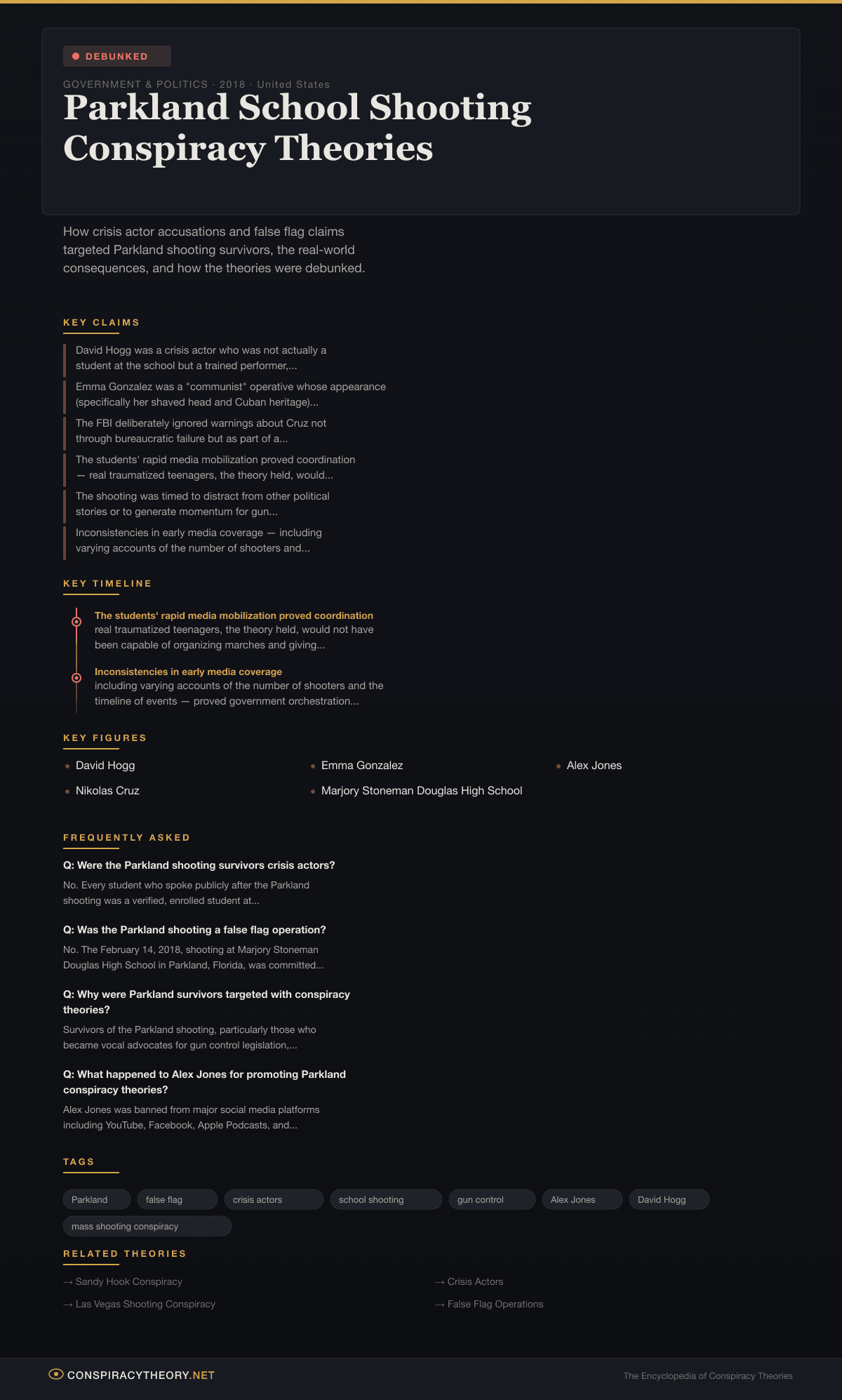
- David Hogg was a crisis actor who was not actually a student at the school but a trained performer, possibly connected to the FBI through his father, a retired FBI agent
- Emma Gonzalez was a “communist” operative whose appearance (specifically her shaved head and Cuban heritage) signaled anti-American allegiance
- The FBI deliberately ignored warnings about Cruz not through bureaucratic failure but as part of a deliberate plan to allow the shooting to occur, thereby creating a pretext for gun confiscation
- The students’ rapid media mobilization proved coordination — real traumatized teenagers, the theory held, would not have been capable of organizing marches and giving polished television interviews within days
- The shooting was timed to distract from other political stories or to generate momentum for gun control legislation during the 2018 midterm election cycle
- Inconsistencies in early media coverage — including varying accounts of the number of shooters and the timeline of events — proved government orchestration rather than the chaos inherent in breaking news reporting
- The March for Our Lives rally in Washington, D.C., on March 24, 2018, was a pre-planned event that could not have been organized in just five weeks without advance knowledge of the shooting
Evidence and Debunking
The Criminal Case
The most comprehensive rebuttal to the false flag narrative is the criminal case against Nikolas Cruz. Cruz was arrested approximately 80 minutes after the shooting, identified by multiple witnesses, captured on school surveillance video, and found with an AR-15 rifle purchased legally at a licensed gun dealer. He confessed to the shooting during police interrogation.
Cruz was indicted by a grand jury, represented by defense counsel, and stood trial in Broward County Circuit Court. In October 2021, he pleaded guilty to 17 counts of first-degree murder and 17 counts of attempted first-degree murder. In October 2022, following a penalty phase trial, a jury recommended life without parole rather than the death penalty. The trial included extensive physical evidence, autopsy reports, ballistics analysis, and testimony from survivors and first responders.
No false flag operation in history has included a full criminal trial of its own perpetrator, let alone a trial lasting months with hundreds of witnesses.
The FBI Failure
The claim that the FBI deliberately allowed the shooting rests on a genuine institutional failure that has been repackaged as intentional malice. In January 2018, a person close to Cruz called the FBI tip line and provided detailed information about his gun ownership, erratic behavior, social media posts, and potential for school violence. The FBI acknowledged that it failed to follow its own protocols by not forwarding the tip to its Miami field office for investigation.
This was a bureaucratic failure, not a conspiracy. The FBI received approximately 750,000 tips in 2017 alone, and the systemic failures in its tip-processing system were documented in a subsequent internal review and congressional investigation. The tips about Cruz were among thousands that fell through institutional cracks — a tragically common occurrence that reflects resource constraints and procedural weaknesses, not deliberate orchestration.
Student Activism and Timing
The claim that the students’ rapid mobilization proved advance planning ignores both the specific circumstances of the Parkland community and the broader capabilities of digitally native teenagers. Several of the student activists had training in public speaking through the school’s debate team and drama program. They had immediate access to smartphones, social media platforms, and a national media apparatus that was actively seeking their voices. The gun control movement had existing organizational infrastructure — including Everytown for Gun Safety and Moms Demand Action — that quickly provided logistical support.
The March for Our Lives rally, held five weeks after the shooting, was organized with professional assistance from experienced rally planners, a fact the organizers openly acknowledged. This is how political movements work in the modern era, not evidence of conspiracy.
Cultural Impact
The Survivor-Activist Phenomenon
The Parkland conspiracy theories occurred against the backdrop of a genuinely novel political phenomenon: mass shooting survivors becoming immediate, effective political activists. The students’ success in driving national conversation, organizing a march that drew an estimated 800,000 people to Washington and millions more to satellite events worldwide, and contributing to the passage of Florida’s Marjory Stoneman Douglas High School Public Safety Act (which raised the age to buy firearms in Florida to 21) represented a level of survivor-driven policy impact not previously seen after a mass shooting in the United States.
This success, paradoxically, intensified the conspiracy theories. In the conspiratorial framework, the effectiveness of the activism was itself evidence of staging — the reasoning being circular but internally consistent: real teenagers could not be this effective, therefore these are not real teenagers, therefore the event was staged.
Platform Accountability
The Parkland conspiracy theories became a turning point for social media platform policy. The trending of the David Hogg crisis actor video on YouTube — promoted by the platform’s own recommendation algorithm — generated intense public pressure on technology companies to address conspiracy content. In August 2018, YouTube, Facebook, Apple, and Spotify simultaneously removed Alex Jones and Infowars from their platforms, citing repeated violations of policies against harassment and promoting violence. While the Sandy Hook content was the most frequently cited justification, the Parkland theories contributed significantly to the momentum for deplatforming.
This marked the beginning of a broader reckoning with algorithmic amplification of conspiracy content that would extend through the COVID-19 pandemic and the 2020 election.
Harassment and Real-World Consequences
The Parkland conspiracy theories had devastating real-world consequences for the students and families targeted. David Hogg reported receiving death threats so frequent that his family required security protection. Other students described persistent online harassment, doxxing, and threats. Two Parkland survivors and a parent of a Sandy Hook victim died by suicide in 2019, and while direct causation cannot be established, the relentless harassment campaigns were cited as contributing factors to the broader trauma environment.
In 2022, the father of one of the Parkland victims, Manuel Oliver, was arrested while protesting gun violence at the White House — an event that was itself reprocessed through the conspiracy framework as evidence that the families were political operatives rather than grieving parents.
In Popular Culture
The Parkland shooting and the conspiracy theories surrounding it have been documented in several works. The 2020 documentary After Parkland followed families in the shooting’s aftermath. The students’ activism was the subject of numerous books, including David Hogg and Lauren Hogg’s #NeverAgain: A New Generation Draws the Line (2018). The broader crisis actor phenomenon was examined in the 2022 documentary The Conspiracy Theory Trap. The intersection of mass shooting conspiracy theories and social media algorithms became a case study in numerous academic papers and journalism investigations.
Timeline
| Date | Event |
|---|---|
| February 14, 2018 | Nikolas Cruz kills 17 people at Marjory Stoneman Douglas High School in Parkland, Florida |
| February 14, 2018 | David Hogg uploads video interviews with students conducted during the shooting |
| February 15, 2018 | Crisis actor accusations begin circulating on social media within 24 hours |
| February 17, 2018 | Emma Gonzalez gives viral “We Call BS” speech at Fort Lauderdale gun control rally |
| February 20, 2018 | ”David Hogg crisis actor” video becomes #1 trending on YouTube before removal |
| February 20, 2018 | Florida legislative aide Benjamin Kelly fired for emailing reporter that students were “actors” |
| February 21, 2018 | Surviving students meet with President Trump and lawmakers at the White House |
| March 9, 2018 | Florida Governor Rick Scott signs the Marjory Stoneman Douglas High School Public Safety Act |
| March 14, 2018 | National school walkout organized by Parkland students draws participation from thousands of schools |
| March 24, 2018 | March for Our Lives rally in Washington, D.C., draws an estimated 800,000 attendees |
| August 6, 2018 | YouTube, Facebook, Apple, and Spotify simultaneously remove Alex Jones/Infowars content |
| October 2021 | Nikolas Cruz pleads guilty to 17 counts of first-degree murder |
| October 2022 | Jury recommends life without parole for Cruz; Sandy Hook defamation verdicts total nearly $1.5 billion against Alex Jones |
| November 2022 | Alex Jones files for personal bankruptcy following Sandy Hook judgments |
Sources & Further Reading
- Williamson, Elizabeth. Sandy Hook: An American Tragedy and the Battle for Truth. Dutton, 2022
- Hogg, David, and Lauren Hogg. #NeverAgain: A New Generation Draws the Line. Random House, 2018
- Marjory Stoneman Douglas High School Public Safety Commission. “Initial Report.” January 2, 2019
- Roose, Kevin. “How YouTube’s Algorithm Pushed a Conspiracy Video to the Top of Search Results.” New York Times, February 21, 2018
- Warzel, Charlie. “YouTube Is Spreading Conspiracy Theories About the Parkland Shooting Survivors.” BuzzFeed News, February 21, 2018
- Mazzei, Patricia, and Agustin Armendariz. “Tipster Told FBI That Nikolas Cruz Was Going to ‘Explode.’” New York Times, February 23, 2018
- Phillips, Whitney. “The Oxygen of Amplification: Better Practices for Reporting on Extremists, Antagonists, and Manipulators.” Data & Society Research Institute, 2018
- Holt, Jared. “After Parkland: How Conspiracy Theories Emerge After Mass Shootings.” Right Wing Watch, February 2018
- Uscinski, Joseph E. Conspiracy Theories: A Primer. Rowman & Littlefield, 2020
Related Theories
- Sandy Hook Conspiracy — The template shooting conspiracy that established the false flag/crisis actor framework
- Crisis Actors — The broader conspiracy theory that mass casualty events use paid performers
- False Flag Operations — The general theory that governments stage attacks to justify policy changes

Frequently Asked Questions
Were the Parkland shooting survivors crisis actors?
Was the Parkland shooting a false flag operation?
Why were Parkland survivors targeted with conspiracy theories?
What happened to Alex Jones for promoting Parkland conspiracy theories?
Infographic
Share this visual summary. Right-click to save.