Paul Walker Was Murdered
Overview
On November 30, 2013, Paul Walker left a charity car show for his disaster relief organization Reach Out Worldwide, climbed into the passenger seat of his friend Roger Rodas’s red Porsche Carrera GT, and never came back. The car hit a concrete lamp post and two trees at approximately 90 miles per hour on a suburban street in Valencia, California, and erupted in flames so intense that both men were burned beyond recognition. Walker was 40 years old. Rodas was 38.
The accident was investigated thoroughly by the Los Angeles County Sheriff’s Department, the California Highway Patrol, and the LA County Coroner. The conclusion was unambiguous: Rodas was driving far too fast, lost control of an inherently treacherous car, and crashed. No mechanical failure. No foul play. No mystery — except the endlessly replayed one of a young, well-liked actor dying in a way that seemed to belong in the very franchise that had made him famous.
And that last detail — the Fast and Furious star dying in a car crash — was the narrative coincidence that conspiracy theorists could not resist. Within hours, the theories began: Paul Walker was an Illuminati sacrifice. He was assassinated because he was investigating corruption in Philippines typhoon relief. He faked his death and was living on an island somewhere. The car was sabotaged by a drone-fired missile. Each theory was more elaborate than the last, and each was supported by the same amount of evidence: none.
Origins & History
Paul Walker’s Life and Career
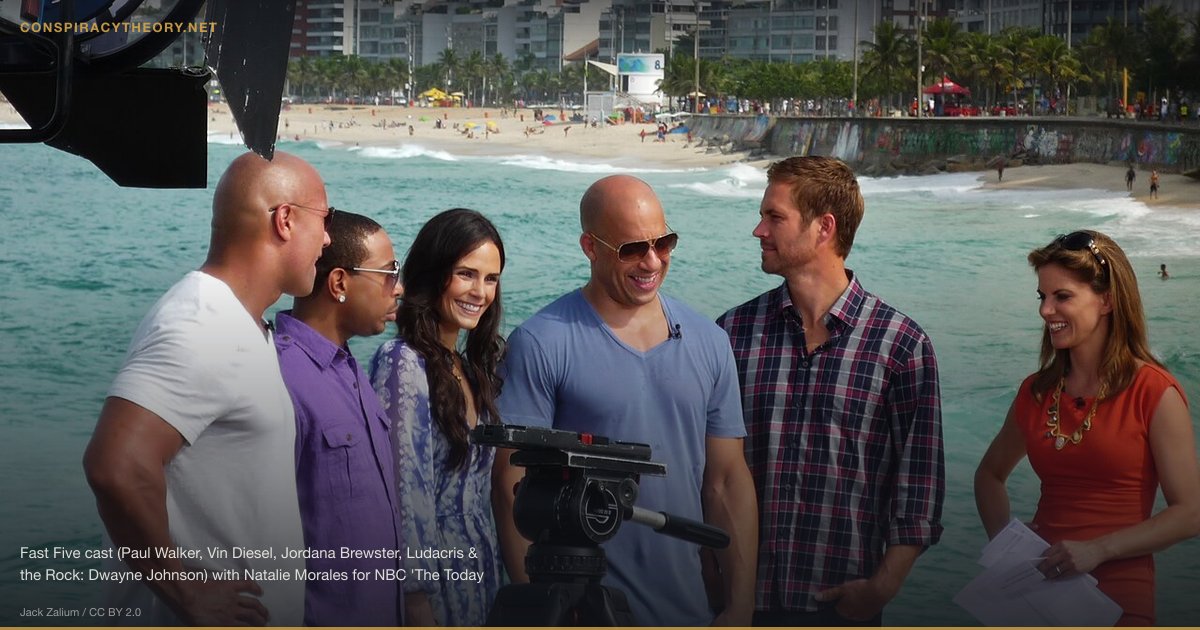
Paul William Walker IV was born in Glendale, California, in 1973. He began acting as a child, appearing in television commercials and small roles throughout the 1980s and 1990s. His career changed forever in 2001 when he was cast as Brian O’Conner in The Fast and the Furious, the first installment of what would become one of the highest-grossing film franchises in history. Walker appeared in six Fast and Furious films and became indelibly associated with the franchise’s culture of fast cars, loyalty, and family.
Off screen, Walker was known for two things that set him apart from the typical Hollywood leading man: his genuine passion for cars and racing (he owned more than thirty vehicles and competed in the Redline Time Attack series), and his humanitarian work. In 2010, he founded Reach Out Worldwide (ROWW), a disaster response organization that deployed teams of skilled volunteers — paramedics, firefighters, construction workers — to disaster zones. ROWW responded to the 2010 Haiti earthquake, the 2011 Christchurch earthquake in New Zealand, and other emergencies.
In November 2013, Typhoon Haiyan devastated the Philippines, killing over 6,000 people. Walker and ROWW were actively involved in relief efforts, and Walker was planning a trip to the Philippines at the time of his death. This humanitarian work would become central to the conspiracy theories.
The Charity Event
On the afternoon of November 30, 2013, Walker attended a charity car show organized by his friend and financial advisor Roger Rodas at a business park in Valencia, a suburban community in the Santa Clarita Valley north of Los Angeles. The event was a fundraiser for ROWW’s Philippines relief efforts. Several dozen people attended, and the parking area was filled with exotic and high-performance cars.
Roger Rodas owned a 2005 Porsche Carrera GT — one of the most celebrated and feared supercars ever built. The Carrera GT was powered by a 5.7-liter V10 engine producing 612 horsepower, could reach 205 mph, and was notorious for its difficulty to drive. Unlike most modern supercars, it lacked electronic stability control. Its rear-engine layout made it prone to snap oversteer — a sudden loss of rear traction that could send the car spinning with almost no warning. Professional racing driver Randy Pobst called it “the most dangerous car I’ve ever driven.” Even Jay Leno, who owned one, described it as requiring constant attention and respect.
At approximately 3:30 p.m., Walker and Rodas left the event in the Carrera GT for what appears to have been a brief drive through the business park — likely a spirited run to enjoy the car. Rodas was driving. Walker was in the passenger seat.
The Crash
Hercules Street, where the crash occurred, is a wide, straight commercial road in an industrial area. The speed limit was 45 mph. Based on physical evidence and vehicle telemetry data recovered by investigators, Rodas was driving between 80 and 93 mph — nearly double the speed limit — when he lost control of the car.
The Carrera GT drifted sideways, struck a concrete lamp post on the passenger side, then struck a large tree. The car came to rest against a second tree and immediately caught fire. The impact forces were so extreme that both men sustained fatal trauma before the fire reached them. Walker died from the combined effects of “traumatic and thermal injuries,” according to the Los Angeles County Coroner.
People at the charity event heard the crash and rushed to the scene. They attempted to reach the car but were driven back by the intensity of the fire. By the time the Los Angeles County Fire Department extinguished the blaze, the Porsche was a burned-out shell. Both bodies were recovered and identified through dental records.
The Investigation
The Los Angeles County Sheriff’s Department and the California Highway Patrol conducted a joint investigation that lasted several months. Their findings were conclusive:
- The crash was caused by unsafe speed for the road conditions
- No mechanical defect or failure contributed to the crash
- No other vehicle was involved
- There was no evidence of a road hazard, obstacle, or other contributing factor
- Toxicology reports showed no drugs or alcohol in either man’s system
- The speed was estimated at 80-93 mph based on physical evidence and the car’s Event Data Recorder
- The tires on the Carrera GT were nine years old — the car’s original tires from 2004, never replaced — and had significantly degraded. While old tires alone were not cited as the cause, they would have reduced the car’s grip and handling performance
Porsche was later sued by both Walker’s daughter, Meadow Walker, and Roger Rodas’s widow. Meadow’s lawsuit alleged design defects in the Carrera GT, while Rodas’s widow alleged the car lacked adequate safety features. Both suits were settled out of court.
Key Claims
Illuminati Sacrifice
The most widely circulated conspiracy theory frames Walker’s death as a ritualistic sacrifice by the Illuminati or other secret societies alleged to control Hollywood. Proponents point to numerological interpretations of the date and circumstances, supposed occult symbolism in the Fast and Furious films, and the general conspiracy framework that attributes celebrity deaths to elite blood rituals.
This theory has no supporting evidence and relies entirely on post-hoc symbolic interpretation — the same methodology that can be applied to find “hidden meanings” in virtually any event.
Philippines Corruption Discovery
A more specific theory alleges that Walker was murdered because he discovered evidence of corruption in the distribution of typhoon relief aid in the Philippines. According to this theory, powerful interests — variously identified as the Philippine government, international aid organizations, or unnamed corporate entities — arranged his death to prevent him from exposing the misuse of humanitarian funds.
This theory gained significant traction on social media, partly because Walker’s ROWW work in the Philippines was genuine and well-documented. However, ROWW was a first-response organization that deployed skilled volunteers, not an investigative body. Walker’s associates have stated that he was focused on disaster relief logistics, not financial auditing. No evidence has surfaced — from ROWW members, from Walker’s private communications, or from any other source — that he had uncovered corruption of any kind.
Drone Strike / Remote Sabotage
One of the more technically inventive theories alleges that the Porsche was destroyed by a drone-launched missile or that the car’s onboard systems were remotely hacked to cause the crash. Proponents cite a “flash of light” visible in one low-quality surveillance video of the crash and point to published research on the theoretical vulnerability of modern vehicles to remote attacks.
The “flash of light” is consistent with the initial fireball from the crash impact. The Carrera GT, being a 2005 model without modern connected-car technology, had no wireless interface through which its systems could be remotely compromised. There is no physical evidence of a missile or explosive device — and such evidence would be detectable in the forensic investigation of the wreckage, regardless of the fire damage.
Faked Death
The least credible theory holds that Walker staged his own death and is living in secret. This theory typically relies on supposed sightings of Walker, analysis of photographs from the crash scene that allegedly show inconsistencies, and the general conspiracy trope of celebrity death-faking.
Walker’s death was confirmed by autopsy, dental records, eyewitness testimony from dozens of people at the charity event, and the first responders who recovered his remains. His daughter Meadow Walker has spoken publicly about her father’s death and filed wrongful death lawsuits. The faked-death theory is contradicted by every available piece of evidence.
Evidence & Analysis
What the Evidence Shows
The physical evidence in Paul Walker’s death is unusually comprehensive for a car crash:
- The crash was witnessed by multiple people
- The CHP reconstructed the crash using physical evidence, vehicle telemetry, and road surface analysis
- The cause was definitively identified as excessive speed
- The car’s old tires were a contributing factor in reduced handling performance
- No mechanical tampering or sabotage was detected
- Both occupants’ identities were confirmed through dental records and autopsy
- The fire was caused by fuel system rupture on impact — a known risk in severe crashes, particularly with rear-engine cars where the fuel system is vulnerable to rear impacts
- Toxicology was clean — no impairment
Why the Theories Persist
The conspiracy theories around Walker’s death persist for several identifiable reasons:
- The Fast and Furious coincidence: a car crash killing the star of a franchise about car crashes felt narratively implausible, even though actors are not immune to the activities their characters perform
- Walker’s humanitarian work provided a ready-made motive for conspiracy (he “knew too much”)
- His genuine likability — Walker was widely regarded as unusually kind and grounded for a Hollywood star — made his death feel unfair in a way that invited explanatory narratives beyond “random accident”
- The intensity of the fire and the condition of the remains made it difficult for the public to process the death as real, fueling faked-death theories
- The general social media ecosystem of 2013, in which conspiracy content was increasingly algorithmically amplified
Cultural Impact
Paul Walker’s death was one of the most mourned celebrity losses of the 2010s. Makeshift memorials appeared at the crash site within hours and persisted for months. Fans drove to the location from across the country, and the lamp post that was struck became a pilgrimage site covered in flowers, photographs, and handwritten notes.
The impact on the Fast and Furious franchise was profound. Furious 7, which was in production at the time of Walker’s death, had to be substantially rewritten and completed using a combination of existing footage, digital face-replacement technology, and appearances by Walker’s brothers Cody and Caleb as stand-ins. The film’s final scene — in which Walker’s character Brian O’Conner drives off into the sunset, accompanied by Vin Diesel’s Dominic Toretto and the Charlie Puth/Wiz Khalifa song “See You Again” — became one of the most emotionally affecting moments in blockbuster film history. Furious 7 grossed $1.5 billion worldwide, and “See You Again” became one of the most-viewed videos in YouTube history.
Walker’s charitable legacy continued through the Paul Walker Foundation, established by Meadow Walker, which supports disaster relief and marine conservation. The conspiracy theories, while persistent in online communities, have had relatively little impact on Walker’s broader public legacy, which remains centered on his kindness, his passion for cars, and the circumstances of a death that was tragic but not mysterious.
Timeline
| Date | Event |
|---|---|
| September 12, 1973 | Paul William Walker IV born in Glendale, California |
| 2001 | Stars in The Fast and the Furious; becomes international star |
| 2010 | Founds Reach Out Worldwide (ROWW) disaster relief organization |
| November 8, 2013 | Typhoon Haiyan strikes the Philippines; ROWW begins relief efforts |
| November 30, 2013 | Walker attends ROWW charity event in Valencia, California |
| November 30, 2013, ~3:30 p.m. | Walker and Roger Rodas leave event in Porsche Carrera GT; car crashes at high speed on Hercules Street |
| November 30, 2013 | Both Walker and Rodas confirmed dead at the scene |
| December 2013 | Conspiracy theories begin circulating on social media |
| December 14, 2013 | Walker’s funeral held; remains cremated |
| March 2014 | LA County Sheriff and CHP conclude investigation: crash caused by unsafe speed; no foul play |
| September 2014 | Meadow Walker files wrongful death lawsuit against Porsche |
| April 3, 2015 | Furious 7 released worldwide; grosses $1.5 billion |
| 2017 | Meadow Walker’s lawsuit against Porsche settled out of court |
Sources & Further Reading
- Los Angeles County Sheriff’s Department. Crash Investigation Report, Paul Walker / Roger Rodas, 2014
- California Highway Patrol. Collision Investigation, Hercules Street, Valencia, 2014
- Los Angeles County Coroner. Autopsy Reports, Paul William Walker IV and Roger Rodas, 2013
- Fleming, Mike Jr. “Paul Walker Death Investigated by Sheriff’s Dept.” Deadline Hollywood, December 2, 2013
- Grover, Ronald. “Paul Walker Autopsy Cites Trauma, Burns as Cause of Death.” Reuters, December 4, 2013
- Oldham, Scott. “Paul Walker: A Remembrance.” Road & Track, December 2013
- Panzarino, Matthew. “The Technology Behind Finishing ‘Furious 7’ Without Paul Walker.” TechCrunch, April 2015
- Reach Out Worldwide Foundation. “Our Mission and History.” ROWW.org
Related Theories
- Celebrity Sacrifice — The broader theory that celebrities are ritualistically killed by secret societies
- Illuminati Music Industry Symbolism — Claims about secret society control of the entertainment industry

Frequently Asked Questions
Was Paul Walker murdered?
Was Paul Walker investigating corruption in the Philippines?
Who was driving the car when Paul Walker died?
Did Paul Walker fake his death?

Infographic
Share this visual summary. Right-click to save.