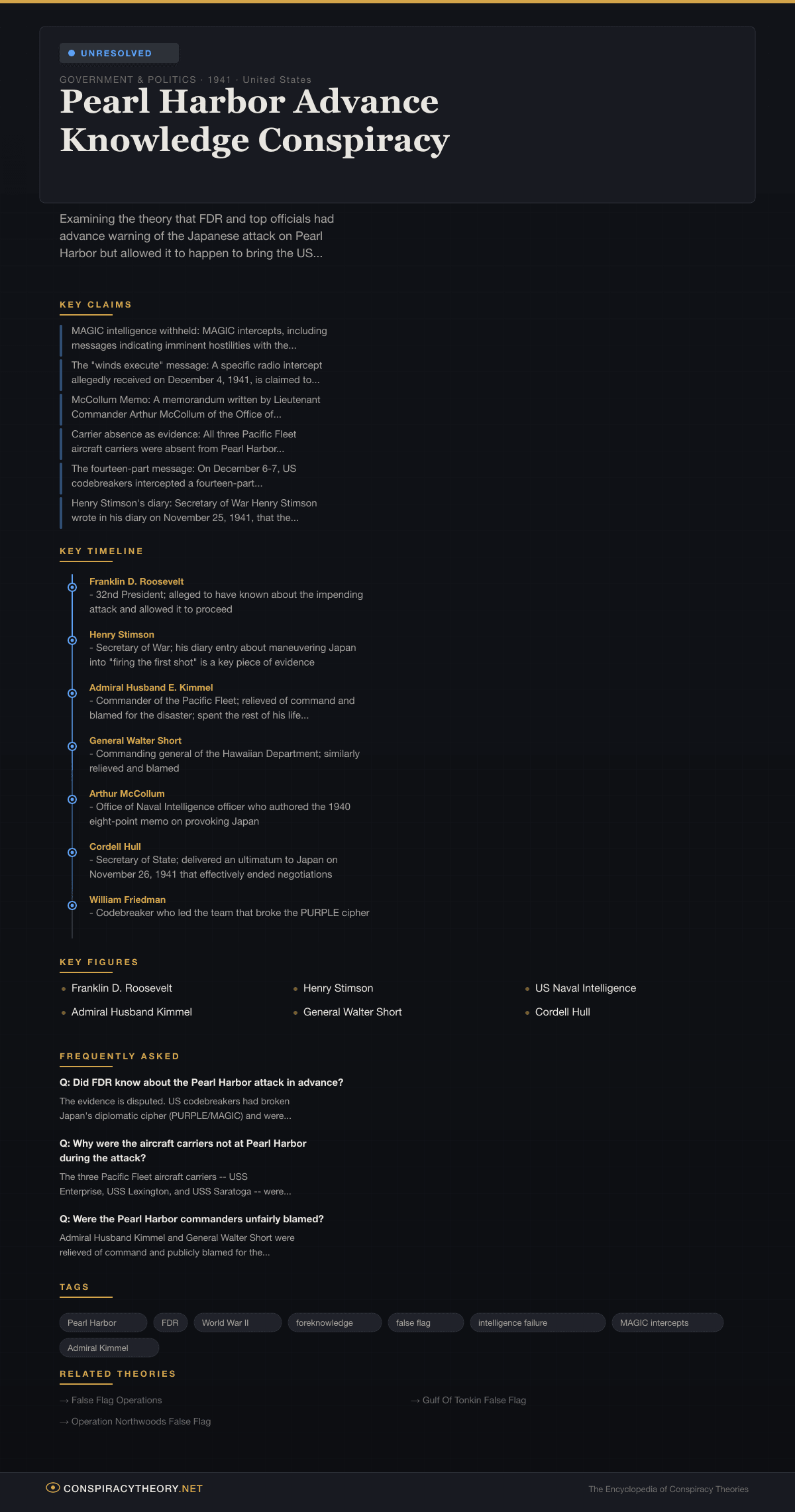
Pearl Harbor Advance Knowledge Conspiracy
Overview
At 7:48 a.m. on December 7, 1941, the first wave of 353 Japanese aircraft descended on the US naval base at Pearl Harbor, Hawaii, catching the Pacific Fleet at anchor and the island’s defenses almost entirely unprepared. Within two hours, 2,403 Americans were dead, 1,178 were wounded, four battleships had been sunk, and the United States was plunged into World War II. President Franklin D. Roosevelt called it “a date which will live in infamy.” His critics have spent eight decades arguing he knew it was coming.
The Pearl Harbor foreknowledge theory holds that FDR and senior officials in Washington had advance intelligence indicating a Japanese attack on Pearl Harbor but deliberately withheld this information from the Hawaiian commanders, allowing the attack to succeed in order to overcome American isolationist sentiment and bring the nation into the war against the Axis powers. The theory does not allege that the US government planned or facilitated the attack itself, but rather that it allowed a known threat to materialize — sacrificing the fleet and its sailors as a political catalyst.
This is not, it should be noted, a fringe claim. Respected historians have debated the foreknowledge question since the 1940s, multiple congressional investigations have examined the intelligence failures, and the families of the Pearl Harbor commanders spent decades fighting to clear their names. The question of what Washington knew, when it knew it, and what it chose not to share remains one of the most intensely argued questions in American military history.
Origins & History
The Road to War
To understand the foreknowledge theory, one must understand the political context of 1941. Roosevelt was personally convinced that American entry into the war against Nazi Germany and Imperial Japan was necessary, but he faced a powerful isolationist movement at home. The America First Committee, backed by figures like Charles Lindbergh, commanded significant public support. Polls in 1941 consistently showed that a majority of Americans opposed entering the war.
FDR had been maneuvering the country toward conflict for over a year. Lend-Lease, enacted in March 1941, provided massive military aid to Britain and later the Soviet Union. US Navy destroyers were escorting convoys in the North Atlantic and engaging German U-boats in what amounted to an undeclared naval war. In August 1941, Roosevelt and Churchill issued the Atlantic Charter, laying out war aims for a conflict the US had not yet officially joined.
But FDR could not simply declare war. The Constitution vests that power in Congress, and Congress reflected public opinion. Roosevelt needed a precipitating event — something so shocking that it would shatter isolationist resistance overnight. The Pearl Harbor foreknowledge theory argues that the Japanese attack provided exactly that, and that Roosevelt knew it was coming.
The Intelligence Landscape
The United States in 1941 possessed remarkable intelligence capabilities that are central to the foreknowledge debate.
MAGIC/PURPLE: American codebreakers, working under the Army’s Signal Intelligence Service, had broken Japan’s highest-level diplomatic cipher, known as PURPLE, in 1940. The resulting intelligence, codenamed MAGIC, gave Washington the ability to read Japan’s most sensitive diplomatic communications, often before the Japanese ambassadors themselves received them. MAGIC intercepts in November and December 1941 made clear that Japan was preparing for war and that a deadline for diplomatic negotiations had been set.
Other intelligence: US Naval Intelligence, the Office of Naval Intelligence (ONI), British intelligence, and Dutch intelligence in the East Indies were all tracking Japanese military movements. Reports from multiple sources indicated a massive Japanese military mobilization in late November 1941, including the movement of troop transports, naval vessels, and aircraft toward Southeast Asia.
The “winds” message: A MAGIC intercept from November 19, 1941, described a “winds” code that would be broadcast on Japanese radio to signal the breakdown of relations with specific countries. A “winds execute” message indicating war with the United States was reportedly intercepted on December 4, 1941 — three days before the attack — though the existence of this intercept has been disputed for decades.
The Immediate Aftermath
The attack on Pearl Harbor achieved Roosevelt’s political objective, whether by design or by fortune. Congress declared war on Japan the following day with only a single dissenting vote. Germany and Italy declared war on the United States on December 11. Isolationism evaporated overnight. The “date which will live in infamy” unified the nation as nothing else could have.
Almost immediately, questions arose about how such a catastrophic surprise had been possible. Admiral Husband E. Kimmel, commander of the Pacific Fleet, and Lieutenant General Walter Short, commanding general of the Hawaiian Department, were relieved of their commands within ten days. Both protested that they had been denied critical intelligence available in Washington.
Key Claims
- MAGIC intelligence withheld: MAGIC intercepts, including messages indicating imminent hostilities with the United States, were available to senior officials in Washington but were not shared with Admiral Kimmel or General Short in Hawaii. The foreknowledge theory argues this withholding was deliberate, not bureaucratic
- The “winds execute” message: A specific radio intercept allegedly received on December 4, 1941, is claimed to have indicated war with the United States was imminent. Proponents allege this message was received, understood, and suppressed
- McCollum Memo: A memorandum written by Lieutenant Commander Arthur McCollum of the Office of Naval Intelligence on October 7, 1940, outlined eight actions designed to provoke Japan into committing an overt act of war against the United States. The memo was discovered in 1994. Proponents argue it served as a blueprint for Roosevelt’s Pacific policy
- Carrier absence as evidence: All three Pacific Fleet aircraft carriers were absent from Pearl Harbor on December 7 — a fact theorists interpret as evidence that the Navy’s most valuable assets were deliberately moved out of harm’s way
- The fourteen-part message: On December 6-7, US codebreakers intercepted a fourteen-part Japanese diplomatic message breaking off negotiations. The thirteenth part was decoded on the evening of December 6, and upon reading it, Roosevelt reportedly said, “This means war.” The fourteenth part, decoded early on December 7, set a 1:00 p.m. delivery deadline — corresponding to early morning in Hawaii — but the warning sent to Pearl Harbor was transmitted by commercial telegraph rather than faster military channels and arrived after the attack had begun
- Henry Stimson’s diary: Secretary of War Henry Stimson wrote in his diary on November 25, 1941, that the question at a meeting with Roosevelt was “how we should maneuver them into the position of firing the first shot without allowing too much danger to ourselves.” Foreknowledge theorists cite this as evidence of deliberate provocation
Evidence
Evidence Supporting the Foreknowledge Theory
The intelligence gap: The central fact of the case is that Washington possessed extensive intelligence about Japanese intentions and military movements, yet the commanders in Hawaii were kept in the dark. MAGIC intercepts were distributed to a small circle of senior officials in Washington — Roosevelt, Stimson, Secretary of the Navy Frank Knox, the Army and Navy chiefs of staff — but not to Kimmel or Short. No satisfactory explanation has ever been provided for why the Hawaiian commanders, who bore primary responsibility for defending against an attack, were excluded from the intelligence that might have prepared them.
The delayed warning: The warning message sent on the morning of December 7 was transmitted by commercial Western Union telegraph rather than by the faster and more secure military radio channels available. The message arrived at the Honolulu telegraph office during the attack and was not delivered to Fort Shafter until hours later. The choice of the slowest available communication method for what was clearly an urgent warning has never been adequately explained.
Stimson’s diary: The November 25, 1941 diary entry is devastating in its plainness. Roosevelt and his war cabinet were explicitly discussing how to maneuver Japan into firing the first shot. This does not prove foreknowledge of Pearl Harbor specifically, but it demonstrates that the highest levels of the US government were actively seeking a Japanese attack as a casus belli.
The McCollum Memo: Discovered by researcher Robert Stinnett in National Archives files in 1994, the eight-point plan recommended actions including maintaining a strong naval presence in the Pacific, establishing British and Dutch embargoes on Japan, and aiding China — steps that closely mirrored the policies actually pursued by the Roosevelt administration in 1940-1941.
British intelligence warnings: Churchill’s government reportedly provided warnings to Washington about Japanese plans. In 2021, declassified British documents revealed that the Government Code and Cypher School at Bletchley Park had shared intelligence about Japanese naval movements in late November 1941. Dutch intelligence in the East Indies also reportedly provided warnings.
The Kimmel-Short scapegoating: Both Kimmel and Short were denied courts-martial that would have allowed them to present evidence and cross-examine witnesses — proceedings they repeatedly requested. Instead, they were subjected to administrative investigations that limited their ability to challenge the government’s narrative. The 1944 Army Pearl Harbor Board and the 1944 Navy Court of Inquiry both concluded that Washington bore significant responsibility for the disaster, but their findings were classified until after the war.
Evidence Against the Foreknowledge Theory
- Intelligence overload: Washington was receiving vast quantities of intelligence from multiple theaters. The MAGIC intercepts indicated Japan was preparing for war, but the most likely targets appeared to be the Philippines, Malaya, the Dutch East Indies, and Thailand — not Hawaii. Analysts in Washington largely expected a southward advance, not an attack on Pearl Harbor
- The Kido Butai’s radio silence: The Japanese strike force, the Kido Butai, maintained strict radio silence during its transit across the North Pacific. US intelligence tracked Japanese naval units by monitoring their radio transmissions; the strike force’s silence meant it effectively disappeared from the intelligence picture
- No smoking gun document: Despite the declassification of millions of pages of documents since 1945, no document has been found in which any US official explicitly acknowledges advance knowledge of the Pearl Harbor attack specifically
- Bureaucratic failure vs. conspiracy: Many historians argue that the intelligence failures were the result of institutional dysfunction — interservice rivalry between the Army and Navy, failure to share intelligence across bureaucratic silos, racial underestimation of Japanese military capability, and the sheer difficulty of correctly predicting the specific target and timing of an attack from ambiguous intelligence
- Strategic illogic: Losing eight battleships, 188 aircraft, and 2,403 lives was an enormous strategic cost. If Roosevelt wanted a casus belli, allowing an attack on a less critical target would have achieved the political objective at far less military cost
Debunking / Verification
The Pearl Harbor foreknowledge theory occupies a spectrum between reasonable historical debate and conspiratorial overreach. At one end is the well-documented fact that Washington possessed intelligence about Japanese war preparations that was not shared with Hawaiian commanders — a failure that multiple official investigations have acknowledged. At the other end is the specific claim that Roosevelt deliberately allowed the attack to proceed, knowing Pearl Harbor was the target, which lacks direct documentary proof.
The most balanced assessment is that FDR and his advisors knew war with Japan was imminent and may have welcomed a Japanese first strike as a political necessity, but that the specific targeting of Pearl Harbor came as a genuine surprise to Washington. The intelligence failures that left Hawaii unprepared were most likely the result of institutional dysfunction, racial assumptions about Japanese capabilities, and the inherent difficulty of predicting a specific attack from fragmentary intelligence — though the failure to share MAGIC with the Hawaiian commanders remains deeply troubling and has never been satisfactorily explained.
The 1995 and 1999 congressional actions to posthumously restore Kimmel and Short’s ranks, while not definitive, represented an official acknowledgment that the two commanders had been unfairly blamed for failures that originated in Washington.
Cultural Impact
The Pearl Harbor foreknowledge theory has been one of the most enduring and influential conspiracy narratives in American history, shaping both popular culture and political discourse.
The theory established the “let it happen” template for conspiracy thinking about government responses to attacks — the idea that governments may deliberately allow catastrophes to occur because the political benefits outweigh the human costs. This framework was explicitly invoked after the September 11, 2001 attacks, when “LIHOP” (Let It Happen On Purpose) became a prominent category of 9/11 conspiracy theory.
In academic historiography, the foreknowledge debate has been remarkably productive, driving the declassification of intelligence records and advancing understanding of how intelligence failures occur. Works by Roberta Wohlstetter (Pearl Harbor: Warning and Decision, 1962), Gordon Prange (At Dawn We Slept, 1981), and Robert Stinnett (Day of Deceit, 2000) represent major contributions to intelligence studies regardless of their conclusions about foreknowledge.
In popular culture, the foreknowledge theory has been referenced in films, novels, and television programs. The 1970 film Tora! Tora! Tora! depicted the intelligence failures with remarkable accuracy. Gore Vidal’s The Golden Age (2000) incorporated the foreknowledge thesis into its fictional narrative of wartime Washington. The theory remains a staple of military history documentaries and is regularly featured in cable television programming.
The debate also has contemporary political relevance. The question of what the government knew before Pearl Harbor has been invoked in debates about intelligence failures before 9/11, the Iraq War’s WMD claims, and the broader relationship between democratic governance and national security secrecy.
Key Figures
- Franklin D. Roosevelt — 32nd President; alleged to have known about the impending attack and allowed it to proceed
- Henry Stimson — Secretary of War; his diary entry about maneuvering Japan into “firing the first shot” is a key piece of evidence
- Admiral Husband E. Kimmel — Commander of the Pacific Fleet; relieved of command and blamed for the disaster; spent the rest of his life seeking exoneration
- General Walter Short — Commanding general of the Hawaiian Department; similarly relieved and blamed
- Arthur McCollum — Office of Naval Intelligence officer who authored the 1940 eight-point memo on provoking Japan
- Cordell Hull — Secretary of State; delivered an ultimatum to Japan on November 26, 1941 that effectively ended negotiations
- William Friedman — Codebreaker who led the team that broke the PURPLE cipher
Timeline
| Date | Event |
|---|---|
| September 1940 | US codebreakers break Japan’s PURPLE diplomatic cipher |
| October 7, 1940 | Lt. Cmdr. McCollum writes eight-point memo on provoking Japan |
| January 27, 1941 | US Ambassador to Japan Joseph Grew reports rumors of a planned attack on Pearl Harbor |
| July 1941 | US freezes Japanese assets and imposes oil embargo |
| November 19, 1941 | MAGIC intercept describes “winds” code for signaling war |
| November 25, 1941 | Stimson diary entry about maneuvering Japan into “firing the first shot” |
| November 26, 1941 | Hull Note delivered to Japan — effectively an ultimatum |
| November 27, 1941 | ”War warning” message sent to Pacific commanders, emphasizing threat to Philippines and Southeast Asia |
| December 2, 1941 | Japanese strike force receives coded order “Climb Mount Niitaka” — proceed with attack |
| December 4, 1941 | Alleged “winds execute” message intercepted (disputed) |
| December 6, 1941 | First 13 parts of Japanese 14-part message intercepted and decoded; FDR reportedly says “This means war” |
| December 7, 1941 | Japan attacks Pearl Harbor at 7:48 a.m. Hawaiian time; 2,403 Americans killed |
| December 7, 1941 | Delayed warning message arrives in Honolulu after attack begins |
| December 8, 1941 | Congress declares war on Japan |
| December 17, 1941 | Kimmel and Short relieved of command |
| 1944 | Army Pearl Harbor Board and Navy Court of Inquiry criticize Washington’s role (classified) |
| 1945-1946 | Joint Congressional Committee investigates; largely supports the “surprise” narrative |
| 1962 | Roberta Wohlstetter publishes Pearl Harbor: Warning and Decision |
| 1994 | McCollum Memo discovered in National Archives |
| 1999 | US Senate passes nonbinding resolution recommending posthumous restoration of Kimmel and Short’s ranks |
| 2000 | Robert Stinnett publishes Day of Deceit, arguing FDR had foreknowledge |
Sources & Further Reading
- Wohlstetter, Roberta. Pearl Harbor: Warning and Decision. Stanford University Press, 1962
- Prange, Gordon W. At Dawn We Slept: The Untold Story of Pearl Harbor. McGraw-Hill, 1981
- Stinnett, Robert B. Day of Deceit: The Truth About FDR and Pearl Harbor. Free Press, 2000
- Toland, John. Infamy: Pearl Harbor and Its Aftermath. Doubleday, 1982
- Clausen, Henry C., and Bruce Lee. Pearl Harbor: Final Judgement. Crown, 1992
- Rusbridger, James, and Eric Nave. Betrayal at Pearl Harbor: How Churchill Lured Roosevelt into World War II. Summit Books, 1991
- Joint Congressional Committee on the Investigation of the Pearl Harbor Attack. Investigation of the Pearl Harbor Attack. US Government Printing Office, 1946
- Kimmel, Husband E. Admiral Kimmel’s Story. Henry Regnery, 1955
- Hanyok, Robert J. “How the Japanese Did It.” Naval History Magazine, December 2009
- Parker, Frederick D. Pearl Harbor Revisited: United States Navy Communications Intelligence 1924-1941. National Security Agency, 1994
Related Theories
- False Flag Operations — The broader concept of governments staging or allowing attacks for political purposes
- Gulf of Tonkin False Flag — The confirmed manipulation of intelligence to justify the Vietnam War
- Operation Northwoods — The declassified DoD plan to stage attacks to justify war with Cuba

Frequently Asked Questions
Did FDR know about the Pearl Harbor attack in advance?
Why were the aircraft carriers not at Pearl Harbor during the attack?
Were the Pearl Harbor commanders unfairly blamed?
Infographic
Share this visual summary. Right-click to save.